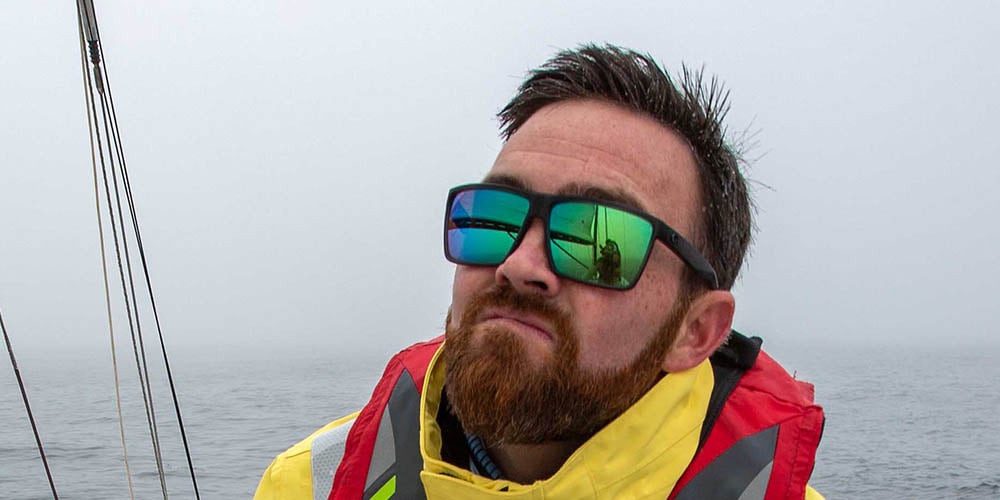
On the water, your eyes are exposed to significantly more UV radiation and glare than on land — direct sunlight above, reflected glare from the water below, and additional reflections from white decks, sails, and windshields. The right pair of sunglasses is essential safety gear for boating, not an accessory. This guide covers what to look for in a pair of marine sunglasses, from lens technology and color to frame materials that survive saltwater.
- Caring for Your Sunglasses
- UV and Glare Protection
- Polarized Lenses
- Visible Light Transmission and Lens Color
- Lens Color for Fishing
- Lens Shape
- Lens Material
- Frames
- Floating Frames and Retainers
- Lens Styles
- Getting a Good Fit
- FAQs
Caring for Your Sunglasses
Proper care extends the life of your sunglasses significantly — particularly important given the investment quality marine sunglasses represent. Never use harsh cleaners, disinfectants, or alcohol-based products on sunglasses as they damage lens coatings and frame materials. To clean, rinse with warm water and use mild dish soap if necessary. Dry with a clean, soft, absorbent cloth. Do not use paper-based products — tissues, paper towels, and napkins can scratch lenses and often contain lotions that leave a film.
Protection from Bright Light and UV Radiation
Sunglasses protect the eyes from UV radiation and improve visibility and comfort on the water by reducing light intensity and filtering glare. On the water, the combination of direct and reflected light is significantly more intense than on land. Glare — the horizontally polarized light reflected off flat surfaces like water, windshields, white decks, and sails — is intense enough to impair vision, causes squinting and eye fatigue, and creates real safety hazards. Glare is present even on hazy and overcast days.
Most sunglasses reduce total light intensity by 80–90 percent through darkening gray, green, amber, or other colored lenses. But colored lenses alone are not sufficient for marine conditions. To genuinely protect your eyes and vision on the water, sunglasses should be:
- Polarized: to filter horizontally polarized glare, not just reduce total light
- UV-blocking: coated to block 99–100 percent of UVA and UVB radiation, which causes degenerative eye diseases including photokeratitis, cataracts, pterygium, and various forms of eye cancer
- Shatterproof: to protect the eyes from impact injury — particularly important for sailors who may be struck by blocks, booms, or flying objects
Polarized Lenses
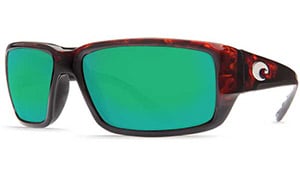
Costa’s Fantail Men’s Sunglasses feature polarized polycarbonate lenses that block 100% of UV rays, absorb harmful high-energy blue light (HEV), and filter harsh yellow light.
When light reflects off a flat surface, the reflected rays concentrate in a horizontal plane — this is polarized light, and glare is its most common form. Ordinary sunglasses reduce total light reaching your eyes, but they do not filter out horizontal polarization specifically. Squinting does the same thing — it reduces intensity but not glare.
A polarized lens contains a polarizing film of molecules running in parallel vertical chains sandwiched between two optical layers. These vertical chains block horizontal light waves, allowing only vertical (ambient) light waves to pass through. The result: glare is eliminated without significantly reducing the total light reaching your eye. Objects retain their definition and visual detail, and what is beneath the water surface becomes visible — fish, depth changes, bottom structure, and underwater hazards that would otherwise be hidden by surface glare.
You can confirm a lens is polarized by rotating the glasses while looking at a reflective surface. The glare reduction will vary significantly with rotation — polarized lenses reduce glare best in a specific orientation.
Polarized lenses and LCD instruments: Some polarized lenses will make LCD displays on chartplotters and fishfinders appear black when viewed at certain angles, because the polarization direction of the lens conflicts with the polarization of the LCD screen. The practical solution is to rotate the glasses slightly or tilt your head until the display becomes readable, or look for polarized lenses specifically designed for LCD compatibility. If neither works, the only option is to remove the glasses briefly to read the display.
Visible Light Transmission and Lens Color
Visible light transmission (VLT) measures the percentage of available light that passes through the lens. For boating, VLT should fall in the 15–30 percent range. On the brightest days on open water, you want the lowest VLT (darkest) lenses. Lens color affects both how much light is filtered and how color is perceived:
- Gray: A neutral all-purpose color that reduces glare with minimal color distortion. The best choice when accurate color perception matters — navigation, reading charts, and assessing water conditions. Ideal for offshore and open-water sailing.
- Brown/amber: Increases contrast in varied light conditions. In addition to bright sun, amber manages light well on cloudy or rainy days and filters high-frequency near-UV light. An excellent all-around choice for inshore boating and overcast conditions.
- Purple/rose: Heightens visual acuity and enhances color against blue or green backgrounds. Provides the brightest field of vision of any tint and is particularly effective for sight fishing, inshore fishing, and low-light conditions.
- Yellow: Reduces blue light (which causes a scattering type of glare called blue haze) and improves contrast in fog and low-light conditions. Not well-suited for bright open-water conditions — more applicable to dawn fishing, overcast days, or night driving.
- Green: Enhances visual acuity in specific conditions including sight fishing and provides good color rendering. Widely used for everyday wear as well as on-water use.
Lens Color for Fishing
For fishing specifically, lens color is one of the most important choices because different colors reveal different things in and around the water.
- Sight fishing in shallow water (flats, reef, inshore): Copper, amber, or rose lenses enhance contrast against a sandy or grassy bottom and make fish visible against the background. These tints cut through the water surface most effectively in shallow water where the bottom is visible.
- Deep or offshore fishing: Gray lenses provide the truest color perception for scanning water color changes, identifying temperature breaks and baitfish concentrations, and reading the horizon. The reduced color distortion of gray is an advantage when reading subtle visual cues on open water.
- Low light (dawn, dusk, overcast): Amber, copper, or yellow lenses gather more light and improve contrast when light levels are low. Fishing during the first and last hours of daylight — often the most productive time — is significantly more comfortable in amber or copper than in dark gray lenses.
- Freshwater bass fishing: Copper and rose lenses are popular because they enhance contrast against green vegetation and increase visibility of fish holding near structure. The enhanced contrast against green-blue water makes bass easier to spot.
Lens Shape
Optically, flatter lenses produce less distortion. Curved lenses refract light as it passes through, so light does not enter your eye in a straight line — your eyes work harder to process and correct the visual information, which causes eye fatigue and headaches over time. This distortion can be eliminated with corrected prismatics; check the label for distortion-free prismatics before purchasing curved or wrap-around sunglasses.
Quality sunglass lenses are constructed from several layers: an antireflective coating on the inside to reduce bounce-back, a water-repellent coating on the outside to shed spray and make cleaning easy, and an ultraviolet coating to block UVA and UVB radiation.
Lens Material
Polycarbonate is extremely tough, lighter than glass, and can be made oversized to wrap around the face and block light, wind, and spray from all sides. Impact-resistant and shatterproof — an important safety feature for sailors and any boater at risk of impact. Polycarbonate naturally blocks 100 percent of UV rays. The trade-off is moderate optical clarity compared to glass, and susceptibility to surface scratches without a hard coating.
Trivex and Kaenon’s proprietary SR-91 material offer UV-blocking and shatterproofness comparable to polycarbonate, but with better optical clarity, less chromatic distortion (particularly at the lens periphery), and better scratch resistance. SR-91 and Trivex are the preferred choice when optical quality matters as much as impact protection.
Optically ground glass provides the best optical quality and superior scratch resistance, but is heavier than plastic alternatives. Not ideal for all-day wear on a moving boat where weight becomes fatiguing. CR-39 is a plastic polymer with optical quality superior to polycarbonate and the best scratch resistance of plastic lenses, with similar impact resistance — a good compromise between optical quality and durability.
Frames
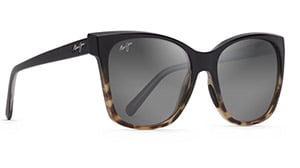
Maui Jim’s Alekona Women’s Sunglasses combine a stylish frame with their PolarizedPlus2® lenses that block 100% of UV light.
For marine use, frame material matters as much as lens technology. The best choices are lightweight, flexible, and corrosion-resistant materials such as nylon, propionate, or acetate (also called zyl). These materials hold their shape, flex without breaking, and resist UV degradation and salt exposure. Metal frames corrode rapidly in a saltwater environment — standard aluminum and stainless hardware can develop corrosion within a single season of regular offshore use. Some manufacturers such as Costa Del Mar use corrosion-resistant monel in their metal frames specifically for marine applications.
Frame hardware is made with either pressed-in pin hinges (strong and maintenance-free) or spring hinges (which flex to accommodate different head widths for a snug fit). All hardware should be corrosion-proof — most quality marine sunglasses use nickel-silver or stainless steel hardware.
Wire core temples have heavy wire embedded in the earpieces for maximum adjustability, allowing the temples to be shaped precisely to the wearer’s head for a custom fit.
Lens coatings add function: waterproof coatings shed spray and make cleaning easier; mirror coatings on the exterior reduce overhead and reflected glare; anti-reflective coatings on the interior reduce bounce-back. Mirror-coated lenses can provide more precise control over wavelength transmission than tint alone.
Floating Frames and Retainers
On a boat, dropping sunglasses overboard is a real and recurring risk. Two solutions:
Floating frames: Some manufacturers design sunglasses with frames and temple materials buoyant enough to float if dropped overboard. These are a meaningful advantage on the water — a pair of sunglasses that floats can be retrieved; one that sinks cannot. Check manufacturer specifications for buoyancy ratings if this matters to you.
Retainers (croakies/straps): A simple strap or cord connecting the temple tips keeps sunglasses around your neck when not being worn and prevents them from falling overboard if they slip off your face. Retainers are inexpensive, work with any frame, and are used by virtually every experienced offshore sailor and angler. If your sunglasses do not float and you do not use a retainer, you will eventually lose them overboard.
Lens Styles
- Aviator: Droplet-shaped lenses that follow the contours of the cheek. A classic style with good downward coverage.
- Cateye: Relatively round lenses with a single nose bridge. More popular for fashion than function in marine applications.
- Clip-ons: For use with prescription glasses; can be flipped up for normal vision indoors or in low light without removing the prescription frames.
- Double bridge: Connects the lens frames in two places — over the nose and between the eyebrows. A classic style associated with traditional sailing eyewear.
- Fisherman style: Features small side lenses to block peripheral light — particularly useful for anglers who look sideways into the water along the boat.
- Shield: A large, single-piece visor-like lens that covers most of the upper face. Maximum protection from light, wind, and spray. Popular for water sports and high-speed boating.
- Wrap-around: Highly curved both horizontally and vertically to match the contours of the face. Blocks light and wind from entering at any angle. The best choice for offshore sailing and open-water conditions where light and wind come from all directions.
Getting a Good Fit
Sunglasses should fit so the optical center of the lens roughly aligns with the wearer’s center of focus. If the lens center is not aligned with where you actually look, your eye is working through the periphery of the lens rather than the optical center, which causes distortion and eye fatigue. The three basic measurements are lens size, temple length, and overall width.
Glasses should fit snugly without pinching. Weight matters for all-day wear — glasses that are heavy on the nose cause headaches over the course of a long offshore day. Wrap-around frames should hug the face closely to prevent light from entering at the sides, but should not press against the temples or cause pressure at the nose bridge.
When trying on sunglasses, look at a distant object through the center of the lens, then slowly move your gaze toward the edge. In a quality lens, the object should not appear to jump or distort. Any noticeable distortion at the optical center or periphery is a sign of poor lens quality or misalignment.
Frequently Asked Questions
Are polarized sunglasses necessary for boating?
Yes — for all practical purposes, polarized lenses are not optional for marine use. Non-polarized sunglasses reduce total light intensity but do not filter horizontal glare, which is the specific type of light reflected off the water surface and the primary cause of eye strain and impaired vision on the water. Polarized lenses eliminate glare while preserving visual detail, making it possible to see below the water surface, spot hazards, and read conditions accurately. Any serious boater, sailor, or angler should use polarized sunglasses.
What lens color is best for boating?
Gray lenses are the best general-purpose choice for offshore and open-water sailing because they provide accurate color perception with minimal distortion. For inshore and mixed conditions, amber or brown lenses offer better contrast and more comfortable vision in variable light. For sight fishing in shallow water, copper or rose lenses enhance contrast against sandy and grassy bottoms. The best choice depends on your primary use — see the lens color and fishing sections above for specific guidance.
What is the difference between polycarbonate and glass lenses?
Glass lenses provide superior optical clarity and scratch resistance but are heavier than plastic alternatives. Polycarbonate lenses are impact-resistant, shatterproof, and lighter than glass, making them the better choice for active marine use where impact is a real risk. Trivex and SR-91 materials split the difference — better optical quality than polycarbonate with similar or better impact resistance and scratch resistance.
Why do polarized sunglasses make my chartplotter screen look black?
LCD screens emit polarized light in a specific orientation. If your polarized lenses are oriented perpendicularly to the screen’s polarization, they block all light from the display and the screen appears dark or black. Tilting or rotating your head slightly often restores visibility. Some manufacturers now produce polarized lenses specifically designed for LCD compatibility. If this is a recurring problem, ask about LCD-compatible polarized lenses when purchasing.
Should I use a retainer strap on my sunglasses while boating?
Yes. A retainer strap keeps sunglasses around your neck when not being worn and prevents them from going overboard if they slip while you are moving around the boat. This is standard practice among experienced sailors and anglers — at any price point, losing sunglasses overboard is an avoidable loss. If your sunglasses do not float, a retainer is essential. If they do float, a retainer still prevents them from drifting away in any sea state.
Can I use regular sunglasses for boating?
Standard fashion sunglasses designed for everyday land use are often inadequate for marine conditions. They may lack polarized lenses, may not block 100 percent of UV, and frames made from metal or low-quality plastic will corrode or degrade rapidly in saltwater and UV exposure. Marine-specific sunglasses are designed with materials that resist corrosion, polarized lenses that cut water glare, UV-blocking coatings, and shatterproof lenses that protect against impact. For occasional daysailing in mild conditions, non-marine sunglasses may be adequate; for regular on-water use, quality marine sunglasses are worth the investment.