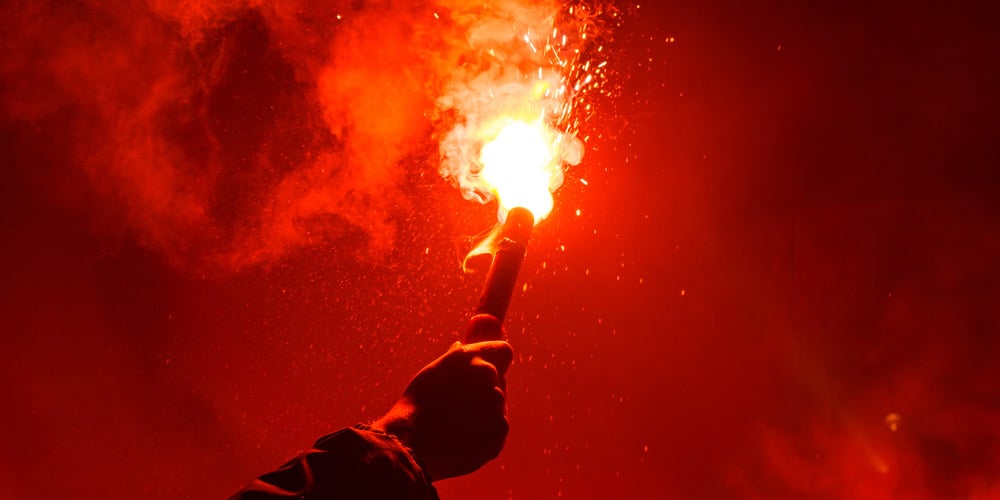
At some time, it is likely that most boaters may face a situation where you need assistance, if you run aground, have an engine failure, fire, leak or an injury to a member of your crew. Boaters use visual distress signals to attract attention in an emergency, either in the daytime or at night. Of course, using a handheld or fixed-mount VHF radio is another very effective way to communicate your situation to potential rescuers, but if your batteries are dead, visual distress signals may be your best hope.
The Regulations:
Coastal Waters and the Great Lakes
All vessels used on coastal waters or the Great Lakes on any body of water with a passageway to the sea at least two miles wide are required to carry Coast Guard Approved visual distress signals, unless exempt. These can be either pyrotechnic devices (flares) or non-pyrotechnic devices (e.g., orange distress flags or electric SOS distress lights). If using pyrotechnics, you’ll need at least three daytime signals and three night-use signals (total of six) or three combination day/night signals, with a manufacture date within 42 months of the current date. If using non-pyrotechnic signals, you need one approved daytime signal (e.g., orange distress flag) and one approved nighttime signal (e.g., electric SOS distress light).
Exceptions to this requirement are limited daytime (sunrise to sunset) use of the following boats:
- Recreational boats less than 16' in length
- Boats participating in organized events like races, regattas or marine parades
- Open sailboats not equipped with propulsion machinery and less than 26 feet in length
- Manually propelled boats (e.g., rowboats, canoes, kayaks)
Day Signals vs. Night Signals
Boaters may select any group or combination as long as it meets the specific requirements for their boat:
| Number on device | Description | Accepted use for | Number required to be carried |
|---|---|---|---|
| 160.021 | Handheld red flare distress signals (500 candela) | Day and night | 3 |
| 160.022 | Floating orange smoke distress signals | Day only | 3 |
| 160.028 | Pistol-launched parachute red flare distress signals | Day and night | 3 |
| 160.036 | Handheld Rocket-propelled Parachute Red (20,000 candela) | Day and night | 3 |
| 160.037 | Handheld orange smoke distress signals (50 seconds) | Day only | 3 |
| 160.057 | Floating orange smoke distress signals (15 minutes) | Day only | 3 |
| 160.066 | Distress signal for boats, red aerial pyrotechnic flare (10,000 candela) | Day and night | 3 |
| 160.072 | Distress signal for boats, orange flag | Day only | 1 |
| 161.013 | Electric distress light for boats | Night only | 1 |
Alert Signals vs. Locate Signals
Pyrotechnic Devices
Must be Coast Guard Approved, in serviceable condition and readily accessible. If they meet the day/night requirement, you need three flares, minimum. In a real emergency, you’ll be glad if you chose to carry more than that quantity. They’re stamped with an “expiration date” of 42 months (3 1/2 years from the date they were manufactured). You can keep them after they’re expired as extra equipment because they usually will still work, but you can’t count them as part of the Coast Guard’s requirements in a Vessel Safety Check inspection. We recommend storing the flares in a container like the Orion Flare Canister.
Alert Signals
Alert signals draw attention to your emergency. Meteor flares are propelled by black powder and launched from a pistol-shaped handheld holder. They reach an altitude of 375' to 500' and burn for 7-8 seconds. Rocket-propelled SOLAS parachute flares rise to 1,000' and burn for 40 seconds. Fire aerial flares after you have sighted or heard a potential rescue vessel. To attract their attention to your distress situation, the U.S. Coast Guard recommends that you fire two aerial flares - one immediately after the other - so rescuers can confirm the sighting and the direction of the signal.
Locate Signals
Locate signals are usually handheld flares and burn for one to two minutes. Orange SOLAS smoke flares are for daytime use only and are the best way for offshore boaters to show their location to rescuers searching in a Coast Guard helicopter. They float on the water’s surface and emit a dense orange cloud for three to four minutes. Handheld signal flares are intended as homing signals to pinpoint your position. The surface-to-surface sighting range on water is approximately three to five miles, depending on boat elevation. If a rescuer is five miles away and running at 20 miles per hour, it will take 15 minutes to reach you. Therefore, you should have at least 12 minutes (total burn time) of signals onboard to maintain a strong homing signal until help arrives.
Signal Kits Include Both Alert and Locate Flares
We carry a selection of Signal Kits geared for different types of boating—inland, coastal or offshore—that are packaged in waterproof storage cases and are much more economical than buying the items individually.
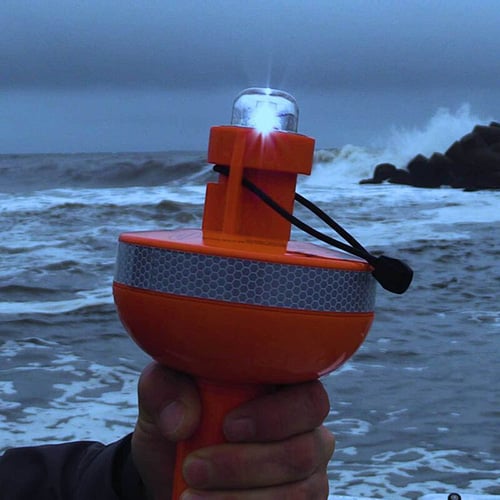
Orion's electronic SOS beacon is a Coast Guard approved alternative to pyrotechnic flares.
Non-pyrotechnic Devices
An orange distress flag is 3' x 3' square with a black square and ball on an orange background. It’s for daytime use only and is less effective at catching attention than a flare, except that it is not limited by a short burning time. An electric distress signal is approved for night only, and must carry the marking: “Night Visual Distress Signal for Boats Complies with U. S. Coast Guard Requirements in 46 CFR 161.013. For Emergency Use Only.” To meet the requirements for both day and night use, the SOS Distress Light is packaged with an orange distress flag. What are the pros and cons of the non-pyrotechnic alternative?
Electronic Non-pyrotechnic Device Pros
- No expiration date
- Family safe so even your kids can operate it in an emergency
- Easier to operate with a simple on/off switch; or unfold and display the distress flag
- Visible up to 10+ nautical miles
- Powered by replaceable “C” cell alkaline batteries that are available worldwide
- Environmentally safe with no hazardous material disposal issues
- Buoyant, so even if you drop it in the water, it’s still active
- One time purchase so it’s less expensive in the long run
Electronic Non-pyrotechnic Device Cons
- Only approved for night use, and flares may be much more visible than a distress flag in the daytime
- More expensive one-time purchase
- Uses batteries that can leak, corrode or fail
Should You Upgrade to SOLAS Signals?
Some categories of offshore boating activity have more rigorous requirements (commercial vessels and participants in offshore sailing races). A good source for offshore outfitting information is the World Sailing (WS) Offshore Special Regulations, which sailboat racers use to equip their boats for offshore racing. The WS requires many more flares than USCG minimum requirements, all of which must meet SOLAS requirements.
We advise offshore fishing vessels, cruisers, and any vessel that operates in open water to use the WS guidelines for distress signals. WS requirements, for races from local and protected (Category 4) to “Round the World” (Category 0) are:
| Race Category: | Red Parachute | Red Handheld | Orange Smoke |
|---|---|---|---|
| 0 Trans-oceanic | 6 | 4 | 2 |
| 1 Long distance / well offshore | 6 | 4 | 2 |
| 2 Shorelines / lg. unprotected bays/ lakes | 4 | 4 | 2 |
| 3 Relatively protected / close to shorelines | 4 | 4 | 2 |
| 4 Monohull / Close to shore / relatively warm or protected waters | 0 | 4 | 2 |
| 4 Multihull / Close to shore / relatively warm or protected waters | 2 | 4 | 2 |
SOLAS flares are a step up from conventional Coast Guard Approved pyrotechnic signals. They meet stricter standards set by an international safety organization (SOLAS stands for Safety Of Life At Sea). SOLAS parachute flares ascend to 1,000' and burn at a dazzling 30,000 candela for 40 seconds.
Handheld SOLAS flares are waterproof and very bright, burning for one minute at 15,000 candela (compared to 700 candela for regular Coast Guard Approved flares). They also do not spray out molten material, unlike standard flares, so they’re safer to use, especially onboard a life raft.
In some instances, SOLAS flares must be carried instead of conventional Coast Guard-approved flares. As mentioned above, sailboats participating in races organized under the International Sailing Federation must carry them and commercial fishing boats that venture more than 50 miles offshore must also carry a modest inventory of SOLAS flares, including three parachute flares, six handheld red flares and three smoke flares. Vessels operating from 3–50 miles offshore aren’t required to have SOLAS-grade flares, but we sure think it’s a good idea.
Number of Signals We Recommend
Carry double the number of meteor or hand flares required: they’re cheap, and you’ll be grateful if you ever need to attract attention.
Selecting Visual Distress Signals FAQs
-
What are visual distress signals, and why are they necessary?
These safety tools, required by the USCG in many waters, help rescuers locate vessels in trouble. They include flares, strobes, and flags to ensure visibility. -
What are the main types of visual distress signals?
Signals are categorized as pyrotechnic (e.g., flares), electronic (e.g., LED strobes), or non-pyrotechnic (e.g., flags or dye markers). -
When are visual distress signals required by law?
The USCG mandates signals for boats in coastal and Great Lakes waters. Specific requirements depend on the boat’s size and time of operation (day or night). -
What are the advantages of electronic distress signals?
They are reusable, less hazardous to store, and approved for day and night use. Unlike flares, they don’t expire every 42 months. -
How long are pyrotechnic flares valid?
Flares are marked with an expiration date, typically 3.5 years from manufacture. After expiration, they must be replaced to comply with USCG rules. -
Are there specific distress signals for nighttime use?
Yes, options like red flares, parachute rockets, and strobe lights are designed to be highly visible in low-light conditions. -
How do I properly store visual distress signals on my boat?
Store them in a waterproof container, easily accessible in emergencies, and away from heat sources to prevent accidental ignition. -
What should I do with expired flares?
Contact your local fire department, USCG station, or hazardous waste facility for guidance on proper disposal methods.
We're Here to Help!
At West Marine, we’re here to help you make every moment on the water count. With expert advice, premium gear, and over 230 stores ready to serve you, we’ve got more of everything you need for unforgettable boating adventures. Use our store finder to locate a West Marine store near you.