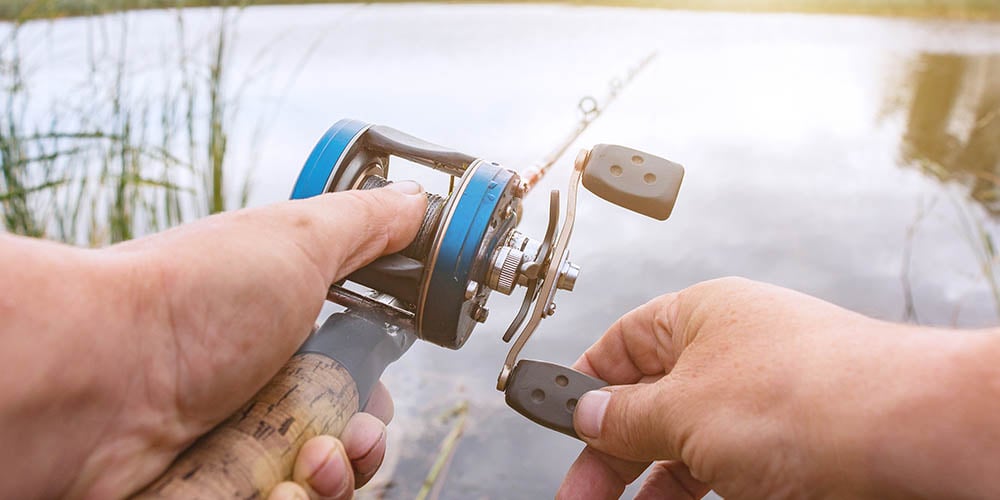
Popular among freshwater and inshore saltwater anglers, baitcasting reels offer higher gear ratios, better casting accuracy, and more power for working specialized lures than spinning reels. Understanding how they work and what the specifications mean helps you match the right reel to your fishing style and target species.
- Advantages of Baitcasting Reels
- Disadvantages of Baitcasting Reels
- What to Consider When Choosing a Reel
- Gear Ratios and Line Speed
- Spool Braking System
- Level Wind System
- Line Capacity
- Low Profile or Round
- Drag Systems
- Ball Bearings
- Anti-Reverse
- Match the Reel to the Rod
- FAQs
Advantages of Baitcasting Reels
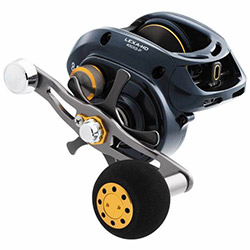
The Lexa 400 Hyper Speed baitcasting reel from Daiwa boasts an 8.1:1 gear ratio and a line speed of 43 inches for fast retrieve.
Baitcasting reels are designed for casting accuracy and speed. Because the reel mounts on top of the rod with the spool perpendicular to the rod, line comes off in a straight line close to the blank, enabling more precise casts than a spinning reel where line spirals off a stationary spool.
Most baitcasting reels include a level-wind mechanism that moves the line back and forth on the spool during retrieve, eliminating the need to guide line with your thumb. Gear ratios and line speeds are generally much higher than on spinning reels, giving anglers the speed needed to work crankbaits, buzzbaits, and other specialized lures effectively. Keeping a buzzbait moving fast enough across the surface to trigger strikes can be exhausting on a spinning reel — a high-speed baitcaster makes it sustainable through hundreds of casts per day.
Disadvantages of Baitcasting Reels
In the hands of a beginner, baitcasting reels can be frustrating. Despite built-in braking systems, an angler must still use their thumb to slow the spool as the lure lands to prevent backlash. Developing this muscle memory takes time. Baitcasting reels also require a minimum lure weight to overcome spool inertia — light lures cause backlash even with proper technique. If you prefer light tackle or finesse presentations, a spinning reel is the better choice.
Most baitcasting reels use a star drag, which can be awkward to adjust while playing a fish compared to a lever drag. The handle also cannot be swapped from one side to the other, so your preferred cranking hand is one of the first criteria to establish before selecting a reel.
What to Consider When Choosing a Reel
Where you fish and what you target are the primary factors. Personal preference matters, but the reel must be suited to the conditions and the species you’re pursuing.
Freshwater or Saltwater?
Freshwater does not corrode reel components nearly as quickly as saltwater. Reels used exclusively in freshwater do not need corrosion-resistant construction. Saltwater corrodes bearings and gears rapidly, making reel action rough if the reel is not built for ocean use. For saltwater applications, look for models with shielded or anti-rust ball bearings and sealed body construction.
Target Species
Baitcasting reels work well for inshore saltwater species and large freshwater species such as largemouth bass, northern pike, and muskellunge. While many baitcasters feature anti-corrosion bearings, they are not appropriate for offshore trolling for marlin, tuna, or other pelagic species — that application calls for conventional trolling reels built specifically for sustained heavy-load offshore use.
Gear Ratios and Line Speed
The gear ratio indicates how many times the spool rotates per one rotation of the handle. A 5.2:1 ratio means the spool rotates 5.2 times per handle turn. Lower ratios bring line in more slowly but provide more torque for large fish. Higher ratios retrieve faster and suit presentations where you cast and retrieve repeatedly at speed.
Line speed specifies how many inches of line are retrieved per handle rotation. Always check both gear ratio and line speed when comparing reels — a higher gear ratio does not automatically mean higher line speed. Line speed depends on both gear ratio and spool diameter, so two reels with identical gear ratios can have different line speeds.
Baitcasting reels excel in both metrics. With gear ratios of 8.1:1 or more and line speeds of 43 inches or higher, experienced anglers can make hundreds of casts per day with little fatigue. High retrieve speed also lets you pull a fish away from grass, timber, or other structure immediately after the hook is set before the fish can bury itself.
Spool Braking System
The braking system moderates spool speed during the cast to prevent backlash. Brakes reduce the problem but must be complemented by the angler’s “educated thumb” at the end of the cast when the lure hits the water. Two types exist:
- Centrifugal brakes are actuated by centrifugal force at the start of the cast. Braking pins inside the reel fly outward to control spool speed, similar to drum brakes. Individual pins can be turned on or off to increase or decrease braking force, giving the angler fine control over the amount of braking applied.
- Magnetic brakes are controlled by a dial on the side of the reel that adjusts the distance between magnets and the spool. The closer the magnets to the spool, the greater the braking force. Magnetic brakes are easier to adjust in the field without opening the reel side plate.
Some manufacturers combine both types: centrifugal brakes handle the high-speed start of the cast, and magnetic brakes maintain control as spool speed decreases through the flight of the lure.
Level Wind System
A level wind system ensures line wraps evenly on the spool during retrieve. As you turn the handle, the level-wind guide moves side to side to distribute line across the spool width. Without this feature, line builds up in one spot and can prevent the spool from rotating freely, causing problems with the next cast. Reels without a level wind require the angler to guide line back and forth with their thumb while reeling — a skill that takes practice and attention.
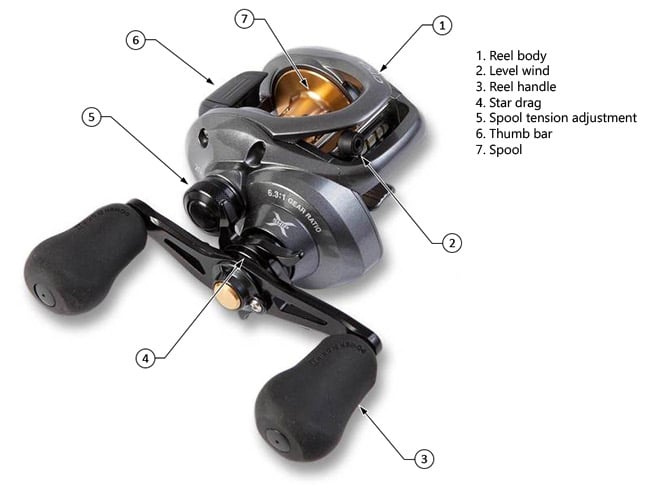
Diagram of the key components of a baitcasting reel.
Line Capacity
Line capacity is the maximum length of line the spool can hold. Line diameter increases with strength, so higher-test line takes up more spool space. A reel rated for 160 yards of 30-pound monofilament might hold only 120 yards of 40-pound or 100 yards of 50-pound. Most manufacturers list capacity for both monofilament and braided fishing line. Braided line achieves higher test in smaller diameters than monofilament (using materials like Dacron and Spectra fiber), so a spool typically holds more footage of braid at equivalent breaking strength.
Match line capacity to the size of fish you are targeting and the amount of line you need to run. For more on line selection, see our West Advisor on Selecting Fishing Line.
Low Profile or Round
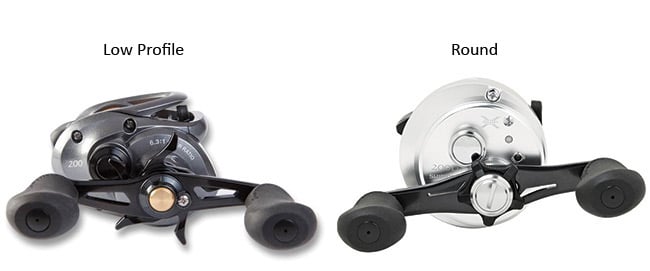
Low profile reels (left) allow the angler to palm the reel for sensitive feedback. Round reels (right) offer larger line capacity for big-fish applications.
Baitcasting reels come in two body styles. Round reels typically offer larger line capacity and allow a big fish to take more line on a run — well-suited for heavy-cover bass fishing, muskie, and applications where line capacity is a priority. Low-profile reels allow the angler to palm the reel and rest the line on their index finger for more sensitive strike detection — the preferred choice for most bass fishing, especially finesse applications where feel matters.
Drag Systems
The drag consists of an adjustment point and metal drag washers separated by carbon fiber or felt washers to reduce friction. It controls how much force is required before the spool slips and releases line. A general rule: set drag at 20–30% of the line’s breaking strength. For 20-pound test, set drag between four and six pounds. A hand-held spring scale makes this easy to verify before fishing.
Most baitcasting reels use a star drag, which is less convenient to adjust while playing a fish than a lever drag. Set your drag correctly before the first cast — mid-fight adjustments on a star drag are possible but awkward.
Ball Bearings
More ball bearings generally produce smoother reel action, but bearing quality matters as much as quantity. A reel with six high-quality shielded bearings will outperform one with ten cheap unsealed bearings in saltwater conditions. For saltwater and surf fishing, confirm the reel uses corrosion-resistant or shielded bearings. Unprotected bearings corrode quickly in salt and will make both reel action and drag operation rough within a season of ocean use.
Anti-Reverse
The anti-reverse is a ratchet mechanism that allows line to be reeled in but prevents the handle from spinning backward. When a fish is on, engaging the anti-reverse locks the handle from back-spinning, which frees one hand for the net without losing control of the reel. Most modern baitcasting reels have an instant anti-reverse with no back-play in the handle — this provides more immediate, positive hooksets than older designs with a small amount of handle movement before the anti-reverse engaged.
Match the Reel to the Rod
Reel and rod selection are inseparable. Baitcasting rods are stiffer than spinning rods, with smaller guides positioned closer to the blank — these keep the line close to the rod during the cast, matching how line comes off a baitcasting spool. Spinning rods have guides that graduate from large to small to accommodate the spiral of line coming off a stationary spool, and they have softer, more flexible actions suited to finesse techniques.
Like reels, rods are rated for line test ranges. Using line heavier than the rod’s rating risks damaging or breaking the blank. Match the rod’s power, action, and line rating to the reel and line you intend to use.
To simplify this process, we offer pre-assembled rod and reel combos matched for balance and performance across a variety of fishing applications.
Frequently Asked Questions
What is the difference between a baitcasting and spinning reel?
A baitcasting reel mounts on top of the rod with the spool perpendicular to the rod, releasing line in a straight path for accurate casts. A spinning reel hangs below the rod with a stationary spool that line spirals off during the cast. Baitcasters offer higher gear ratios, better accuracy for experienced anglers, and more power for large lures. Spinning reels are easier to learn, better for light lures and light line, and more versatile for beginners and finesse fishing.
What gear ratio should I choose for bass fishing?
It depends on the technique. A 5:1–6:1 ratio is best for deep crankbaits and swimbaits where slower retrieve and more torque help work the lure at depth. A 7:1–8:1 ratio suits topwater, buzzbaits, and any presentation where speed and fast line pickup matter. Many bass anglers own multiple reels at different ratios to match techniques throughout the day.
What causes backlash and how do I prevent it?
Backlash occurs when the spool spins faster than the line is pulling off — typically when the lure slows at the end of the cast but the spool keeps rotating. Preventing it requires a combination of properly adjusted brakes (set conservatively until you learn the reel) and developing the thumb pressure habit to slow the spool as the lure approaches the water. Start with brakes on the higher end of their range and gradually reduce them as your technique improves.
How do I set drag on a baitcasting reel?
Set drag at 20–30% of your line’s breaking strength. For 20-pound test, that is four to six pounds of drag. Use a hand-held spring scale: clip it to the line, pull steadily, and adjust the star drag until the spool slips at the target resistance. Set drag before you begin fishing — adjusting a star drag while playing a fish is possible but awkward compared to a lever drag.
Can I use a baitcasting reel for saltwater fishing?
Yes, for inshore saltwater species — redfish, snook, striped bass, flounder, and similar species. Look for reels with shielded or sealed bearings and corrosion-resistant construction. Rinse the reel thoroughly with fresh water after every saltwater use. For offshore trolling for large pelagics (marlin, tuna, wahoo), conventional trolling reels are the correct choice — baitcasting reels are not designed for the sustained heavy loads of offshore trolling.