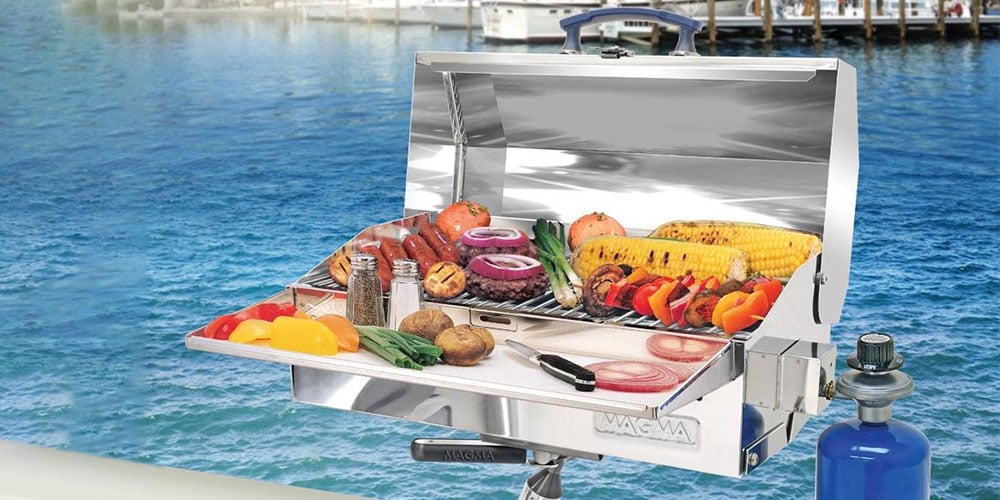
Marine barbecues have become a popular addition to cruising boats, sailboats and day boats because few things compare to enjoying a freshly grilled meal at anchor. Whether you're cooking for the family after a day on the water or adding extra cooking capacity for entertaining guests, a marine grill can transform your onboard experience.
Today's marine grills are designed specifically for life on the water. They feature corrosion-resistant materials, compact footprints, secure mounting systems and improved temperature control. Choosing the right grill depends on your boat, available mounting locations, cooking style and fuel preference.
- Choose Your Fuel: Propane or Charcoal
- Choose Your Form Factor: Round or Rectangular
- Choose Your Size
- Decide If You Want an Infrared Grill
- Choose Your Mount
- Safe Barbecuing
- Marine Grill FAQ
Why Choose a Marine Barbecue?
Unlike standard backyard grills, marine barbecues are built to withstand saltwater exposure, vibration and limited deck space. They are designed to mount securely to rails, rod holders or pedestal mounts and often include features that improve safety and efficiency onboard.
Stainless steel housing: High-end marine barbecues feature a double-lined stainless steel shell that helps prevent discoloration, reduces grease leaks and keeps exterior surfaces cooler. For saltwater boating, marine-grade stainless steel construction offers the best resistance to corrosion and helps maintain the grill's appearance over time.
Choose Your Fuel: Propane or Charcoal
Marine barbecues are generally powered by propane, compressed natural gas (CNG) or charcoal. Each fuel type offers advantages depending on your cooking preferences and boating style.
Charcoal grills: Many grilling enthusiasts prefer charcoal because it produces traditional barbecue flavor and offers the classic grilling experience. Charcoal grills are generally simple in design and require fewer mechanical components.
Gas grills: Propane grills are the most popular option for boaters because they are convenient, easy to light and simple to control. They require little setup time, heat quickly and allow precise temperature adjustments through control valves and built-in thermometers.
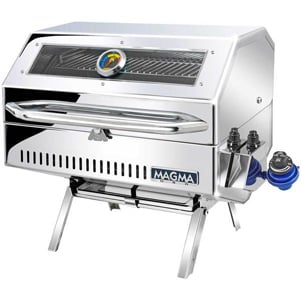
The Catalina 2 Infrared Marine Grill uses infrared cooking technology to deliver consistent heat and reduce flare-ups.
Canister or onboard fuel system: Many marine grills connect directly to standard one-pound propane canisters, making them portable and easy to use ashore. Others can connect to onboard LPG or CNG systems using optional adapters.
Push-button ignition: Many modern marine grills use piezo-electric ignition systems that generate a spark without requiring batteries or shore power. These systems provide reliable ignition in marine environments where moisture and salt exposure are common.
Choose Your Form Factor: Round or Rectangular
Marine grills are available in two primary shapes: round kettle-style grills and rectangular grills.
Round kettle grills: Kettle-style grills feature a compact design with a domed lid that helps retain heat and protect food from wind. Many can grill, boil, fry and simmer while taking up minimal deck space.
Rectangular grills: Rectangular models typically offer larger cooking surfaces and may include multiple burners for greater cooking flexibility. Many feature warming racks, hinged lids and larger capacity for entertaining larger groups.
Boaters who frequently cook for several people often prefer rectangular grills, while smaller crews and limited deck space may favor a compact kettle-style design.
Choose Your Size
Selecting the right size depends on available mounting space and the number of people you typically cook for.
Cooking surface: Compact round grills typically offer cooking areas between 150 and 200 square inches. Mid-sized rectangular grills often provide around 160 square inches, while larger premium models can exceed 400 square inches of cooking space.
Btu ratings: Gas grill output is measured in British Thermal Units (BTUs). Higher BTU ratings generally provide greater heat output, but efficiency matters as well. Most marine grills are engineered to maximize cooking performance while minimizing fuel consumption.
Keep in mind that a standard one-pound propane cylinder contains approximately 20,000 to 22,000 BTUs of fuel. Higher-output grills will consume fuel more quickly when operated at maximum heat.
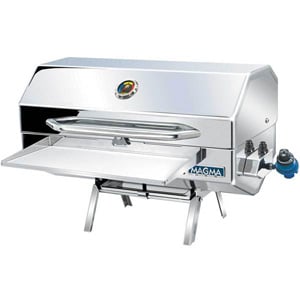
Larger marine grills provide expanded cooking capacity for entertaining guests aboard.
Decide If You Want an Infrared Grill
Infrared cooking technology has become increasingly popular in premium marine grills because it offers fast heat-up times, excellent temperature consistency and reduced flare-ups.
Traditional Cooking Methods
Conduction: Heat transfers directly from a hot surface to food, such as cooking on a frying pan.
Convection: Heated air circulates around food to cook it. Most traditional gas grills primarily rely on convection cooking.
Infrared Cooking
Radiant heat: Infrared grills use heated ceramic or stainless-steel surfaces that emit radiant heat directly toward the food. This allows the exterior to sear quickly while helping retain moisture inside.
Infrared grills can reach temperatures exceeding 900°F and often provide more even heat distribution than conventional grills. Many boaters prefer infrared cooking because it can produce steakhouse-quality searing while minimizing flare-ups caused by dripping grease.
Another advantage of infrared technology is faster preheating and greater fuel efficiency compared to some conventional grill designs.
Choose Your Mount
The mounting system you choose affects both convenience and safety.
Rail mounts: Popular on sailboats and cruising boats, rail mounts position the grill securely on the stern rail while keeping it clear of cockpit traffic.
Rod holder mounts: Many powerboats can utilize existing rod holders to support a grill without additional hardware.
Pedestal mounts: Pedestal systems create a dedicated grilling station and may be removable when not in use.
Shore stands: If you plan to use your grill while camping or picnicking ashore, a portable stand provides additional versatility.
Helpful Accessories
Accessories can improve cooking performance and convenience. Popular additions include:
- Radiant plates or ceramic briquettes for even heat distribution
- Fish baskets and grilling trays
- Grill carrying cases
- Protective covers
- Serving shelves and side tables
- Stainless steel grilling tools
- Disposable drip tray liners
A quality cover is highly recommended. While marine-grade stainless steel resists corrosion, a protective cover helps reduce exposure to salt, moisture and UV rays, extending the life of the grill.
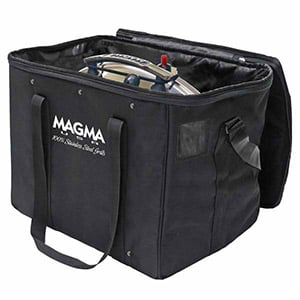
Protective carrying cases help keep marine grills clean during storage and transport.
Safe Barbecuing
- Use moderate heat whenever possible to avoid flare-ups and overcooking.
- Keep a spray bottle of water nearby to control minor flare-ups.
- Always light the grill with the lid open.
- Maintain at least two feet of clearance from combustible materials.
- Trim excess fat from meats to reduce grease flare-ups.
- Inspect fuel connections regularly for leaks or damage.
- Never leave a lit grill unattended.
Keeping Your Barbecue Clean
Exterior: Wash regularly with mild soap and water and keep the grill covered when not in use.
Interior: Remove grease buildup and empty drip trays regularly. Deep clean the grill at least annually or before long-term storage.
Cooking grates: Apply a light coating of cooking oil before use to help prevent sticking. Clean warm grates with a brass grill brush after cooking.
Ignition components: Keep ignition electrodes free of grease and debris and avoid damaging ceramic insulation.
Control valves: Do not disassemble control valves. Remove obstructions carefully using the manufacturer's recommended procedures.
Never use steel wool or highly abrasive cleaners on stainless steel grill surfaces.
Marine Grill FAQ
What is the best fuel source for a marine grill?
Most boaters prefer propane because it heats quickly, is easy to control and requires minimal cleanup. Charcoal remains popular among grilling enthusiasts who prioritize traditional barbecue flavor.
Are infrared marine grills worth it?
Infrared grills provide excellent heat distribution, fast preheating and superior searing performance. Many boaters find them worthwhile, particularly if they grill frequently.
Can I connect a marine grill to my boat's propane system?
Many propane grills can connect to onboard LPG systems using manufacturer-approved adapters. Always follow installation and safety guidelines.
How large of a grill do I need?
Small crews typically do well with compact grills under 200 square inches of cooking space. Larger crews or frequent entertaining may benefit from grills offering 300 square inches or more.
How do I protect my grill from saltwater corrosion?
Choose marine-grade stainless steel construction, rinse the grill periodically with fresh water and use a protective cover whenever the grill is not in use.