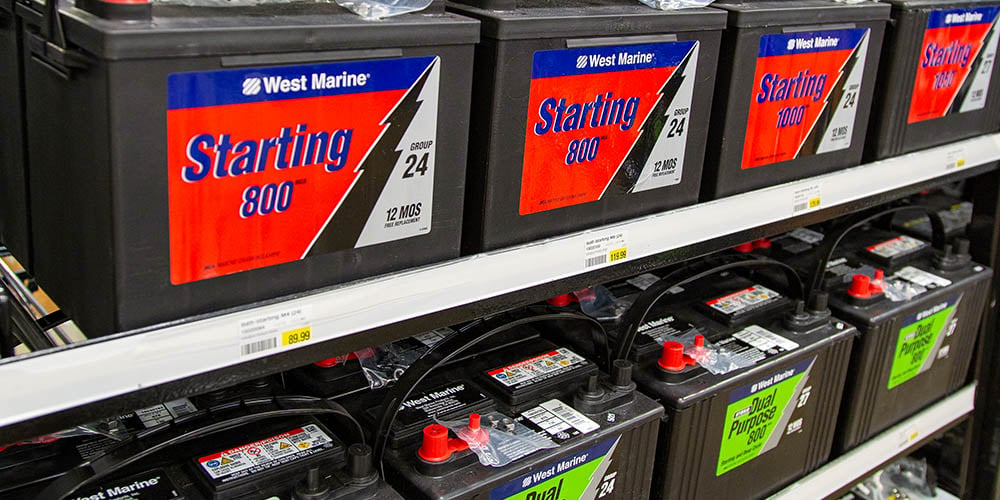
Marine Battery Types
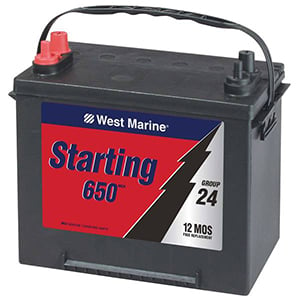
Flooded marine batteries are commonly used in starting applications. This battery has a no-spill design and can be tilted to a 45° angle, making it perfect for marine use.
Choosing the wrong marine battery doesn’t just cost you money — it can leave you stranded. There are two decisions to make: battery type (starting, deep cycle, or dual-purpose) and battery chemistry (flooded, AGM, gel, or lithium). Get both right and your battery will last years longer and perform when it counts. This guide walks you through both choices clearly.
| Chemistry | Cost | Cycle Life | Self-Discharge | Maintenance | Best For |
|---|---|---|---|---|---|
| Flooded | $ | 200–500 cycles | 6–7% / month | Required | Budget starting / house banks |
| Gel | $$ | 500+ cycles | 3% / month | None | Deep cycle, sensitive installs |
| AGM | $$ | 400–600 cycles | 3% / month | None | Dual-purpose, fast recharge |
| Lithium | $$$$ | 2,000–3,500+ cycles | <1% / month | None | House banks, weight-sensitive boats |
Cycle life estimates assume proper charging and discharge practices. Lithium cycle life varies by brand and depth of discharge. Always follow manufacturer recommendations.
- Starting Batteries
- Deep Cycle Batteries
- Dual Purpose Batteries
- Battery Chemistries
- What Battery Ratings to Look For
- Battery Tips for Best Performance
- Related Articles
- Browse Our Selection of Electrical Gear
Starting Batteries
Starting batteries, which crank the starter of your boat’s engine, are the sprinters of your electrical system. They deliver between 75 and 400 amperes for 5–15 seconds, and then are recharged in short order by your engine’s alternator. Like all lead-acid batteries, they are constructed with alternating layers of negative and positive plates with insulation between them.
Starting batteries have thinner and more numerous plates, providing extra surface area to generate high amperage bursts of current. The two drawbacks of this construction are that the plates are relatively fragile in high-impact environments, and that starting batteries do not tolerate deep discharges, which reduce their operating lifespan.
Deep Cycle Batteries
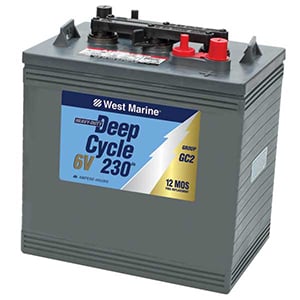
Six volt “Traction Batteries” are heavily over-built for industrial applications. This GC2 deep cycle battery is rated at 230 amp-hours. You’ll need a pair connected in series for 12 volts.
Your boat’s house battery bank uses deep cycle batteries, the marathon runners of the storage system. They power the electrical loads on your boat when no charge source (shore power charger, engine alternator, wind generator, or solar panel) is available. Consider them a kind of savings account into which energy is deposited or withdrawn.
Compared to starting batteries, which deliver high bursts of energy for short periods, deep cycle batteries recover fully after being heavily discharged over longer periods because their design features thicker plates with a high content of antimony. Overnight, their use might deplete 50–70 percent of the battery capacity, depending on the house loads of the boat. When the batteries are recharged, energy is re-deposited into the bank, and the process, or cycle, starts over. Generally, deep cycle batteries should be sized to store three to four times the expected amount of energy to be used between recharge cycles.
Dual-Purpose Batteries
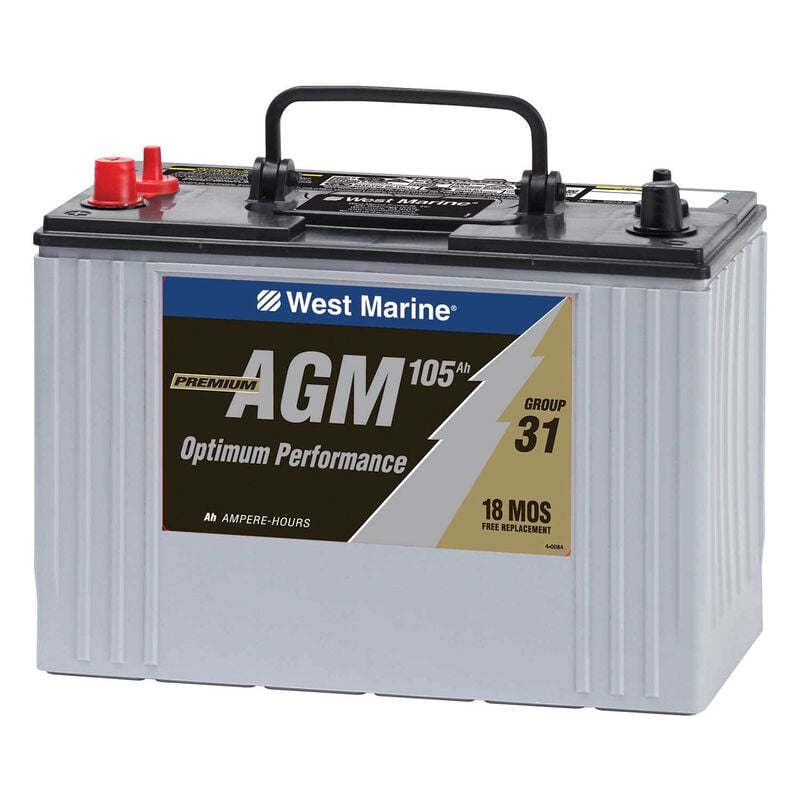
Sealed marine batteries, like this dual purpose AGM battery, are more rugged and accept higher charging current than flooded type batteries.
With large, thick plates containing more antimony than starting batteries and an active lead paste chemistry, dual-purpose batteries are a good compromise, tolerating deep discharges that would ruin a typical starting battery. Since they have lower storage capacity than comparably-sized deep cycles, we recommend them for the following applications:
- Runabouts or other small powerboats using a single battery for both starting and running loads with the engine turned off.
- Sailboats with two identical batteries used interchangeably for starting and house electrical loads.
- Boats with one battery bank that does double-duty for house applications and engine starting.
Battery Chemistries
At West Marine, you can choose from among four different battery chemistries: flooded lead acid, gel, AGM (Absorbed Glass Mat), and Lithium Iron Phosphate. Select the battery chemistry based on your needs (deep cycle versus starting versus dual-purpose) and on the performance you desire balanced against your budget.


High cranking power for quick engine start
Starting your Engine: Very good
Powering Electronics: Poor
Extending your day on the water: Poor

Starting your engine, powering electronics and accessories
Starting your Engine: Good
Powering Electronics: Fair
Extending your day on the water: Fair

Long lasting power for trolling motors, electronics and accessories
Starting your Engine: Fair
Powering Electronics: Good
Extending your day on the water: Very good

Superior durable technology for starting, trolling motors, and powering electronics and accessories
Starting your Engine: Very good
Powering Electronics: Very good
Extending your day on the water: Very good

Longest lasting, all-in-one solution for powering all your onboard systems
Starting your Engine: Very good*
Powering Electronics: Very good
Extending your day on the water: Very good
High cranking power for quick engine start
Starting your Engine: Very good
Powering Electronics: Poor
Extending your day on the water: Poor
Starting your engine, powering electronics and accessories
Starting your Engine: Good
Powering Electronics: Fair
Extending your day on the water: Fair
Long lasting power for trolling motors, electronics and accessories
Starting your Engine: Fair
Powering Electronics: Good
Extending your day on the water: Very good
Superior durable technology for starting, trolling motors, and powering electronics and accessories
Starting your Engine: Very good
Powering Electronics: Very good
Extending your day on the water: Very good
Longest lasting, all-in-one solution for powering all your onboard systems
Starting your Engine: Very good*
Powering Electronics: Very good
Extending your day on the water: Very good
*Applies to select models only.
Flooded Batteries
Flooded batteries, unlike other types, use a reservoir of liquid sulfuric acid and produce hydrogen and oxygen when the battery is being charged. Vented wet cells allow the gases to escape into the atmosphere, unlike gel and AGM batteries, which recombine the gases and re-introduce them to the system. Hydrogen is an explosive gas, so battery boxes and compartments must be vented to let the gas escape safely.
Other Articles on Batteries
Flooded batteries require periodic inspection and the cells must be topped off with distilled water when levels get low. Since flooded batteries are not sealed and allow excess hydrogen to escape, they handle overcharging better than gel and AGM batteries. They self-discharge at a higher rate (6 to 7 percent per month) and thus require off-season charging. Wet cells must be installed in an upright position and don’t tolerate high amounts of vibration. Their initial cost is lower than similarly sized AGM or gel batteries, and significantly lower than lithium batteries. Properly charged and maintained, wet cell deep-cycle batteries are capable of between a few hundred and over a thousand charging cycles.
Gel Batteries
Sealed, valve-regulated (SVR) gelled-electrolyte batteries offer several advantages over regular flooded batteries. They self-discharge at only three percent per month, are maintenance free, spill proof, submersible, and leakproof. A pressure release valve keeps their internal pressure at a slightly positive level but can release excess pressure if needed. The SVR design nearly eliminates gassing, so they are safer to install around people and sensitive electronics (though gel and AGM batteries still need to be vented). Gel batteries are manufactured to very high quality standards and need carefully regulated smart charging to prevent damage.
AGM Batteries
More boaters are switching to this type for a performance improvement over flooded batteries. Sealed, valve-regulated AGM (Absorbed Glass Mat) batteries feature fine, highly porous microfiber glass separators compressed tightly between the battery’s positive and negative plates, saturated with just enough acid electrolyte to activate the battery. During charging, precision pressure valves allow oxygen produced on the positive plate to migrate to the negative plate and recombine with the hydrogen, producing water. The fibers in the dense glass mats embed themselves into the plates’ surface like reinforcing rods in concrete, providing more plate support and better shock and vibration protection than conventional batteries.
High-density AGM batteries have lower internal resistance, allowing greater starting power and charge acceptance of up to 45 percent of the battery’s total capacity, and quicker recharging than other lead-acid types. Long life, a low three percent self-discharge rate, and outstanding performance make AGM batteries excellent dual-purpose batteries for boaters who require fast recharging, quick starting power, and reliable deep cycle ability.
Lithium Iron Phosphate Batteries
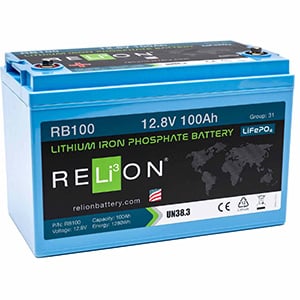
RELiON’s RB-100 100Ah Group 31 Lithium Iron Phosphate battery can sustain up to 3,500 charging cycles — 10X the charging cycles of comparable Group 31 AGMs.
RELiON Lithium Iron Phosphate Batteries represent a significant advance over flooded, gel, or AGM batteries. Compared to those chemistries, which should only be discharged to 50 percent of their capacity, RELiON batteries can discharge up to 80 percent of their capacity — which equates to 60 percent more usable power. They can also be recharged at a faster rate and weigh less than half their flooded, gel, or AGM counterparts. Compared to the roughly 400–600 discharge/charge cycles of a typical Group 31 AGM battery, Lithium Iron Phosphate batteries can be cycled up to 3,500 times. All of this performance does come at a cost. For an expanded discussion of how lithium batteries differ from lead-acid chemistries and how they can pay for themselves over the long haul, read our West Advisor article Are Lithium Batteries a Good Choice for You?
Can Lithium Batteries Be Used for Engine Starting?
While lithium batteries offer superior performance for powering house loads, most are not designed for engine starting. Standard RELiON batteries have a typical peak current of 200A and should not be used for engine starting. West Marine offers RELiON’s HP line of batteries, which deliver a peak current of 800A for two seconds — one of the few lithium batteries in the industry designed and rated for engine starting. Like other lithium batteries, the RELiON HP series is also a deep cycle battery, making it a true dual-purpose lithium option.
What Battery Ratings to Look For
Starting functions: The amount of power available for cranking a starter is measured several ways.
CCA vs. MCA: The two common power measurements are CCA (Cold Cranking Amps — the number of amps a battery can deliver for 30 seconds at 0°F while maintaining voltage above 7.2 volts) and MCA (Marine Cranking Amps, similar but measured at 32°F instead of 0°F). MCA ratings run 20–25% higher than CCA because batteries perform better at higher temperatures.
Reserve Minutes indicate how long a battery can sustain a load of 25 amps before dropping to 10.5 volts. A battery rated at 150 minutes can operate a 25A load for 2½ hours at 80°F. Reserve minutes are less critical for starting batteries since they are not used to handle sustained loads.
Size: Engine size, type, and ambient temperature determine what size cranking battery you need. High cranking power (and a larger battery) is required for cold temperatures, diesel engines, or large and high-compression gasoline engines. The first sizing criteria is to meet the minimum CCA stated by the engine or boat manufacturer. If a Group 24, 550 CCA battery worked well for five years, replace it with a similar model. If it cranked slowly or failed after a season or two, look for a battery with a higher CCA or MCA rating.
Deep cycle functions: Battery capacity is commonly expressed in Amp-hours (Ah) and Reserve Minutes. Amp-hours measure the total energy a battery can deliver for 20 hours at a constant rate of discharge before the voltage drops to 10.5 volts — a 200Ah battery can run a 10A load for 20 hours. Reserve minutes for deep cycle batteries work the same way as for starting batteries. House loads typically range from 5A to 25A or more. Amp-hours is generally the more relevant measurement for house banks.
Longevity: Battery manufacturers measure longevity by discharging batteries at 80°F until voltage drops to 10.5 volts, then recharging under controlled conditions, repeating until the battery fails to hold half its rated capacity. This measurement, called cycle life, shows how many discharge cycles a battery provides over its lifespan. This ability to cycle repeatedly is what differentiates deep cycle batteries from starting batteries, which cannot withstand more than a few deep discharges before beginning to fail.
Battery Tips for Best Performance
No matter what battery chemistry you choose, follow the manufacturer’s recommendations to get the best performance. Note: the following recommendations apply to flooded, gel, and AGM batteries. For the special considerations that apply to lithium batteries, read our West Advisor article Are Lithium Batteries a Good Choice for You?
- Stay with one battery chemistry (flooded, gel, or AGM). Each battery type requires specific charging voltages. Mixing battery types can result in under- or over-charging, and may mean replacing all batteries on board at the same time.
- Never mix old batteries with new ones in the same bank. Old batteries tend to pull down new ones to their deteriorated level.
- Regulate charge voltages based on battery temperature and acceptance to maximize battery life and reduce charge time. Ensure your charging system can deliver sufficient amperage to charge battery banks efficiently — generally an alternator output of 25% to 40% the capacity of the entire battery bank.
- Keep batteries clean, cool, and dry.
- Check terminal connectors regularly to avoid loss of conductivity.
- Add distilled water to flooded lead-acid batteries when needed. Keep them charged — leaving them in a discharged state for any length of time will damage them and permanently lower their capacity.
- Clean corrosion with a paste of baking soda and water.
Frequently Asked Questions
What is the difference between a starting battery and a deep cycle battery?
Starting batteries deliver short, high-amperage bursts to crank an engine and are recharged quickly by the alternator. Deep cycle batteries are designed to be discharged slowly over longer periods and recharged repeatedly — they power your boat’s electronics and appliances when no charge source is available. Using a starting battery as a house battery will damage it quickly.
Can I use a lithium battery for engine starting?
Most lithium batteries are not rated for engine starting due to their lower peak current output. However, RELiON’s HP series lithium batteries deliver 800A peak current for two seconds and are rated for engine starting, making them a true dual-purpose lithium option.
How long do marine batteries last?
Flooded lead-acid batteries typically last 2–5 years with proper maintenance. AGM batteries last 4–7 years. Lithium Iron Phosphate batteries can last 10+ years, with cycle lives of 2,000–3,500+ charge cycles compared to 400–600 for AGM.
What does CCA mean on a marine battery?
CCA stands for Cold Cranking Amps — the number of amps a battery can deliver for 30 seconds at 0°F while maintaining voltage above 7.2V. MCA (Marine Cranking Amps) is measured at 32°F and runs 20–25% higher. Both measure starting power — match or exceed your engine manufacturer’s minimum CCA recommendation.
Can I mix AGM and flooded batteries in the same bank?
No. Different battery chemistries require different charging voltages. Mixing them will result in one type being overcharged and the other undercharged, reducing the lifespan of both. Always use the same chemistry and ideally the same age within a battery bank.
How deep can I discharge a marine battery?
Flooded and AGM batteries should not be discharged below 50% of capacity — doing so repeatedly shortens their lifespan significantly. Gel batteries tolerate discharge up to around 80%. Lithium Iron Phosphate batteries can safely discharge to 80–100% of capacity, which is one of their key advantages over lead-acid chemistries.
Related Articles
- What is the Best Battery for You?
- West Marine’s Battery Testing Program
- Sizing Your House Battery Bank
- Do-it-Yourself: Installing a Second Battery
- Are Lithium Batteries a Good Choice for You?
Browse Our Selection of Electrical Gear
- Starting, deep-cycle, AGM, and lithium batteries
- Onboard and portable battery chargers
- DC-to-AC power inverters
- Shore power cords, inlets, and adapters
- Navigation, cabin, deck, and underwater lighting
- Marine-grade electrical wire
- Panels, bus bars, and fuse blocks
- Connectors, terminals, and wiring accessories
- Replacement batteries for electronics and devices