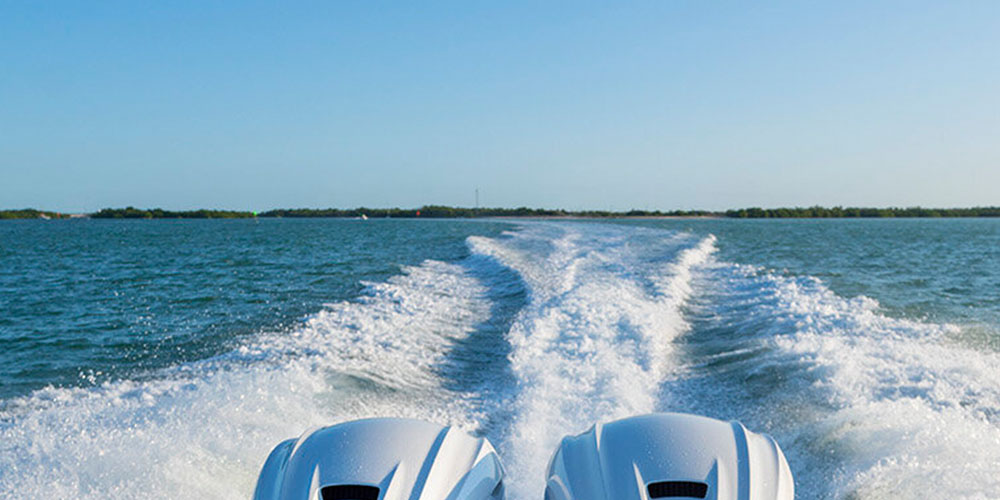
- What Problems Are You Looking to Solve?
- Elevation and Weight
- Ventilation & Cavitation
- Selection Criteria
- Propeller Nomenclature
- What Propellor Material is Best?
- Four Blade Propellers
- Modular Hub Systems
What problems are you looking to solve?
Is your boat sluggish coming out of the hole and slow to get on a plane? Are you not hitting the top speed you think you should? Do you want an improvement in fuel economy? Hoping for better all-around performance? Is your current prop blowing out or ventilating excessively in turns or when you accelerate? Are you looking to improve your boat’s watersports performance for tubing, skiing or wakeboarding? Once you have defined your goals, you can move on in the selection process.
Is your engine over or under revving?
Selecting the correct prop should result in your engine running within the designed rpm range at Wide Open Throttle (WOT). Your owner’s manual should include this spec—usually 5000–5500rpm for an outboard or 4200-5000rpm for a sterndrive—or your mechanic or dealer may know. Allowing your engine to under rev or over rev at WOT can result in engine damage. Over revving or under revving can be corrected by selecting a prop with a different pitch.
How to Select the Right Propeller: 5 Steps
Step 1 — Find your engine's WOT RPM range
Check your owner's manual for the manufacturer's recommended Wide Open Throttle (WOT) RPM range. For most outboards this is 5,000–5,500 RPM; for sterndrives, typically 4,200–5,000 RPM. This range is your target — everything else is tuning around it.
Step 2 — Test your current prop at WOT
With a normal load aboard, run your boat at full throttle and record the RPM with a tachometer. This single number tells you whether your current prop is the problem.
Step 3 — Interpret the result
- RPM too low (under-revving): Your pitch is too high. Drop pitch to bring RPM up. As a rule of thumb, every 2 inches of pitch reduction raises RPM by 300–400.
- RPM too high (over-revving): Your pitch is too low. Increase pitch to bring RPM down.
- RPM in range: Your pitch is correct. Consider blade count or material changes for performance goals.
Step 4 — Match to your use case
Fishing / general use → 3-blade aluminum, mid-range pitch
Watersports / towing → 4-blade for better hole shot and pull
Performance / top speed → 3-blade stainless steel, pitched to top of WOT range
Heavy loads / older boat → 4-blade to improve lift and planing
Step 5 — Use our Prop Selector tool to confirm
Not sure which prop fits your engine? Use our free Prop Selector tool — enter your engine make, model, and horsepower and we'll match you to the right options.
Elevation and Weight
Elevation: Many small, trailered boats are used at vastly different elevations, such as high mountain lakes and bays at sea level. Reduced concentrations of oxygen at high altitude cause engines to produce less power (about 20 percent less at 7000'). You can partially compensate for this decrease in performance by carrying a second prop with reduced pitch, making it easier for the engine to achieve the correct rpm at WOT.
Weight: Your boat may have a lot of heavy gear inside, or you may sometimes use it to tow skiers or wakeboarders, in which case the original-equipment prop may have too much pitch, causing your engine’s rpm to be on the low side. If you change configurations, sometimes running light and other times loaded with camping equipment, two props with different pitches make sense. There are two ways you can tailor your prop’s pitch to match a variety of conditions: carry two complete props or two modular props with different pitch.
Ventilation and Cavitation
Ventilation: This problem occurs when air from the surface or exhaust gas from the engine gets drawn into the prop’s blades. The boat’s speed drops, the engine over-revs and screams, and the prop sucks air. Ventilation results from excessively tight turns, a motor that is mounted too high on the transom, or an engine that is over trimmed. Ventilation can also occur from prop designs that are not matched to the application, poorly designed props, props with little or no cup, or props that are worn or have damaged edges or cup profiles.
Cavitation: Often confused with ventilation, cavitation results from water vaporizing or “boiling” due to the extreme lack of pressure on the back of the propeller blade. Many propellers partially cavitate during normal operation, but excessive cavitation may result in “cavitation burn,” metal erosion or pitting of the prop’s blade surface. Causes of cavitation include incorrect engine height (outboards), dings or sharp corners in the leading edge, poor polishing, too much cup or crummy blade design. Cavitation can also occur from thru-hulls, sensors, or other turbulence-producing protrusions under the boat forward of the prop.
Selection Criteria
We stock propellers to fit most outboards and sterndrives. Choices include propellers and hubs made by Mercury (Quicksilver) and Turning Point. Regardless of the brand you prefer, you will need to gather as much information as possible (see below) to make the best selection. After processing this information, you can make a better-informed decision. You can do this by speaking with an associate at one of our stores, calling our Technical Sales Department at 1-800-BOATING, using the Turning Point Prop Wizard. If you prefer a Mercury product, use the Quicksilver Propeller Selection Guide. NOTE: Mercury and Turning Point both offer modular hubs and propellers. Hubs are purchased separately from props. You will find an explanation of modular hub systems at the end of this article. Mercury also continues to offer one-piece, traditional props.
Propeller Data
- Present prop diameter
- Present prop pitch
- Right or left hand prop rotation (clockwise is right hand)
- Number of blades
- Material (Usually aluminum or stainless steel)
Other useful information
- Manufacturer’s part number
- Shaft diameter and number of splines or keyway type
Engine Data
- Number of engines
- Rated horsepower
- Gear case size
- RPM at WOT
- Manufacturer, model and year
Other very useful information
- Displacement in cubic inches or centimeters
- Power trim or trim tabs
Boat Data
- Length overall
- Hull material
Other very useful information
- Manufacturer, model and year
- Hull shape
- Present/desired top speed
Propeller Nomenclature—"Prop Talk"
Propeller size is expressed with two numbers, diameter and pitch, with diameter always stated first. Diameter is two times the distance from the center of the hub to the tip of any blade. Smaller prop diameters generally go with smaller engines, or with fast high performing boats. Pitch is the theoretical forward distance, in inches, that a propeller travels during one revolution. There is always some “slip” between the propeller and the water (generally 10 to 15 percent) so the actual distance traveled is somewhat less than the theoretical value. Think of pitch as speed, or as the gear selection on a car’s transmission.
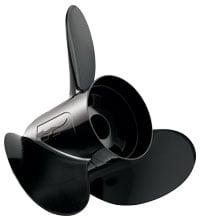
Turning Point Propellers use a squeeze casting process to create thinner blades. The manufacturer boasts stainless performance at aluminum prices.
Rake is the degree that the blades slant forward or backward in relation to the hub. Rake can affect how water flows through the propeller, which can make a difference regarding boat performance. Aft rake helps to lift the boat’s bow, decreasing the hull’s wetted surface area and improving top end planing speed. Today’s aggressively raked propellers may require that you add a high performance trim tab to your shopping list. The blade tips of these new propellers may strike the older style trim tabs on your engine.
Cupping of the trailing edge of the propeller blade is common on many propellers. A downward curve of the lip of the blade (like a plane’s wing with the “flaps” down) allows a better hole shot, less slippage and ventilation, and helps the propeller get a better bite on the water. A cupped prop may allow the engine to be trimmed with the prop closer to the surface, and will also decrease rpm by 150 to 300.
What propeller material is best?
Most outboards and IOs are originally sold with aluminum props, which are inexpensive and repairable. Inboards use three- and four-bladed props of bronze, or a nickel-bronze-aluminum alloy. Replacement props for IO or outboard boats are available in aluminum or stainless steel. These materials compare as follows:
Aluminum is the most common, least expensive material. Suitable for most outboard and sterndrive applications.
Stainless steel offers a performance advantage over aluminum due to stiffer, thinner blades and more advanced designs. Best choice at speeds over 50mph, or if your boat is running over oyster beds or sandbars regularly. Stainless costs more but is five times more durable than aluminum. Stainless props can be repaired, at a higher cost, to like-new condition, while repaired aluminum will suffer from metal fatigue and a loss of strength.
Aluminum vs. Stainless Steel: Which Should You Choose?
Aluminum ($100–$250)
- Standard on most outboard boats
- Lighter and less expensive
- Bends rather than breaks on impact, which can protect your lower unit
- Blades flex slightly under load, which costs a small amount of efficiency
- Best for: general recreational use, shallow or debris-prone water, boaters who want easy and affordable replacement
Stainless Steel ($300–$800)
- Thinner, stiffer blades with less drag
- Typically adds 1–3 mph of top speed and improves fuel efficiency 5–10% over a comparable aluminum prop
- Does not flex, so impact force transfers to the lower unit — a prop strike can be costly
- Lasts significantly longer under regular use
- Best for: performance-focused boaters, saltwater use, anyone running 30+ hours per season
Bottom line: If you boat regularly and don't run in rocky or shallow water, stainless pays for itself over time. If you're in a sandy bay, keep an aluminum spare aboard — it can be swapped in 15 minutes and may save your lower unit.
Should you choose a four-blade prop?
Three or four blades work well in either sterndrive or outboard applications. Three-blade designs give you all-around performance with an advantage on top end speed. Four-blade designs work well with boats that are difficult to get on plane, underpowered or used in watersports where top-end speed is not critical.
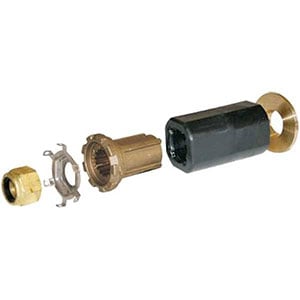
The composite cores of modular hubs are designed to break away upon significant prop strikes, helping to protect the prop body and engine drive train from damage.
Four blades in many cases will drop your rpm by 50 to 150rpm with identical pitch. Three-blade props are generally best for recreational boats with three-, four- and six-cylinder outboards and sterndrives, giving good hole shot and top-end performance.
The blades on three-blade props fill up about 50 to 55 percent of the available area inside the circle formed by the prop’s diameter (referred to as the Diameter Area Ratio). Adding a fourth blade increases the DAR to between 60 and 65 percent, so you can expect more thrust to keep your boat planing at lower rpm, a potential boost in fuel economy, but also a reduction of 50–100rpm at WOT.
Modular Hub Systems
Modular hub systems consist of a hub that fits on to the splined shaft of the engine and the prop body which fits on to the hub. These systems offer two main advantages. First, in the event of a significant prop strike, the composite hub breaks away, which reduces the chance of damage to the engine, engine drive or propeller. Damaged hubs are easily user replaced and this lowers the “replacement cost” of the prop strike. Also, if the prop is bent but the hub is intact, replacing just the prop is also less expensive. Either way you stand to save $$$ if you have a problem.
Frequently Asked Questions for Choosing a Boat Propeller
What material should my propeller be made from?
The most common propeller materials are:
- Aluminum: Affordable, durable, and works well for most recreational boats. Easy to repair but less durable than stainless steel.
- Stainless steel: More durable, provides better performance, and is resistant to corrosion. Ideal for higher-speed or high-performance boats.
- Composites: Lighter and often more resistant to damage but typically not as high-performing as aluminum or stainless steel.
- The choice of material depends on your budget, boating conditions, and how often you want to replace or repair your propeller.
What type of propeller is best for my boating style (e.g., fishing, watersports, cruising)?
The type of propeller you need depends on your boating activities:
- For cruising: A propeller with a moderate pitch that offers a good balance of speed and fuel efficiency is typically best.
- For watersports (towing): You may need a prop with lower pitch for better acceleration and torque.
- For fishing: A prop with good durability and moderate pitch works well, depending on whether you need to travel long distances or maneuver slowly in shallow water.
- For performance boats: Stainless steel props with higher pitch provide better speed and handling at high RPMs.
How do I know if my prop pitch is wrong?
Run your engine at Wide Open Throttle with a normal load and check the RPM with a tachometer. If it falls below your engine's recommended WOT range, your pitch is too high. If it exceeds the range, your pitch is too low.
What's the difference between 3-blade and 4-blade propellers?
A 3-blade prop generally delivers higher top speed and is the right choice for most boaters. A 4-blade prop sacrifices about 1–2 mph of top speed but gives you a better hole shot, more pull at low speeds, and the ability to stay on plane at lower RPM — making it the better choice for watersports, fishing boats, and heavier vessels.
Is stainless steel worth the extra cost?
For boaters who go out regularly (30+ hours per season), yes. Stainless props typically add 1–3 mph top speed, improve fuel efficiency by 5–10%, and last longer. The savings in fuel and replacement costs offset the higher upfront price within a few seasons.
What does prop size mean? (e.g. 14 x 17)
Prop size is expressed as diameter x pitch, both in inches. A 14 x 17 prop has a 14-inch diameter and a 17-inch pitch — meaning it theoretically travels 17 inches forward per revolution.
Can the wrong propeller damage my engine?
Yes. Sustained under-revving (too much pitch) overloads the engine and causes premature wear. Sustained over-revving (too little pitch) can cause overheating and internal damage. Always verify your WOT RPM falls within the manufacturer's specified range.