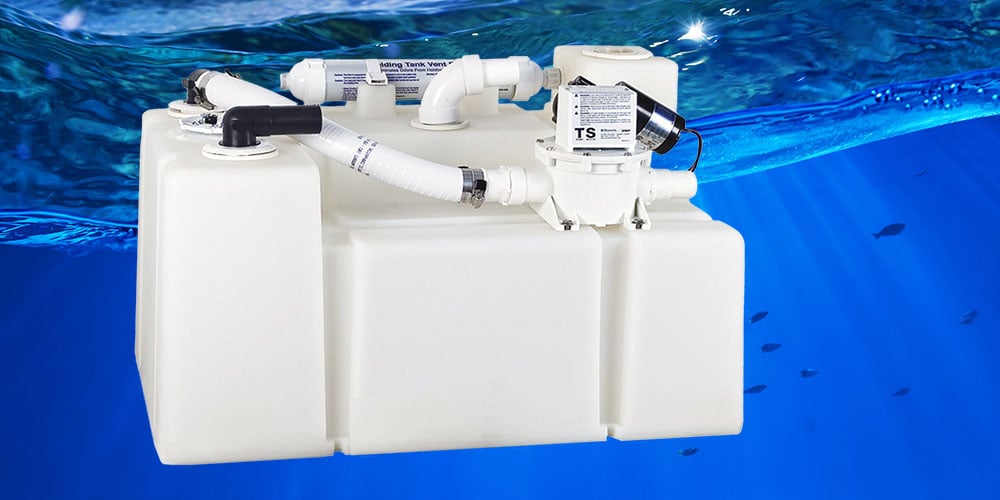
Maintaining your marine sanitation device can seem daunting, but most problems arise from owner neglect rather than fundamental system failure. Components like Y-valves, macerators, and holding tanks do sometimes need replacement, but a properly installed and maintained system brings real convenience to life aboard. This article covers typical installations, system components, maintenance, and the laws that govern marine sanitation device use.
- Know the Law
- Waste Storage Options
- Manual Heads, Electric Heads, and System Components
- Bacteria and Odor Control
- Let’s All Do Our Part
- FAQs
Know the Law
All boats operating in U.S. waters with permanently installed toilets are required by federal law to have a Marine Sanitation Device (MSD) on board that either stores human waste until it can be transferred ashore, or reduces the coliform count to levels low enough that discharged sewage poses no public health hazard. While the MSD must satisfy Coast Guard regulations, boat owners still have significant choice in product types and overall system design.
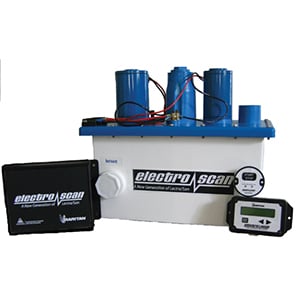
The Raritan Electro Scan utilizes electrodes to temporarily convert salt water into a powerful bactericide. The treated wastewater safely reverts to salt and water, meeting EPA Type I standards for overboard discharge.
- More than three miles from the coast: It is legal to discharge raw (untreated) waste overboard, either directly from the toilet or by emptying the holding tank. The most sensible system design gives you the choice of both dockside pump-out and the ability to empty the tank yourself when offshore.
- Inside the three-mile limit: It is illegal to discharge raw sewage. Boaters may discharge waste only if it has been treated by an onboard treatment device (Type I or II MSD, such as the Raritan Electro Scan). Otherwise, waste must be contained in a Type III MSD — a holding tank — and transferred ashore at a pump-out station.
- No Discharge Zones (NDZ): All non-navigable inland freshwater lakes and the Great Lakes are NDZs under federal law. In NDZs, overboard discharge of any kind is illegal and subject to fine. You must have a holding tank, and some local authorities may prohibit even a Y-valve between the toilet and holding tank. Michigan, New Mexico, Rhode Island, and Vermont have designated all their waters as no-discharge. A rapidly increasing number of coastal areas are also being designated as NDZs as states demonstrate adequate pump-out facilities.
Waste Storage Options
The most common system by far is a toilet plumbed to a holding tank. These range from simple self-contained portable heads to fairly complex systems incorporating multiple valves, pumps, and hoses. Here are the main configurations:
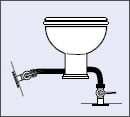
Direct discharge — legal only offshore beyond the three-mile limit.
Direct Discharge
Pumping raw sewage directly overboard is legal only beyond the three-mile offshore limit. Inside that limit it is illegal. Never operate a head without a means to contain or treat waste aboard. In foreign countries, do not pump waste overboard within 100 yards of the beach — this harms swimmers and those who eat local fish and shellfish.

Portable toilet — a simple, no-plumbing solution for smaller boats.
Portable Toilets
A practical solution for thousands of weekend and trailer boats that need to hold small amounts of waste. They eliminate permanent plumbing, are almost impossible to clog, and are inexpensive. They need to be emptied periodically at a marina toilet, but a deodorizing chemical in the tank keeps odors manageable.
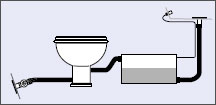
Holding tank without self-discharge — simple and legally compliant where pump-out facilities are available.
Holding Tank without a Self-Discharge Option
A holding tank connected between the head discharge and a through-deck fitting is a simple, inexpensive installation that satisfies the law. Install the largest tank the space will accommodate — a full crew can fill a small tank quickly, especially if they flush thoroughly (which is actually recommended to keep waste from collecting in hoses). The drawback is that you have nowhere to go if the tank is full and no pump-out station is available.
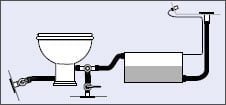
Holding tank with Y-valve for optional overboard discharge offshore.
Holding Tank with Optional Overboard Discharge
A Y-valve between the toilet and tank allows direct overboard discharge beyond the three-mile limit while using the holding tank inshore. Two drawbacks: the risk of accidental discharge (which is why some authorities prohibit Y-valves upstream of the holding tank), and the inability to empty the holding tank at sea.
Our Favorite Method: Holding Tank with Multiple Discharge Options
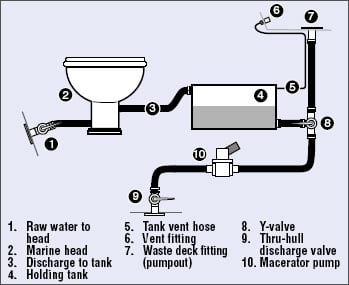
Our preferred system: all waste to the holding tank, with Y-valve downstream for dockside pump-out or overboard discharge offshore.
All waste is pumped into a holding tank, but a Y-valve downstream of the tank (not between the toilet and tank) allows emptying via the deck pipe inshore or overboard by manual or electric pump offshore. This eliminates the Y-valve upstream of the tank that concerns authorities in NDZs, while still giving you flexibility offshore. As with any system, a clogged valve or hose can make for a difficult service job, so carrying spare parts and rebuild kits is strongly recommended.
Manual Heads, Electric Heads, and System Components
On smaller boats, manual heads are most common due to their simplicity and low cost. Toilet trouble at sea is particularly unpleasant, so this is one piece of equipment worth spending a little extra on. Features to look for:
- Joker valve: The rubber valve through which waste passes with each pump stroke. The larger the valve, the less chance of a clog.
- Pump handle throw: A horizontal throw (back and forth) is less tiring than a vertical throw (up and down). The extra linkage for horizontal throws adds cost slightly.
- Ease of rebuilding: Frequently-used marine toilets generally require rebuilding (pump leather, springs, gaskets) every one to two years. Always carry a rebuild kit and instructions; in an emergency, faster is better.
- Sturdy seat: Sitting on the head at an angle while underway puts stress on the seat hinges. A flimsy seat can fail at the most inopportune moment.
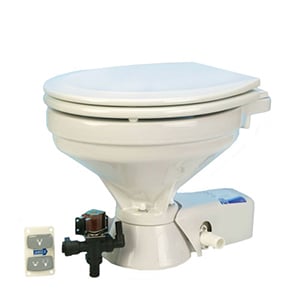
The Jabsco Quiet Flush Electric Head includes a water control solenoid valve with anti-siphon breaker to prevent contamination of the potable water supply.
Electric heads draw very little current despite their convenience — the Jabsco Quiet-Flush, for example, draws 10A but with a 30-second flush cycle, total energy per flush is just 0.15Ah. Advantages include easier operation for inexperienced guests and a lower clogging risk, because the built-in macerator grinds waste and toilet paper before it reaches the holding tank.
Seacocks and Thru-Hulls
Most head systems use a 3/4” intake seacock and thru-hull for seawater flushing, and a 1-1/2” seacock and thru-hull for overboard discharge. Bronze fittings are most common for their strength and durability. Marelon fittings are an alternative for their non-conductive, non-corroding nature — particularly appropriate on metal boats.
Hose
All sanitation hose will eventually smell if sewage is allowed to stand for extended periods. Use only smooth interior wall hose — corrugated types trap waste and restrict flow. The best hoses for containing odors are SeaLand OdorSafe Plus, Shields Heavy Duty Vinyl Hose (#148), and Super Head Hose (#101). Rigid PVC does not pass odors but is harder to route and does not connect directly to pumps and thru-hulls. It can be used for straight sections, switching to hose where flexibility is needed.
Hose Installation Tips
Flush the system after every use. Install hoses without any low spots where waste can collect — low spots cause odor and clogging. Never heat hose to force it over barbed adapters; this weakens the hose. Buy fittings specifically made for 1-1/2” sanitation hose instead.
Seawater vs. Freshwater Flush
Using fresh water to flush the head seems wasteful, but electric heads from Jabsco and SeaLand use very little — as little as a pint or two per flush. Freshwater flushes significantly reduce odors caused by microorganisms (plankton, krill) dying and decaying in the bowl and hose. In areas where seawater is fouled or especially warm, freshwater flush is worthwhile.
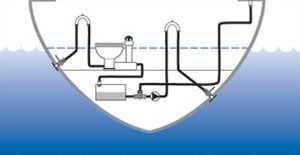
Below-waterline installation requires vented loops to prevent back-siphoning when the boat heels.
Vented Loops
A common cause of boat sinkings is backflow from siphons in head intake hoses, engine seawater intake hoses, and head discharge hoses. When a through-hull fitting is below the waterline and the boat heels or the pump creates a siphon, water can flow back into the boat unchecked. Vented loops installed in the hose above the waterline break the siphon without impeding normal flow. Both bronze and Marelon models are available.
Holding Tanks
Thick-walled (1/4” or thicker) high-density polyethylene tanks are the best choice: light, non-corroding, and far less expensive than metal or fiberglass. Thin-wall tanks rarely burst but can bulge enough to stress fittings to the point of leaking. Taller, narrower tanks empty more completely but are harder to secure. Plumbing fittings should be positioned as low as possible for drainage and as high as possible for vent connections. Flexible tanks work in oddly-shaped spaces but lack the odor resistance and structural integrity of rigid tanks — not recommended for waste.
Y-Valves
The best Y-valve is made by Whale — it has a center position that closes both ports. The Bosworth Y-valve can be surface-mounted so you don’t have to climb into a locker to change directions. Forespar Marelon valves are very strong, and Jabsco valves can be adjusted to a variety of configurations and include a lockable feature for USCG inspections.
Pumps
Discharge pumps empty the holding tank overboard. Large-diameter diaphragm pumps are least likely to clog. The Whale Manual Waste Pump is the best non-electric choice — its plastic body won’t corrode like aluminum-body alternatives. Macerator pumps by Jabsco and SHURflo grind waste for easier passage; when used as discharge pumps, monitor the tank level closely — running them dry burns them out quickly.
For a more durable electric solution, the SeaLand T Series Discharge Pump can run dry without damage, and the Whale Gulper handles solids up to 1-1/2”. Always confirm your seacock is open before pumping — an electric pump working against a closed outlet can invert its valves or rupture hose connections.
Tank Monitors
Tank level indicators reduce the risk of overfilling the holding tank, which can push sewage out the vent line or, if that line is clogged, rupture the system elsewhere. Mount the monitor near the discharge pump switch so you can empty the tank before it overflows.
Bacteria and Odor Control
Holding tanks contain either aerobic (good) or anaerobic (bad) bacteria. Aerobic bacteria require oxygen and produce only carbon dioxide and water as they break down waste — both odorless. Anaerobic bacteria thrive without oxygen and produce hydrogen sulfide gas with the characteristic rotten egg smell.
The best prevention for holding tank odor is encouraging aerobic bacteria by increasing ventilation. Standard tank vents on most small boats are 5/8” — make sure the vent hose is unobstructed. Increasing vent size and adding vents on both sides of the boat for cross-ventilation helps significantly but may not be practical on all boats.
Head and holding tank treatments can mask or eliminate odors using a variety of chemical and biological approaches. For more, see Head and Holding Tank Treatments.
Let’s All Do Our Part
Marine sanitation has come a long way since the days of cedar buckets. Today, with thousands of cruisers on the water, maintaining a proper sanitation system is both a legal obligation and an environmental responsibility. The systems available today are reliable and convenient when installed and maintained correctly. We owe it to each other — and to the waters we use — to leave a clean wake.
Frequently Asked Questions
What is the legal difference between Type I, II, and III MSDs?
A Type I MSD is a flow-through treatment device that discharges treated effluent with a coliform count not exceeding 1,000 per 100ml and no visible floating solids (such as the Raritan Electro Scan). A Type II MSD meets a higher treatment standard — coliform count not exceeding 200 per 100ml. Both Type I and II are legal for overboard discharge inside the three-mile limit in most U.S. waters, but not in No Discharge Zones. A Type III MSD is a holding tank that stores waste with no overboard discharge capability — required in NDZs.
How do I know what discharge is legal where I am?
Beyond three miles offshore: raw discharge is legal. Within three miles: only Type I or II treated discharge is permitted; otherwise the holding tank must be used. In a No Discharge Zone (NDZ): no overboard discharge of any kind is allowed regardless of treatment. Check EPA and state environmental agency resources for current NDZ designations in your cruising area — the number of NDZs has grown significantly in recent years. Michigan, New Mexico, Rhode Island, and Vermont have statewide NDZs.
How large a holding tank do I need?
Install the largest tank your space will accommodate. A practical minimum is one gallon of capacity per person per day of expected use between pump-outs, plus a 50% buffer. A four-person crew on a three-day weekend cruise needs at least 18 gallons of capacity before needing a pump-out. Vigorous flushing (recommended to prevent waste from collecting in hoses) will fill a tank faster than light flushing. Where pump-out stations are scarce — remote anchorages, the Great Lakes — more capacity is always better.
What causes holding tank odors and how do I eliminate them?
Odors come from anaerobic bacteria producing hydrogen sulfide gas as they break down waste without oxygen. Prevention: ensure the vent hose is unobstructed and large enough (5/8” minimum; larger is better) to allow adequate airflow into the tank. Treat with products that encourage aerobic bacteria or use chemical or enzyme-based holding tank treatments. Always flush the head thoroughly after use to prevent waste from sitting in hoses where it produces odor faster than in the tank itself.
What is a vented loop and why is it critical?
A vented loop is a high point in a hose run with a small air-admission valve at the top. It breaks the siphon that can form when a hose passes below the waterline. Without a vented loop on the head intake and discharge hoses (and the engine raw water intake), a siphon can allow seawater to flow continuously into the boat even with the seacock open. This is a known cause of sinkings and is particularly dangerous when a boat heels under sail. Install vented loops on all below-waterline sanitation and raw water hose runs, positioned above the heeled waterline.
What is the best way to prevent sanitation hose odors?
Use smooth-bore, odor-resistant hose (SeaLand OdorSafe Plus, Shields Heavy Duty Vinyl, or Super Head Hose) — not corrugated hose, which traps waste and promotes odor. Install all hose runs without low spots where waste can pool. Flush thoroughly after every use. Replace hose that is more than five to seven years old even if it appears intact, as hose becomes permeable to odors with age regardless of outward condition.
We’re Here to Help
Use our store locator to find a West Marine store near you. Our staff can help you select the right components for your sanitation system and answer questions about installation and maintenance.