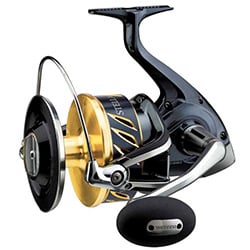
The Stella SW 30000 spinning reel from Shimano is built for ocean use and is powerful enough to pull in bluefin tuna.
From finesse fishing for bass with ultralight tackle to pulling in large bluefin tuna offshore, spinning reels cover more fishing applications than any other reel type. Their ease of use, ability to cast light lures, and wide size range make them the most popular reel style among recreational anglers worldwide. This guide covers how to choose the right spinning reel for your fishing style — including size, gear ratio, drag system, line capacity, and how to match the reel to a rod.
- Advantages of Spinning Reels
- Disadvantages of Spinning Reels
- Reel Size Guide
- Freshwater vs. Saltwater
- What Fish Are Spinning Reels Good For?
- Parts of a Spinning Reel
- Gear Ratios and Line Speed
- Line Capacity
- Drag Systems
- Ball Bearings and Construction
- What You Get at Different Price Points
- Match the Reel to the Rod
- FAQs
Advantages of Spinning Reels
Spinning reels mount on the underside of the rod with the spool axis parallel to the rod. The spool remains stationary during a cast — line peels off the front of the spool in coils rather than spinning off like a baitcaster. This eliminates backlash, the “bird’s nest” of tangled line that occurs when a baitcasting spool overruns the line during a cast. No backlash risk lets the angler focus on cast direction and distance rather than managing spool speed.
The stationary spool also creates minimal resistance at the start of a cast, allowing spinning reels to cast light or even unweighted lures that would not load a baitcasting reel at all. This is why spinning tackle dominates finesse fishing applications: drop-shot rigs, ned rigs, small jigs, and lightweight soft plastics all cast better on spinning gear.
Line twists are the main downside of spinning reels and can be minimized with good habits: stop the line with your finger when the lure hits the water, close the bail manually rather than by turning the handle, and change line that has developed memory from sitting on the spool. Adding a swivel above the lure also helps on retrieves that put twist in the line.
Disadvantages of Spinning Reels
The same stationary spool that prevents backlash limits accuracy. Line spiraling off the spool adds a small amount of unpredictability compared to the more direct line control of a baitcaster. Experienced spinning anglers compensate for this, but it is a genuine limitation for pin-point work like skipping a lure under a dock.
Gear ratios on spinning reels are typically lower than baitcasters — most fall between 4.8:1 and 6.2:1, while baitcasters routinely reach 8.1:1 and higher. For lures that need a fast retrieve to perform correctly — buzzbaits, certain topwater lures, bladed jigs — this matters. Cranking a busybait fast enough to keep it on the surface on a 5.2:1 reel will tire your arm. A high-speed baitcaster is a better tool for those applications.
Spinning reels are also less well-suited to heavy cover fishing where you need to lock down on a fish immediately after the hookset and horse it away from structure. The open-face design and rotor mechanism generate more flex under extreme pressure than a low-profile baitcaster.
Reel Size Guide
Spinning reel sizes are expressed as numbers — typically 1000, 2500, 3000, 4000, 5000, and up to 30000 for heavy offshore models. The numbers are not standardized across brands, but they are consistent within a brand’s lineup. A Shimano 2500 and a Penn 2500 are similar in size; a Shimano 2500 and a Daiwa 2500 are comparable. Here is a general framework for matching reel size to application:
| Reel Size | Line (Mono) | Best Applications | Target Species |
|---|---|---|---|
| 1000–2000 | 4–8 lb | Ultralight, finesse, ice fishing | Trout, panfish, crappie |
| 2500–3000 | 8–12 lb | Light freshwater, light inshore | Bass, walleye, redfish, flounder |
| 4000–5000 | 12–20 lb | Medium inshore, light surf | Stripers, snook, salmon, light surf |
| 6000–8000 | 20–30 lb | Heavy surf, nearshore | Stripers, bluefish, mahi-mahi |
| 10000+ | 30–50 lb+ | Offshore, heavy saltwater | Tuna, sharks, billfish |
When in doubt between sizes, go with the larger reel. A reel that is slightly oversized for an application is easier to fish than one that is undersized and running at the limit of its drag and line capacity.
Freshwater vs. Saltwater
Saltwater corrodes reel components significantly faster than freshwater, and a reel not designed for saltwater use will fail within a season of ocean fishing. For ocean and surf use, look for:
- Sealed gearbox and drag system: Prevents saltwater intrusion into the mechanism. Unsealed reels will develop rough action and inconsistent drag as salt crystalizes inside.
- Sealed or shielded bearings: Anti-rust or stainless steel shielded bearings resist corrosion. Standard bearings will roughen and seize with salt exposure.
- Corrosion-resistant body: Aluminum bodies are stronger and more durable than graphite but require anodizing or other treatment to resist corrosion. Graphite bodies do not corrode but are less rigid under heavy loads. High-quality saltwater reels use aluminum with proper surface treatment.
Rinse all reels thoroughly with fresh water after every saltwater session, regardless of saltwater rating. Even sealed reels benefit from a fresh water rinse to remove surface salt before it works its way into any exposed gap.
What Fish Are Spinning Reels Good For?
Spinning reels cover an enormous range of species. Here is how to think about matching the reel to the target:
- Trout and panfish (1000–2000 size): Small spinning reels with light line are the standard setup for trout streams, ponds, and ice fishing. The ability to cast tiny lures and light jigs is where small spinning reels have no competition.
- Bass (2500–4000 size): Spinning reels dominate finesse bass fishing — drop-shot, ned rig, shaky head, and light swimbait applications where baitcasters struggle with light lures. Many bass anglers carry one spinning rod for finesse and one baitcaster for power applications.
- Inshore saltwater (3000–5000 size): Redfish, flounder, snook, and speckled trout are all well-matched to mid-size spinning reels. The ability to cast live bait and lighter artificial lures makes spinning gear the standard for shallow flats fishing.
- Surf fishing (6000–8000 size): Large spinning reels dominate surf fishing because they cast farther than any other reel type and can handle the long runs of large surf species like stripers and bluefish.
- Nearshore and light offshore (5000–10000 size): Mahi-mahi, kingfish, and cobia can all be targeted on large spinning reels. The ability to cast lures and live baits quickly is an advantage over conventional tackle when fish are visible on the surface.
- Offshore (10000–30000 size): Purpose-built large frame spinning reels like the Shimano Stella SW or Penn Spinfisher can handle tuna and other heavy pelagics. These are specialized tools for experienced offshore anglers who prefer spinning tackle’s casting ability for certain situations.
Parts of a Spinning Reel
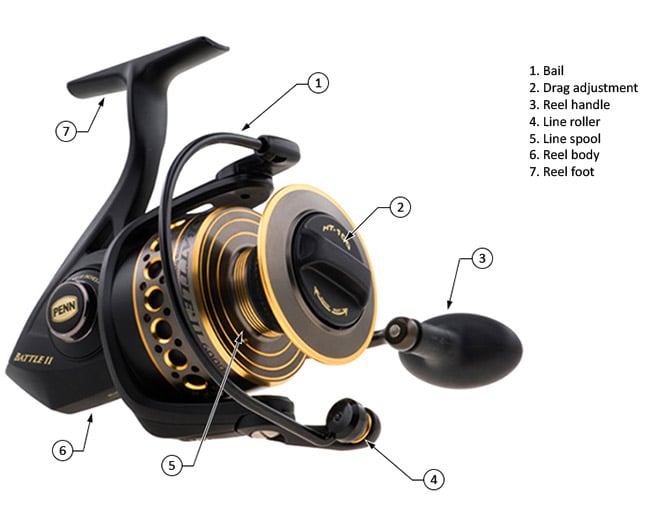
Key components of a spinning reel: spool, bail, rotor, line roller, drag knob, body, handle, and anti-reverse switch.
Gear Ratios and Line Speed
The gear ratio indicates how many times the rotor revolves for each full rotation of the handle. A 6.2:1 ratio means the rotor (and line) wraps around 6.2 times per handle turn. Higher gear ratio means faster line retrieve per crank.
Gear ratio alone does not determine line speed — spool diameter also matters. A larger spool at a lower gear ratio can collect more line per rotation than a smaller spool at a higher ratio. This is why manufacturers list both gear ratio and retrieve rate (inches of line per crank) in the reel specifications. Retrieve rate is the more directly useful number when comparing across different reel sizes and brands.
Most spinning reels fall between 4.8:1 and 6.2:1. These ratios work well for most freshwater and inshore applications. If you fish lures that need a fast retrieve — buzzbaits, certain topwaters — consider a higher-ratio spinning reel or switch to a baitcasting reel, which routinely reaches 8.1:1 and higher.
Line Capacity
Line capacity is the maximum amount of line the spool holds at a given line diameter. Heavier line takes up more spool space, so a reel rated for 160 yards of 30 lb mono might hold only 120 yards of 40 lb or 100 yards of 50 lb. Most manufacturers list capacities for both monofilament and braid.
Braided line holds significantly more capacity than mono at equivalent strength because high-performance fibers like Spectra and Dyneema achieve much higher break strength at a smaller diameter. A reel that holds 200 yards of 20 lb mono might hold 300+ yards of 20 lb braid. This is why braided line is preferred for offshore and deep-water applications where long runs and deep drops demand maximum line on the spool.
When selecting a reel, match line capacity to the expected run length of your target species and the depth you fish. For more detail, see our West Advisor on Selecting Fishing Line.
Drag Systems
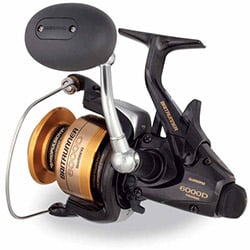
The Baitrunner from Shimano features a secondary rear drag that lets live bait swim freely with the bail closed.
The drag system controls how much force a fish must exert before the spool slips and releases line. It consists of an adjustment point and stacked washers — typically alternating metal and carbon fiber or felt — that create controlled friction against the spool. The general rule is to set drag at 20–30 percent of the line’s breaking strength to avoid a break-off while still fighting the fish. For 20 lb test, set drag between 4 and 6 pounds. Check your setting with a handheld spring scale rather than guessing.
Front drag: The most common configuration. The drag knob is on top of the spool. Front drag systems generally provide higher maximum drag than rear drag and more consistent pressure across the drag range. Preferred for most applications and for any heavy saltwater use.
Rear drag: The adjustment knob is at the back of the reel body. Easier to reach and adjust while playing a fish without disturbing your grip on the rod, which is the main practical advantage. Maximum drag is typically lower than front drag systems. More common on entry-level and mid-range reels.
Dual drag / Baitrunner style: A secondary rear drag system that allows bait to swim freely with the bail closed, applying just enough resistance to keep the bait from running the line off completely. When a fish grabs the bait, the angler flips a lever to re-engage the main front drag and sets the hook. Useful for live bait fishing where the fish needs time to fully take the bait before the hookset. The Shimano Baitrunner and Thunnus are the most recognized examples.
For saltwater use, drag smoothness and consistency under sustained pressure matter more than maximum drag rating alone. Carbon fiber drag washers provide better performance and longevity than felt under heavy loads.
Ball Bearings and Construction
Ball bearings support the rotor and handle and determine how smooth the retrieve feels. More bearings generally means smoother operation, but bearing quality matters more than quantity. A reel with six high-quality ABEC-5 bearings will outperform a cheap reel with ten low-quality bearings.
For saltwater fishing, look for bearings specifically rated as anti-rust or stainless steel shielded — this is not always the case even on reels marketed for saltwater. Standard chrome bearings will roughen within a few seasons of ocean use. Anti-reverse bearings prevent any handle backplay when the drag is engaged, resulting in a more direct feel when setting the hook.
Reel body material affects rigidity and corrosion resistance:
- Graphite/composite body: Lightweight and corrosion-proof. Less rigid under heavy loads, which can cause the rotor to flex slightly under extreme pressure and affect drag consistency. Common on freshwater and entry-level saltwater reels.
- Aluminum body and rotor: More rigid, better drag consistency under heavy loads, more durable. Heavier than graphite. Standard for mid-range and premium saltwater reels. Must be properly anodized to resist corrosion.
- Carbon fiber components: Found on premium reels. Lightweight and rigid, used for rotors, side plates, and structural components to reduce weight without sacrificing rigidity.
What You Get at Different Price Points
The difference between a $50 spinning reel and a $500 one is not marketing — it is measurable in bearing quality, drag smoothness, body rigidity, corrosion resistance, and overall service life. Here is what to expect at each tier:
- Under $75 (entry-level): Graphite body, basic drag system with felt washers, standard chrome bearings. Adequate for casual freshwater fishing and occasional use. Drag may feel notchy at low settings. Will not hold up to sustained saltwater use. Good choices: Penn Pursuit, Shimano Sienna.
- $75–$200 (mid-range): Better bearing count and quality, carbon fiber or HT-100 drag washers for smoother pressure, aluminum or composite body, improved corrosion resistance. Appropriate for serious freshwater fishing and light to moderate inshore saltwater. Good choices: Penn Battle, Daiwa BG, Shimano Sahara.
- $200–$400 (upper mid-range): Fully aluminum or carbon/aluminum body, sealed gearbox, shielded bearings, very smooth drag with high maximum drag rating, better retrieve feel. Appropriate for heavy inshore and nearshore saltwater. Good choices: Penn Spinfisher VII, Shimano Stradic, Daiwa Certate.
- $400+ (premium): The best available bearing quality, fully sealed waterproof construction, carbon fiber rotors and body components, extremely smooth drag with consistent pressure across the full range, significantly lighter weight. For serious offshore use and anglers who demand the best performance and longest service life. Good choices: Shimano Stella, Penn Torque, Daiwa Saltiga.
For casual freshwater fishing, mid-range is the sweet spot — you get meaningful quality improvements over entry-level without paying for features you will not use. For serious saltwater fishing, investing in upper mid-range or premium reels pays off in longevity and performance where it matters.
Match the Reel to the Rod
A spinning reel must be paired with a spinning rod — not a baitcasting rod. Spinning rods have guides on the underside of the blank and a reel seat designed for spinning reels. Beyond that compatibility, the reel and rod must be matched in size and power class.
Rods are rated for line test and lure weight ranges. A rod rated for 8–17 lb line and 3/8–1 oz lures pairs with a 3000–4000 size reel spooled with line in that test range. Using heavier line than the rod is rated for risks breaking the rod under a hookset or heavy fish. Using a much larger reel than the rod is designed for throws off the balance and makes the rig uncomfortable to cast all day.
When buying a reel to pair with an existing rod, match the reel size to the rod’s line rating. When starting from scratch, consider a pre-matched rod and reel combo — manufacturers design these to work together and they remove the guesswork.
Spinning rod action also differs from baitcasting rods. Spinning rods tend to be more flexible with lighter tip action, which helps cast light lures and absorbs the initial run of a fish. Baitcasting rods are stiffer with more backbone for power hooksets. Neither is universally better — choose the combination that matches your target species and fishing style.
Frequently Asked Questions
What size spinning reel do I need?
Match reel size to your target species and line weight. A 1000–2000 size handles ultralight trout and panfish fishing with 4–8 lb line. A 2500–3000 is the standard all-around freshwater and light inshore size, good for bass and redfish on 8–12 lb. A 4000–5000 covers medium inshore and light surf on 12–20 lb. Go 6000+ for heavy surf, nearshore, and offshore applications. When between sizes, go larger.
Spinning vs. baitcasting reel — which should I choose?
Spinning reels excel with light lures, finesse techniques, and beginners. Baitcasting reels offer more accuracy, higher gear ratios for fast retrieves, and better control in heavy cover. Many experienced anglers use both — spinning for finesse and lighter applications, baitcasting for power fishing. If you are just starting out, learn on spinning tackle. If you already fish spinning gear and want more precision and higher retrieve speeds, adding a baitcasting setup makes sense.
What is the best spinning reel for saltwater?
For inshore saltwater (redfish, snook, stripers), the Penn Battle III, Daiwa BG, and Shimano Stradic FL are all proven choices in the mid-range. For heavier nearshore and offshore use, the Penn Spinfisher VII, Daiwa Certate, and Shimano Saragosa offer sealed construction and higher drag ratings. For serious offshore spinning, the Penn Torque, Daiwa Saltiga, and Shimano Stella SW are the benchmark reels. All of these are available at West Marine from brands including Penn, Shimano, Daiwa, and Okuma.
How do I set the drag on a spinning reel?
Set drag at 20–30 percent of your line’s breaking strength. For 20 lb test, that is 4–6 pounds of drag. Use a handheld spring scale to measure: tie the line to the scale, pull steadily, and adjust the drag knob until the scale reads your target. Do not rely on feel alone — drag that feels right in your hand is often too tight when a large fish is running. A drag that slips at the right threshold protects the line and tires the fish more effectively than a locked-down drag.
How do I prevent line twist on a spinning reel?
Line twist is common on spinning reels and mostly preventable: close the bail manually with your hand rather than by turning the handle; stop the line with your finger when the lure hits the water rather than letting the bail close under tension; use a swivel between the line and lures that rotate during retrieve; and replace line that has developed a strong memory from sitting on the spool. If line twist develops mid-session, let the line trail in the current or water while the boat moves slowly — the current will spin out the twist.
Related: