By Danielle Buenrostro
Stand-up paddleboarding continues to grow as a popular way for beginners and experienced paddlers alike to enjoy getting on the water. If you’re looking to join the fun and don’t know where to start, we’ll help you understand your SUP options and guide you to the right board.
Experience Level and Paddler Size
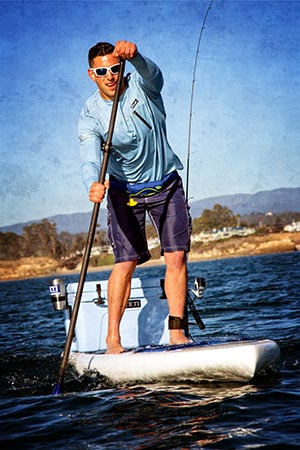
Touring SUPs are designed to hold plenty of gear for day-long fishing or cruising excursions.
Beginners have lots of user-friendly design options to get started. The most important choice is to find a board that is wide and stable until you’ve mastered the balancing act. Larger first-time paddlers will want to find a board compatible with their weight capacity that has more volume.
The longer, thicker, and wider a board is, the more volume it has. Greater volume provides more flotation and stability. However, as a general rule, the wider a board, the less maneuverable it will be. Smaller and lighter riders will appreciate a more compact board within their weight capacity — easier to carry but still stable.
Experienced paddlers can handle a narrower, more responsive board. There are also specialized boards for wave riding, racing, and touring, discussed below.
A general sizing guide by paddler weight:
| Paddler Weight | Recommended Volume | Suggested Board Width |
|---|---|---|
| Under 150 lbs | 150–200L | 29–31” |
| 150–200 lbs | 200–240L | 31–33” |
| 200–250 lbs | 240–280L | 32–34” |
| Over 250 lbs | 280L+ | 34”+ |
Volume in liters is the most reliable sizing metric. A board with higher volume than your weight minimum will be more stable; lower volume boards are faster but less forgiving. Always stay within the board’s stated maximum weight capacity.
Paddling Activity
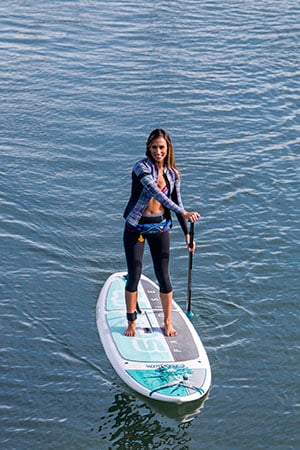
All-around SUPs offer greater stability and buoyancy for a smooth, comfortable ride in a variety of conditions.
The type of paddling activity you enjoy will determine which board is right for you.
Cruising / All-Around: The most versatile option. Also known as hybrid boards, all-around SUPs are generally thicker, wider, and longer, offering the most stability while cruising on flatwater and calm inland waters with the ability to handle some chop. Cruising boards have moderate rocker — the upward curve from nose to tail — which enables easier turning. These are the best starting point for beginners.
Touring: For long-distance paddling sessions. Touring boards are long and narrow for efficient paddling with more of a displacement (V-hull) shape and better tracking. They go faster than all-around boards but are less stable and require more experience to handle comfortably. Also the best choice for multi-hour fishing or camping excursions where you’re covering real distance.
Racing: Similar to touring boards but narrower still, built for advanced paddlers who prioritize speed over stability. Not recommended for beginners.
Wave Riding: Surf-style boards are shorter and narrower at the tail and nose, with elevated rocker to help cut waves. They are less stable on flat water but highly maneuverable in surf. Prior surfing experience is a genuine advantage here.
SUP Yoga: Wide and stable platform with a full-coverage nonskid deck pad. Some models include anchor compatibility to keep you stationary during practice. Width is the primary consideration — 33” or wider is generally recommended for yoga-focused use.
SUP Fishing: Boards made with multiple rod holder mounts, attachment points for gear bags and coolers, added weight capacity, and extra volume for gear. The extra width required for fishing stability is a meaningful design difference from general-purpose boards. Look for a board that includes or accommodates a kayak-style anchor system to stay on a productive spot.
Prone Paddling: Paddling while lying on your stomach or kneeling — used in racing competitions and cross-training without standing. Any stable board works, though some prone paddlers prefer a slightly narrower profile for efficiency.
Board Types
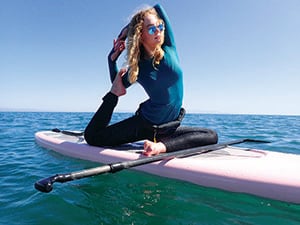
Wide and stable SUPs offer a great platform for practicing yoga on the water.
Rigid (Hard) Boards: The exterior of rigid boards consists of either a fiberglass/polyester or a premium fiberglass/epoxy resin matrix. The fiberglass/epoxy construction is more durable, lighter, and more responsive, and costs more. Premium boards may also include wood inlays for aesthetics and stiffness. Hard boards provide the best overall performance in terms of glide, speed, and responsiveness but require a vehicle rack or storage space proportional to their length (typically 9–12 feet).
Inflatable Boards: Ideal for paddlers with limited storage space or who need to travel with their board. Constructed with drop-stitch PVC technology — the same materials used in high-pressure inflatable boats — quality inflatables inflate to 12–15 PSI and offer performance that approaches rigid boards when properly inflated. They roll up to fit in a backpack and are virtually indestructible for everyday use. The trade-off is setup time (10–15 minutes with a hand pump, or 2–3 minutes with an electric pump) and slightly less responsiveness than a same-priced rigid board.
Soft-Top Boards: Made of a dense foam core with a softer foam layer on top and a hard plastic bottom. Less expensive and a great choice for entry-level paddlers, kids, and anyone prioritizing durability and forgiveness over performance. Soft-tops are also safer around other swimmers due to the soft deck surface. Serious paddlers may want to consider upgrading once they outgrow a soft-top.
Accessories and Packages
Some boards are offered in packages that include a paddle, leash, fins, and/or board bag. Packages are great for beginners who need everything to get started.
Fins: Fins provide directional stability and tracking. Most boards use one of three configurations: a single large center fin (most common on all-around and touring boards), a thruster setup with three smaller fins (common on surf-style boards for maneuverability), or a 2+1 setup with a large center fin and two smaller side fins (a versatile middle ground). Many boards use a tool-free fin box system that allows quick swaps.
Leash: A SUP leash is a safety essential, not an accessory. A coiled ankle leash connects you to your board so that if you fall off, the board — your primary floatation device — stays with you. In open water, wind, or current, an unattached board can drift faster than you can swim. Always wear your leash. Coiled leashes are preferred for flatwater use; straight leashes are standard for surf to avoid tangling on waves.
Paddle: The correct paddle length is approximately your height plus 8–12 inches for flatwater cruising. A three-piece adjustable paddle is the most versatile option and fits multiple paddlers. Carbon fiber paddles are lighter and more efficient for serious or frequent paddlers; aluminum and fiberglass paddles are less expensive and more durable for everyday recreational use.
Read our guide to Selecting a SUP Paddle for a full breakdown. When you’re ready to get on the water, check out our Beginner’s Guide to Stand-Up Paddleboarding.
Frequently Asked Questions
What size SUP do I need?
Volume in liters is the best sizing metric. As a starting point: paddlers under 150 lbs. should look for 150–200L; 150–200 lbs. needs 200–240L; 200–250 lbs. needs 240–280L; over 250 lbs. needs 280L or more. Stay within the board’s stated maximum weight capacity. For beginners, choose a board with more volume than your minimum — the extra stability is worth more than the slight reduction in speed. Width matters as much as volume: beginners generally do best on boards 31–33” wide or wider.
Should I buy a hard board or an inflatable?
If you have vehicle rack access and storage space, a hard board will give you better performance per dollar at any price point — more glide, faster, more responsive. If you live in an apartment, travel frequently, or want one board that goes everywhere (including on planes and backpacking trips), an inflatable is the better choice. Quality inflatables from established brands inflated to the correct PSI perform well enough that most recreational paddlers won’t notice a meaningful difference from a rigid board. Avoid very inexpensive inflatables that can’t hold high pressure — an underinflated SUP is slow, unstable, and will buckle under load.
How long does it take to learn to stand-up paddleboard?
Most people can stand and paddle in flatwater conditions within 15–30 minutes on their first session. Staying upright in chop, learning efficient paddle technique, and developing the balance to handle uneven conditions takes longer — typically a few sessions over several weeks. Starting on calm, protected water and choosing a wide, stable board accelerates the learning curve significantly. Falls are a normal part of learning and the main reason to always wear your leash in open water.
Do I need a leash for SUP?
Yes, every time on open water. A leash keeps the board — your primary flotation device — attached to you if you fall. Wind and current can push an unattached board faster than most people can swim. Use a coiled leash for flatwater and a straight leash for surf. Attach at the ankle for flatwater; consider a waist or calf attachment for river SUP to avoid entanglement hazards in current.