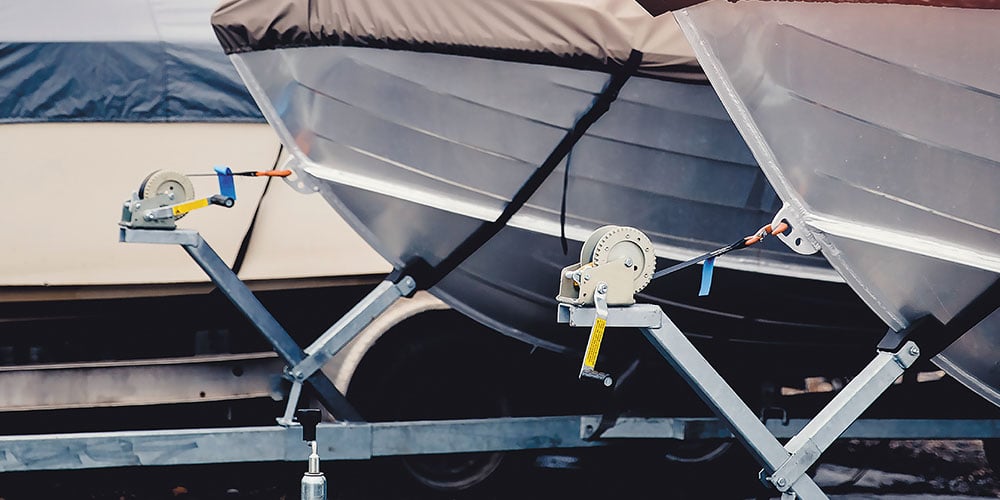
Trailer winches let you pull your boat onto the trailer while it’s on an inclined launching ramp. Winches are mounted on a dedicated winch stand on the trailer tongue, on the support for the bow stop, or on the trailer’s hitch ball using an adapter plate. A reel or spool holds 20–50 feet of cable, rope, or webbing with a snap at the bitter end. With the snap clipped onto the bow eye of the boat, the winch operator can crank the boat onto the trailer or allow it to slide backwards into the water at a controlled rate. Here’s what to consider when choosing a winch.
- Manual Trailer Winches
- Your Boat’s Environment
- Winch Weight Capacities
- Single-Speed or Two-Speed Winches
- Winch Straps and Lines
- Trailer Winch Safety Tips
- FAQs
Manual Trailer Winches
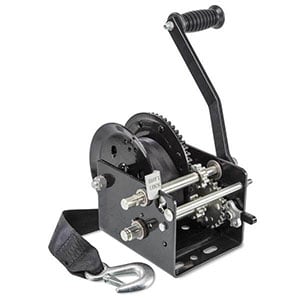
West Marine’s 2600 lb. Two-Speed Manual Trailer Winch with Strap.
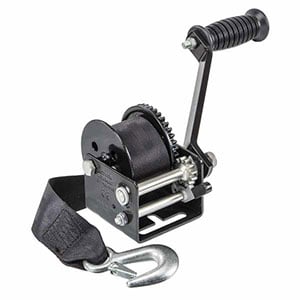
West Marine’s 900 lb. Manual Trailer Winch with Strap.
Hand-cranked manual winches multiply your strength, allowing you to pull a relatively heavy boat against gravity and friction. A ratchet holds the boat at any point on the trailer so it doesn’t slide back into the water. With a crank about a foot long and simple gearing, a normal person can retrieve a boat weighing well over a ton. Larger models have a lower gear ratio for greater mechanical advantage and two speeds for heavy-duty work.
Your Boat’s Environment
Consider whether you use your boat in freshwater or saltwater. Winches are available with galvanized, zinc-plated, powder-coated, or aluminum construction. For saltwater use, check the manufacturer’s corrosion rating — not all winches are equally resistant to marine environments. A winch that holds up in freshwater may fail quickly in regular saltwater exposure. Choose the most corrosion-resistant construction your budget allows for any saltwater application.
Winch Weight Capacities
Winches are rated by weight capacity, not by boat length. Choose a winch to match the combined weight of your boat, motor, fuel, and gear.
The general rule: select a winch rated for at least 3/4 of the combined loaded weight of your boat and trailer. This ratio varies depending on your launch conditions:
- Steep ramps or carpeted wood bunks: Winch load is higher. Select a winch rated closer to the full loaded weight of the boat.
- Gently sloped ramps or roller trailers: Less resistance means you can choose a smaller-capacity winch. However, since the price difference between winch sizes is modest, upsizing is generally worth it.
Anti-friction pads on the trailer’s bunks (Glyde Sliks, EZ Slides, or similar) reduce resistance and help your boat slide smoothly. Most trailers use a standard winch assembly bolt pattern, so upgrading to a stronger winch is a straightforward swap if the current winch proves inadequate.
Single-Speed or Two-Speed Winch
For lighter boats — dinghies, inflatables, and catamarans — a single-speed manual winch with a 3:1, 4:1, or 5:1 gear ratio is typically sufficient. A 5:1 ratio means you turn the handle five times for each rotation of the drum, providing meaningful mechanical advantage at an economical price.
For heavier boats, two-speed winches provide both fast retrieval and high-power capability. Fulton’s F2 Manual Winches, for example, offer a fast 5:1 first speed for quick pull-in and a second low speed at 16.2:1 for maximum mechanical advantage when the boat is stuck on bunks or the ramp is steep.
Winch Straps and Lines
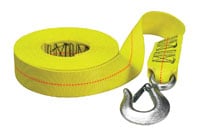
Polyester winch straps like this one from Boat Buckle (rated to 5,500 lb.) won’t scrape your boat’s bow and are gentle on hands.
Trailer winch lines come in three main types, each with different characteristics:
- Wire cable: The traditional choice. Very strong and durable but can develop sharp broken strands that cut hands. Must be lubricated regularly with wire rope lubricant to reduce strand friction and extend life. Inspect for kinks, fraying, and rust before each use.
- Polypropylene rope: Common on smaller, lower-capacity winches. Lightweight and inexpensive, but UV and abrasion resistance is limited. Not recommended for heavy saltwater use.
- Polyester webbing strap: The best all-around choice for most recreational applications. Flat straps won’t scrape the bow of your boat, won’t injure hands if they let go, and handle well in both fresh and saltwater. Boat Buckle polyester straps are rated for up to 5,500 pounds and are a popular upgrade from wire cable on most winch sizes.
Regardless of line type, inspect the winch line before every use and replace it at the first sign of fraying, wear, or corrosion. A winch line failure at the ramp is a frustrating inconvenience; a failure while the boat is in motion on a ramp can be dangerous.
Trailer Winch Safety Tips
- Winches are not tiedowns. Use dedicated bow, gunwale, and stern tiedowns to secure your boat on the trailer for transport. For large boats, add a safety chain to the bow eye. The winch holds the boat during loading — it is not rated as a transport tie-down.
- Maintain secure footing. Slips and falls by winch operators and injuries from winch handles that kick back are among the most common boat ramp accidents. Use non-skid footwear and position yourself with solid footing before cranking.
- Inspect and replace worn winch lines. If frayed or worn spots appear on cable, rope, or strap, replace the line immediately with one of the correct type, size, and strength for your winch. Wire cable life can be extended by frequent lubrication with wire rope lubricant, which reduces strand friction and the development of snags and frays.
- Never stand in the path of the winch line. If a line under tension parts, it releases significant stored energy. Keep crew clear of the line’s path during retrieval.
Frequently Asked Questions
What size trailer winch do I need for my boat?
Select a winch rated for at least 3/4 of the combined loaded weight of your boat, motor, fuel, and gear. For a boat with a loaded weight of 3,000 pounds, choose a winch rated for at least 2,250 pounds. If you launch on steep ramps or have carpeted bunk trailers (which create more friction), size up toward the full loaded weight. The price difference between winch capacity ratings is modest, so err on the side of more capacity.
What is the difference between a single-speed and two-speed trailer winch?
A single-speed winch has one fixed gear ratio — adequate for lighter boats and easy launching conditions. A two-speed winch has a fast first speed (typically 5:1) for quick retrieval when the load is light, and a low second speed (often 16:1 or higher) for maximum mechanical advantage when the boat is heavy or stuck on bunks. For most boats over 1,500 pounds, a two-speed winch is worth the modest price premium.
Should I use wire cable or a strap on my trailer winch?
For most recreational applications, a polyester webbing strap is the better choice. Straps won’t develop sharp broken strands like wire cable, are gentler on the boat’s bow and on hands, require less maintenance, and are available in high weight ratings. Wire cable is more durable under abrasion but requires regular lubrication and careful inspection for fraying. If your winch currently uses wire cable, upgrading to a polyester strap is a worthwhile improvement for most boaters.
Can I use my trailer winch as a tiedown for trailering?
No. Trailer winches are designed for loading and launching, not for securing the boat during highway transport. Always use dedicated bow, stern, and gunwale straps or chains for transport tiedowns. For large or heavy boats, add a safety chain from the bow eye to the trailer tongue as additional backup. The winch is supplemental during transport, not a primary tiedown.