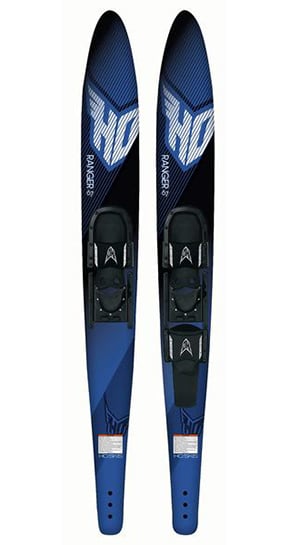
The Ranger Ski Combo is HO’s most popular and easiest-to-use combo ski. These 67” skis accommodate riders from 120–220 lb. The horseshoe bindings are easy to adjust and fit men’s foot sizes from 5–14.
If you’re new to water skiing or getting back into the sport, choosing water skis can be challenging given the wide selection and technologies available. Thirty years ago, skis were mostly varnished ash or other hardwood, bindings were simple molded straps, and concave skis were considered exotic. Today’s skis are frequently made of carbon fiber wrapped over a high-density foam core, with a variety of precise shapes, sizes, and binding choices. Here is what to look for.
Ski Types and Uses
Slalom Skis are sold as a single ski with two bindings, one behind the other. The shape is widest under the forward binding, while the rear part of the ski (the “tail”) is narrow. The narrow tail allows stronger skiers to decelerate rapidly when coming into a turn, making it ideal for skiers who want a quick-turning ski for recreation or slalom course work.
Shaped Skis (also called mid-skis) are similar to slalom skis in that they are a single ski with two bindings, but they are significantly wider for easier starts and a more stable ride. Sidecuts — a narrowing of the ski near the bindings — allow easier turns on the wider platform. This makes them well-suited for less experienced riders, those learning single-ski techniques, or skiers who want a less tiring ride. Shaped skis also work at slower speeds and are an excellent teaching tool for deep water starts and slalom course techniques.
Combo Skis are sold as a pair, with one ski set up with two bindings and the other with a single binding. Combos are well-suited for families and general use: beginners can use both skis for easier starts and more stability, while more advanced skiers can start on one ski or drop one after getting up on two. They generally have adjustable bindings to fit a variety of skiers and are available in both narrower slalom-style and wider shaped-ski widths.
Youth or Junior Skis are shorter for smaller, lighter riders. Entry-level youth skis include a removable retainer — a rope or bar — between the two skis, with the towrope connected to this retainer. An adult onboard holds the free end of the rope, ready for instant release. This system prevents a child from being dragged underwater during starts or falls, keeps the skis the correct distance apart, and builds confidence toward mastering traditional skiing techniques.
Bindings hold the foot to the top of the ski. They are generally made from soft neoprene shaped to wrap snugly around the foot. By twisting the foot or shifting weight from one side to the other, the skier controls the direction of the skis.
Fins extend down under the tail of the ski to keep it from sliding sideways during turns and to maintain tracking when skiing straight.
Ski Sizing
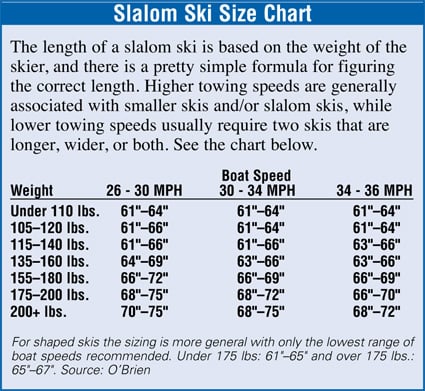
Ski length is determined by skier weight, preferred skiing speed, and ski type. Shaped skis, due to their increased width, run approximately 4” shorter than slalom skis for equivalent riders. Recreational skiers will find that ski length is far less critical than it is for slalom skiers.
A useful starting rule: a 160 lb. skier generally uses a 66” ski. For every 20 lb. difference in skier weight, add or subtract 2” of ski length. Speed also factors in — faster speeds generate more lift, so skiers who prefer higher speeds can often use a slightly shorter ski than their weight alone would suggest. Slower speeds or larger body weights favor a longer ski for additional flotation and stability during starts.
When in doubt between two sizes, the longer ski is typically the more forgiving choice for recreational skiers. The shorter ski rewards more aggressive technique but is less stable at lower speeds or for skiers still developing their technique.
Tow Speed
Tow speed affects ski performance significantly. Too slow and the ski won’t plane properly; too fast and the skier loses control and tires quickly. General starting guidelines:
- Children and beginners (combo skis): 14–20 mph
- Recreational skiers (combo or shaped skis): 20–26 mph
- Intermediate slalom skiers: 26–30 mph
- Advanced slalom skiers: 30–36 mph
Heavier skiers and those using longer skis generally perform better at the higher end of their range. These are starting points — adjust based on the skier’s comfort, ability, and the ski manufacturer’s recommendations. In competition, boat speed and rope length are standardized; recreational skiers should simply find the speed that makes the ride comfortable and controlled.
Construction
There are two common manufacturing methods for water skis. In both, the process begins by injecting high-density polyurethane foam into a heated mold to form the ski core. The core is then wrapped with fiberglass, carbon/graphite, or a combination, and saturated with epoxy resin. Top and bottom surface layers — typically PBT or Acrylam — are added for aesthetics and durability.
Rim molding is the more economical process. It results in a ski with more liberal tolerances for flex and durability, and is the common method for manufacturing combo skis and entry-level product.
Compression molding applies heat and pressure in a controlled press, allowing specific flex characteristics to be built into different areas of the ski. This produces better durability and more precise performance characteristics and is the standard method for performance-oriented slalom skis.
Within either method, material choices determine the performance and price of the ski. Carbon/graphite is stronger, lighter, and more expensive than fiberglass mat, and is found in higher-end skis. PBT top surfaces (also called ABS by some manufacturers) produce brighter, more colorful graphics and resist scratches and dents better than other materials.
Shape



Narrow tunnel bottoms are designed for directional stability. They handle rough water well and are easier to manage on wake crossings. The flat spots on the edges give the ski a forgiving ride that suits recreational skiers and those in varied water conditions.
Edge-to-edge concave bottoms are the standard for performance slalom skis. These skis are designed to perform when on edge — the harder you turn, the better they respond. They reward aggressive technique but are less forgiving than tunnel-bottom skis in rough water.
Beveled edges on the sides of skis control stability and turn behavior. A square, sharp edge makes the ski stable and predictable. A round or soft edge allows the ski to sit deeper in the water during turns, providing more progressive control through the arc.
Rocker
Rocker is the amount of curvature from tip to tail along the ski’s length.
- More rocker makes a ski turn easily but increases drag and reduces top speed.
- Less rocker makes a ski faster and more directionally stable.
- Most skis combine rocker and flat sections to create a ski that turns easily and accelerates efficiently.
Flex
- Stiffness makes a ski fast and stable, suited to aggressive skiers who can generate their own turning force.
- Flexibility makes a ski easier to initiate turns, suited to recreational skiers and those still developing technique.
- Most performance skis combine these characteristics: a stiff forebody for acceleration and a softer tail for turning responsiveness.
Binding Selection
There are a few key decisions when selecting bindings separately from a ski, or when choosing a ski with bindings already installed.
Shared or personal use? If the ski will be shared among multiple riders, adjustable bindings are essential. Adjustable bindings accommodate a wide range of foot sizes and are standard on combo skis and boat-gear skis used by different family members or guests. If the ski is a personal ski for one rider, a tighter, more form-fitting boot-style binding provides better control and direct power transfer at the cost of flexibility in sizing.
How tight should the bindings be? This depends on skill level and intent.
- Beginners and recreational skiers should use bindings loose enough to exit during a fall. A binding that releases easily prevents injuries and builds confidence. Horseshoe-style and open-toe bindings are ideal for this use.
- Intermediate skiers can use a medium-fit binding that provides good feedback and control while still releasing in a hard fall.
- Expert and competition skiers generally prefer very tight, boot-style bindings that transfer weight and pressure directly to the ski without any flex in the connection. This precision comes with the trade-off that deep water starts may require both feet to be inserted before entry, and the binding may require effort to put on. The tighter connection enables the subtle weight shifts that produce precise turns at speed.
Frequently Asked Questions
What type of water ski is best for a beginner?
Combo skis are the best starting point for most beginners. Using both skis provides more stability and makes it significantly easier to get up out of the water. The adjustable bindings on most combo sets accommodate different family members and guests. Once a beginner is comfortable getting up and maintaining balance, they can progress to dropping one ski or transitioning to a shaped ski for single-ski practice.
How do I know what size water ski I need?
Start with the weight-based rule: a 160 lb. skier generally uses a 66” ski, adding or subtracting 2” for every 20 lb. difference in weight. Factor in skiing speed — faster speeds generate more lift and allow a slightly shorter ski. Shaped skis run about 4” shorter than slalom skis for the same skier. When between sizes, choose the longer ski for more stability and an easier time getting up; choose the shorter ski if you want more agility and are willing to sacrifice some stability.
What tow speed should I use for water skiing?
Start at the low end of the range for the skier’s ability level and adjust for comfort. Children and beginners on combo skis typically start at 14–20 mph. Recreational adult skiers on combo or shaped skis are comfortable at 20–26 mph. Intermediate slalom skiers generally prefer 26–30 mph, while advanced skiers may ski at 30–36 mph. Heavier skiers and those who prefer longer skis do better at the higher end of their range.
What is the difference between a slalom ski and a shaped ski?
Both are single skis with two bindings, but shaped skis are significantly wider. The extra width makes shaped skis more stable, easier to get up on, and usable at slower speeds — advantages for developing skiers. Slalom skis are narrower with a tapered tail, designed for quick, precise turns and higher speeds. The sidecut on a shaped ski allows it to turn despite its width, but it will not feel as quick or responsive as a dedicated slalom ski at speed.
Should I get adjustable or fixed bindings?
If the ski will be used by multiple people with different foot sizes, adjustable bindings are essential. If it is a dedicated personal ski for one rider, fixed boot-style bindings provide better control and more direct power transfer. For beginners of any age, bindings that exit easily during a fall are safer and build confidence faster than tight boot-style bindings.