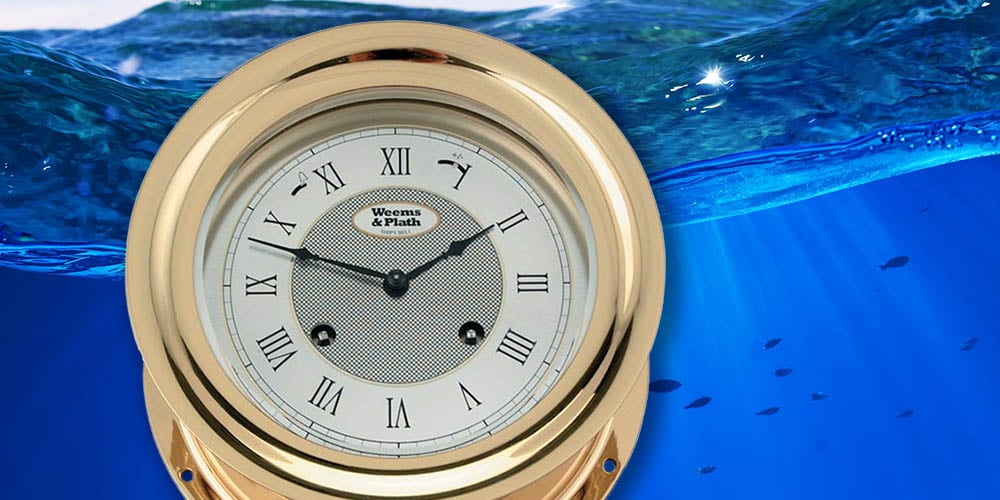
The Atlantis 8-Day Wind Ship’s Bell Clock can be mounted to a bulkhead or displayed on a desk or mantel with the optional Mahogany Base.
By Tom Burden, West Marine Technical Editor
Ship’s bell striking clocks keep time in the traditional maritime watch system that structured life at sea for centuries. If you own a ship’s bell clock — or are considering one — understanding what the bells mean gives the clock its full meaning. The following explanation of the watch system and bell count is drawn from Chapman’s Piloting, Seamanship and Small Boat Handling, the standard reference for recreational mariners.
How Ship’s Bell Time Works
Ship’s bell time originated in sailing ship days when the crew of a vessel was divided into Port and Starboard Watches, each on duty four hours, then off four hours. One stroke of the ship’s bell indicates the first half hour of the watch. An additional bell is struck for each succeeding half-hour interval. Eight bells indicates the end of a four-hour watch. When the time calls for two or more strokes, they are sounded in groups of two, making the count easy to follow even on a noisy deck.
Because the same bell count recurs three times daily — once for each four-hour watch period — the strikes alone do not tell you which watch is running. Crew members knew the time from context and routine. The bell’s purpose was not to display time as a clock face does, but to signal half-hour intervals and the end of a watch so the crew could be relieved promptly.
The Watch Schedule
The first five watches divide the 24-hour day into four-hour periods:
- First Watch, 8pm to Midnight (20:00 to 00:00 hours)
- Middle Watch, Midnight to 4am (00:00 to 04:00 hours)
- Morning Watch, 4am to 8am (04:00 to 08:00 hours)
- Forenoon Watch, 8am to Noon (08:00 to 12:00 hours)
- Afternoon Watch, Noon to 4pm (12:00 to 16:00 hours)
The next four hours are divided into two Dog Watches — the First Dog Watch, 4pm to 6pm (16:00 to 18:00 hours), and the Second Dog Watch, 6pm to 8pm (18:00 to 20:00 hours). By splitting the afternoon into two short watches rather than one full four-hour watch, the total number of watches in a day becomes odd rather than even. This means the watch schedule automatically shifts each day, so the same crew members do not stand the same watches every night. Without the Dog Watches, each sailor would always be on duty at the same time — including always standing the middle-of-the-night watch or always sleeping through the day. The Dog Watches ensure fair rotation so that over time every crew member shares both the desirable and the undesirable watches equally.
Ship’s Bell Time Reference Table
| Number of Bells | Bell Pattern | Hour (am and pm) |
|---|---|---|
| One bell | o | 12:30, 4:30, 8:30 |
| Two bells | oo | 1:00, 5:00, 9:00 |
| Three bells | oo o | 1:30, 5:30, 9:30 |
| Four bells | oo oo | 2:00, 6:00, 10:00 |
| Five bells | oo oo o | 2:30, 6:30, 10:30 |
| Six bells | oo oo oo | 3:00, 7:00, 11:00 |
| Seven bells | oo oo oo o | 3:30, 7:30, 11:30 |
| Eight bells | oo oo oo oo | 4:00, 8:00, 12:00 |
Ship’s Bells as Required Safety Equipment
Beyond their traditional timekeeping role, ship’s bells serve as required sound-signaling devices under the U.S. Coast Guard’s Navigation Rules. Vessels over 20 meters (65.6 feet) in length are required to carry a bell capable of producing a prescribed sound level for use in restricted visibility conditions. In fog, a vessel at anchor is required to ring the bell rapidly for about five seconds at intervals of not more than one minute. Vessels under 20 meters are not required to carry a bell but must have some means of making an efficient sound signal. If your boat falls in that size range, a ship’s bell is a practical, traditional, and seamanlike choice for your fog-signaling equipment.
Ship’s Bell Time FAQs
Why are there two Dog Watches in the ship’s bell system?
The two Dog Watches — 4pm to 6pm and 6pm to 8pm — split what would otherwise be a single four-hour afternoon watch into two shorter periods. This makes the total number of watches in a 24-hour day an odd number (seven), which causes the watch schedule to rotate automatically each day. Without this rotation, the same crew members would stand the same watches every day — including the exhausting middle-of-the-night watch — for the duration of the voyage. The Dog Watches ensure fair sharing of all duty periods, including the desirable and the undesirable ones, over the course of a long passage.
Is the ship’s bell system still used today?
On most modern commercial vessels, electronic timekeeping and radio watch schedules have replaced the ship’s bell as the primary timekeeping method. However, some naval vessels, tall ships, and traditional sailing craft still observe the bell watch system as an active practice, not just a tradition. The USCG Navigation Rules still require a bell aboard vessels over 65.6 feet as a required fog-signaling device. For recreational boaters, ship’s bell striking clocks remain a popular nautical instrument that connects owners to maritime history while also functioning as a practical timepiece.
What is the significance of eight bells in maritime tradition?
Eight bells signals the end of a four-hour watch — the moment when one crew shifts off duty and the relieving watch comes on. Eight bells is the maximum, because no watch lasts longer than four hours and each half-hour is marked by one additional bell. In naval tradition, eight bells has also taken on symbolic significance beyond timekeeping: at a sailor’s funeral or memorial service, “eight bells” is sounded to mark the end of their final watch — a farewell rooted in centuries of seafaring custom.
Why do ship’s bells strike in groups of two?
Striking in pairs makes the count easier to follow in noisy conditions — on a working deck with wind, waves, and machinery noise, a single continuous series of strikes is difficult to count accurately. Two distinct strokes, a brief pause, then two more strokes allows the listener to count pairs and determine the total quickly. This was a practical decision made for the environment in which the system operated: the open sea, where conditions are rarely quiet.
How did the ship’s bell system affect the crew’s daily life?
The bell system imposed a regular structure on every aspect of shipboard life — meals, sleep, duties, and rest all organized around the half-hour bell intervals and the four-hour watch cycle. On a long passage far from any port, days and weeks can blur together without external reference points. The watch system and its bells gave each day a consistent rhythm that helped crews maintain discipline, manage fatigue, and distribute both the workload and the rest time fairly across all hands. For officers, the bell also provided an auditable record — the log entry for each watch was timestamped against the bell count, giving the ship’s master a reliable record of events at sea.
