When geese begin winging their way south, boaters in the far north — places like Chicago, Milwaukee and Duluth — turn to the task of removing their boats from the water and laying them up for winter. This is the unavoidable consequence of keeping a boat where ice can develop to over three feet thick. In more temperate climates where snow and ice are less of an issue, storing a boat in or out of the water becomes an open question.
The right storage choice depends on climate, boat type, hull material, budget, access needs, storm exposure and how thoroughly the boat is winterized. Dry storage can reduce sinking risk and give the hull a chance to dry, but boats stored ashore may be more vulnerable to sudden freezes. Wet storage can make spring access easier, but it requires dependable bilge pumps, dock lines, chafe protection, bottom paint and monitoring. This guide explains the major winter boat storage options and the tradeoffs behind each one.
- Wet vs. Dry Storage
- Dry Stacking
- Boat Lifts
- Custom Cradles
- Boat Stands
- Shrink Wrap
- Boat Covers
- Tarps
- Boat Storage FAQ
Wet vs. Dry Storage
When considering wet versus dry storage, start by penciling out the costs in financial terms. How much does it cost to keep your boat in the water all year long versus six months “in” and six months “out”? In addition to dockage or storage charges, factor in haulout fees, blocking, winterization, bottom paint timing, cover or shrink wrap cost, storm exposure, access for maintenance and insurance requirements.
Wintering “on the hard” may make financial sense in the long run. Fiberglass boats stored on land have a chance to dry out, and for this reason develop fewer osmotic blisters due to water getting into the fiberglass laminate compared to boats stored in the water. Osmotic blisters form when water migrates through the gelcoat and into the fiberglass laminate, where it reacts with soluble materials in the laminate to form acidic solution pockets that push outward against the hull surface. Blister repairs require extensive grinding, drying, and barrier coat application and can cost thousands of dollars on a mid-sized boat — storing the hull out of the water for the winter months reduces the cumulative exposure time that allows blistering to develop.
Although wet storing your boat might give you an early start on boating in the spring, if your boat’s bottom needs painting, consider dry storage. Many of today’s bottom paints, such as copolymer ablative paints, do not oxidize in air, so you can paint in the fall and be ready to splash in the spring without a second haul.
Dry-stored boats don’t sink. A boat stored on land is not dependent on a bilge pump, shore power, batteries or dock-line adjustment to stay afloat. That alone makes dry storage attractive for owners who cannot check the boat frequently. Dry storage also makes it easier to inspect through-hulls, transducers, running gear, zincs, trim tabs, outdrives and hull damage before spring launch — with the boat on stands, every inch of the underwater hull is accessible without diving gear or a diver.
Dry storage is not risk-free. As BoatUS has noted in regard to insurance claims:
“The vast majority of claims in temperate states involved boats that were being stored ashore. Since water retains heat longer than air, boats surrounded by air are more vulnerable to a sudden freeze than boats surrounded by water. Even a brief cold spell that lasts only a night or two can do considerable damage. In temperate states, boaters must winterize engines and freshwater systems especially when boats are stored ashore. In deep freeze states, boats stored ashore must be winterized earlier than boats stored in the water.”
The bottom line is that if any chance of freeze damage exists, you need to either winterize your boat or implement measures to prevent damage should a freeze occur. Engines, freshwater systems, heads, washdowns, livewells, pumps, strainers and air-conditioning systems can all hold water. For advice on how to protect engine, electrical, interior and plumbing systems against winter, visit our boat winterization page. With the right preparation, you’ll save time, money and hassles when you recommission in spring.
Dry Stacking

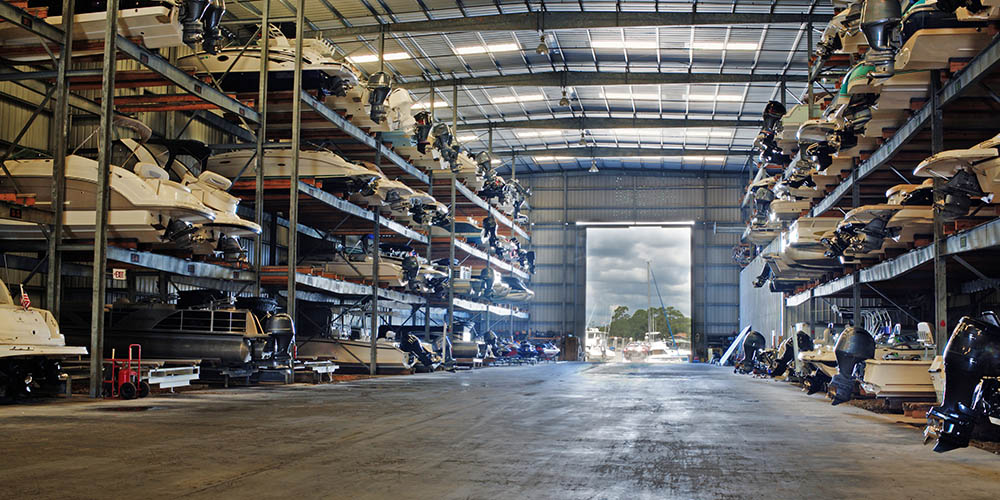
Dry Stack Facility. (Photo courtesy Garrett’s Marina, Bowlers Wharf, VA.)
Rack storage, commonly referred to as dry stacking, has become an increasingly popular way to dry store powerboats during winter layup and during the boating season. Originally conceived in the 1950s as a way to store lightweight powerboats, dry stacking has evolved into a sophisticated industry with facilities able to store much larger boats than early rack systems could handle.
Rack storage facilities include movable freestanding racks that can be repositioned within a marina, sheds (typically three-sided buildings with a roof), and steel dry-stack buildings often referred to as “barns.” Due to their structural strength and wind resistance, dry stack barns are the best choice for boats stored in hurricane-prone areas — an enclosed steel structure provides dramatically better protection than an open yard or even a simple shed when a major storm passes through.
Dry stacking works best for powerboats that fit the facility’s length, beam, height and weight limits. It keeps the hull out of the water, reduces bottom growth, eliminates dock-line chafe and can make routine use convenient when the marina offers launch-on-demand service. It may not be the right choice if you want unrestricted after-hours access, need to work on the boat frequently, or own a sailboat or unusually shaped hull that the facility cannot rack safely.
Many rack storage facilities offer services such as boat washdowns, winterization and shrink wrapping at the end of the year. Make sure you know up front what all these services cost. Ask how far in advance launches must be scheduled, whether there are blackout periods, how storm preparation is handled, whether batteries can remain on charge, and what their policy is toward do-it-yourselfers. Does the facility provide an area where you can perform routine maintenance on your boat between launch requests?
Boat Lifts
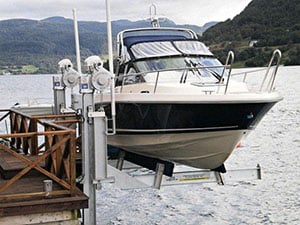
Boat Lift (Photo courtesy Golden Boat Lifts, North Fort Myers, FL)
Boat lifts offer the ability to store your boat high and dry yet ready for use in minutes. They are especially useful for owners who keep a boat at home or at a private dock and want to reduce bottom growth while still having quick access. A properly sized lift can also reduce the need for frequent bottom cleaning and may extend the life of bottom paint by keeping the hull out of the water between uses.
However, lifts do not fare well in hurricanes and strong nor’easters. Wind, waves, and surge can shift the boat on the lift, and torrential rains or heavy snow can increase the boat’s weight to the point of overloading the lift structure. One way to reduce this risk is to keep your boat on a trailer when a major storm is forecast rather than leaving it on the lift. If you do store your boat on a lift, make sure the lift is well maintained, rated for your boat’s weight with a reasonable safety margin, and that the boat is covered to keep rain and snow accumulation from adding unexpected load.
Because boats stored on lifts are surrounded by air rather than water, they are more vulnerable to a sudden freeze than boats left in the water. You will either need to winterize the boat or implement measures such as a bilge heater or engine room heater to prevent damage if temperatures drop unexpectedly. Also inspect lift cables, bunks, motors, switches and cradle pads before the season begins — a lift is only as safe as its weakest cable, bracket or support point, and wear is not always visible from dockside.
Custom Cradles
Storing your boat on a custom cradle — one specifically designed to support structural areas such as your boat’s engine, bulkheads, and keel — helps ensure that the engine remains aligned to the shaft and that the hull does not distort over a long storage period. A custom cradle is designed with your hull shape in mind, with support pads positioned at frames, bulkheads, and other structural members rather than at arbitrary points along the hull. Do not store your boat on a cradle designed for a different boat: support points that are wrong for your hull can create localized pressure, distort the fiberglass or aluminum, or leave critical structural areas unsupported.
The main practical drawback of cradles is that they occupy considerable space in a boatyard. For this reason, many yards prefer to use adjustable boat stands, also called jack stands, which nest compactly when not in use. If your boat has a custom cradle, inspect it before haulout. Look for cracked welds, rotten wooden pads, missing fasteners, bent supports and corrosion that could compromise the cradle under load. A cradle that looked fine last spring may have deteriorated significantly over a season of outdoor storage.
Boat Stands
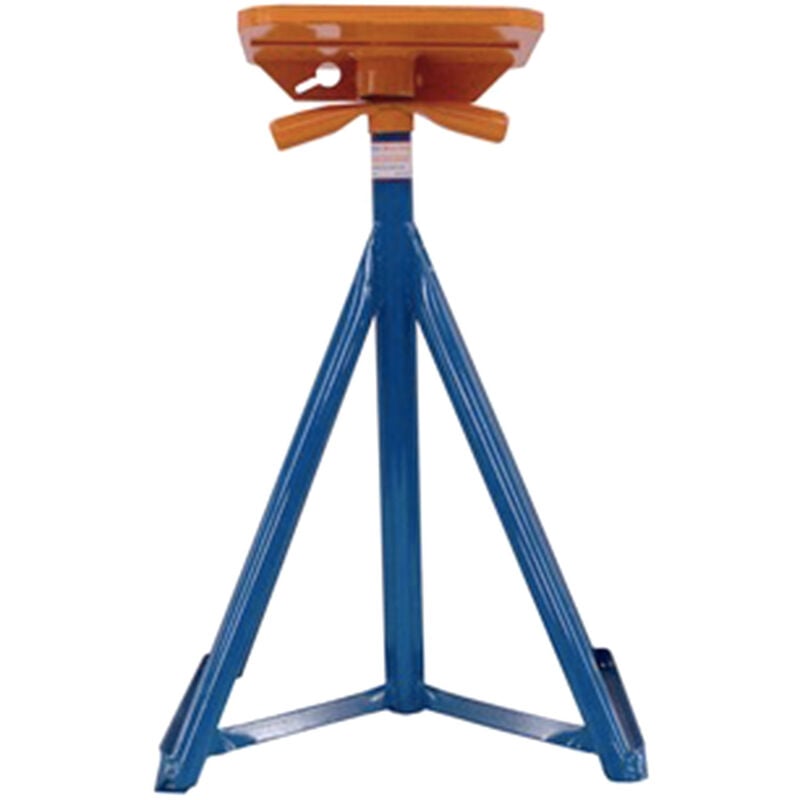
Adjustable boat stands are used to balance a boat when it’s stored on land.
If you or a yard will be laying up your boat using boat stands, make sure that the hull and keel are properly supported, taking into account load-bearing areas within the hull such as the locations of the engine, water, fuel and sanitation holding tanks. Emptying water and sanitation holding tanks during winterization reduces load in those areas, but the fuel tank should be 95% full to guard against condensation and fuel degradation from air contact.
Generally speaking, when a boat is blocked and held up by boat stands, the keel should bear most of the weight. In this case, boat stands serve to balance the boat, not primarily support it. Heavy timbers should support the keel. To get around trial-and-error shimming, adjustable keel stands can be used. This approach works well for powerboats and full-keel sailboats, but for sailboats with deep fin keels, supporting all the weight on the keel can put undue stress on the keel-to-hull joint. In these cases, some weight may need to be shared with the stands, taking care not to deform the hull in the process — a hull deformed in storage may not return to its designed shape, affecting performance and water tightness.
To prevent failures, boat stands should be chained together to prevent them from spreading apart under load. Each stand must be placed at a 90-degree angle to the hull so that the boat’s weight is squarely transferred to the ground through the stand’s foot rather than at an angle that could allow the stand to tip. Pads should sit flat against the hull, not balanced on edges or corners. In areas with high wind or hurricane risk, it is smart to anchor boats on stands to the ground with strapping or cable, and to have a plan for additional storm preparations if a named storm threatens.
Shrink Wrap

Shrink-wrapped boats laid up on cradles. Each installation includes several vents to allow moisture to escape and prevent mildew.
Shrink wrapping a boat effectively seals out dirt, debris, rain, snow and pests that would otherwise find their way aboard during a long layup. However, shrink wrap also traps moisture inside, which can lead to condensation and mold on upholstery, wood trim, and canvas. The best way to prevent this is to thoroughly dry out the boat’s interior before the wrap goes on. Adding vents to the installation allows remaining moisture to escape — a properly vented shrink wrap installation can breathe without admitting weather.
West Marine offers a variety of mold and mildew cleaners and products for odor odor control. Among them are Star brite’s NosGUARD Odor Control Bags, which use chlorine dioxide technology to help reduce mold, mildew and associated odors. If you are shrink wrapping your boat, adding a zippered access door to the shrink installation allows you to re-treat the boat’s interior during a long winter without having to cut and reseal the wrap.
Shrink wrap works best when it is properly framed, tightly secured and ventilated. Pad sharp corners, bow rails and windshield frames so they do not chafe through the plastic from the inside. Avoid wrapping so tightly that the cover presses against upholstery, canvas or electronics. As a single-use material, shrink wrap must be disposed of at the beginning of the boating season — most boatyards and marinas have designated collection points for used shrink wrap. The cost of shrink wrapping varies with boat size. For a 20’ boat, first-time do-it-yourselfers can expect to pay $500–$600 for a reusable heat gun kit and enough material for two or three installations. Professional installation typically runs $12–$15 per foot.
Boat Covers
Custom boat covers cost more up front than shrink wrap, but they can pay for themselves over multiple seasons of reuse. Fabric covers offer breathability that shrink wrap cannot match — moisture trapped inside a covered boat can escape through the fabric rather than condensing on interior surfaces. Breathability can be enhanced further by adding vents and by leaving locker lids slightly cracked where weather protection allows it. A fabric cover can also be lifted for access to the boat at any time during the storage period, unlike shrink wrap which requires cutting and re-sealing after any entry.
If you decide to store your boat under a fabric cover, use a boat cover support system to prevent the accumulation of rain and snow. Water pooling on a flat cover stretches the fabric, opens seams, loads mounting hardware and can eventually collapse the cover into the cockpit. A good support structure creates enough pitch for water and snow to shed off the sides while keeping fabric off sharp corners and fittings that would chafe through the material. For help selecting a cover for your boat, see Selecting the Right Boat Cover.
Tarps
A simple polyethylene tarp is sometimes the most practical option, particularly for short-term protection or for boats on trailers where a fitted cover is not available. To prevent the accumulation of rain or snow, the tarp must be supported so water sheds off rather than pooling. One effective approach is an A-frame support built from 2×4s and sawhorse brackets, placed inside the boat, with the tarp stretched over it and lashed down securely.
Do not lay a tarp directly over hardware, rails or upholstery without support. A flat tarp collects water, sags, chafes gelcoat and traps condensation against whatever surface it contacts. Pad sharp areas where the tarp touches hardware and leave airflow at the edges so moisture can escape. Tarps are inexpensive and useful for short-term protection, but for an entire winter, a fitted cover or properly installed shrink wrap usually provides better protection, better breathability, and fewer maintenance surprises come spring.
Boat Storage FAQ
For many boats, dry storage is the better long-term option because the hull can dry and reduce osmotic blister formation, the boat cannot sink, and maintenance access is easier. Wet storage may be convenient in mild climates or for year-round use, but it requires reliable bilge pumps, dock lines, bottom paint, monitoring and freeze protection if cold weather is possible. Fiberglass hulls stored out of the water accumulate significantly less water contact time, which is the primary driver of osmotic blistering over a hull’s life.
Yes, if freezing temperatures are possible. Boats stored ashore are surrounded by cold air and can freeze faster than boats sitting in relatively warmer water, which retains heat longer than air. Even a brief overnight freeze in a temperate climate can crack an engine block, split a pump housing, or fracture a pipe fitting if water has not been removed. Engines, freshwater systems, heads, pumps, washdowns and air-conditioning systems should all be winterized before any freeze risk exists.
Shrink wrap provides a tight seasonal seal against rain, snow, dirt and pests and conforms well to any hull shape, but it is single-use, must be ventilated to prevent condensation and mold, and requires cutting open for any access during the storage period. A quality boat cover costs more up front but can be reused for multiple seasons, provides better breathability, and can be lifted for access at any time. For multi-year storage, a fitted cover typically has a lower cost per season than annual shrink wrapping.
You can store a boat on a lift if the lift is rated for the load, properly maintained, and the boat is covered to prevent rain and snow from adding unexpected weight. In freeze-prone areas, the boat still needs winterization because it is surrounded by cold air. Lifts do not fare well in hurricanes and major nor’easters — wind, waves, surge and heavy precipitation can all exceed the lift’s design loads. Have a storm plan that includes removing the boat from the lift if a major storm is forecast.
Remove valuables, electronics that are easy to take off, all food, soft goods that can mildew, portable safety gear and anything that could freeze, leak or attract pests. Clean and dry the interior before covering the boat. Leave lockers and compartments open enough for airflow where weather protection allows it — trapped moisture in a sealed compartment is the primary cause of mildew on stored boats. Drain all freshwater systems, heads and washdowns, and remove the boat’s batteries to a temperature-controlled location for winter storage or connect them to a float-mode battery maintainer.