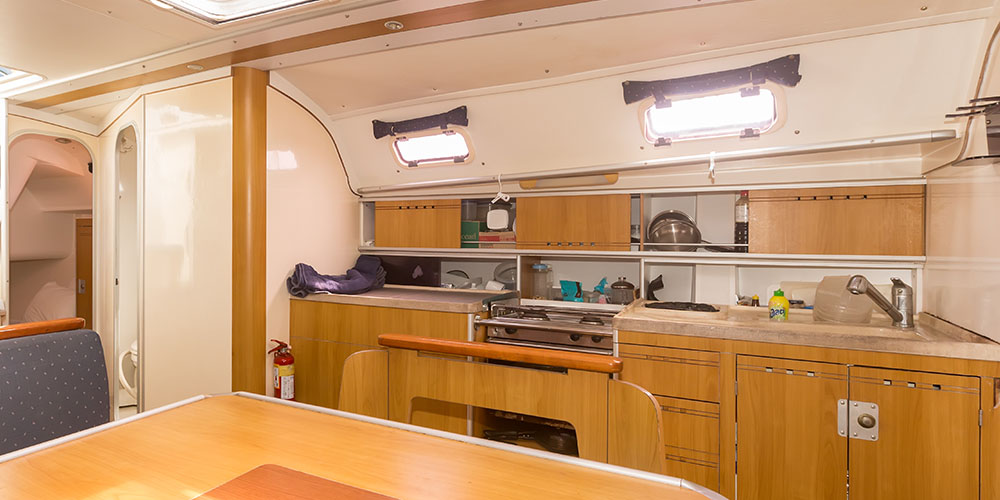
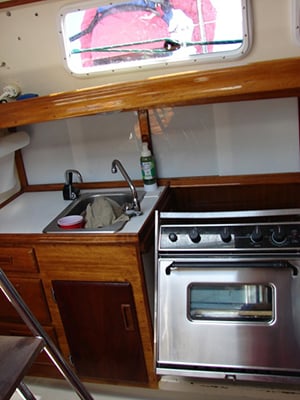
The stove is level because it is gimbaled. The sailboat is heeling.
Marine stoves use one of several combustible fuels or electricity to produce heat for cooking onboard. They are generally compact to fit in boat galleys and have special modifications for use underway. Choosing the right stove means matching the fuel type and configuration to your boat, your cruising style, and your safety requirements.
- Distinguishing Features of Galley Stoves
- Electric and Induction Stoves
- Alcohol Stoves
- Kerosene and Diesel Stoves
- CNG Stoves
- LPG (Propane) Stoves
- Butane Stoves
- Heat Content Comparison
- Selection Questions
- FAQs
Distinguishing Features of Galley Stoves
Galley stoves are different from household ranges. They must operate normally at angles up to 30° without cookware sliding off. Oven doors are latched securely so they cannot be forced open by the weight of baking containers if the boat heels. Controls are located on the front or side so the cook does not have to reach over hot cookware on a moving boat. There are no continuous pilot lights that could cause a fuel explosion.
Sailboat stoves are usually gimbaled, meaning the stove can swing on two pivot points to remain level even when the boat is heeling. This keeps pots and pans from sliding while the boat is moving. Powerboat stoves are generally not gimbaled.
Stoves are made from non-corroding materials like stainless steel. Most have two or more top burners, and many include a burner in the oven for baking. Potholders — bracket clamps that encircle the base of pots — are standard on both power and sail stoves.
Electric and Induction Stoves
Resistance electric stoves are common on large boats with plentiful 120V AC power from a generator or shore power. They are probably the safest stoves available — no explosive gases, no open flames, no carbon monoxide. However, resistance heating requires very large amounts of electricity. A single burner typically draws 1,100–1,300 watts; a full stovetop may draw 3,000–5,000 watts. This makes resistance electric stoves impractical on any boat without a generator or continuous shore power.
Induction stoves are an increasingly compelling option for boats with large lithium battery banks and high-capacity inverters. Induction cooking uses magnetic fields to heat the cookware directly rather than a heating element, making it significantly more efficient than resistance cooking — typically 85–90% efficient compared to 70–75% for resistance elements. A single-burner induction cooktop draws 1,200–1,800 watts, which is similar to resistance heating in absolute terms, but the faster cooking time means less total energy consumed per meal.
The practical case for induction on a modern cruising boat: a well-equipped lithium system (400–600Ah at 12V with a 2,000–3,000W inverter) can support induction cooking for a typical meal without stressing the battery bank significantly. Many new production sailboats and powerboats are now delivered with induction cooktops rather than propane. Induction stoves require magnetic cookware — cast iron, magnetic stainless steel, or induction-compatible pans. Standard aluminum and copper cookware will not work.
The primary limitation of both electric and induction stoves remains power dependency. At anchor without solar or a generator, cooking a multi-course dinner can draw down a battery bank meaningfully. For extended offshore passages or extended anchoring without generation capacity, a backup fuel stove remains the more self-sufficient choice.
Alcohol Stoves
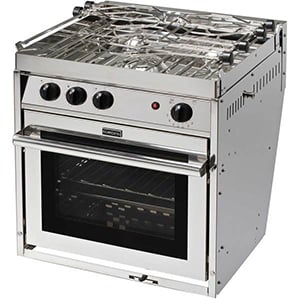
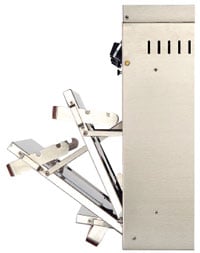
This Three-Burner Gourmet Galley Gimbaled Propane Range from Force 10 features a patented slide-away oven door to maximize galley space while maintaining true gimbal balance whether the door is open or closed.
Alcohol has been common on production sailboats and powerboats for decades. In liquid form it does not explode, and alcohol fires can be extinguished with water. However, it has low heat content, burns with an unpleasant odor, and produces a lot of water vapor. It is also more expensive per cooking hour than propane or kerosene.
Old-style pressurized alcohol stoves (Kenyon, Shipmate, Galley Maid, and others) use pressurized tanks feeding burners that must be pre-heated with liquid alcohol to reach vaporization temperature. If this process is not done correctly, the stove can flare up dramatically, sending flames well above the stove surface. Liquid fuel overflow can also cause a large low-intensity fire when it ignites. Many boat fires have been caused by alcohol stove flare-ups, and pressurized alcohol stoves have declined significantly in popularity.
Modern alcohol stoves (such as those from Dometic Environmental) use non-pressurized burners that store liquid fuel in an absorbent material rather than a pressurized tank. A chimney-style burner creates a draft that intensifies the gentle flame. There is no priming, no flare-up risk, and significantly less fire danger on board. Modern non-pressurized alcohol stoves are substantially safer than the pressurized designs they replace.
Kerosene and Diesel Stoves
Kerosene and diesel stoves are less common today, used mainly by northern-latitude cruisers and commercial vessels. Both fuels burn extremely hot, are reasonably safe in liquid form, and have high heat content. On diesel-powered boats, the ship’s fuel tank can power both the stove and a cabin heater, which is a practical advantage.
The drawbacks are significant: both fuels must be pre-heated before they will burn cleanly (similar to pressurized alcohol), produce some soot, and have an odor when burned that some people find intensely unpleasant or nauseating. The pre-heating process adds hassle that makes spontaneous use — boiling water for tea or coffee — less convenient than propane.
CNG (Compressed Natural Gas) Stoves
CNG stoves are uncommon except in certain areas of the United States, specifically Southern California. CNG is compressed methane stored as a gas under very high pressure — approximately 2,400 psi at 100°F, more than ten times the storage pressure of propane. Monitoring remaining fuel is straightforward because pressure declines steadily as the gas is consumed.
CNG is lighter than air, which is a safety advantage over propane. However, the very high storage pressure creates additional safety concerns, and CNG has lower heat content than propane, making it less efficient for cooking. The most significant practical limitation is availability: CNG is unavailable outside the U.S. and in many areas within it, and cylinders can only be filled by a limited number of authorized distributors. This makes CNG a poor choice for any cruising beyond a limited local area.
LPG (Propane) Stoves
LPG has largely replaced alcohol and kerosene on most new production boats. It is stored as a liquid under moderate pressure (approximately 177 psi at 100°F), giving it compact energy density. It has high heat content, lights instantly without pre-heating, and burns with minimal odor. For sheer cooking convenience and efficiency, propane is the clear choice among combustible fuels.
The safety concern with propane is real and must be taken seriously. LPG is heavier than air and will collect in low areas of the hull if a leak occurs. In sufficient concentration, it can ignite explosively. A properly installed propane system with an isolated vented locker, solenoid shutoff, pressure gauge, and approved hose eliminates the practical risk. The key requirements:
- Installation must comply with ABYC guidelines without shortcuts
- A vapor-tight isolated storage locker vented directly overboard
- A pressure gauge immediately after the tank valve (for leak detection)
- Continuous approved supply hose from locker to stove
- A solenoid shutoff valve controlled from the galley
- Optional but strongly recommended: propane vapor detector/alarm
Safe propane stove operating procedure: When finished cooking, leave the burners lit and shut off the solenoid from the galley switch. The burners will slowly go out as the fuel remaining in the supply line is consumed. This confirms the solenoid is working and drains the supply line of fuel between uses. Never leave propane flowing to the stove when it is not in use.
For complete propane system installation and safety guidance, see our West Advisor: Safe Propane Installations.
Butane Stoves
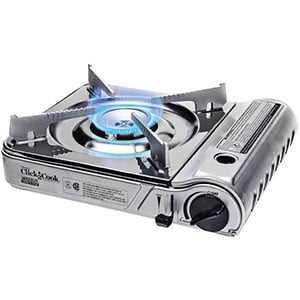
The Click 2 Cook stainless steel butane stove is portable and easy to set up when cooking is only occasionally needed onboard.
Butane stoves are portable, economical alternatives to permanent stoves on boats where cooking is only occasional. Butane is stored in small disposable canisters and is available in most countries, making it a practical choice for day sailors and casual boaters who don’t need a full galley installation.
Butane and propane come from the same hydrocarbon family but differ in one important way: butane liquefies at a higher temperature and lower pressure than propane. This means butane works poorly in cold weather — below approximately 40°F (4°C), liquid butane may not evaporate quickly enough to feed the burner effectively. For cruising in cold climates, propane is more reliable than butane.
Heat Content Comparison
The heat content of a fuel determines how quickly and efficiently it cooks. Higher Btu per gallon means more thermal energy per unit of fuel stored.
| Fuel | Btu Per Gallon |
|---|---|
| CNG | 37,500* |
| Alcohol | 64,600 |
| LPG (Propane) | 91,000 |
| Butane | 102,000 |
| Kerosene (Paraffin) | 129,350 |
*Approximate, based on a conversion from cubic feet to gallons. CNG is not stored in liquid form.
Selection Questions
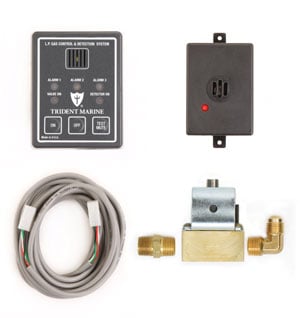
An LP Gas Detection and Control System enables you to turn gas on and off remotely, includes a “sniffer” to detect explosive propane vapors, and sounds an alarm when vapors reach 20 percent of the Lower Explosive Limit.
How many burners do you want?
Two, three, and four-burner ranges are available. Two-burner gas models typically offer one 5,000 Btu and one 8,000 Btu burner. Three and four-burner models add additional 5,000 Btu burners. Electric stoves are rated in watts, with 1,100–1,300 watts per burner.
Do you need a European-size stove?
European boats use a metric-size stove that is slightly narrower than conventional American stoves. If you are replacing a stove on a Beneteau, Jeanneau, or other European-built vessel, metric sizes can be special ordered.
Do your space constraints make an oven a tight fit?
Countertop cooktops, cooktops with broilers, and gas cooktops with electric microwave ovens are all options when vertical space is limited. Many boats cannot accommodate a full oven but can fit a broiler unit that is approximately 10” shorter.
Do you need a gimbaled stove?
Sailors whose stoves pivot in the direction of heel need a gimbaled stove. Powerboats and sailboats with cross-mounted stoves generally do not. A drop-in range, which sits flush in a countertop, is another option for boats where cabinetry integration is a priority.
Frequently Asked Questions
What is the best fuel type for a marine galley stove?
For most cruising sailors and powerboaters, propane (LPG) is the best overall choice: it has high heat content, lights instantly without priming, burns cleanly, and is widely available in the U.S. and internationally. The safety requirements for a marine propane installation are real but achievable with proper components. Induction cooking is the best option for boats with large lithium battery banks and high-capacity inverters, eliminating open flame entirely. Alcohol is a reasonable choice for occasional use or where propane installation is not practical.
Is propane safe on a boat?
A correctly installed propane system is safe and the risks are manageable. The danger comes from shortcuts: improper storage, missing solenoid shutoff, no vapor detector, or non-approved hose. A system installed to ABYC specifications with a vapor-tight vented locker, solenoid shutoff, and pressure gauge eliminates the practical risk. See our Safe Propane Installations guide for complete installation requirements.
Can I use an induction cooktop on my boat?
Yes, if your boat has the electrical capacity to support it. A single-burner induction cooktop draws 1,200–1,800 watts, requiring a properly sized inverter (typically 2,000–3,000W or larger) and a battery bank large enough to handle the draw. Lithium battery systems are particularly well-suited to induction cooking because they can deliver high current without the voltage sag that affects lead-acid batteries under heavy load. Induction stoves require magnetic cookware — cast iron or induction-compatible stainless steel. Standard aluminum and copper pans will not work.
What is the difference between LPG and CNG for a boat stove?
Both are gaseous fuels used in marine galley stoves, but they differ in important ways. LPG (propane) is stored as a liquid under moderate pressure, has higher heat content than CNG, is available almost everywhere, and is the standard choice for cruising boats. CNG (compressed methane) is stored as a gas under very high pressure (2,400 psi), has lower heat content, and is only available from a limited number of suppliers in certain U.S. regions. LPG is the practical choice for any boat that cruises beyond a limited local area.
Why do alcohol stoves have a reputation for causing fires?
The fire risk is specific to old-style pressurized alcohol stoves, which require pre-heating liquid alcohol in the burner before it will vaporize. If the pre-heating is incomplete or the stove is lit too early, liquid alcohol can flare up dramatically or overflow and ignite on surrounding surfaces. Modern non-pressurized alcohol stoves (which store fuel in an absorbent material) do not have this risk and are significantly safer. If you have an older pressurized alcohol stove, learn the correct pre-heating procedure thoroughly — or consider replacing it.