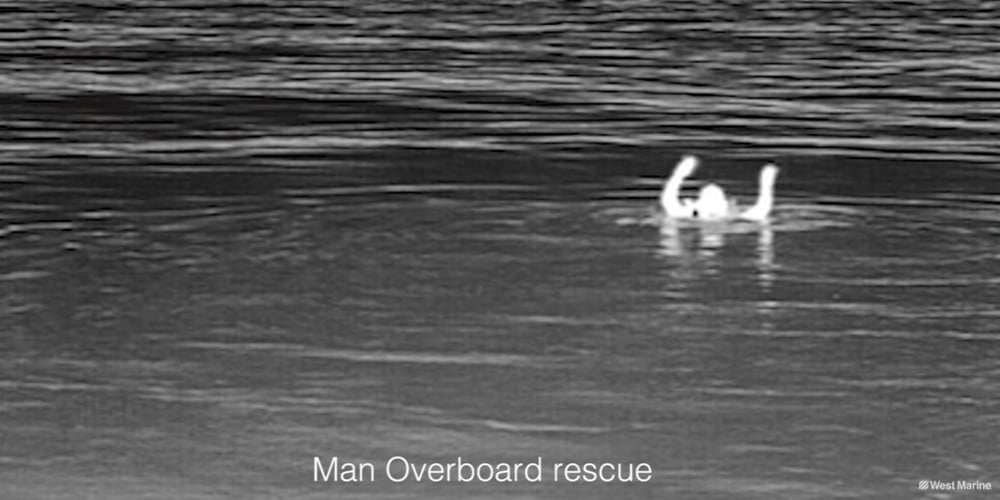
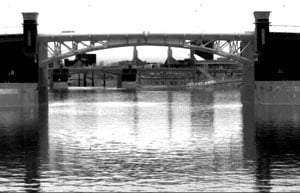
With thermal imaging.
Thermal cameras are not blinded by lights in the background, unlike old-style light-amplification devices. Thermal cameras are the only technology that can see an overboard person in the dark.

Without thermal imaging.
Thermal imaging cameras give boaters another way to see at night, in low light and in situations where glare, shadows or background lights make ordinary vision difficult. Instead of relying on visible light, thermal cameras detect small differences in heat and convert them into images that are easy to interpret on a display or handheld device.
For boaters, this can be valuable when navigating at night, spotting floating debris, identifying shorelines, seeing unlit objects, finding a person overboard or improving situational awareness around docks, bridges and channels. Thermal imaging does not replace radar, AIS, GPS, a proper lookout or safe speed, but it can add another powerful layer of awareness.
- How Thermal Imaging Cameras Work
- Thermal Imaging vs. Night Vision
- Best Uses for Thermal Cameras on Boats
- Real-World Limits
- Fixed, Handheld and Smartphone Thermal Cameras
- What to Look For When Choosing a Thermal Camera
- Thermal Camera FAQ
How Thermal Imaging Cameras Work
Night vision devices and low-light cameras receive and amplify ambient light in the visible part of the spectrum. They use image-intensifier tubes that amplify minimal ambient light to useful brightness levels. These are the “old school” of night vision, previously the best products for the boater.
Thermal imaging cameras use infrared thermal imaging to help boaters see in darkness. An infrared camera detects infrared radiation and produces an image based on heat differences instead of visible light. Instead of the 450–750 nanometer range of visible light cameras, infrared cameras operate at longer wavelengths, including wavelengths as long as 14,000nm, or 14 µm.
Thermal imaging cameras are often confused with night vision scopes, which make the hazy green images seen on TV and in movies, but they are very different technologies. Thermal cameras are similar to the video and digital cameras we use at home, except they create images by detecting tiny differences in heat, not light. Even the heat from a person’s hand on a wall can leave enough thermal energy behind to show up clearly to a thermal camera.
Does that mean thermal imagers only let you see things that are hot? Not exactly. Everything generates thermal energy, even ice. This molecular heat is invisible to the naked eye, but thermal cameras detect it and turn it into digital images that allow you to see more than your eyes alone can reveal. Thermal cameras capture more than heat; they detect tiny differences in heat, sometimes as small as 0.01°C, and display those differences as shades of gray or color depending on the device.
Thermal cameras do not need visible light. In fact, thermal cameras do not see visible light the same way a standard camera does, so they can work after the sun goes down, in shadowed areas and around confusing background lights.
Thermal Imaging vs. Night Vision
Traditional night vision amplifies existing light. That means it works best when some moonlight, starlight or ambient light is available. Bright lights in the background can also create glare or blooming that makes objects harder to identify.
Thermal imaging works differently. Because it detects heat differences, it can reveal people, animals, engine heat, shoreline features, docks, bridge structures and floating objects that may be hard to see with ordinary vision or low-light cameras. This is why thermal imaging is especially useful when background lights, darkness or glare reduce visibility.
For boaters, the difference matters most in emergency and navigation situations. A person in the water, a floating log, an unlit buoy or a shoreline obstruction may stand out on a thermal display even when it is difficult to see with the naked eye.
Best Uses for Thermal Cameras on Boats
Thermal imaging can be useful in several real-world boating situations:
- Man overboard recovery: A person’s head and body can create a thermal signature that stands out against cooler surrounding water.
- Night navigation: Thermal cameras can help identify shorelines, bridge structures, pilings, rocks and other hazards in darkness.
- Floating debris detection: Logs, crab pots and other objects may be easier to spot with thermal contrast.
- Docking and marina awareness: Thermal cameras can help reveal docks, pilings and other boats in dark marinas.
- Wildlife detection: Birds, animals and marine life near the surface may be easier to notice due to heat contrast.
- Security and monitoring: Handheld or fixed thermal cameras can help identify activity around the boat at night.
Thermal imaging can be a great asset in an emergency such as a man overboard incident because it can reveal the difference in heat signature between the water and a person’s head. It can also help during routine nighttime operation by making hidden hazards easier to detect.
Real-World Limits
Thermal imaging is powerful, but it has limits. Screen resolution is one consideration. Some recreational thermal units use lower resolution than standard visual cameras, so small objects may not display with the same detail you expect from daylight video.
Water is opaque to thermal imagers, meaning thermal cameras cannot see below the surface. Fog, rain, heavy spray and very humid conditions can also reduce thermal performance because moisture in the air can obscure infrared energy. Thermal imaging should be used as one tool among several, not as a replacement for safe speed, radar, chartplotters, AIS, navigation lights and a proper lookout.
Some fixed-mount thermal imagers include a low-light visual camera. This combination is useful because it gives the operator both visual and thermal perspectives on a chartplotter or multifunction display. The visual camera may help with detail, while the thermal camera helps identify heat contrast.
Fixed, Handheld and Smartphone Thermal Cameras
There are several types of thermal imaging options for boaters.
Fixed-mount thermal cameras are typically installed on a hardtop, mast, arch or cabin structure and connected to a compatible display. These are well suited for serious night navigation, larger boats and owners who want thermal imaging integrated with their helm electronics.
Handheld thermal cameras are portable and versatile. They can be used from the helm, cockpit, dock, tender or shore. Handheld models are useful on many boats because they require no permanent installation and can also be used for camping, security and other dry-land applications.
Smartphone thermal cameras add thermal imaging to a mobile device. The FLIR One Pro includes thermal and visible light cameras and blends images from both to provide more detail than a thermal-only image. FLIR One has its own included battery, so it does not drain your smartphone’s limited battery life.
What to Look For When Choosing a Thermal Camera
When comparing thermal imaging cameras for boating, consider how and where you will use the device.
- Mounting style: Choose fixed-mount for helm integration or handheld for portability.
- Resolution: Higher thermal resolution generally provides more detail and easier object recognition.
- Field of view: Wider fields help close-range awareness, while narrower views may help identify objects farther away.
- Display compatibility: Fixed cameras should be compatible with your chartplotter or multifunction display.
- Low-light camera integration: Some systems combine thermal and visual imaging for better context.
- Water resistance: Marine use demands equipment that can handle spray, moisture and vibration.
- Power and battery life: Handheld and smartphone-connected options should have enough battery life for your expected use.
Choose a system that matches your boating style. A coastal cruiser who regularly runs before dawn may benefit from a fixed helm-mounted system. A day boater or angler may prefer a handheld unit for occasional night use, security checks or man overboard preparedness.
Affordable Thermal Imaging for Smartphones
The newest application for thermal imaging is, as you might guess in our mobile-friendly world, for your smartphone. FLIR has developed the FLIR One Pro, with versions for the iPhone and Android phones.
The FLIR One Pro includes thermal and visible light cameras, and blends images from both to provide a higher level of detail than you get from a thermal-only image. FLIR One has its own included battery, so it doesn’t drain your smartphone’s limited battery life.
Thermal Camera FAQ
Are thermal cameras the same as night vision?
No. Night vision amplifies visible light, while thermal cameras detect heat differences. Thermal cameras do not need visible light and can help identify people, animals and objects based on thermal contrast.
Can a thermal camera see a person overboard?
Thermal cameras are one of the best technologies for spotting a person in the water at night because a person’s heat signature can contrast with the surrounding water. Conditions such as rain, fog, spray and distance can still affect performance.
Can thermal cameras see through fog or rain?
Thermal cameras can help in some low-visibility conditions, but fog, rain and heavy moisture can reduce image quality because water in the air can obscure infrared energy.
Can thermal cameras see underwater?
No. Water is opaque to thermal imaging, so thermal cameras cannot see objects below the surface.
Do I need a fixed thermal camera or a handheld model?
A fixed thermal camera is best for regular night navigation and helm integration. A handheld model is better for portability, occasional use, security checks and smaller boats where permanent installation is not practical.
Conclusion
Thermal imaging gives boaters a powerful way to improve visibility when light is limited or confusing. It can help identify hazards, improve nighttime awareness and support emergency response, especially during a man overboard situation.
While thermal cameras do not replace good seamanship or other navigation tools, they can add valuable information when conditions make ordinary vision unreliable.