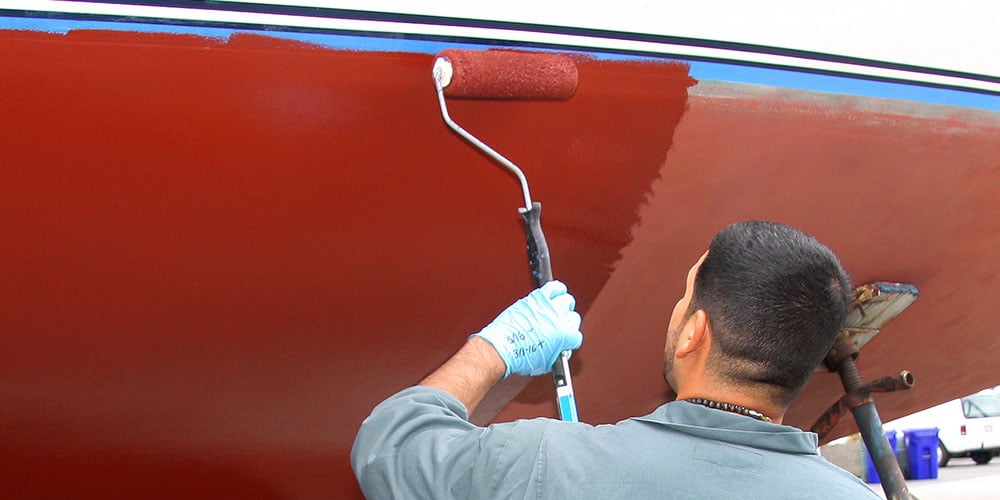
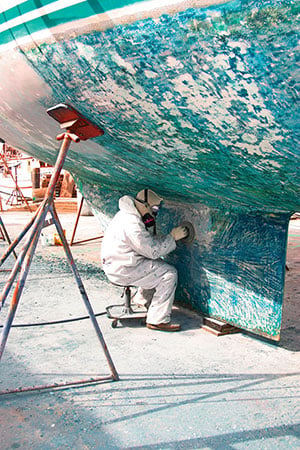
Fully outfitted in safety gear to protect against toxic antifouling paint dust.
If you store your boat in the water at least part of the year, keeping the hull free of marine growth with one or more coats of quality antifouling paint is critical to maintaining performance and controlling fuel costs. A clean hull is fast and efficient — a fouled bottom reduces speed, maneuverability, and drives up fuel consumption. Here are 10 questions to ask yourself before buying.
- What Antifouling Paint Does
- 1. Are You Painting Over an Aluminum Hull or Sterndrive?
- 2. Do You Want Bright Colors?
- 3. Are You in an Area that Restricts Copper Biocides?
- 4. Do You Want to Use a Water-Based Paint?
- 5. Do You Want to Haul Out Over Winter and Relaunch Without Repainting?
- 6. Are You Going to Use a Vinyl-Based Paint?
- 7. Do You Boat in Saltwater or Freshwater?
- 8. How Often Do You Use Your Boat?
- 9. Do You Store Out of the Water When Not Using It?
- 10. Are You Painting Over Old Paint?
- Painting Guides with Color Charts
- FAQs
What Antifouling Paint Does
Antifouling paint prevents marine organisms — barnacles, zebra mussels, weeds, slime, and algae — from attaching to the hull. Most antifouling paints use a metal biocide that dissipates from the hull surface into the adjacent water to prevent biofouling. Historically, hulls were covered with solid copper sheathing below the waterline. Today, copper in the form of cuprous oxide or other copper compounds remains the principal biocide in most antifouling paints.
Antifouling paint choices tend to be regional, with boaters in the Great Lakes, Pacific Coast, Southeast, Gulf Coast, and other areas choosing similarly to their neighbors at the local marina. Using the same paint as your neighbor may work well, but also consider how you use your boat and what you applied previously — compatibility problems between different formulations are real. In general, softer paints can be applied over harder paints but not vice versa; vinyl paints should only be applied over vinyl paints. Consult a compatibility chart before changing paint types.
1. Are You Painting Over an Aluminum Hull or Sterndrive?
Never apply antifouling paint that contains cuprous oxide on an aluminum hull or outdrive. The galvanic reaction between copper and aluminum will cause serious corrosion damage. Instead, select a paint containing zinc, cuprous thiocyanate, or a non-metallic biocide such as ECONEA™. Examples include Vivid (cuprous thiocyanate), Trilux 33 (cuprous thiocyanate), and Hydrocoat ECO (ECONEA).
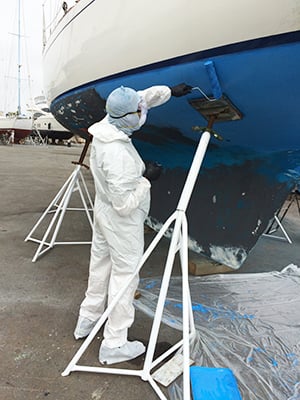
Applying Hydrocoat ECO to a Cal 40. No organic vapor respirator needed — this ECONEA-based paint has virtually no smell.
2. Do You Want Bright Colors?
Use a paint that contains white copper (cuprous thiocyanate), zinc, or ECONEA as the biocide. White copper is clean white in color and is used in brightly colored paints such as Pettit’s Vivid and Interlux Trilux 33. White copper formulations require 50% less copper than conventional cuprous oxide paints and produce the brightest colors, whitest whites, and blackest blacks.
ECONEA® is a metal-free biocide that, depending on the paint formulation, can be as effective as cuprous oxide at about one-tenth the concentration by weight. This results in a brighter color range compared to darker cuprous oxide-based paints. ECONEA also does not cause discoloration in the presence of sulfides, as metal-based paints do.
3. Are You in an Area that Restricts Copper Biocides?
Use a bottom paint that contains zinc or ECONEA as the biocide. Also worth noting: PropSpeed contains no biocide at all. Instead it is a super-slick fluoropolymer coating that sheds marine growth through its surface properties rather than toxicity. PropSpeed is designed for underwater metals — props, struts, shafts, and keel coolers — not for hull surfaces, but it is an effective tool for hardware in copper-restricted areas.
4. Do You Want to Use a Water-Based Paint?
Water-based antifouling paints replace the harsh solvents in most bottom paints with water, resulting in easier application and cleanup with minimal solvent odor. Our WBA paint and Pettit’s Hydrocoat Eco are both strong options in this category.
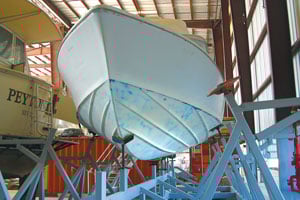
Storing your boat for the winter without antifouling paint is one option. Another is to apply a copolymer paint in the fall, which can be reactivated in the spring without repainting.
5. Do You Want to Haul Out Over Winter and Relaunch Without Repainting?
Use a copolymer ablative antifouling formulation. Copolymer paints release biocide at a constantly controlled rate throughout their lives, wearing away gradually — much like a bar of soap — rather than depleting their biocide from a fixed coating. Paint wears faster in high-drag areas on the hull and appendages. These paints work well in high-growth areas and remain effective after haulout. In the spring, a light scrubbing or sanding reactivates the surface and you’re ready for another season without repainting — a significant time-saver for northern boaters.
Apply two or three coats on the first application of a copolymer paint. Copolymer paints with anti-slime additives are best for heavy-fouling areas. Environmentally preferable Ultima ECO and Pacifica Plus are ECONEA-based copolymer ablatives.
Non-copolymer ablative paints work similarly and minimize annual sanding when applying a fresh coat. Best suited as a single-season paint for frequently used boats without a diver service. Not recommended when you want a super-smooth bottom finish maintained by regular diving — scrubbing removes paint and reduces longevity.
6. Are You Going to Use a Vinyl-Based Paint?
Remove all old paint film unless it is also vinyl-based. Vinyl paints do not adhere reliably over other paint formulations, and applying a non-vinyl paint over a vinyl base can cause adhesion failure. Consult the manufacturer’s compatibility chart for your specific products before applying any paint over an existing vinyl coat.
7. Do You Boat in Saltwater or Freshwater?
Some paints are formulated specifically for one environment. Interlux Micron 66, for example, depends on a chemical reaction with saltwater to activate its biocide and should not be used in freshwater. Pettit’s SR-21, favored for racing boats, is best suited for freshwater or short-term use in low-fouling, cold saltwater. Always confirm the manufacturer’s recommendation for your boating environment before purchasing.
8. How Often Do You Use Your Boat?
Frequently used boats: An ablative paint is a good choice. The hull surface polishes smoother with use and sheds light growth more effectively the more the boat moves through the water.
Infrequently used boats: A modified epoxy (hard) paint provides better antifouling protection when the boat sits still for extended periods. Hard paints leach biocide on contact with water regardless of whether the boat is moving.
Boats that stay in the water year round: A high-copper-content modified epoxy paint is typically the best choice. These contact-leaching paints release biocide at a steadily decreasing rate and leave the full coating thickness at season’s end. Higher copper content, rather than paint type, generally determines effectiveness for hard paints. Modified epoxy paints adhere well to most surfaces and can be applied over most paint types — except vinyl-based paints. Because they do not wear away, successive applications build up an eggshell-like layer over time. Eventually stripping all accumulated paint becomes necessary.
9. Do You Store Your Boat Out of the Water When Not in Use?
Choose a copolymer paint that remains effective for an indefinite period. Copolymer paints offer true multi-season protection, lasting as long as reasonable coating thickness remains. Because they expose fresh biocide as they wear, additional coats extend longevity proportionally. Examples include West Marine PCA Gold, Interlux Micron Extra, and Pettit Hydrocoat.
10. Are You Painting Over Old Paint?
Three general rules:
- Make sure the old paint is firmly attached. Do not apply new paint over loose, flaky, or peeling old paint.
- Do not apply paint over old paint that contains a slippery vinyl or PTFE agent.
- Do not apply a hard paint over a soft paint.
When in doubt, consult the new paint manufacturer’s compatibility chart. Compatibility problems between formulations are common and can cause adhesion failure, blistering, or accelerated paint loss.
Help for the Do-It-Yourself Painter
For detailed guidance on prepping your hull and applying antifouling paint, see our companion West Advisor and video: Do-It-Yourself Bottom Painting.
Painting Guides with Color Charts

Frequently Asked Questions
Can I use any antifouling paint on an aluminum hull?
No. Never apply antifouling paint containing cuprous oxide to an aluminum hull or aluminum outdrive. Copper and aluminum create a galvanic couple in salt water that aggressively corrodes the aluminum. Use only paints formulated for aluminum with zinc, cuprous thiocyanate (white copper), or ECONEA as the biocide. This is one of the most consequential antifouling paint mistakes and can cause rapid, severe hull damage.
What is the difference between ablative and hard (modified epoxy) antifouling paint?
Ablative paints wear away gradually as the boat moves through the water, continuously exposing fresh biocide at the surface. They get smoother with use, work well for frequently used boats, and copolymer versions can be reactivated without repainting after a winter haulout. Hard modified epoxy paints maintain their full coating thickness throughout the season and leach biocide on contact with water regardless of whether the boat is moving — better for boats that sit still for long periods. Hard paints build up over successive seasons and eventually require stripping.
What is ECONEA and why would I choose it over copper?
ECONEA is a metal-free organic biocide that is effective at roughly one-tenth the concentration of cuprous oxide by weight. It is the right choice for three situations: aluminum hulls (copper causes galvanic corrosion), copper-restricted areas (Washington, California, and some other states have copper regulations for recreational boats), and boaters who want brighter paint colors (ECONEA does not darken paint the way cuprous oxide does). ECONEA-based paints have no sulfide discoloration issues and are generally considered more environmentally benign than copper-based formulations.
Can I apply any antifouling paint over any existing paint?
No. Compatibility between paint formulations is critical. The main rules: soft (ablative) paints can go over hard paints, but hard paints cannot go over soft paints. Vinyl paints must only be applied over existing vinyl paint. No paint should be applied over a vinyl or PTFE-containing finish. Always consult the new paint manufacturer’s compatibility chart before applying over an existing coat, especially if you are changing brands or formulation types.
How do I choose between ablative and hard paint if I keep my boat in the water year round?
For year-round liveaboards or boats that rarely haul out, a high-copper-content modified epoxy paint typically provides the best protection. These paints work when the boat is stationary, which ablatives do not as effectively. The trade-off is paint buildup over time — eventually requiring a full strip. If you haul out annually and want to avoid repainting every spring, a copolymer ablative is the better choice.