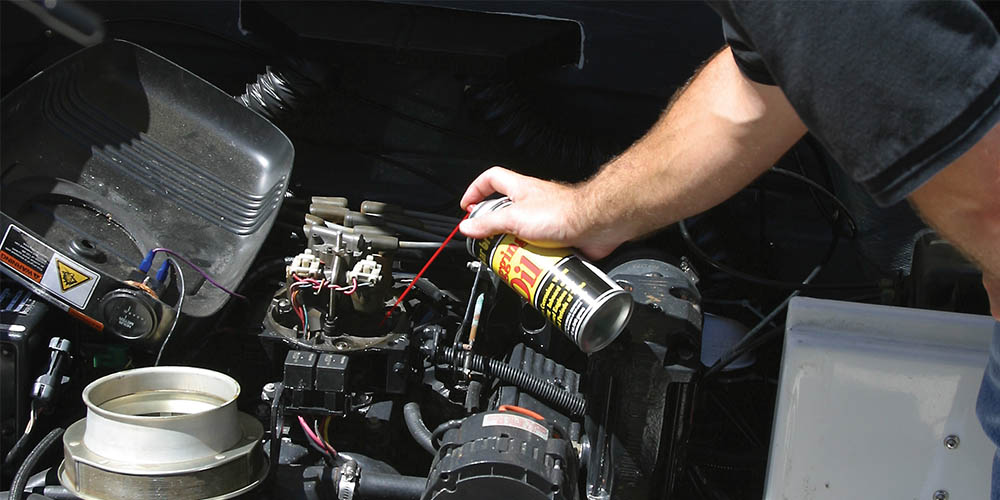
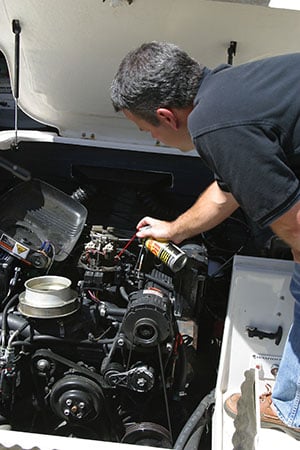
Kevin is spraying Star Brite Fogging Oil into the carburetor of this Volvo Penta engine.
Winterizing your power train extends the life of your engine and prevents the most costly repairs from freeze damage. There are four primary tasks, presented here in the order you should complete them.
- Clean Fuel and Clean Filters
- Adding Antifreeze
- Adding Antifreeze to a Stern Drive
- Fogging the Engine on a Stern Drive
- Adding Antifreeze and Fogging the Engine on an Inboard
- Change Engine and Transmission Oil
- Other Preventive Maintenance
- FAQs
Clean Fuel and Clean Filters
Step one of winterizing is to fill the tank with fresh gasoline and add a fuel stabilizer such as Star Brite EZ-To-Start, or whatever your owner’s manual recommends. Expert consensus on ethanol-blended gasoline is to keep the tank full to reduce air space. Air holds moisture, and as temperature drops that moisture condenses and ends up as water in the bottom of the tank. Water accumulation fills your fuel-water separator and causes hard starting in the spring.
Fuel stabilizer also prevents varnish buildup in fuel lines, carburetors, or fuel injectors during the long lay-up period. Winterization is also an excellent time to replace the filter element in your fuel filter-water separator — start spring with a clean filter rather than discovering a clogged one on the first day you want to go out.
Adding Antifreeze
The next job is winterizing the engine block with antifreeze to prevent residual water from freezing, expanding, and cracking the block. Some boatyards winterize by opening all petcocks in the block and blowing compressed air through the entire raw water cooling system. There is real risk in this approach — any leftover water remaining in the block can cause a crack. Flushing with antifreeze is both easier and safer.
Two Types of Antifreeze
There are two types of antifreeze. Common automotive antifreeze (like Prestone) is excellent for cars and a good choice for boats with a closed freshwater cooling system that uses a heat exchanger to dissipate heat into the raw water side — similar to a car radiator.
Most boats use a raw water cooling system, pulling water in from the lake or ocean, circulating it through the engine block, and discharging it overboard. For these systems, automotive antifreeze is not appropriate — it is highly toxic and any discharged into storm drains or the water where you boat is an environmental hazard. Use non-toxic propylene glycol antifreeze instead. West Marine antifreeze is premium “virgin” propylene glycol (not recycled) with corrosion inhibitors to protect the engine and cooling system.
Three Levels of Concentration
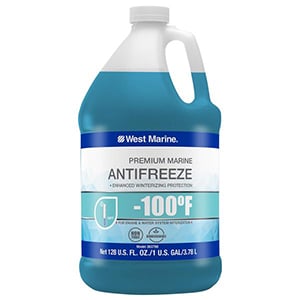
Non-toxic West Marine propylene glycol antifreeze is recommended for winterizing potable water systems and all raw water-cooled engines.
With -50, -60, and -100°F antifreezes available, which should you choose? For engine winterization, use the -100°F concentration. The reason: there is always residual water inside the engine that dilutes whatever antifreeze you introduce. What goes in as -50°F may not deliver -50°F protection once diluted by that residual water. Starting with -100°F gives you the margin to account for dilution.
One more note: propylene glycol antifreeze has a “slush point” of +11°F for the -50 concentration. Slushing will not harm your engine or other systems. For technical detail on burst point, freeze point, and slush point, see the Antifreeze 101 link at the bottom of this article.
Putting in the Antifreeze — Sterndrives
For a sterndrive, West Marine sells a do-it-yourself winterizing kit that simplifies the job. Begin by connecting a garden hose to a motor flusher, placing it over the raw water intake, turning on the water, and starting the engine. Let the engine warm to operating temperature so the thermostat opens and coolant circulates through the entire engine. Warming up also allows the fuel stabilizer you added in step one to circulate through all fuel lines and the carburetor or injectors.
Fogging the Engine
After warming the engine, shut it off and connect the winterizing kit to the motor flusher in place of the garden hose. Remove the flame arrestor from the carburetor so you can introduce antifreeze and fogging oil.
Restart the engine, open the winterizing kit valve, and watch the antifreeze level drop in the tank. Antifreeze should begin appearing at the exhaust outlet. When the tank is nearly empty, begin spraying fogging oil into the carburetor. On lower-horsepower engines this typically stalls the engine; higher-horsepower engines may cough and continue running while emitting white smoke. Spray a generous amount of fogging oil through the intake and then shut the engine off.
An alternative method: remove spark plugs one at a time and spray fogging oil directly into each combustion chamber, then reinstall the plugs. Both approaches work equally well.
Adding Antifreeze and Fogging Oil to an Inboard Engine
The procedure is slightly different for a true inboard. Warm the engine to operating temperature as with a sterndrive. Instead of a winterizing kit, you need a five-gallon bucket and enough antifreeze for your engine and related plumbing — at least two gallons, more if your engine has a large cooling circuit. Have a helper ready to add antifreeze to the bucket if needed.
- Fill a five-gallon bucket with undiluted non-toxic propylene glycol antifreeze. Have extra antifreeze ready if you know your system takes more, or if this is your first time winterizing.
- If the boat is in the water, close the intake seacock.
- Remove the raw water intake hose from the seacock and insert the open end into the bucket of antifreeze. Hose clamps and hoses may be stiff — work carefully to avoid cracking aged hose.
- Start the engine and run at idle until antifreeze appears at the exhaust outlet and continues discharging for at least 30 seconds.
- When the bucket is nearly empty, fog the carburetor as with the sterndrive procedure. Spray generously while the engine coughs, and turn the ignition off when the antifreeze runs out.
- Reconnect the raw water intake hose to the seacock and reopen the seacock.
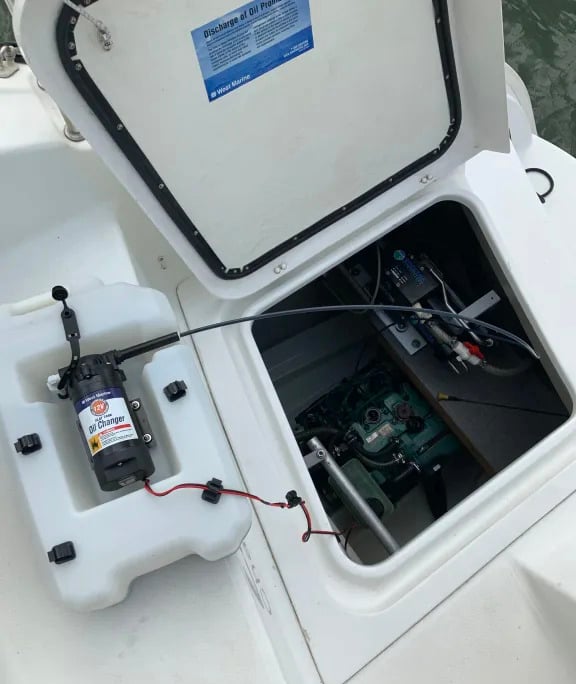
Oil change pumps like the West Marine Flat Tank Oil Changer make restricted-access oil changes straightforward.
Changing the Engine and Transmission Oil
With the engine still warm from the antifreeze procedure, change the engine oil and replace the oil filter. Do this now rather than waiting until spring — old, dirty oil contains contaminants and acids that will corrode engine internals during the lay-up. Clean oil protects the engine for months of storage. Change the transmission oil for the same reason. Warm oil drains more completely and carries contaminants out more effectively than cold oil. If you cannot change the oil before storage, add a crankcase oil stabilizer before winterizing.
For sterndrive engines, also change the lower unit gear oil at winterization. If the drained oil appears milky or discolored, water has entered the lower unit through a failed seal and should be inspected by a dealer before the boat returns to service.
Check the Exhaust System
Disconnect the exhaust from the water lift muffler or exhaust manifold and inspect for carbon buildup or corrosion. Remove the raw water injection hose from the injection nipple and check for debris or scale blockage.
Inspect Hoses
Check all hoses for softness, bulging, or cracking — paying particular attention to hoses on the hot side of the exhaust and cooling systems. Confirm all hose clamps are tight and look for signs of corrosion on the clamps themselves. Corroded or overtightened clamps can crack aged hose during the lay-up.
Seal Engine Openings
Seal all openings into the engine to prevent damp air from getting inside over the winter. Make caps from plastic bags, plastic containers, or tape to cover the air inlet, transmission and crankcase breathers, and exhaust outlets.
Write a list of every opening you seal and tape it somewhere obvious — on the steering wheel, the ignition key, or the companionway hatch. Forgetting to remove a cap before spring startup is one of the most common and potentially damaging recommissioning mistakes.
Other Preventive Maintenance
- If your inboard boat will be stored in the water, tighten the stuffing box to eliminate all dripping, and leave a prominent reminder note to loosen it in the spring before first use.
- Inspect motor mounts and check their flexible rubber elements for softening caused by oil or diesel fuel contamination.
- Lubricate all grease points on the engine.
- Remove control cables from their housings and coat with marine grease.
- Disconnect the battery or connect it to a trickle charger or smart battery maintainer for the lay-up period. A battery left disconnected and uncharged will self-discharge over the winter and may sulfate to the point where it cannot be recovered. A battery maintainer keeps it at full charge without overcharging.
Note all damage, needed repairs, or maintenance items discovered during your inspections. Get repairs done before spring, if possible. Touch up paint, address rust, clean up accumulated grease. These small items are easy to overlook in the rush of spring recommissioning — and they are far easier to address during a winter with no schedule pressure.

View & Shop Winterization Products
Frequently Asked Questions
Why should I use -100°F antifreeze instead of -50°F for winterizing my engine?
Residual water inside the engine dilutes the antifreeze you introduce. What goes in as -50°F may be significantly diluted by remaining water in the block, raising the effective freezing point well above -50°F. Starting with -100°F concentration gives you the margin to account for dilution and ensures protection even in the coldest storage conditions. The cost difference is minor compared to the cost of a cracked block.
Can I use automotive antifreeze (Prestone) in my boat engine?
Only if your engine has a closed freshwater cooling system with a heat exchanger — similar to a car. If your engine uses a raw water cooling system (the vast majority of recreational marine engines), use non-toxic propylene glycol antifreeze only. Automotive antifreeze is highly toxic and any discharged into the water or storm drains poses a serious environmental hazard.
Why should I change the engine oil at winterization rather than in the spring?
Old oil contains combustion byproducts, moisture, and acids that corrode engine internals during months of storage. Fresh oil protects the engine throughout the lay-up. Changing oil while warm also drains more completely, removing more contaminants. This is one of the highest-value winterization steps and one of the most commonly skipped.
What is fogging oil and why do I need it?
Fogging oil is a heavy petroleum-based spray that coats the cylinder walls, pistons, and valves with a protective film that resists corrosion during storage. Without fogging, the thin oil film on cylinder walls drains down over winter, leaving bare metal exposed to moisture-laden air. Fogging oil clings to metal surfaces for months, preventing rust and corrosion that would otherwise cause rough starting and accelerated wear at spring startup.
How do I know if my sterndrive lower unit needs service at winterization?
Drain the lower unit gear oil before or during winterization. If the oil is milky, cream-colored, or contains visible water droplets, water has entered the lower unit through a failed seal. Drain and refill with fresh gear oil, but also have a dealer inspect the seals before the boat returns to service in the spring. Running a lower unit with water-contaminated oil causes rapid bearing and gear damage.