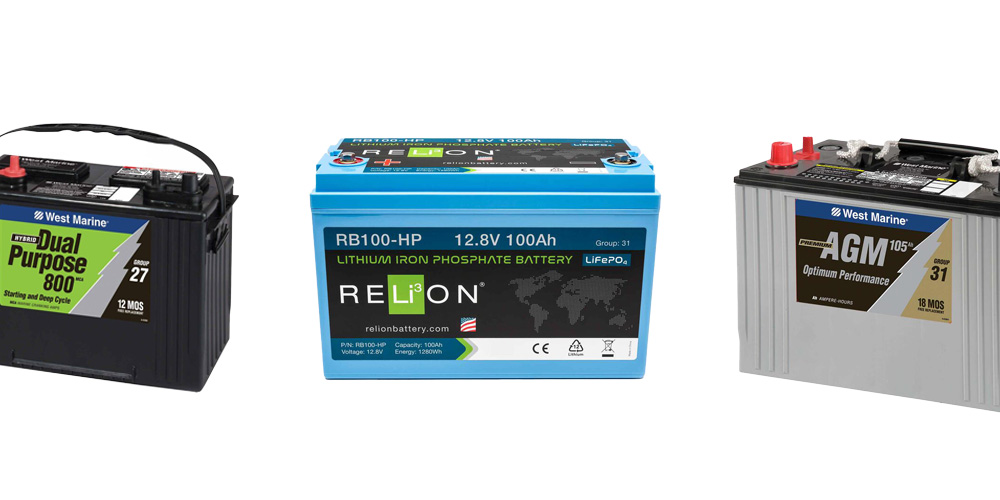
Don’t have space for two batteries on your boat but still want to run a trolling motor or your sound system with the engine off? You need a dual-purpose marine battery. These batteries are built to deliver the high cranking amps needed to start your engine, run your electronics while you’re on the water, and start the engine again to get you home — all from a single battery. Here are four of our most popular options, ranging from an affordable flooded battery to a premium lithium upgrade.
- For a great balance between cost and performance: West Marine Group 31 Dual Purpose Marine AGM Battery
- For an incredibly durable battery with high cranking amps: Odyssey Extreme Group 31 Dual Purpose Marine AGM Battery
- For a top-of-the-line lithium battery: RELiON Group 31 RB100-HP Lithium Iron Phosphate Dual Purpose Battery
- For an affordable dual purpose battery suitable for sailboats or powerboats: West Marine Group 27 Dual Purpose Marine Battery
West Marine Group 31 Dual Purpose Marine AGM Battery
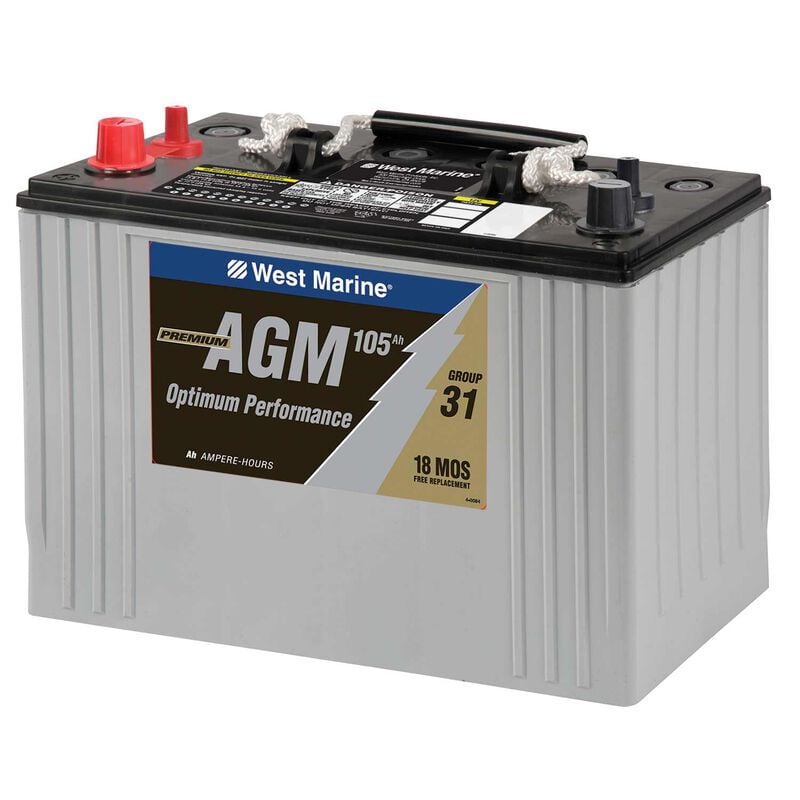
Top features: Our West Marine Group 31 Dual Purpose Marine AGM Battery is a strong choice for any boat. Absorbed Glass Mat (AGM) batteries are more rugged than traditional flooded batteries, accept higher charging current, and are sealed, spill-proof, and submersible. With a low 3% monthly self-discharge rate and over 250 quality control checks before the battery ships, you can expect reliable performance season after season.
Specifications:
- Battery type: Sealed AGM, Dual Purpose
- Amp hours: 105 Ah
- Marine cranking amps: 1,000 MCA
- Reserve minutes: 200
What makes it stand out: Manufactured for West Marine by East Penn, one of the most reputable battery manufacturers in the United States. East Penn produces batteries for many of the top marine brands, and their quality control is among the best in the industry.
Who it’s right for: Boaters who want a reliable, proven AGM battery at a reasonable price point. If you’re upgrading from a flooded battery for the first time and want the maintenance-free, spill-proof benefits of AGM without paying a premium price, this is the right starting point. The 105 Ah capacity and 1,000 MCA cover the majority of outboard and sterndrive engine displacement ranges.
Odyssey Extreme Group 31 Dual Purpose Marine AGM Battery
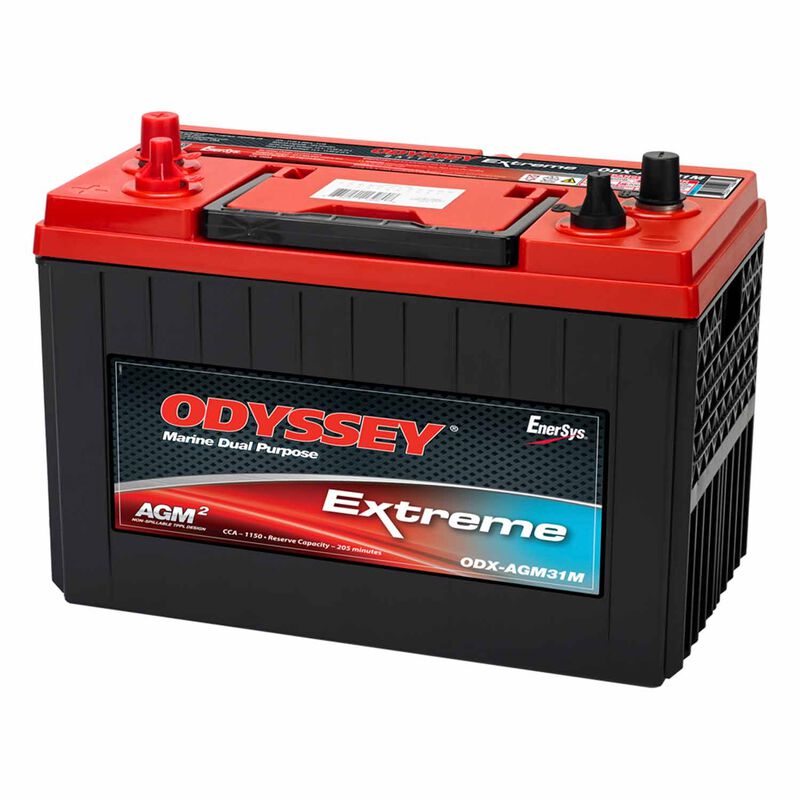
Top features: The Odyssey Extreme Group 31 Dual Purpose Marine AGM Battery delivers massive starting power and outstanding deep cycling capability. Rated for up to 400 cycles at 80% depth of discharge, it handles trolling motor loads, electronics, and repeated engine starts without the capacity degradation that conventional batteries experience after heavy cycling. It is engineered for extreme temperature tolerance and exceptional vibration resistance.
Specifications:
- Battery type: Sealed AGM, Dual Purpose
- Amp hours: 103 Ah
- Marine cranking amps: 1,370 MCA
- Reserve minutes: 220
What makes it stand out: The 1,370 MCA rating is among the highest available in a Group 31 dual purpose battery — substantially more cranking power than most engines in this size class require, which means the battery is never taxed by a normal cold start. Odyssey rates this battery at twice the overall power and three times the service life of conventional marine batteries.
Who it’s right for: Anglers and boaters who put heavy demands on their battery — running a trolling motor for extended periods, powering a full electronics suite (chartplotter, sonar, VHF, live wells), and starting a large displacement engine, all from one battery. The 400-cycle deep discharge rating makes this battery genuinely appropriate for serious dual-purpose use where a lesser battery would see rapid capacity decline within two to three seasons.
RELiON Group 31 RB100-HP Lithium Iron Phosphate Dual Purpose Battery
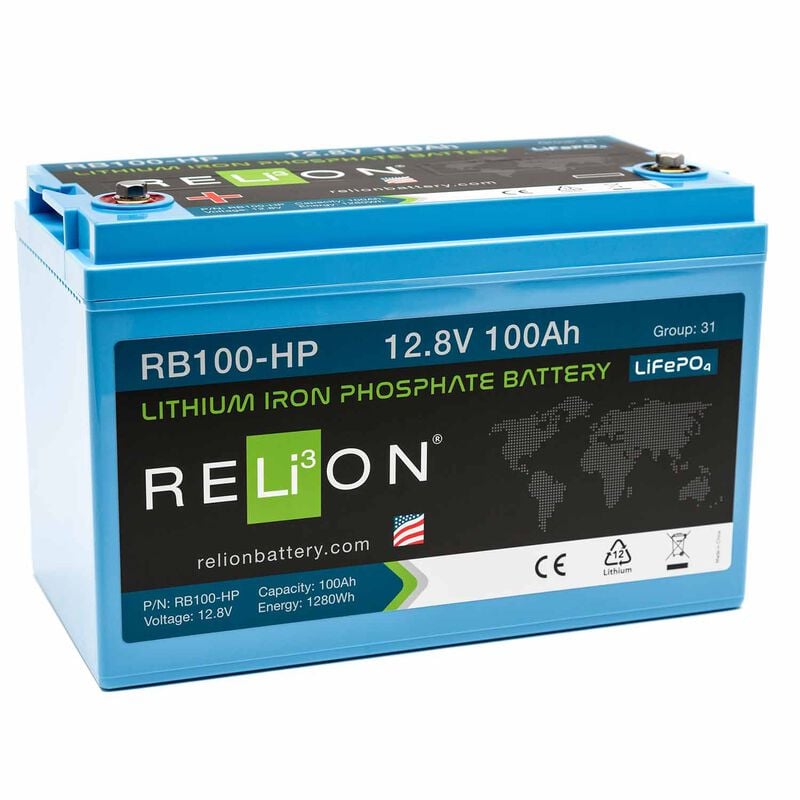
Top features: The RELiON Group 31 RB100-HP Lithium Iron Phosphate Dual Purpose Battery brings lithium technology to dual purpose applications. Weighing 50–60% less than a comparable lead-acid battery and with a lifespan up to 10 times longer, this battery is a significant upgrade over flooded dual purpose batteries. It retains 80% of rated capacity after 2,000 cycles and delivers 100% of its capacity regardless of the discharge rate — unlike lead-acid batteries, which lose effective capacity under high-current loads.
Specifications:
- Battery type: Sealed Lithium Iron Phosphate (LiFePO4), Dual Purpose
- Amp hours: 100 Ah Marine cranking amps: Up to 800 MCA
- Reserve minutes: 240
What makes it stand out: The RELiON RB100-HP is the only lithium starting battery that meets Mercury’s new engine specifications for lithium compatibility — a meaningful distinction for Mercury outboard owners, who should verify their engine’s charging system is compatible with lithium batteries before switching. The built-in Battery Management System (BMS) protects against overcharge, over-discharge, and short circuit automatically.
Who it’s right for: Boaters upgrading to lithium for the first time who need starting capability as well as house power from a single battery. The weight reduction is particularly valuable on small trailerable boats where weight placement affects trim, and on performance boats where every pound matters. If your engine is Mercury and you’ve been hesitant to switch to lithium over compatibility concerns, this is the battery that addresses that directly. Note: lithium batteries require a lithium-compatible charger — a standard lead-acid charger will not charge them correctly.
West Marine Group 27 Dual Purpose Marine Battery
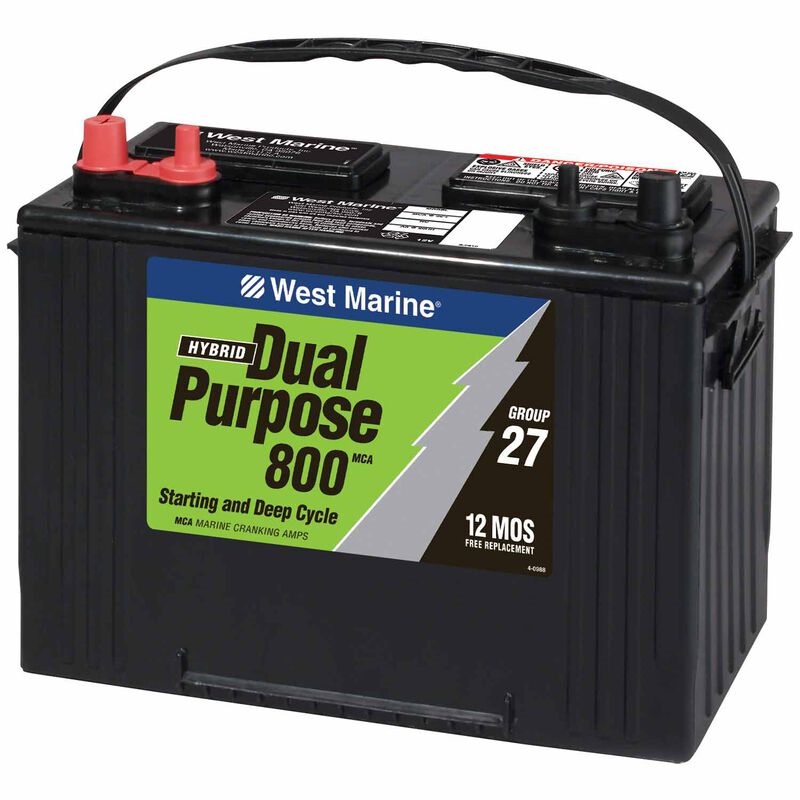
Top features: Our West Marine Group 27 Dual Purpose Marine Battery delivers the cranking amps needed for your engine and the deep cycle capacity for electronics and accessories. It features a no-spill design that allows the battery to be used at up to a 45° heel angle, making it suitable for both sailboats and powerboats. Over 250 quality assurance checks ensure it will perform season after season.
Specifications:
- Battery type: Flooded, Dual Purpose
- Amp hours: 80 Ah
- Marine cranking amps: 800 MCA
- Reserve minutes: 175
What makes it stand out: An affordable flooded dual purpose battery that is suitable for both sailboats and powerboats, with a 45° heel tolerance that most sealed batteries also meet but that flooded batteries typically do not. The Group 27 size is slightly smaller and lighter than the Group 31 batteries above, making it a practical choice for boats with more limited battery compartment space.
Who it’s right for: Boaters with smaller engines, tighter battery budgets, or boats with limited battery compartment space. If you have a smaller outboard (under 150 HP), run moderate electronics loads, and want a proven dual-purpose battery at an entry-level price, this is a reliable starting point. Keep in mind that flooded batteries require periodic water addition and must be mounted upright, unlike the AGM batteries above.
Ready to Buy?
Before you commit to one of these, confirm that the marine cranking amps (MCA) the battery provides is equal to or greater than the starting battery in your boat. Check your engine manual or the label on your current battery for the minimum MCA requirement. All four batteries listed above cover a wide range of engine sizes — but if you have a large displacement inboard or diesel, verify the MCA rating against your engine’s specification before purchasing.
Frequently Asked Questions
What is a dual purpose marine battery?
A dual purpose battery is designed to both start an engine (deliver high cranking amps in a short burst) and power accessories over an extended period (deep cycling). Dedicated starting batteries optimize for cranking power but have thin plates that are damaged by deep discharge. Dedicated deep cycle batteries have thick plates for extended discharge but cannot deliver the high burst current needed to crank an engine reliably. Dual purpose batteries compromise between these two designs — they can do both, but are not the optimal choice for extreme demands at either end. For boats that need to run a trolling motor extensively and start a large engine reliably, a dedicated starting battery paired with a dedicated deep cycle battery is still the better long-term investment.
What is the difference between AGM and flooded marine batteries?
Flooded (wet cell) batteries use a liquid electrolyte and require periodic water addition to replace what evaporates during charging. They must be mounted upright, cannot be used in enclosed spaces without ventilation (they off-gas hydrogen during charging), and are the least expensive option. AGM (Absorbed Glass Mat) batteries absorb the electrolyte into glass mat separators. They are sealed, maintenance-free, spill-proof, can be mounted in any orientation, do not off-gas under normal charging, accept a higher charging rate, and have a lower self-discharge rate. AGM batteries cost more but are superior in nearly every practical dimension for marine use.
Can I use a lithium battery as a starting battery on my boat?
Yes, with the right battery and the right charging system. LiFePO4 (lithium iron phosphate) batteries like the RELiON RB100-HP are designed to deliver the high cranking current needed to start engines. However, your alternator and charging system must be compatible with lithium batteries. Many older marine alternators have regulators designed for lead-acid chemistry and will not charge lithium batteries correctly — some will damage lithium batteries or be damaged themselves. Check your engine manufacturer’s specifications before switching. Mercury has specific lithium compatibility requirements that the RELiON RB100-HP meets. Also note: you will need a lithium-compatible battery charger for dockside charging.
What is the difference between MCA and CCA?
Both measure a battery’s ability to deliver cranking current, but at different temperatures. CCA (Cold Cranking Amps) is measured at 0°F (−18°C) — it represents how much current the battery can deliver for 30 seconds at freezing temperatures while maintaining 7.2 volts. MCA (Marine Cranking Amps) is measured at 32°F (0°C), a less demanding condition that produces a higher number from the same battery. Marine batteries are typically rated in MCA because boats operate in above-freezing water conditions more often than automotive applications. When comparing marine batteries, use MCA for like-for-like comparisons. When comparing a marine battery to your engine’s CCA specification, a general rule is that MCA ≈ CCA × 1.2, so a 1,000 MCA battery is roughly equivalent to an 833 CCA battery.
Need More Help?
Our in-store teams have you covered. With plenty of lifelong boaters on our crew, we have the know-how you need for any project. Find your nearest West Marine store.


