
Every skilled boater knows that reading buoys is like understanding a secret language, one that keeps you safe and in control on the water. Whether you're navigating a tricky channel, avoiding hidden hazards, or simply finding your way back to the marina, these floating guides are your best friends.
This guide covers 49 of the most common buoys you’ll encounter—what they look like, what they mean, and how to use them like a pro. So, grab your charts, sharpen your skills, and let’s cast off!
- Navigational Buoys
- Regulatory and Warning Buoys
- Specialized Buoys for Waterways & Harbors
- Buoys Used in Specific Water Activities
- Deep Water & Offshore Buoys
- Conclusion
- Buoys offered by West Marine
- We're Here to Help!
- Related Articles
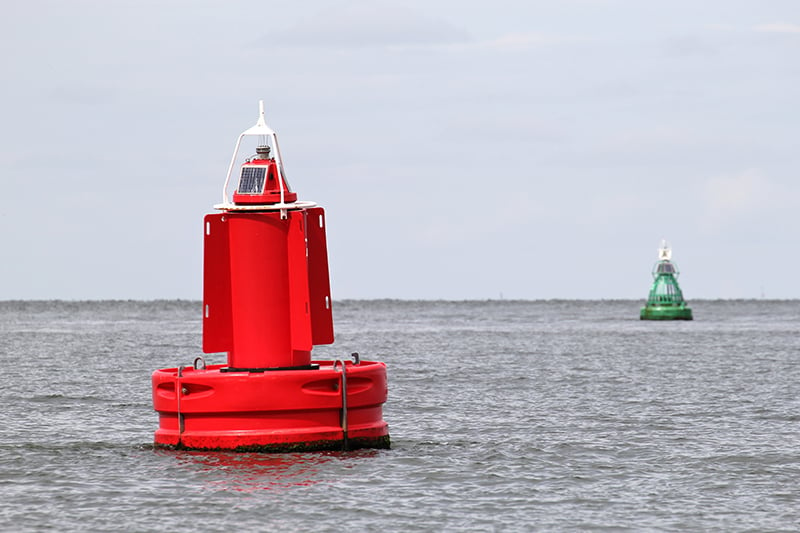 Channel marker buoys.
Navigational Buoys
Navigational buoys serve as the waterway’s roadmap, guiding boats safely through channels, marking hazards, and ensuring a smooth passage. These buoys come in distinct colors and shapes, such as red and green lateral markers, striped safe water buoys, and cardinal buoys that indicate the safest direction around a hazard. Understanding these buoys is essential for safe and efficient navigation.
1. Lateral Buoys (Red & Green Channel Markers)
Description: Floating cylindrical or conical buoys that mark the edges of a navigable channel. Red buoys have even numbers, while green buoys have odd numbers.
Function: Marks the sides of a navigable channel, guiding boats safely through the waterway.
2. Port-Hand Buoy (Red)
Description: Cylindrical (can-shaped) buoy indicating the left side of a channel when entering from seaward.
Function: Marks the port (left) side of a channel when returning from the sea.
3. Starboard-Hand Buoy (Green)
Description: Conical (nun-shaped) buoy marking the right side of a channel when entering from seaward.
Function: Marks the starboard (right) side of a channel when returning from the sea.
4. Preferred Channel Marker (Red & Green)
Description: A horizontally striped red and green buoy indicating which side to pass for the preferred channel.
Function: Indicates the preferred channel when a waterway splits or a channel has a primary side for navigation.
5. Safe Water Buoy (Red & White Striped)
Description: A vertically striped buoy (red and white) with a spherical, cylindrical, or pillar shape that marks safe water.
Function: Marks safe, navigable water that is clear of hazards.
6. Isolated Danger Buoy (Black & Red Bands)
Description: A black buoy with one or more horizontal red bands and two black top marks, placed over a hazard surrounded by safe water.
Function: Indicates a submerged hazard, such as a rock or wreck, in otherwise safe waters.
7. Special Purpose Buoy (Yellow)
Description: A cylindrical or pillar buoy used to indicate cautionary areas such as pipelines, dredging zones, or military areas.
Function: Marks areas with special purposes or specific warnings, such as private zones or restricted access.
8. Cardinal Buoy (North, South, East, West)
Description: A yellow and black buoy with two triangular top marks indicating safe water direction relative to a hazard.
Function: Indicates the safest direction for passage relative to a hazard, marking safe water zones.
Regulatory and Warning Buoys
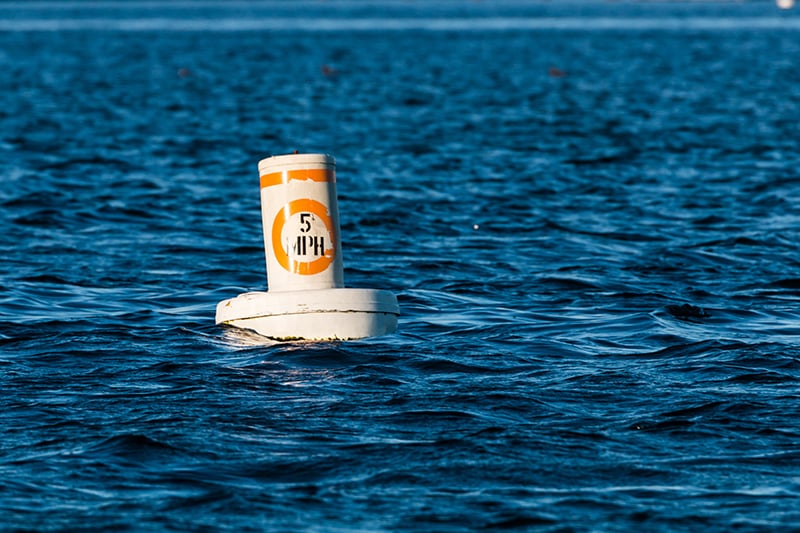 Speed limit buoy.
Regulatory and warning buoys communicate important rules and safety precautions to boaters. These buoys are typically white with orange markings and shapes, indicating speed limits, no-wake zones, hazards, or restricted areas. Paying attention to these markers helps prevent accidents and ensures responsible boating.
9.No-Wake Buoy
Description: White cylindrical buoy with an orange crossed-circle symbol, indicating no-wake zones.
Function: Marks areas where boats must travel at idle speed to avoid creating large wakes.
10. Speed Limit Buoy
Description: White buoy with an orange square or circle displaying speed limits in knots or miles per hour.
Function: Indicates speed restrictions in specific areas to ensure safe boating practices.
11. No-Entry Buoy
Description: White buoy with an orange diamond and a black diagonal slash, marking restricted areas.
Function: Indicates zones where boat entry is prohibited, such as military areas or protected environments.
12. Hazard Buoy
Description: White buoy with an orange diamond symbol, warning of submerged dangers like shoals or wrecks.
Function: Warns boaters of potential hazards below the water’s surface, such as rocks or wreckage.
13. Swim Area Buoy
Description: White buoy with an orange crossed-circle or text marking designated swimming areas.
Function: Marks areas designated for swimming, where boaters should avoid entering.
14. Diver Down Buoy
Description: A red buoy with a white diagonal stripe or a white buoy with a red flag, signaling divers in the water.
Function: Alerts boaters to the presence of divers, ensuring safe passage around dive sites.
15. Information Buoy
Description: White buoy with an orange square, providing non-regulatory information (e.g., marina locations).
Function: Provides helpful information, such as directions to nearby facilities or changes in navigational conditions.
16. Keep-Out Buoy
Description: White buoy with an orange diamond and a cross, marking areas where boats are prohibited.
Function: Marks areas where boat entry is restricted, often for safety or environmental protection.
17. Fishing Restriction Buoy
Description: Yellow buoy with a black fish symbol or text indicating fishing regulations.
Function: Marks areas where fishing is restricted or regulated, to protect fish populations.
18. Pipeline or Cable Buoy
Description: Yellow cylindrical or pillar buoy marking underwater pipelines or cables.
Function: Marks the location of submerged pipelines or cables to prevent damage from passing vessels.
Specialized Buoys for Waterways & Harbors
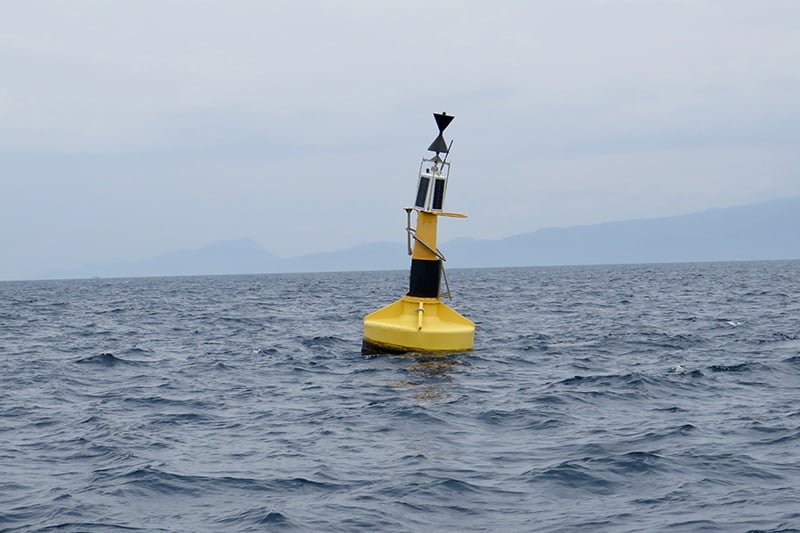 Weather buoy.
Specialized buoys in harbors and waterways serve unique purposes, such as guiding ships to anchorages, indicating security zones, or collecting scientific data. These buoys vary in size and color and are often equipped with lights, sensors, or communication devices to assist maritime operations.
19. Anchorage Buoy
Description: Yellow or white buoy marking designated anchoring areas, often with a black anchor symbol.
Function: Indicates designated areas for vessels to anchor safely in harbors or sheltered waters.
20. Security Zone Buoy
Description: Yellow or white buoy with black text marking security-sensitive zones near government or military installations.
Function: Marks restricted zones where access is limited due to security concerns.
21. Quarantine Buoy
Description: Yellow buoy with a black "Q" indicating a quarantine area for incoming vessels.
Function: Marks areas where incoming vessels must undergo quarantine procedures before entering the port.
22. Weather Buoy
Description: Large yellow buoy equipped with meteorological instruments to collect weather data.
Function: Monitors environmental conditions like wind speed, air pressure, and temperature for weather forecasting.
23. Scientific Buoy
Description: Yellow buoy with solar panels or antennas used for research and data collection.
Function: Collects data on various marine conditions for scientific research and environmental monitoring.
24. Traffic Separation Buoy
Description: Red or green buoy used to regulate vessel movement in heavy-traffic areas.
Function: Guides vessels through busy waterways to ensure safe passage and prevent collisions.
25. Dredging Buoy
Description: Yellow or red buoy marking active dredging operations or temporary channels.
Function: Marks areas where dredging is taking place, directing boats to avoid the work zones.
26. Ice Buoy
Description: White or yellow buoy used to mark safe passage through icy waters.
Function: Indicates channels or paths free of ice, ensuring safe navigation in freezing conditions.
27. Harbor Entrance Buoy
Description: Large red or green buoy marking the entrance to a harbor, often fitted with a light or bell.
Function: Marks the safe entrance to harbors or ports, helping vessels navigate safely at night.
28. Pilot Boarding Buoy
Description: Yellow buoy marking designated areas where maritime pilots board ships.
Function: Indicates locations where pilots are picked up to guide ships into port.
Buoys Used in Specific Water Activities
 Kayak trail buoy.
Certain buoys are used to mark areas designated for recreational or specialized water activities. These buoys, often bright in color, help define race courses, designate swimming zones, or separate watercraft activities to enhance safety and organization.
29. Race Course Buoy
Description: Inflatable or fixed bright-colored buoys marking the course for sailing or powerboat races.
Function: Defines the path for racing events, marking boundaries for competitive water sports.
30. Water Ski Buoy
Description: Small yellow or orange buoy marking water skiing areas or slalom courses.
Function: Indicates areas where water skiing is permitted, including designated slalom courses.
31. Rowing Lane Buoy
Description: Bright-colored cylindrical buoy marking rowing lanes for competitions.
Function: Marks the designated lanes for rowing events, keeping other boats clear of the racecourse.
32. Kayak Trail Buoy
Description: Small white or green buoy marking designated kayaking routes.
Function: Guides kayakers along established trails, ensuring a safe and enjoyable paddle.
33. Personal Watercraft (PWC) Buoy
Description: White or yellow buoy designating zones for jet skis and similar craft.
Function: Marks areas specifically for personal watercraft, keeping them separated from other vessels.
34. Event Marker Buoy
Description: Temporary inflatable buoy used for marine events or competitions.
Function: Marks specific locations for events like boat races, regattas, or other aquatic competitions.
35. Artificial Reef Buoy
Description: White or yellow buoy marking the location of artificial reefs for divers and anglers.
Function: Marks the location of artificial reefs, providing an attractive spot for diving or fishing.
36. Fish Habitat Buoy
Description: Yellow buoy with a black fish symbol, marking fish conservation zones.
Function: Indicates zones set aside to protect fish populations and marine ecosystems.
37. Seaplane Buoy
Description: White buoy marking designated seaplane landing and takeoff areas.
Function: Marks safe areas for seaplanes to land and take off, often near harbors or lakes.
38. Floating Dock Buoy
Description: White or yellow buoy marking floating docks and platforms.
Function: Marks the location of floating docks or platforms, ensuring boaters navigate safely around them.
39. Mooring Buoy (White with Blue Band)
Description: A white spherical or cylindrical buoy with a single blue stripe, used for mooring boats.
Function: Provides a location where boats can anchor temporarily, typically in marinas or harbors.
Deep Water & Offshore Buoys
Deep-water and offshore buoys serve critical functions in open waters, from monitoring ocean conditions to marking shipping lanes. These buoys are usually large, brightly colored, and equipped with sensors, lights, or communication technology to aid navigation and scientific research.
40. Oceanographic Buoy
Description: Large orange, yellow, or red buoy with instruments for long-term environmental monitoring.
Function: Collects data on oceanographic conditions such as temperature, salinity, and currents for scientific purposes.
41. Wave Measurement Buoy
Description: Yellow buoy with wave-sensing instruments to measure sea conditions.
Function: Measures wave height, period, and direction, providing real-time data on sea conditions.
42. Oil Platform Marker Buoy
Description: Yellow or red buoy marking the perimeter of offshore oil rigs.
Function: Marks the boundaries of oil rigs to prevent vessels from approaching too closely.
43. Submarine Exercise Buoy
Description: Yellow buoy marking areas of submarine training or testing.
Function: Marks areas used for submarine exercises, warning vessels to stay clear of these restricted zones.
44. Military Restricted Zone Buoy
Description: White, yellow, or red buoy marking off-limits military areas.
Function: Marks areas restricted for military use, often near naval installations or training zones.
45. Deep-Water Mooring Buoy
Description: Large white buoy with a blue band, used for mooring large vessels offshore.
Function: Provides a safe mooring point for large vessels in deep water.
46. Shipping Lane Buoy
Description: Red, green, or yellow buoy marking international shipping routes.
Function: Marks major shipping lanes, guiding large vessels along internationally recognized routes.
47. Storm Warning Buoy
Description: Red or yellow buoy fitted with flashing lights to signal severe weather conditions.
Function: Alerts vessels of impending storms or severe weather, ensuring safe navigation.
48. Tide Gauge Buoy
Description: White or yellow buoy with instruments for measuring tidal levels.
Function: Monitors and records tide levels, providing essential data for navigation and scientific research.
49. Cable Crossing Buoy
Description: Yellow buoy with black text marking the presence of underwater cables.
Function: Marks locations where underwater cables cross, preventing damage from vessel anchorages or other activities.
Conclusion
Navigational buoys are like traffic lights and road signs for the water—they keep everything moving safely and smoothly. Just as you wouldn’t ignore a stop sign or a one-way street, you shouldn’t overlook buoys when boating. By paying attention to these markers, you’ll avoid hazards, stay on course, and make every trip safer for yourself and those around you.
Buoys offered by West Marine
While you won't find a sophisticated, high-tech weather buoy at West Marine, you will find a variety of other buoys mentioned in this article, Here are some links for you to explore:
Shop Mooring Buoys>
Shop Regulatory and Warning Buoys>
Shop Sure-Mark™ Buoy Labels>
Shop Crab Buoys>
We're Here to Help!
Whether you need a set of marker buoys, life jackets, fishing gear, or anything else for your boat, West Marine has you covered. Shop online or visit one of our 230+ stores. Use our store locator to find the nearest West Marine location!


