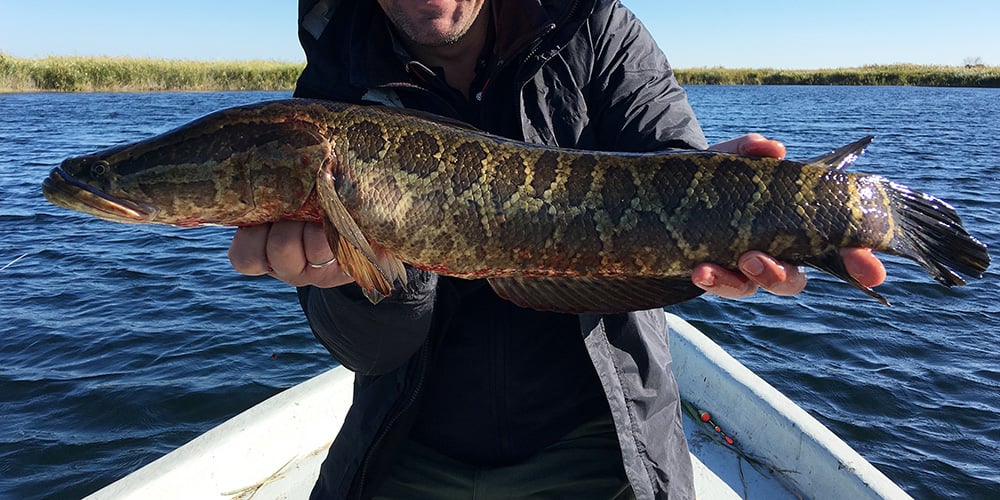
Snakehead — officially renamed the Chesapeake Channa by the Maryland General Assembly in 2024 — are one of the most exciting invasive sport fish in the eastern United States. They hit hard, fight dirty, and once you’ve seen a hollow-body frog disappear in an explosion of white water over a grass mat, you’ll understand why dedicated snakehead anglers plan entire seasons around this fish. We have the fishing gear and the advice you need to get into them.
- Where to Find Snakehead
- When to Fish for Snakehead
- Gear Setup
- Best Baits and Lures
- Techniques That Work
- Regulations and Table Fare
- FAQs
Where to Find Snakehead
What started with a single Crofton, Maryland pond in 2002 has spread dramatically. Snakehead have now established populations in at least 14 states — from the Mid-Atlantic corridor down through Florida, west to California, and even in Hawaii. In the Mid-Atlantic, the Potomac River and its extensive tributary system is the epicenter. The Rappahannock, Susquehanna, Nanticoke, and the Blackwater National Wildlife Refuge are all productive. Delaware, Pennsylvania, New Jersey, New York, Arkansas, and Georgia all have fishable populations.
Reading the Water
Snakehead are shallow-water, cover-oriented predators. The main river channel is rarely productive — focus almost exclusively on slow-moving, vegetated water with three to six feet of depth. The best locations:
- Feeder creeks and backwaters: The tributaries that feed major rivers, not the rivers themselves. Tidal creeks with grass beds and lily pad fields on the Potomac are the most consistent producers in the Mid-Atlantic. If you’re new to an area, find the creek mouths and work inward — fish concentrate where tidal flow meets the stagnant backwater.
- Grass mats and pad fields: Dense surface vegetation is prime snakehead territory. They hold underneath, dart out to ambush prey, and return to cover. The thicker the better — if you’re snagging, you’re in the right place. Switch to a weedless frog or Texas-rigged plastic and fish deeper into the mat.
- Transition zones: The edges where open water meets grass mats, submerged timber, or dock pilings concentrate fish. These are the highest-percentage casting targets on any body of water. Cast parallel to the edge, not perpendicular into it.
- Docks and woody cover: Where vegetation is sparse, snakehead will use any available structure. Docks, fallen timber, and bridge pilings all hold fish. Skip a frog up under dock walkways the same way bass anglers skip under docks — snakehead respond to the same presentation.
- Shallow bays and lake margins: Backwater bays in lakes with established grass or pad cover fish similarly to tidal creeks. On impoundments with snakehead populations, look for areas where inflowing streams create warmer water and carry baitfish into the vegetation edges.
One location tip that experienced Potomac anglers emphasize: don’t overlook water that looks too shallow. Snakehead will sit in grass with their backs barely covered. If you can see a dorsal fin above the surface, you’re in the right place — slow down, make a careful approach, and put the lure beyond the fish rather than on top of it.
When to Fish for Snakehead
Time of Day
Snakehead are warm-water fish and activity peaks when water temperatures are highest. The window from 2:00 pm to 5:00 pm produces consistently for most anglers, as afternoon heat pushes fish into the shallows to feed. That said, snakehead also feed at night — bowfishing and night casting with topwater lures can be extremely productive from late spring through summer, especially on warm, calm nights when fish cruise the surface edges of grass beds. Dawn can also be productive before the heat of the day pushes fish deeper into cover, particularly in midsummer when midday surface temperatures get very high.
Season
The fishery comes alive when water temperatures climb above 65°F in spring and stays productive until temperatures drop in October or November. The very best fishing is typically late May through early September — peak summer heat drives the most aggressive topwater activity. Snakehead don’t hibernate but become nearly dormant in cold water and are difficult to locate in winter. Slow presentations like Texas-rigged plastics dragged along the bottom near deep structure are the best approach in cool water if you want to target them year-round. Spring is also when snakehead nest and guard eggs and fry, making them particularly aggressive and territorial — a lure worked near a nesting pair will often draw an immediate, violent response.
Spawning Behavior
Snakehead typically spawn from late spring through late summer, potentially multiple times per season. Both parents build a circular nest in vegetation and actively guard eggs and fry, attacking anything that comes near. The fry school near the surface and the parents circle below them — if you see what looks like a ball of tiny fry on the surface surrounded by nervous water, you’re looking at an active nest. If you catch a snakehead and immediately hook another on the next cast from the same spot, you’ve likely found a nesting pair. Some anglers choose not to target actively nesting fish; check your state’s regulations for any specific guidance.
Gear Setup
Rod and Reel
A 7’ to 7’6” medium-heavy to heavy baitcasting rod with a fast action tip is the standard setup for snakehead. The backbone needs to drive hooks through hard mouths and pull fish out of heavy cover immediately after the strike — a rod that loads up slowly will cost you fish in the grass before you can turn them. The fast tip helps on topwater lures by allowing the frog to walk properly on a slack-line cadence. Pair with a baitcasting reel sized for the cover you’re fishing:
- High gear ratio (7:1 or faster): Topwater lures like frogs and buzzbaits — lets you pick up slack quickly after the strike and keep the lure moving at the right pace across the mat without the lure diving below the surface on a slow retrieve.
- Medium gear ratio (6:1): Live bait, soft plastics, and jigs — the best all-around choice if you’re carrying one rod. Provides enough retrieve speed for most presentations without sacrificing the torque needed for fighting fish in heavy cover.
- Low gear ratio (5:1): Deep-running crankbaits — lower ratio provides more torque to grind a diving lure through resistance and helps prevent lure blowout at speed.
If you’re new to baitcasting, start with a medium gear ratio reel and one versatile medium-heavy rod. A quality baitcaster with a well-tuned magnetic brake system will minimize backlashes as you develop your casting stroke. Most Potomac guides recommend a name-brand reel in the $100–$200 range over a budget reel — the difference in casting smoothness and drag performance is significant in heavy-cover fishing where every fish hooked needs to be turned immediately.
Line and Leader
Braided line is non-negotiable for snakehead fishing in heavy cover. Monofilament will fray, stretch, and break on grass and lily pad stems; braid cuts through cleanly and has zero stretch, which lets you feel every subtle strike and drive the hook home the instant you feel weight. The difference in hook-up rate between braid and mono in heavy cover is dramatic. Standard setups:
- 30–50 lb. braid for most frog and topwater fishing in heavy grass and pad fields. The heavier end is appropriate for the densest cover where you need maximum pulling power to horse a fish out before it wraps you in vegetation.
- 20–30 lb. braid for lighter presentations in open water or less dense cover where lure action and longer casts matter more than brute strength.
- Fluorocarbon leader (20–30 lb., 2–3 feet): Optional but recommended in clear water or pressured areas — fluorocarbon is nearly invisible underwater and reduces the chance of spooking fish that have seen a lot of fishing pressure. Attach with a double uni knot or Alberto knot. In stained or dark water typical of Potomac backwaters, a leader adds little and you can tie directly to the braid.
Best Baits and Lures for Snakehead
Snakehead are opportunistic predators that eat fish, frogs, crayfish, insects, small mammals, and waterfowl. They have been documented consuming birds and rodents that fall into the water. Almost anything that moves near them can trigger a strike — but some presentations are significantly more productive and more fishable in the heavy cover where snakehead live.
Hollow-Body Frog Lures
The go-to snakehead lure. Hollow-body frog lures are weedless by design — the hooks ride point-up inside the soft body and don’t snag on surface vegetation. They can be walked across the surface of the densest grass mats and lily pad fields where snakehead hold, which is exactly where you need to present a lure. Walk the frog with a steady rod-tip-twitching cadence, moving the rod tip side to side in short strokes while reeling just fast enough to maintain tension. Pause over every open pocket, edge, and dark water gap in the vegetation — these are the spots where snakehead are most likely to be looking up.
When you see an explosion, resist the instinct to set the hook at the first visual strike — this is the single most common mistake new snakehead anglers make. Wait until you feel weight on the line, then set hard with a long sweep of the rod. Snakehead frequently miss frogs on the first strike and circle back immediately for a second attempt; if you lift the lure at the first splash, you pull it away from a fish that would have eaten it on the next half-second. Drop the rod tip after the miss and let the frog sit dead in the water — a follow-up strike often comes within seconds.
Buzzbaits
Buzzbaits produce well along the edges of grass mats and in transition zones between cover and open water. They work better than frogs in areas where surface vegetation is less dense — the buzzbait blade needs to run cleanly on the surface without fouling constantly on vegetation. Their noise, surface disturbance, and flash can pull snakehead out of cover from several feet away, making them effective for covering water quickly along a long grass edge. Run a trailer hook on any buzzbait for snakehead — their strikes are explosive but they sometimes miss the main hook on fast-moving topwater lures, and a trailer drastically improves hook-up rate.
Chatterbaits and Swimbaits
When snakehead aren’t committed to surface presentations — post-frontal conditions, cooler water, midday on a pressured fishery — chatterbaits and bladed jigs with a paddle-tail swimbait trailer fish just below the surface through and around emergent vegetation. The blade creates vibration and flash that mimics a struggling baitfish. These are particularly effective in fall when water temperatures begin to drop and fish move slightly deeper into the base of grass beds. Retrieve slowly enough to maintain contact with the vegetation edges rather than running the lure out into open water.
Topwater Walking Lures
Pencil-style walking lures like a Heddon Zara Spook fished with a “walk the dog” cadence work well in open pockets within grass beds and along edges. Less snag-resistant than frogs in heavy cover, but the side-to-side action can be extremely effective when fish are finicky and not committing to a stationary frog. The longer casting distance of a hard walking lure can also be advantageous in open backwater situations where you want to cover more water.
Soft Plastic Creature Baits
Texas-rigged soft plastics — creature baits, craw imitations, soft jerkbaits — work well on a slower presentation when fish are less aggressive. Fish them weedless through the vegetation, letting them fall into pockets and openings in the grass. The slow, natural drop into a dark pocket in the vegetation is often irresistible to a snakehead that won’t chase a fast-moving surface lure. This is the most productive approach in cooler water, under high pressure, or on post-frontal days when fish are lethargic and holding tight to cover.
Live Bait
Live minnows, crayfish, frogs, and small baitfish native to the area are all effective, particularly for anglers unfamiliar with the water who want to find fish before committing to a specific artificial presentation. Rig live bait weedless on a wide-gap hook and suspend it in or near the edges of cover under a float if needed. The natural movement of a live minnow struggling in a grass pocket is difficult for snakehead to ignore. Live bait also performs well at night when sight casting is not an option and fish are feeding by feel and vibration.
Techniques That Work
Sight Casting
Snakehead are uniquely visible compared to most freshwater sport fish, which is a major part of their appeal. They are obligate air breathers — they must surface periodically to breathe atmospheric oxygen using a modified gill chamber — and their large dorsal fin often breaks the surface when they hold in very shallow water. This means you can actively hunt individual fish rather than blind-casting and hoping.
Polarized sunglasses are valuable here: scan the surface of grass beds and pad fields for the subtle ripple of a dorsal fin breaking the surface, a swirl from a fish rolling to breathe, or the slight disturbance of a snakehead moving through shallow vegetation. When you spot one, cast beyond the fish and bring the lure past its position rather than dropping it directly on top, which can spook a pressured fish. Position the boat or wade so the sun is at your back for the best visibility into the water. Sight-cast snakehead fishing in clear, shallow backwaters on a bright day is some of the most exciting sight-fishing available in freshwater.
Blind Casting Structure
Without visible fish to target, work systematically and cover structure thoroughly. Cast parallel to the edge of a grass mat rather than into it from 90 degrees — the transition zone between grass and open water is where fish actively feed, and a parallel retrieve keeps your lure in that zone for the entire cast rather than just the last few feet. Work every dock piling, fallen tree, bridge shadow, and pocket in the vegetation.
Snakehead are territorial and hold in specific spots. If you catch one from a particular dock or grass pocket, mark the location — another fish will often move into the same territory within days. Experienced Potomac anglers maintain mental maps of productive spots and revisit them throughout the season rather than constantly prospecting new water.
Bowfishing
Bowfishing for snakehead has grown rapidly in popularity, particularly for night fishing when fish are more active near the surface. It allows harvesting large numbers of fish efficiently, which aligns with management goals for this invasive species. A bowfishing setup typically consists of a recurve or compound bow with a bowfishing reel, heavy line, and a barbed arrow with a slide. Spotlights or LED bow-mounted lights illuminate the shallows for targeting. Night bowfishing trips on the Potomac and its tributaries are offered by several guide services if you want to experience this style before investing in equipment.
Hook Setting
The single most common mistake new snakehead anglers make is setting the hook at the first visual strike on a topwater lure. When a snakehead blows up on a frog or buzzbait, pause — keep your rod tip down — wait until you feel the weight of the fish loading the line, then sweep set hard with a long, sustained rod swing. Snakehead have dense, hard mouths that require a firm, committed hook set to drive the hook through. With braid and a fast-action rod, you have zero stretch in the system, which means the set goes directly to the fish. Reel down to eliminate slack first, make contact, then drive the hook home. After the set, keep steady pressure and steer the fish out of cover immediately — a snakehead allowed to turn back into heavy grass after the hookset will bury itself and pop off or throw the hook.
Regulations and Table Fare
Legal Considerations
Snakehead are classified as an injurious species under federal law. Transporting or possessing live snakehead is illegal under federal law and illegal under most state laws as well. If you intend to keep a snakehead, kill it immediately before leaving the water — do not attempt to transport it live under any circumstances. Most states with snakehead populations have no size or possession limits and actively encourage harvest to help manage the population. Regulations vary by state, so confirm current rules with your state fish and wildlife agency before fishing.
In Maryland, catches can be reported to the Maryland DNR at fishingreports@dnr.state.md.us with a photo if possible — this contributes to population monitoring and helps researchers track the spread and density of the fishery.
Eating Snakehead
Snakehead are excellent table fare and one of the better reasons to harvest them. The flesh is firm, white, and mild-tasting — comparable to striped bass or grouper in texture. It holds up well to virtually any cooking method: grilled, pan-seared, fried, baked, steamed, or used in fish tacos. Because the meat is lean and firm it won’t fall apart on the grill the way softer freshwater fish do. Many Chesapeake-area restaurants have begun featuring Chesapeake Channa on their menus specifically because of its culinary quality and the ecological benefit of promoting harvest. Filleting a snakehead is straightforward — they have a standard bone structure similar to bass, and the meat is easy to work with. Skin the fillets and remove the dark lateral line meat if you prefer a milder flavor.
Need More Help?
West Marine is the perfect place to get ready for your next fishing trip. We offer free line spooling and locally assorted tackle in most of our stores to gear you up for what’s biting in your area. With plenty of anglers on our crew, we have the local know-how you need. Find your nearest store.
Snakehead Fishing FAQ
They are the same fish — the northern snakehead (Channa argus). In 2024, the Maryland General Assembly officially renamed the species the “Chesapeake Channa” as part of an effort to rebrand the fish positively and encourage more anglers to target and harvest it. The name change is specific to Maryland; other states still use “snakehead” as the common name. Both names refer to the same invasive species that has established throughout the Mid-Atlantic and beyond.
Yes — in all states where snakehead are established, sport fishing for them is legal and actively encouraged as part of population management. However, transporting or possessing live snakehead is illegal under federal law and most state laws. If you keep a fish, kill it immediately before leaving the water. Most states have no size or bag limits. Check your specific state’s regulations before fishing, as requirements for reporting or recording catches may vary.
Hollow-body frog lures fished across grass mats and pad fields are the most effective and most exciting presentation. They are weedless, can be fished in the densest vegetation where snakehead hold, and produce the explosive topwater strikes the fishery is famous for. Buzzbaits and chatterbaits are strong alternatives along edges and in less dense cover. In cooler water or post-frontal conditions, Texas-rigged soft plastics fished slowly through pockets in the grass are the most reliable producers when fish won’t chase fast-moving surface lures.
30–50 lb. braided line is standard for heavy-cover snakehead fishing. Braid cuts through grass and lily pad stems without fraying, has zero stretch for better hooksets, and gives you the pulling power to turn a fish before it wraps you in heavy vegetation. Add a 2–3 foot fluorocarbon leader in clearer water or on pressured fish. Do not use monofilament in heavy cover — it will fray on vegetation and significantly reduce your hook-up rate and line strength.
Snakehead are aggressive and have sharp teeth — handle them carefully, especially around the mouth. They can bite, and a large snakehead held incorrectly can cause a painful laceration. Use a net to land them and grip them firmly around the midsection as you would a bass — lip-gripping tools work well for controlling the jaw. Do not put your fingers near an unsecured snakehead’s mouth. Outside of a fishing context, snakehead pose no physical threat to humans — they are not venomous and don’t attack people in the water.