From upland creeks in Georgia to cold, clear streams in Maine to the lakes and rivers of California’s Sierra Nevada, trout fishing is one of the most popular freshwater pursuits in the United States. For children, fishing teaches patience and persistence; for adults, a morning on the water is as much about the experience as the catch. This guide covers where to find trout, how to read the water, and the techniques and fishing gear you need to catch them.
- Trout Habitat
- How to Read Trout Water
- Types of Trout
- Best Time of Day to Catch Trout
- When Can You Catch Trout?
- Gear for Trout Fishing
- Bait Fishing for Trout
- Lure Fishing for Trout
- Terminal Tackle: Hooks, Sinkers, and Leaders
- Keep Your Rig Simple
- Trout Fishing Tips
- Catch-and-Release Best Practices
- FAQs
Trout Habitat
Trout require clean, cold, well-oxygenated water. The sweet spot is 50–60°F — below 45°F they become sluggish and feed infrequently; above 68°F their metabolism stresses and they seek cold-water refuges. They are found in rivers, streams, lakes, and ponds with clear water and rocky or gravelly bottoms. They require an environment with abundant insects — caddisflies, mayflies, stoneflies, and their larvae — along with other small aquatic organisms. They also need cover: submerged logs, boulders, undercut banks, and overhanging vegetation where they can hide from predators and ambush prey.
The ideal trout habitat combines riffles (shallow, fast-moving water with a rocky bottom that oxygenates the water and produces insect life) and pools (deeper, slower water where trout rest and hold between feeding). Understanding where trout position themselves within that structure is the foundation of consistently catching them.
How to Read Trout Water
Knowing where trout hold in a given piece of water is as important as knowing what they’re eating or what lure to use. Trout are efficient: they position themselves where the current delivers food to them without requiring much energy to hold position. The key locations:
- Behind boulders and rocks: The downstream side of any substantial rock creates a low-pressure zone where trout can hold with minimal effort while food drifts into the eddy. The upstream side of large boulders also holds fish in certain flows.
- Pools below riffles: Riffles produce insect life and tumble it into the pool below. The head of a pool — where the riffle dumps in — and the tail of a pool — where the water shallows and speeds before the next riffle — are the two most productive zones in any pool.
- Undercut banks: The inside bend of a stream frequently produces undercut banks where the current has eroded the bank from below. These are classic big-trout lies — deep, shaded, with cover above and current delivering food.
- Log jams and fallen timber: Any woody structure in the water provides both cover and current breaks. Work the downstream edge and any seam between the current and the slack water on the inside of the structure.
- The seam: Where fast water meets slow water, a visible current seam forms on the surface. Trout hold in the slow water just inches from the fast water, intercepting food that rides the current. The seam is often the most productive single feature in a stretch of river.
- Overhanging vegetation: Terrestrial insects — grasshoppers, beetles, ants — fall from bankside vegetation throughout summer. Trout that live under overhanging vegetation watch for these drops and respond aggressively.
Types of Trout
The most commonly targeted trout species in the United States are rainbow, brown, and brook trout. Each has distinct habitat preferences and behavioral tendencies worth understanding.
Rainbow trout (native to the Pacific coast, now widely stocked throughout the US) are the most commonly stocked trout and the species most beginners encounter. They prefer slightly warmer and faster water than brown trout, are more aggressive in their feeding behavior, and tend to fight harder pound for pound. In rivers they often hold in faster riffles and pocket water. In lakes they suspend at thermocline depth and can be targeted with trolling or vertical jigging.
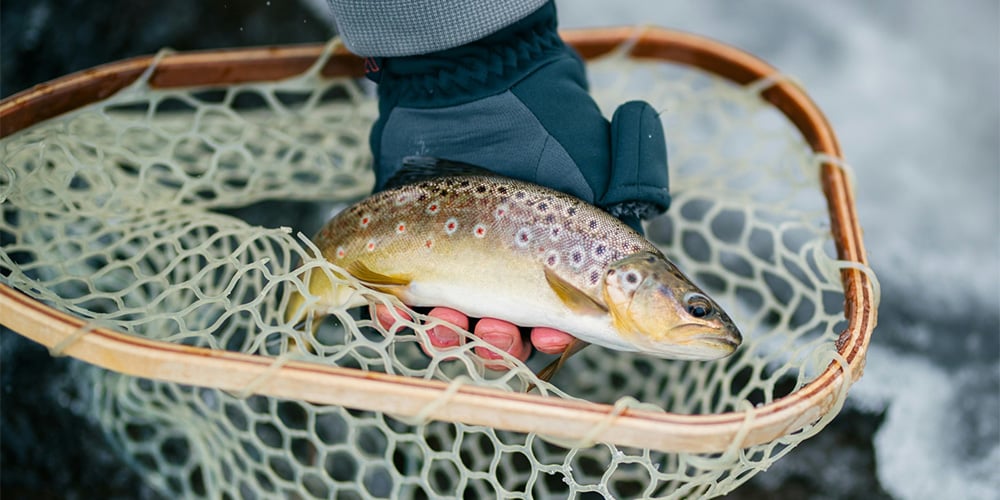
Brown trout (introduced from Europe in the late 1800s) are the most wary and selective of the common trout species. They grow large, feed heavily on other fish as well as insects, and often hold in slower, deeper pools than rainbows. Large browns are primarily nocturnal feeders. The biggest brown trout in most rivers are caught at night on large streamers or by fishing after dark with big surface lures.
Brook trout (native to the eastern US, the only true native trout east of the Mississippi) prefer the coldest, cleanest water of any common trout. They are found in high-elevation streams and spring-fed creeks and tend to be less wary than browns, which makes them more accessible for beginning anglers. They are also among the most colorful freshwater fish in North America.
Other species: Cutthroat trout (native to the Rocky Mountains and Pacific Northwest), lake trout (deep, cold lakes across the north), Dolly Varden (Pacific Northwest and Alaska), golden trout (California high country), and Apache trout (Arizona highlands) round out the native US trout family.
Best Time of Day to Catch Trout
Trout feed most actively at dawn and dusk. Early morning — the first two hours after sunrise — is consistently the most productive period on most waters, as low light levels reduce the trout’s wariness and insect hatches are often at their peak. Evening, as shadows lengthen and the water cools, produces a similar feeding window. Midday fishing is productive in early spring when water temperatures are still cold throughout the day, and in fall as temperatures drop. In summer, midday fishing in warm lowland streams often slows to nearly nothing as water temperatures climb above the trout’s comfort range.
Overcast days are generally better than bright sunny days — cloud cover reduces light penetration and makes trout less wary about moving into open water to feed.
When Can You Catch Trout?
Trout can be caught year-round in many states, but most states close specific waters to trout fishing during the fall-to-spring spawning period to protect the fish during their most vulnerable stage. Opening and closing dates vary by state and often by water type (wild trout streams may have different seasons than stocked ponds). Check your state fish and wildlife agency’s current regulations before fishing any new water — regulations change annually. You will also need a valid fishing license and, in some states, a separate trout stamp.
Gear for Trout Fishing
The most versatile trout fishing setup is lightweight spinning gear: a light to medium-light action spinning rod in the 5–7 foot range paired with a small spinning reel spooled with 4–8 lb fishing line.
Rod length and action: Shorter rods (5–6 feet) are better for small, brush-choked streams where casting room is limited. Longer rods (6–7 feet) work better for lakes, open rivers, and situations where you need to control drift over a longer distance. Light to medium-light action rods have the sensitivity to feel subtle bites and the flexibility to cast light lures and baits without breaking light tippet on the hookset.
Line: 4 lb monofilament is the standard for most stream trout fishing with bait. 6 lb mono works for larger rivers and lakes. Fluorocarbon leader material (4–6 lb) is worth using in clear, pressured water — its near-invisibility underwater produces more strikes from wary fish.
Rather than purchasing rod and reel separately, a spinning rod and reel combo simplifies the process. Penn’s Battle® III 1000 Spinning Combo pairs a medium-light, fast-action 6’6” composite rod with the Battle® III 1000 Spinning Reel, designed for 2–6 lb mono with 4 lb as the sweet spot.
Polarized sunglasses are underrated trout fishing gear. They cut glare on the water surface, allowing you to see into the water to spot trout holding in pools, locate structure, and sight-cast to individual fish. Any serious stream fisherman considers them essential, not optional.
Bait Fishing for Trout
Trout can be caught on a wide range of natural and prepared baits. The most effective choices:
- Worms and nightcrawlers: The universal trout bait. A small piece of worm on a size 10 or 12 baitholder hook, weighted lightly with split shot, drifted naturally through a pool or run will catch trout anywhere. Fresh-dug worms outperform old refrigerated ones.
- Salmon eggs: Particularly effective for rainbow trout, which are naturally conditioned to feed on loose eggs during spawning. Use salmon egg hooks (size 8–14) and fish a single egg or a cluster, allowing it to drift naturally along the bottom.
- PowerBait: The go-to bait for stocked trout in lakes and ponds. Hatchery-raised trout are conditioned to floating pellet food, and PowerBait (which floats and has a similar scent profile) is extremely effective on recently stocked fish. Use a Carolina or floating rig so the bait suspends just above the bottom.
- Grasshoppers: During summer, live grasshoppers drifted under overhanging bankside vegetation produce explosive strikes. Hook them through the collar just behind the head on a size 8 or 10 baitholder hook with no weight — let them drift and kick naturally on the surface.
- Crickets and wax worms: Effective alternatives where grasshoppers aren’t available.
Bait presentation in moving water: Pick a location on the downstream side of a boulder, alongside a log, adjacent to an undercut bank, or under overhanging vegetation. Cast upstream of your target and allow the bait to drift naturally with the current to where it passes through the holding zone. Maintain light tension — just enough to feel the bait tap along the bottom. With experience you learn to distinguish the difference between a tap (bottom contact) and a bite, at which point a quick rod jerk sets the hook. If you don’t get a strike, let the bait continue well past the target before retrieving.
Lure Fishing for Trout
Artificial lures cover more water than bait fishing and are often more effective for actively feeding fish. The most productive trout lures:
- In-line spinners (Mepps, Panther Martin, Rooster Tail): The most consistently effective trout lure across all water types. The rotating blade generates flash and vibration that trout respond to even in off-color water. Cast across and slightly downstream, retrieve at a steady pace that keeps the blade spinning. Sizes 1–3 are appropriate for stream trout; larger sizes for lake fish. Gold blades work best in low light and stained water; silver in bright light and clear water.
- Small spoons (Kastmaster, Little Cleo, Swedish Pimple): Excellent for lakes where you need to cast distance and reach suspended fish at different depths. Cast out, count down to the desired depth, then retrieve with a varied speed — a stop-and-go action mimics a wounded baitfish. In rivers, cast upstream and retrieve just fast enough to keep the spoon at depth as it swings through the current.
- Soft plastic swimbaits and grubs: Small (1–3 inch) paddle-tail swimbaits on a 1/16–1/8 oz jighead are extremely effective for lake trout and are often overlooked by stream anglers. Fish them with a slow, steady retrieve at the same depth where you see fish holding.
- Crankbaits: Small (1–2 inch) floating or suspending minnow-style crankbaits (Rapala Original, Rapala Husky Jerk) are deadly on large brown trout in rivers and large rainbow trout in lakes. The twitch-and-pause retrieve triggers reaction strikes from fish that won’t chase a moving lure.
General lure technique in moving water: Cast upstream or across-stream and retrieve across the current, letting the current add action to the lure. Slow down in cold water — trout are less willing to chase fast lures when water temperatures are below 45°F. Speed up in warmer water when trout are actively feeding.
Terminal Tackle: Hooks, Sinkers, and Leaders
Salmon egg hooks have a rounded shape that conceals a single egg, hiding the hook from wary trout. Match hook size to egg size — size 14 (smallest) through size 8 are the most common. Egg hooks in sizes 10 and 12 work well for most salmon egg fishing.
Baitholder hooks have a longer shank and barbs on the shank that hold soft bait in place. Use them for worms, nightcrawlers, PowerBait, grasshoppers, and other live or soft bait. Sizes 8–12 work well for most stream trout fishing.
Fishing hooks in smaller sizes (10–14) are the right choice for trout in clear, pressured water where the fish are wary. Larger hooks are appropriate for night fishing for big brown trout or when using large bait like full nightcrawlers.
Keep Your Rig Simple
In creeks and streams with moderate current, the simplest approach is a single hook tied to the end of the line, relying on the weight of the hook and bait alone. This produces the most natural presentation. In practice, you will usually need to add a small amount of weight — one or two removable split shot sinkers pinched to the line 6–12 inches above the hook. Add as little weight as possible: excess weight makes the bait clunk along the bottom noisily, spooks fish, and causes snags.
For lake fishing where long casts are needed, a Carolina rig works well. For trout, this consists of: a 1/8–1/4 oz egg-style sliding sinker, a glass bead (to protect the knot from the sinker), a small barrel swivel, and 2–3 feet of leader line ending in a hook. The sinker slides on the main line and stays on the bottom while the bait floats or drifts above it. This is particularly effective with PowerBait, which needs to float above the bottom to be visible to trout.
Trout Fishing Tips
- Keep it natural: When bait fishing in moving water, the most effective presentation is one that looks and moves exactly like natural food. Use as little weight as possible and let the current do the work.
- Fish the undercuts: The inside bend of a stream creates undercut banks where the current erodes the bank from below. These are classic holding spots for larger, wary trout that rarely move far from their hiding spot.
- Avoid casting a shadow: Trout have excellent vision above the waterline and will immediately spook if they see your silhouette or shadow pass over the water. Keep the sun at your back when possible, or position yourself so your shadow falls away from the fishing area.
- Practice stealth: Trout can feel vibrations through the water and substrate. Move slowly and quietly along the bank, avoid scraping rocks with your boots, and stay back from the bank edge — your footfall vibrates through the bank and alerts fish in the water below.
- Cast upstream: In moving water, always cast upstream of your target and let the bait or lure drift downstream to where the fish are holding. Trout face into the current and are more likely to see and react to something coming toward them than something approaching from behind.
- Watch your step: Stream fishing often involves wet rocks, algae-covered cobbles, and submerged logs. Wear boots or waders with good grip, wade slowly, and use a wading staff if the current is strong. A fall ruins the day and spooks every fish within 50 yards.
- Match the hatch: If you see insects on the water surface and trout rising to eat them, switch to a lure or fly that approximates the size and color of what you observe. Trout keyed in on a specific insect will frequently ignore everything else.
- Downsize in clear water: In gin-clear, low-flow summer conditions, drop to lighter line (4 lb or even 2 lb fluorocarbon), smaller hooks, and less weight. What works in a spring-runoff river will spook fish in a late-summer pool.
Catch-and-Release Best Practices
Many trout streams — particularly wild trout fisheries — have catch-and-release regulations, and even where they don’t, releasing wild trout helps maintain a healthy fishery for everyone. Proper release technique matters: a poorly handled trout has a much lower survival rate than one released correctly.
- Wet your hands before handling the fish. Dry hands remove the protective slime coat that guards against infection.
- Keep the fish in the water as much as possible. Limit air exposure to under 30 seconds — if you want a photo, have the camera ready before lifting the fish.
- Support the fish horizontally. Never hold a trout vertically by the jaw or tail. Support the body from below with both hands.
- Use barbless hooks or crimp the barb. Barbless hooks allow faster release with less tissue damage and are required on many catch-and-release waters.
- Revive exhausted fish. Hold the fish gently in the current, facing upstream, until it swims away under its own power. A fish that rolls onto its side needs more recovery time.
Frequently Asked Questions
What is the best bait for trout?
It depends on the water and the fish. For stocked trout in lakes and ponds, PowerBait is the most reliable choice — hatchery fish are conditioned to floating pellet food and respond predictably to PowerBait’s floating, scented profile. For wild stream trout, live worms are the universal answer, with salmon eggs highly effective for rainbow trout and grasshoppers extremely effective in summer near bankside vegetation. In heavily pressured catch-and-release streams, artificial lures often outperform bait because the fish have been caught and released on bait repeatedly.
What pound test line should I use for trout?
4 lb monofilament is the standard for most stream trout fishing — light enough not to inhibit the action of small lures and baits, strong enough for most fish you’ll encounter. In clear, pressured water, switch to 4 lb fluorocarbon leader material, which is nearly invisible underwater. In lakes or larger rivers where bigger trout are likely, 6 lb mono is appropriate. Avoid going heavier than necessary — trout are line-shy, especially in low-flow, clear conditions.
What is the best lure for trout?
In-line spinners (Mepps Aglia, Panther Martin, Rooster Tail) are the most consistently effective trout lure across all water types and conditions. The rotating blade produces flash and vibration in any current speed, the lure is easy to cast on light spinning gear, and trout in most environments respond to it throughout the season. Gold blades work best in low light and stained water; silver in bright, clear conditions. For lakes, small kastmasters and Swedish Pimples add the casting distance needed to reach suspended fish.
Do trout bite in cold water?
Yes, but they feed less aggressively and less frequently. Below 45°F, trout metabolism slows significantly and they conserve energy, feeding in short windows rather than actively chasing food. Fish slower, downsize your presentation, and target the warmest water in the system — south-facing pools, the confluence with a warmer tributary, or spring-fed areas. The most successful cold-water technique is a dead-drifted bait moving naturally with the current directly through a holding lie.
Do I need a license to fish for trout?
Yes, in all US states. A valid state fishing license is required, and many states require an additional trout stamp or permit for certain waters. Regulations including season dates, size limits, bag limits, and gear restrictions vary by state and often by specific water body. Check your state fish and wildlife agency’s current regulations before fishing any new water.
Need More Help?
West Marine is the perfect place to get ready for your next fishing trip. We offer free line spooling and locally assorted tackle in most of our stores to gear you up for what’s biting in your area. With plenty of anglers on our crew, we have the know-how you need. Find your nearest store.