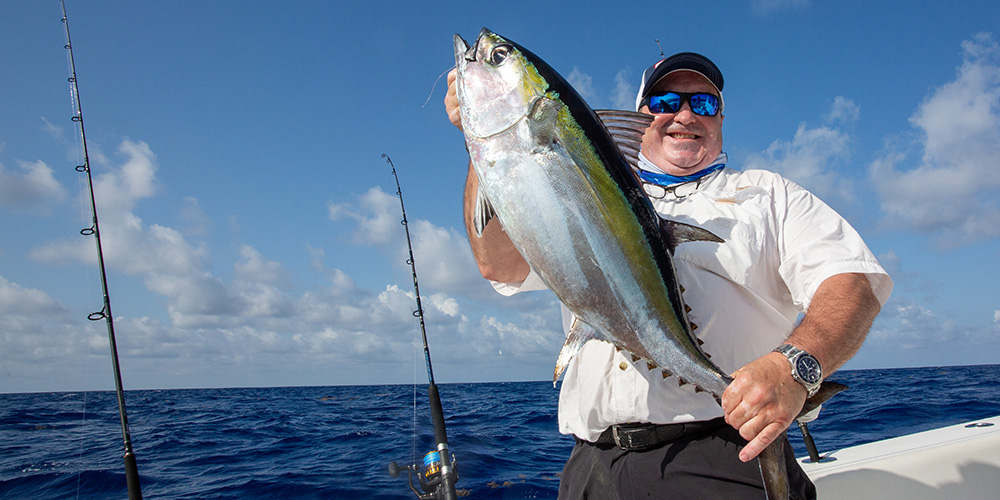
Targeting tuna successfully requires robust gear that can handle their speed and strength, as well as specialized setups for different techniques (trolling, chunking, casting, jigging). Here's a breakdown of recommended fishing rods, reels, terminal tackle and other essentials required for catching tuna:
Article Contents
- Rods
- Reels
- Lines
- Terminal Tackle
- Lures and Baits
- Other Tuna Fishing Gear
- Finding Tuna: Habitats and Signs
- When to Fish: Timing and Conditions
- Techniques by Species
- Bait Prep and Tactics
- Reeling It All In
- How to Catch Tuna FAQs
- Shop the Gear
- We're Here to Help!
- Related Articles
Rods
Stout, high-quality rods are a must for tuna. For trolling or live baiting large tuna, anglers favor heavy-action conventional rods in the 5'6" to 7' range, often with short butts or bent-butts for use in fighting chairs or belt harnesses. These rods are typically rated for 50-130 lb line and have strong backbone to lift powerful fish. For casting and jigging applications (common with medium tuna like yellowfin or albacore), a 7'-8' heavy spinning rod or jigging rod is ideal - look for one that can handle 50-80 lb braid and has a fast tip to work lures but plenty of lifting power. A bit of forgiveness in the rod tip helps absorb sudden runs at the boat. Essentially, choose a rod based on the size of tuna you expect: medium setups for school tuna (10-50 lbs), and true big-game rods for trophy-class fish.
Reels
Both conventional and spinning reels are used in tuna fishing, and each has its place. For trolling and live bait, two-speed conventional reels in the 30 to 80 wide class are standard. Two-speed lever drag reels (by makers like Penn, Shimano, Avet) let you crank in high gear for line pickup and switch to low gear for winching up stubborn tuna from the depths. They should hold ample line (at least 300-500 yards of heavy braid) and have a strong drag (20-40+ lbs of drag pressure) that stays smooth. For casting topwater lures or dropping jigs to busting tuna, anglers often use large spinning reels - typically size 8000 to 14000 (equivalent to 60-100 lb class). Modern saltwater spinning reels have high retrieve speeds and drags capable of 20+ lbs, enabling them to beat surprisingly large tuna on appropriate rods. A high gear ratio (e.g. 5:1 or higher) is helpful for quickly gaining line when a hooked tuna charges toward the boat. Ensure your reels are in top condition; tuna will find any weakness in your gear quickly.
Lines
Go for braided line as your main line for its high strength-to-diameter and low stretch. Common choices are 50-80 lb test braid for school tuna or light tackle scenarios, and 80-130 lb braid for giant tuna hunting. Braid lets you pack hundreds of yards on the spool and helps drive hooks home at a distance.
Terminal Tackle
Terminal tackle includes leaders, topshots and hooks, all of which must be able to sustain the shock of a tuna bite and stand up to the power of these fish.
Topshots and Leaders
Every tuna fishing setup requires a leader, with an optional topshot for added shock absorption. A leader-essential for all tuna rigs-is a short, heavy section (6-20 feet, 80-200+ lb test) of fluorocarbon or monofilament tied to your lure or bait, resisting abrasion from a tuna's rough mouth or tail and reducing visibility for wary species like bluefin or albacore. Fluorocarbon leaders (60-130 lb, 6-8 feet for yellowfin, up to 20 feet for big bluefin) are favored for their stealth, connected to the main line or topshot via a PR knot or wind-on swivel for smooth reeling. A topshot, while optional, is a longer length of monofilament (30-80 feet, 60-80 lb test) tied between braided main line and the leader, adding stretch to absorb shocks from hard-charging tuna like yellowfin or bluefin during trolling or casting. For smaller tuna, like skipjack, a 30-foot 60 lb monofilament topshot can help, but you can skip it and tie the leader directly to the braid. Wire leaders are rarely needed for tuna, as they may spook fish, unlike for sharks; a rare skipjack rig near toothy predators might use light wire. Always inspect your leader-and topshot, if used-after a fight, as tuna battles can fray lines, risking break-offs.
Hooks
Use strong, corrosion-resistant hooks sized to your bait and target tuna. When chunking or live bait fishing for medium-to-large tuna, circle hooks in the 5/0 to 8/0 range are often required by regulation and are a smart choice anyway - they tend to hook in the corner of the mouth, leading to a secure hold and easier release. Look for 2X or 3X strong circles (e.g. Mustad Demon circles or Owner Offshore series). For trolling with rigged baits (like ballyhoo) or larger lures, anglers commonly use J-hooks or tuna-strength treble hooks (e.g. 8/0 or 9/0 4X trebles on big plugs). Ensure any treble hooks or jig assist hooks are beefy enough; stock hooks on some lures can be too weak for tuna and might need upgrading. On vertical jigs, assist hooks with Kevlar cord are attached to the jig's top - sizes 5/0 to 8/0 double assist hooks are typical for 100-300 g tuna jigs. Keep hooks razor sharp; tuna have tough mouths and you want maximum penetration on the hookset.
Lures and Baits
The "right" lure or bait for tuna can depend on species and method, but there are several proven categories:
Trolling Lures
When covering ground to find tuna, trolling is effective. Cedar plugs (cigar-shaped wooden plugs) are a legendary yellowfin and albacore lure - trolled at ~6-8 knots, they mimic small fish and often get hammered by schooling tuna. Also popular are feathers and squid skirts (such as Zuker and Williamson tuna feathers) in colors like blue/white or pink, often rigged in daisy chains. For high-speed trolling (8-12 knots), bullet-head jet lures or resin heads with skirts can entice tuna as well as marlin. Diving plugs like the Rapala X-Rap Magnum (which runs 15-30 ft deep) are deadly on medium tuna - these are typically trolled on the flat lines or down the middles. In many tuna spreads, one might deploy a spreader bar or daisy chain multiple teaser lures simulating a school of baitfish - with a hooked lure trailing behind. Spreader bars with squid imitations are a staple in bluefin tuna hunting in the Northeast. Pro tip: mix up your trolling spread with a variety of lure types and positions (surface and diving) to cover different water depths and mimic a fleeing school of prey.
Live Baits and Chunking
Using bait can be extremely productive. Live bait options include sardines, anchovies, herring, mackerel, or in some areas flying fish or small bonito. Present live baits by slow-trolling them or drifting. Kite fishing (dangling a live bait from a kite so it skips on the surface) is a specialized but very effective method for large tuna (especially bluefin and yellowfin), as it keeps the bait lively and on the surface. Chunking is another time-tested technique: at anchor or drifting, crews toss handfuls of cut bait (chunks of sardine, menhaden, etc.) into the water at intervals to create a chum slick. Tuna smell the trail and, with luck, swim up-current to your boat. Meanwhile, you drift a hooked chunk or live bait back at the same pace as the chum. Chunking is classic for canyon fishing at night in the Atlantic. It's important to use fluorocarbon leaders and perhaps a small circle hook concealed in the chunk for wary tuna. Additionally, setting a butterfly jig or flutter jig to sink beneath the school of chummed fish can provoke strikes from deeper-holding tuna in the area.
Casting Lures
When tuna are feeding near the surface (busting bait or foaming), casting lures to them is one of the most exciting ways to fish. Large poppers (such as Halco Roosta, Yo-Zuri Bull poppers, or Nomad Chug Norris) can draw explosive strikes from tuna as they chug and splash on the surface. Stickbaits (long, slender sinking or floating lures that swim when retrieved) are another favorite - their wounded fish action often entices tuna even when they're not actively surface feeding. Brands like Strategic Angler or Shimano's Orca stickbaits are designed for big tuna. Use heavy spinning gear to launch these lures at breaking fish. Retrieve poppers with a pop-pause cadence, and stickbaits with a sweeping or twitching motion. Pro tip: Watch for working birds and bait "showering" out of the water - this signals tuna pushing bait up, and is the time to cast your lure right into the frenzy. Also, be prepared to crank fast; sometimes a rapid, steady retrieve triggers a reaction bite from tuna on the move.
Jigging
Vertical jigging for tuna involves dropping a heavy metal jig straight down and then retrieving it in an erratic, jerking motion to imitate an injured baitfish. Knife jigs or butterfly jigs (100 to 300 grams, depending on depth and current) are extremely effective, especially when tuna are marked deeper in the water column. Deploy the jig to the tuna's depth (or just above) and work it with rapid lifts and short drops of the rod tip, reeling as you go. Many strikes occur as the jig flutters back down or right after a pause. Jigging can be deadly during low-light or at night, when tuna often hold at intermediate depths. Pro tip from East Coast captains: while chunking at night, drop a flutter jig down to the thermocline or around 100-150 feet and vary your retrieve speed sometimes a slow, tantalizing fall is what a finicky tuna will hit. Use tackle that can handle sudden hits; high drag settings and short powerful jigging rods are common. Also, consider glow-in-the-dark jigs for night fishing (charge them with a light before dropping).
Other Tuna Fishing Gear
A few extra items round out the tuna angler's kit:
Fighting Belts
A quality fighting belt (for stand-up fishing) or a full harness for battling larger tuna will save your back. When a 100 lb tuna dives straight down, you'll be glad for the lower-back support of a harness.
Gaffs
A gaff (at least 4-6 ft in length with a 3-4 inch hook gap) is typically used to land tuna that are destined for the cooler. Make sure it's very sharp. Larger tuna may even require two gaffs or a specialized tuna door on big boats.
Outriggers
Outriggers can improve your trolling spread, letting you troll more lines separated without tangling - useful for covering more water for tuna. Green sticks (used in commercial tuna trolling) and planers are advanced tools some anglers use, but those are more specialized.
Submersible Lights
A Hydro Glow or similar submersible fishing light can be deployed at night while chunking; it attracts baitfish and squid, which can in turn attract tuna into your chum slick.
Landing Net
A large landing net isn't usually employed for big tuna (gaffs are preferred), but for smaller tunas or if practicing release, a knotless rubberized landing net can be handy.
Knives and Cutters
Finally, don't forget a sharp knife or line cutter, pliers (for hook removal), and a sturdy rod holder or rail mount if you need a rest during the fight. On long battles, keeping the line clear of the boat's hull and motors is critical - enlist your crew to help maneuver the boat or clear other lines as needed.
With the right gear tuned up and ready - drags set properly, knots tested - you'll significantly increase your odds of success when that tuna of a lifetime strikes. Tuna fishing is a gear-intensive game, and attention to detail in your tackle can make the difference between landing a trophy and telling a story about "the one that got away."
Finding Tuna: Habitats and Signs
Catching tuna consistently takes not just good gear but also knowledge of where and when to find them, and how to adapt your techniques to different conditions. One thing to remember is that tuna are pelagic wanderers, but they are not random — they follow food and favorable conditions. Here are some places where tuna are often found:
Temperature Breaks and Currents
Tuna often congregate along thermoclines (temperature gradients) or current edges where water of different temperatures meets. These breaks can aggregate baitfish. Offshore anglers use sea surface temperature charts to find slight temp changes (even ~2°F) over underwater structure. For example, the edges of the Gulf Stream or other warm currents can hold yellowfin and bigeye tuna. Troll along these color and temperature breaks for best results.
Offshore Structure
Underwater features like continental shelf drop-offs, canyons, seamounts, and banks tend to concentrate bait and thus tuna. In the Atlantic, the canyons along the shelf (Hudson Canyon, etc.) are famous tuna grounds. In the Pacific, seamounts or ridges can hold bigeye and albacore. Even subtle lumps or submarine mount peaks can create upwellings that attract fish. If you're in blue water and see depth rapidly changing on your chart (e.g., from 1000 ft to 300 ft), you're on a likely hotspot.
Floating Debris and FADs
Tuna, especially species like skipjack and yellowfin, often gather under flotsam - anything from weed lines and driftwood to man-made FADs (Fish Attracting Devices). If you spot a large weedline or floating object, approach it quietly and scan for baitfish or visual flashes of fish. Oftentimes, school yellowfin or skipjack will be orbiting underneath. Casting or trolling around such structure can yield fast action. Off Puerto Rico and other areas, anchored FADs are intentionally placed and become tuna magnets.
Bird Activity
Keep an eye out for diving birds (terns, shearwaters, gulls) or fast-flying frigate birds that are tracking schools of tuna pushing bait to the surface. If you see a cluster of birds repeatedly dipping down to the water, chances are there are predatory fish (tuna or others) corralling bait below. Run toward the action, but approach from upwind/upcurrent and slow down as you near to avoid spooking the fish.
Electronics
Use your boat's fishfinder to look for the "marks" of tuna, which appear as arcs or dense clusters at various depths. These arcs, referred to as "meatballs," are actually schools of baitfish such as sardines, anchovies, or mackerel that have formed into a spherical shape as a defense mechanism against predators like tuna. A technique: after trolling over a promising bait ball that is deep (e.g., 100-300 ft down) where tuna didn't bite, circle back and drop jigs or bait to that depth. Chunking can also pull mid-depth fish up. Additionally, modern CHIRP sonars help locate the thermocline's depth, where tuna often lurk just below it during the day.
When to Fish: Timing and Conditions
Tuna feed and behave differently by time of day, season, and even moon phase.
Dawn and Dusk
These are prime times for tuna fishing. Many tuna species feed more aggressively during low light. At first light, tuna that spent the night deeper will often push bait to the surface, creating the classic dawn topwater bite. Similarly, the last hours of daylight can spark a frenzy. Yellowfin, for instance, are notorious for a flurry of bites at dawn/dusk. Plan to be on the grounds early - sometimes the window of opportunity is brief.
Midday Strategy
As the sun climbs and surface waters warm, tuna often go deeper. They may hold near the thermocline (a depth where water temperature changes) or just above structure or bait schools. During bright midday hours, adjust by trolling deeper lines (use downriggers, planers, or deep-diving lures) or switch to jigging and chunking to target the depths where fish are marked. It's common that tuna stay 200+ feet down at midday but will rise shallower again in late afternoon. Also, if you have live bait, sending one bait down on a weighted line can entice midday tuna that won't come up.
Night Fishing
In some fisheries, night offers excellent tuna action - particularly for yellowfin and bigeye tuna. At night, these tunas often move into the upper water layers under cover of darkness. Techniques like drifting with a chum slick under floating lights can draw them in. Many longrange West Coast trips fish through the night at offshore banks using glow jigs or live squid for bigeye and yellowfin. Bigeye tuna especially are known for feeding deep during the day but coming up shallower at night. If you're set up for it, don't hesitate to put lines out overnight just stay vigilant, as multiple hook-ups in the dark can be chaotic!
Seasonal Patterns
Each species has its season. For example, albacore tuna might only appear in certain areas during summer months when waters hit the right temperature (~60-65°F). Yellowfin and skipjack prefer warmer waters (70-80°F) and may be year-round in tropics, but only summer/fall visitors in temperate zones. Bluefin tuna have distinct migratory runs - e.g., Atlantic bluefin are in the Gulf of Mexico in late spring (spawning time, where fishing is closed) then off New England and Eastern Canada in summer and fall. Pacific bluefin show up off California and Baja mainly in summer. Research the seasonal tuna movements for your locale. Water temperature is a big clue: for instance, yellowfin typically show up when warm eddies or currents move in. Local fishing reports and charts of sea temps/chlorophyll can guide you.
Moon and Tides
Many tuna anglers swear by the influence of the moon phase. A common belief is that tuna feed heavily on the nights around a full moon (because they can see bait in bright moonlight) and thus may be a bit more sluggish during the following day. Conversely, dark new-moon nights can make for great daytime bites (tuna had a tougher time feeding at night). Plan trips accordingly - some captains like the few days before the full moon for all-day action, or targeting the full moon itself for productive night chunking. Tidal currents also matter: a good current (either incoming or outgoing tide offshore) can ignite a bite, while slack tide often sees a lull in surface activity. If fishing near islands or gulf stream edges, note when tide rips form (tuna often patrol along strong rip lines for food).
Techniques by Species
While all tunas share similarities, fine-tuning your technique for the species can improve results:
Bluefin Tuna
Bluefin, especially the giant variety, require patience and heavy gear. In the Northeast Atlantic fishery, popular methods include trolling spreader bars and daisy chains, slow-trolling live baits (live mackerel or herring are bluefin candy), and drifting while "chunking" with butterfish or sardines. Bluefin can be selective feeders; at times they gorge on sand eels or halfbeaks and ignore other offerings. Matching the hatch helps for example, if bluefin are on halfbeaks, a slender soft-plastic lure trolled on the surface might work. Bluefin also have incredible eyesight, so use longer fluorocarbon leaders and try to fish during periods of lower light or choppy surface (to break up visibility). In recent years, jig-and-pop techniques (vertical jigging and surface popping) have taken many bluefin, especially the smaller 50-150 lb class fish in the Pacific. Be prepared for an endurance battle with larger bluefin - fights over an hour are common, and proper technique (pumping the rod, gaining line on down turns) is crucial. Always have a plan and crew coordination for when a giant nears the boat, as that's when chaos can ensue.
Yellowfin Tuna
Yellowfins are the aggressive extroverts of the tuna clan. They readily strike trolled lures, and the sight of a pack of yellowfin crashing a surface plug is unforgettable. For yellowfin, high-speed trolling (7-10 knots) with cedar plugs, feathers, and small jet heads works well to find the schools. Once located, you can switch to live bait (such as sardines or chunking) to keep the school around. Yellowfin often travel with dolphins or birds - if you see spinner dolphins jumping, there could be yellowfin below.
When chumming with live bait, if you have a live well full of sardines or pilchards, tossing out a handful every few minutes can really fire up a school of football size yellowfins behind your boat). Tip: If you're specifically after yellowfin, consider using a fluorocarbon leader of ~40-80 lb; as they can be leader-shy at times. Also, when you hook one, keep it in the water until a second is hooked if possible - tuna school, and seeing a buddy on the line can keep others nearby (the "one in, all in" approach). On the U.S. Gulf Coast, kite fishing with live flying fish or hardtails is popular for big yellowfin around oil rigs. Yellowfin will also respond to vertical jigs; dropping a jig to 200+ ft near a rig or other structure and cranking up fast can produce violent strikes.
Albacore Tuna
Albacore (often called "longfin") tend to favor cooler water and can be a bit more mellow in feeding habits. A classic West Coast albacore technique is trolling with a mix of feather jigs and deep-running plugs until you get a hook-up, then stopping to bait fish (throwing cut bait and freelining live anchovies on light lines) to keep the school around. Albacore often bite in flurries - you'll get multiple hook-ups as the school passes through, then a lull. They have softer mouths than yellowfin, so don't over-tighten the drag or you risk pulling hooks.
Albacore also have a habit of all diving deep when one is hooked (sometimes crossing lines in the process), so it's key to keep constant pressure and not let them slack. Because albacore are smaller, you can get away with lighter tackle which makes for sporting fights - 20-30 lb line and small trolling clones or feathers in purple/black or Mexican flag color are albacore staples. Keep an eye on water temperature breaks around 62-64°F; that's often prime albacore water off California-Oregon. When they are near the surface, albacore will hit cast lures like small surface iron jigs or swim baits too.
Skipjack and Others
Skipjack tuna are the "bread and butter" fish in many tropical fisheries not huge, but plentiful and fun. They aren't very picky: small bright lures trolled quickly will get them. If you find a school (often indicated by birds dipping and the fish "boiling" at the surface), you can cast small spoons, jigs, or even fly tackle to them. Skipjack have a tendency to hit anything that moves when they're feeding. Because their raw flesh has a stronger taste, many anglers use skipjack as bait for bigger game or release them, but they can be bled and iced for fair eating or used in curries and such.
Blackfin tuna, common in Florida and the Gulf, act a lot like skipjack and yellowfin (they'll readily hit trolled lures or come into a chum slick). Blackfin can be targeted by chumming near reefs and then casting small live baits or jigging. They bite well at dusk. One specialized approach in the Keys is night fishing with vertical jigs or drifted shrimp boat bycatch behind anchored shrimp boats, which often results in dozens of blackfin catches in a night.
Bait Prep and Tactics
A couple of finer points: if you're trolling ballyhoo or other natural baits, make sure they're rigged to swim true (no spinning). Use chin weights or troll slow enough to keep baits looking natural. For chunking, establish a rhythm - e.g., a few chunks every minute - and mind the current to ensure your bait drifts naturally among the chum. If tuna are popping up and down (bonito or skipjack often do this), anticipate their direction and have anglers ready to cast where they will surface next, not just where they were.
Playing and Landing Tuna
Once hooked, try to keep the fish from pointing its head down and digging - if it does, and starts pinwheeling, you're in for a slog. Shortstroking with the rod (pump up a few feet, quickly crank down) is an effective way to gain line when a tuna circles below. If the tuna runs, let it - don't crank against a peeling drag as that can break the line or pull the hook. When the fish is near the boat, back off the drag a touch to account for shorter line stretch and be ready for sudden dives. Clear other lines early in the fight to prevent tangles, and communicate with the driver sometimes "backing down" on a big tuna helps recover line faster. Use gloves or a towel if leadering by hand. A tuna may do a last-minute spin or tail kick, so when gaffing, aim just behind the head or in the shoulder area with a strong, decisive pull - then haul it safely over the rail.
Pro Tip
Always "match the hatch" when possible - observe what bait the tuna are feeding on and adjust your lure size/color accordingly. For example, if you notice tuna regurgitating small red squid, try a purple 6-inch squid skirt. If they're busting tiny silversides, a small metal lure might do better than a big plug. Also, time of day matters for color: dark or silhouetted lures (black/purple) often work at dawn/dusk, whereas bright or natural colors work in sunlight.
Reeling It All In
In summary, finding tuna is about reading the water and signs of life, timing your trip with their habits, and deploying the right tactic at the right time. Stay flexible - sometimes you'll start trolling, then switch to casting or jigging once you locate fish. Successful tuna anglers often say "find the bait, and you'll find the tuna." Use all your senses and tools: watch for birds, feel for temperature changes, listen to the radio chatter of the fleet, and trust your fishfinder. When preparation meets opportunity, you'll be in the action - and when those tuna start slamming your baits, you'll know the hard work paid off.
How to Catch Tuna FAQs
What gear do I need to catch tuna?
Use heavy-action rods (5'6"-8', 50-130 lb), two-speed conventional or large spinning reels (30-80 wide or 8000-14000), 50-130 lb braided line, and 80-200+ lb leaders with 5/0-9/0 hooks.
What techniques are used to catch tuna?
Trolling with lures, chunking with cut bait, casting with poppers/stickbaits, and vertical jigging with metal jigs are common methods.
What type of rod should I use for tuna fishing?
Use 5'6"-7' conventional rods for trolling large tuna or 7'-8' spinning/jigging rods for medium tuna, based on fish size.
What reels are best for tuna?
Two-speed conventional reels (30-80 wide) for trolling or large spinning reels (8000-14000) for casting, with 20-40+ lbs drag.
What lures or baits work for tuna?
Use trolling lures (cedar plugs, squid skirts), live baits (sardines, mackerel), chunking bait, poppers/stickbaits, or 100-300 g jigs.
Where can I find tuna?
Look along thermoclines, offshore structures, floating debris/FADs, or where birds dive, using fishfinders to spot baitfish "meatballs."
What's the best time to fish for tuna?
Dawn and dusk for surface bites, midday for deeper trolling/jigging, and night with chum/lights for yellowfin/bigeye.
How do I catch bluefin tuna?
Troll spreader bars, slow-troll live mackerel, or chunk with butterfish, using heavy gear for long fights.
What's the best way to catch yellowfin tuna?
Troll at 7-10 knots with cedar plugs or chum with live bait, using 40-80 lb fluorocarbon leaders.
How do I land a tuna?
Short-stroke to gain line, let it run, clear lines, and gaff behind the head with a 4-6 ft gaff.
Any pro tips for tuna fishing?
Match lure size/color to bait, fish dawn/dusk with dark lures, and target baitfish areas using all senses.
What extra gear should I bring?
Bring a fighting belt/harness, 4-6 ft gaff, outriggers, submersible lights, and tools like a sharp knife and pliers for safety and efficiency.
Shop the Gear
- Shop all Rod & Reel Combos
- Shop all Fishing Rods
- Shop all Fishing Reels
- Shop all Terminal Tackle
- Shop all Fishing Lures and Baits
- Shop all Fishing Line and Leaders
- Shop all Fishing Hooks
- Shop all Fishing Gaffs
- Shop all Outriggers and Rigging Kits
- Shop all Fighting Belts
We're Here to Help!
At West Marine, we're dedicated to supporting you with the knowledge and gear you need for your tuna fishing adventures. Whether you're heading offshore to target tuna or exploring other fishing pursuits, we're here to assist. Shop online or visit a West Marine store near you. Click on our store locator to find the West Marine store closest to you.