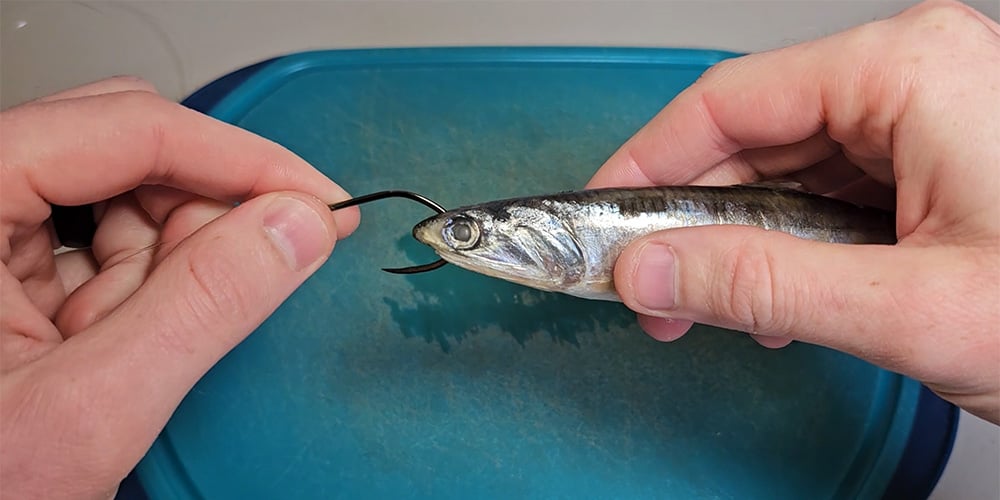
Nothing beats live bait. Fish are conditioned to eating it, it moves naturally in the water, and it produces strikes from species that ignore artificials entirely. The key is keeping it alive and presenting it correctly — and that starts with how you put it on the hook. We’ll show you three easy hooking options that work for most baitfish without worrying about the hook pulling out before a fish is on.
- Option 1: Hook Through the Head and Mouth
- Option 2: Hook Under the Dorsal Fin
- Option 3: Hook Above the Rear Fin
- Which Method Should You Use?
- Hook Size and Type
- Keeping Bait Alive
- FAQs
Option 1: Hook Through the Head and Mouth
- Push the hook through the head just in front of the bait’s eyes
- Keep pushing the hook down through the bottom of the bait’s mouth
The mouth hook gives you good control over the bait’s direction and is one of the most secure placements — the hook sits in a tough part of the fish’s anatomy and is unlikely to pull out under casting or current pressure. The bait swims forward naturally, which is the right action for most presentations. This is the preferred method for casting live bait toward structure, for kite fishing where the bait needs to stay at the surface and work against current, and for any situation where you want to cast the bait a meaningful distance.
Option 2: Hook Under the Dorsal Fin
- Find the bait’s dorsal fin
- Push the hook through the bait underneath the dorsal fin — through the back, not the belly side
- Remove any scales stuck to your hook
The dorsal hook is the best placement for keeping bait alive longest. The hook passes through muscle rather than vital organs, and the bait can swim freely in all directions. It’s the preferred method for slow trolling, drifting, or still fishing where the bait needs to stay lively and move naturally for extended periods. The dorsal hook is also preferred when fishing with predators that attack from below — the hook is positioned in the middle of the bait where a striking fish is most likely to make contact. Remove any scales on the hook point after rigging to ensure clean penetration when the fish bites.
Option 3: Hook Above the Rear Fin
- Find the bottom rear fin of the bait
- Push the hook through the bait above the fin
- Remove any scales stuck to your hook
Hooking near the tail causes the bait to swim head-down and struggle, which creates an erratic, distressed action that can trigger aggressive strikes from predators. The tail hook is used when you want maximum bait action rather than maximum survival time — the hook placement is harder on the bait but the struggling motion is highly effective for species like tarpon, snook, and large striped bass that key on injured or fleeing prey. As with the dorsal method, clear any scales from the hook point after rigging.
Which Method Should You Use?
The right rigging depends on your fishing scenario:
| Situation | Best Method | Why |
|---|---|---|
| Casting to structure or cover | Head/mouth | Secure hookup, bait survives the cast, natural forward swimming direction |
| Kite fishing | Head/mouth | Bait works against current and wave action without coming off |
| Slow trolling or drifting | Dorsal fin | Longest survival, natural 360° swimming action |
| Still fishing under a float | Dorsal fin | Bait stays lively for long periods, moves freely under the float |
| Targeting aggressive predators | Above rear fin | Erratic, distressed struggling action triggers reaction strikes |
Hook Size and Type
Hook size should match the size of the bait, not the size of the fish you’re targeting. A hook too large for the bait will kill it quickly and prevent natural swimming action. A hook too small may not penetrate through tough jaw tissue on a hard-mouthed target species.
- Small baitfish (2–4 inches) — pilchards, small mullet, scaled sardines: Size 1 to 2/0 circle or J-hook
- Medium baitfish (4–7 inches) — threadfin herring, medium mullet, pinfish: Size 2/0 to 4/0
- Large baitfish (7–12 inches) — large mullet, goggle-eyes, bluefish: Size 5/0 to 7/0
Circle hooks are strongly recommended for live bait fishing. They are designed to hook the fish in the corner of the mouth rather than deep in the throat, which dramatically improves survival rates for catch-and-release and reduces gut-hooking. Let the fish run a moment before engaging the drag — do not jerk to set a circle hook the way you would a J-hook. The hook sets itself as the fish turns and pressure increases.
Keeping Bait Alive
The best hooking technique is wasted if the bait is dead before a fish finds it. A few basics:
- Aerated livewell: Baitfish need well-oxygenated, cool water. An aerated livewell or bait bucket with a battery-powered aerator keeps bait alive throughout the day. Recirculating livewells that continuously replace the water are the best option for larger quantities of bait.
- Don’t overcrowd the well: Too many fish in a small volume of water depletes oxygen rapidly. A rough guide is one gallon of water per two to three small baitfish.
- Handle bait minimally: Every time you remove bait from the water, net it rather than grabbing with dry hands. A dry hand removes the protective slime coat and shortens bait life.
- Hook quickly: Move the bait from the well to the hook to the water as fast as possible. Bait left exposed to air deteriorates rapidly, especially in hot weather.
Frequently Asked Questions
Why do you remove scales from the hook after rigging?
Scales on the hook point reduce its sharpness and can prevent full penetration when a fish strikes. A scale sitting on the hook point acts as a barrier between the point and the fish’s jaw tissue. A quick wipe of the hook point on your pants or a rag removes any scales and ensures the hook is ready to drive home on the strike. Check the point every time you rebait.
Should I use circle hooks or J-hooks for live bait?
Circle hooks are generally preferred for live bait fishing. They are self-setting — the hook rotates and catches in the corner of the fish’s mouth as it swims away — and they dramatically reduce deep hooking and gut-hooking compared to J-hooks. The technique is different: do not jerk to set the hook. Let the fish run, engage the drag, and reel. The circle hook does the work. J-hooks remain appropriate in some scenarios where an immediate hookset is needed, such as fast-moving trolling where the hook must penetrate instantly at speed.
What is the best live bait for saltwater fishing?
This depends on your region and target species, but the most universally effective saltwater live baits are pilchards (scaled sardines), threadfin herring, mullet, and pinfish in the south Atlantic and Gulf; bunker (menhaden) and mackerel on the northeast coast; anchovies and sardines on the Pacific coast. As a general rule, use what the target species is already eating in that location — local bait shops and West Marine crew with local knowledge can tell you what’s working in your area.
What is the best live bait for freshwater fishing?
Shiners (golden shiners especially) are the dominant live bait for largemouth bass across the southeast and remain effective nationally. Nightcrawlers and worms are the universal freshwater live bait effective on bass, trout, walleye, crappie, and panfish. Creek chubs and suckers are top choices for large predators including muskie, pike, and big flathead catfish. Match the bait size to the target — large predators prefer large baits.
Need More Help?
West Marine is the perfect place to get ready for your next fishing trip. We offer free line spooling and locally assorted tackle in most of our stores to gear you up for what’s biting in your area. Find your nearest store.