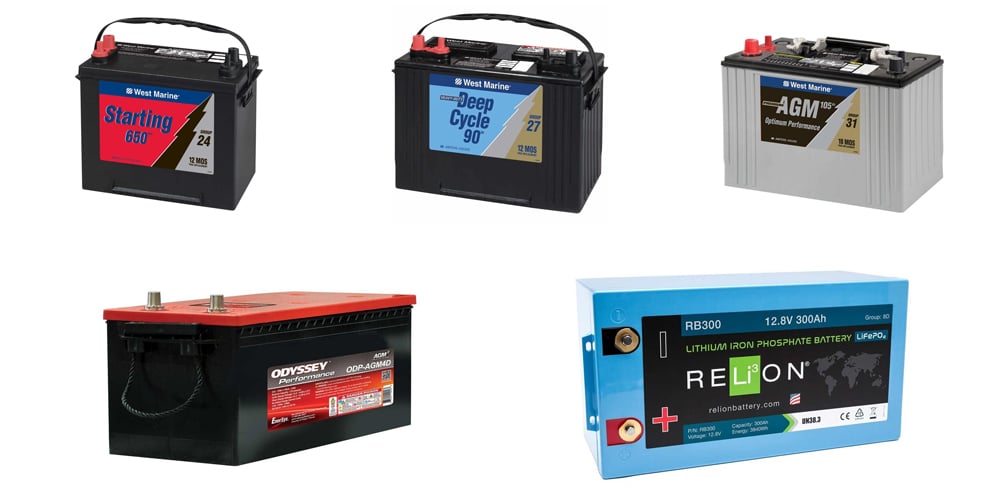
Marine battery group sizes are a standardized physical specification that determines whether a battery fits your boat’s battery compartment, battery box, and hold-down hardware. Understanding what group sizes mean — and how they relate to the capacity and performance specifications that actually determine how long your battery will power your equipment — gives you the information to make a genuinely informed purchase rather than guessing at compatibility.
- BCI Group Size Standards
- Typical Applications for Battery Group Sizes
- How Much Capacity Do You Need?
- Battery Group Size Comparisons
- Terminal Configurations and Placement
- Installation and Safety Guidelines
- Temperature and Environmental Considerations
- Marine Battery Group Sizes FAQs
- Conclusion
- We’re Here to Help!
- Related Articles
BCI Group Size Standards
Battery group sizes are set by the Battery Council International (BCI), a trade organization that publishes standardized physical dimensions for batteries used in marine, automotive, and commercial applications. The group size designation — Group 24, Group 27, Group 31, 4D, 8D — specifies the length, width, and height of the battery case, as well as the location and type of terminals. Batteries from different manufacturers that share the same group size designation will have compatible physical dimensions, which means they will fit the same battery box, hold-down hardware, and compartment.
What group size does not specify is internal chemistry, capacity, or performance. Two Group 31 batteries from different manufacturers — one flooded lead-acid, one AGM, one lithium — will have identical external dimensions but very different capacity, cycle life, charge acceptance rates, and maintenance requirements. Group size is the starting point for finding a replacement; the internal specifications determine which battery is actually right for your application.
Typical Applications for Battery Group Sizes
Group 24 and Group 27
Group 24 batteries are compact and well-suited to smaller boats with moderate power demands — running cabin lights, a fishfinder, a VHF radio, and a small trolling motor. Actual capacity varies by chemistry and manufacturer, but typically ranges from 55 to 80 amp-hours for lead-acid and AGM types in this group size.
Group 27 batteries offer more capacity in a slightly longer case and are commonly used as house batteries on mid-sized powerboats and sailboats, or as the dedicated deep-cycle battery in a dual-battery setup on a fishing boat. Lead-acid and AGM Group 27 batteries typically range from 85 to 105 amp-hours.
Group 31, 4D, and 8D
Group 31 is the most widely used battery group size in recreational marine applications requiring serious capacity — extended trips, sailboat house banks, larger trolling motor systems, and boats with refrigeration or other significant continuous loads. AGM Group 31 batteries commonly range from 100 to 130 amp-hours. Lithium Group 31 batteries in the same case size offer 100 amp-hours of usable capacity but with substantially lower weight and the ability to use nearly all rated capacity rather than only 50% as with lead-acid.
4D and 8D batteries are large-format units used on larger powerboats, motorsailers, and cruising sailboats with substantial house loads — refrigerators, watermakers, air conditioning, and navigation equipment running continuously. AGM 4D batteries typically offer 180 to 220 amp-hours; 8D batteries range from 230 to 300 amp-hours. These are heavy batteries — an AGM 8D weighs 130 to 160 pounds — and require planning for installation access and cable routing.
How Much Capacity Do You Need?
Battery capacity requirements are calculated from your boat’s actual DC loads and how long you intend to run them between charging opportunities. The basic method:
- List all DC devices and their current draw in amps. Most electronics have their draw printed on the label or listed in the manual. If you only have wattage, divide by 12 (for a 12V system) to get amps: watts ÷ 12V = amps.
- Estimate daily usage hours for each device. Multiply amps × hours = amp-hours consumed per day by each device.
- Total all devices to get your daily amp-hour consumption.
- Multiply by the number of days between charges to get the total capacity required.
- Account for battery chemistry. Lead-acid batteries (flooded, AGM, gel) should not be discharged below 50% of rated capacity without shortening their service life significantly. This means you need twice the amp-hours of your actual consumption if using lead-acid. Lithium iron phosphate batteries can be safely used down to 20% state of charge, so you need roughly 1.25 times your actual consumption in rated capacity.
For a detailed step-by-step walkthrough, see our West Advisor article Sizing Your House Battery Bank.
For starting batteries, consult your engine manual for the minimum Cold Cranking Amps (CCA) or Marine Cranking Amps (MCA) required. CCA is measured at 0°F; MCA is measured at 32°F and is typically 20–25% higher than CCA for the same battery because batteries perform better at higher temperatures.
Battery Group Size Comparisons
| Group Size | Dimensions (L x W x H) | Typical Ah Range (Lead-Acid/AGM) |
|---|---|---|
| Group 24 | 10.25” x 6.8” x 8.9” | 55–80 Ah |
| Group 27 | 12.06” x 6.8” x 8.9” | 85–105 Ah |
| Group 31 | 13” x 6.8” x 9.4” | 100–130 Ah |
| 4D | 20.75” x 8.75” x 10.0” | 180–220 Ah |
| 8D | 20.75” x 11.13” x 9.88” | 230–300 Ah |
Note: Ah ratings vary by manufacturer and chemistry. Lithium batteries in the same group size case will often have the same nominal Ah rating as their AGM equivalents but provide significantly more usable capacity because they can be discharged more deeply without damage.
Terminal Types and Placement
BCI group size specifies battery dimensions but does not standardize terminal type or location. Before purchasing a replacement battery, verify that the terminal type and polarity orientation match your existing wiring. Common marine battery terminal configurations:
- SAE posts: The standard tapered round post used on most automotive and recreational marine batteries. The positive post is slightly larger in diameter than the negative, which prevents reverse connection. SAE posts accept standard battery clamps and ring lugs.
- Stud terminals: Threaded posts that accept ring terminal connections tightened with a nut. Stud terminals provide a more secure, lower-resistance connection than SAE clamps, particularly for high-current applications like windlasses and large trolling motors.
- Dual terminals: Batteries with both SAE posts and threaded stud terminals, allowing connection with either ring lugs or clamp-style connectors without changing your existing cable hardware.
Also confirm that the positive and negative terminals are on the correct sides for your installation. Two batteries of the same group size from different manufacturers may have reversed terminal positions, which would require either different cables or a battery with the opposite terminal layout.
Installation and Safety Guidelines
Measure before purchasing. Measure your battery compartment in all three dimensions — length, width, and height — and verify the group size will fit with adequate clearance for ventilation and for connecting and disconnecting cables. A battery that physically fits the compartment but has no clearance for the terminal boots or cable connectors is a problem.
Match ventilation requirements to battery chemistry. Flooded lead-acid batteries generate hydrogen gas when charging, which must be vented directly to the outside of the boat from the top of the compartment. A sealed compartment with a flooded battery is a fire and explosion risk. AGM and gel batteries produce minimal off-gassing under normal charging conditions and can be installed in enclosed spaces. Lithium iron phosphate batteries produce no off-gassing under normal conditions and have the most flexible installation requirements, but the compartment should still have some airflow for temperature management.
Secure the battery against movement. ABYC standards require marine batteries to be secured so they cannot move more than one inch in any direction. Use a properly sized polypropylene battery box with a lid and hold-down strap, or the manufacturer-supplied mounting hardware. A Group 31 lead-acid battery weighs 60 to 75 pounds; an unsecured battery is both a physical injury hazard and a potential short-circuit hazard if it shifts and contacts metal hull structure.
Protect terminals and use marine-grade hardware. Cover positive terminals with terminal boots to prevent accidental shorting. Use tin-plated copper ring terminals on all connections — not unplated copper, which corrodes rapidly in a marine environment. Apply a corrosion-inhibiting compound to all terminal connections after installation. Install a fuse or circuit breaker on the positive cable within 18 inches of the battery terminal on every circuit, as required by ABYC E-11.
Temperature and Environmental Considerations
All battery chemistries are affected by temperature, but the nature of that effect differs between lead-acid and lithium iron phosphate (LiFePO4).
Lead-acid batteries (flooded, AGM, gel): Cold temperatures significantly reduce capacity. At 32°F, a lead-acid battery delivers approximately 75–80% of its rated capacity. At 0°F, capacity drops to roughly 50% of the rated amp-hour figure. High temperatures increase capacity slightly in the short term but accelerate plate degradation and shorten battery service life significantly. The general rule is that service life is halved for every 15°F increase above 77°F in the battery’s average operating temperature.
Lithium iron phosphate batteries: LiFePO4 batteries perform better than lead-acid at cold temperatures during discharge — at 0°F, lithium retains approximately 80% of rated capacity compared to roughly 50% for lead-acid. However, LiFePO4 batteries have an important cold-temperature charging limitation: charging below 32°F at normal charge rates causes lithium plating on the anode, which permanently reduces capacity and can cause internal short circuits. Most marine LiFePO4 batteries include a Battery Management System (BMS) that cuts off charging below the minimum temperature threshold to protect the cells. Boaters in cold climates should confirm their lithium battery’s low-temperature charging cutoff and ensure their shore power charger is compatible with the BMS’s communication output. Some lithium batteries include integrated heating elements that allow safe cold-temperature charging — this is a meaningful feature for cold-climate boaters.
For all battery types, avoid installing batteries in direct contact with the hull in boats kept in cold water climates — hull-transmitted cold can keep a battery below safe charging temperature even when the air temperature is above freezing.
Marine Battery Group Sizes FAQs
What is a marine battery group size, and why does it matter?
A battery group size is a standardized set of physical dimensions — length, width, and height — established by the Battery Council International (BCI). Group size matters because it determines whether a replacement battery will physically fit your boat’s battery compartment, battery box, and hold-down hardware. It does not determine chemistry, capacity, or performance — those specifications must be checked separately against your power requirements.
Can a larger group size provide more power?
Generally, yes. Larger group sizes accommodate more battery material in the case, which typically yields higher amp-hour capacity and higher cranking amp ratings. However, two batteries of the same group size but different chemistries can have significantly different usable capacity. A Group 31 lithium battery with 100Ah nominal capacity provides approximately 80Ah of usable capacity (80% depth of discharge). A Group 31 AGM battery with 100Ah nominal capacity provides approximately 50Ah of practical usable capacity before risking damage. Always match group size to your compartment and chemistry to your power requirements.
What’s the difference between a starting battery and a deep-cycle battery?
Starting batteries are engineered to deliver a large current burst for a short period — the cold cranking amps needed to spin an engine starter — and then recover quickly once the alternator begins charging. They are not tolerant of deep discharge; repeatedly drawing them below 50% shortens their service life. Deep-cycle batteries are built with thicker plates designed for repeated deep discharge and recharge cycles. They deliver sustained power over time rather than brief bursts. Dual-purpose batteries compromise between both designs — adequate for starting and tolerant of deeper discharge than a pure starting battery, but with less capacity than a comparably sized dedicated deep-cycle.
How do I calculate the amp-hour capacity I need?
List all DC devices, their current draw in amps, and estimated daily usage hours. Multiply amps × hours for each device to get daily amp-hours consumed. Sum all devices for total daily consumption. Multiply by days between charges. For lead-acid batteries, double this figure (because you should only use 50% of rated capacity). For lithium, multiply by 1.25 (because you can safely use 80% of rated capacity). This gives you the minimum rated battery capacity to purchase.
Are all Group 27 batteries the same?
No. All Group 27 batteries share the same external dimensions, but internal construction, chemistry (flooded, AGM, gel, lithium), amp-hour capacity, cranking amps, and cycle life vary significantly between manufacturers and product lines. Two Group 27 batteries of the same external size can have very different performance characteristics, maintenance requirements, and price points. Always verify the internal specifications match your application — not just that the group size matches your compartment.
What should I consider when replacing a battery?
Confirm the group size fits your compartment. Verify the terminal type and polarity orientation match your existing wiring. Confirm the amp-hour capacity meets your power requirements. Verify the battery chemistry is compatible with your charging system — particularly important if switching from lead-acid to lithium, which requires a compatible charger and may require a compatible alternator. Match the new battery’s chemistry to other batteries in the same bank if they charge together.
Do marine batteries require special maintenance?
Maintenance requirements depend on chemistry. Flooded lead-acid batteries require periodic checking and refilling of electrolyte levels and regular cleaning of terminals. AGM and gel batteries are sealed and maintenance-free internally but should be inspected for terminal corrosion and charged with an AGM-compatible charger. Lithium iron phosphate batteries are virtually maintenance-free, but the BMS should be monitored for fault conditions and the battery should be stored at 50–60% state of charge for long-term storage rather than fully charged or fully depleted. All battery types benefit from regular terminal cleaning and corrosion-inhibitor application.
What are the advantages of lithium marine batteries?
Lithium iron phosphate (LiFePO4) batteries offer 50–60% less weight than lead-acid at the same nominal capacity, usable capacity of approximately 80% of rated amp-hours versus 50% for lead-acid, 2,000 or more charge cycles versus 300–500 for most AGM batteries, faster charge acceptance (up to 50–80% of rated capacity as charge current), and better discharge performance at cold temperatures. The tradeoffs are higher upfront cost, a charging temperature limitation below 32°F (unless the battery includes low-temperature charging capability), and the requirement for a lithium-compatible charger and alternator management in some installations.
Conclusion
Selecting the right marine battery starts with group size — the physical specification that determines fit — and continues with capacity, chemistry, and terminal configuration, which determine performance. Match the group size to your compartment, select the chemistry that fits your charging system and usage pattern, size the capacity to your actual loads with appropriate depth-of-discharge margins for the chemistry you choose, and verify terminal compatibility before purchasing. With these four considerations addressed, you will have a battery that fits, performs, and lasts.
We’re Here to Help!
Still have questions on how to pick the right size batteries for your boat? Online and in over 230 West Marine stores, our experienced crew is ready to help. Whether you need advice on battery group sizes, installation tips, or selecting the best option for your boat’s power demands, we’ve got you covered. Use our store locator to find the West Marine store nearest to you.