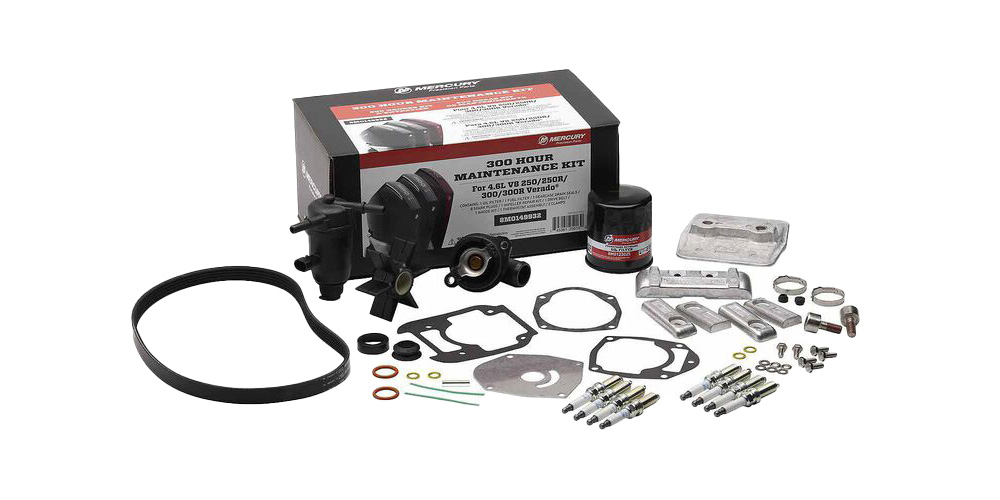
OEM stands for Original Equipment Manufacturer. An OEM part is made by — or to the exact specifications of — the company that built your engine. When you buy a Quicksilver water pump kit for a Mercury outboard, you are buying the same impeller, housing gasket, and O-rings that Mercury installs at the factory: same neoprene compound, same vane geometry, same dimensional tolerances. That matters on the water in a way that it doesn’t on a highway. A breakdown offshore, in an inlet with building conditions, or 40 miles from the nearest marina is a materially different problem than a breakdown with a car on the shoulder of a road with a cell signal and AAA.
This guide explains what OEM parts are, why they matter, what brands West Marine carries, what the most critical OEM service items are for each engine type, and how to find the exact part for your engine.
- What OEM Means — and What It Doesn’t
- The OEM Parts That Matter Most
- OEM Brands at West Marine
- Mercury Marine & Quicksilver
- Yamaha Outboards
- Evinrude / Johnson (OMC)
- Volvo Penta
- Honda Marine
- Suzuki Marine
- Sierra: OEM-Specification Aftermarket Parts
- Anode Selection: Zinc, Aluminum, or Magnesium?
- How to Find the Right Part for Your Engine
- FAQs
What OEM Means — and What It Doesn’t
OEM refers to the original manufacturer’s specifications, not necessarily to where a part was physically made. A Yamaha OEM spark plug meets Yamaha’s heat range, electrode gap, and thread specification for that engine. A Volvo Penta OEM thermostat opens at the precise temperature Volvo Penta’s engineers determined for that engine’s cooling system. The part is validated for that specific engine by the people who designed it — that is the core value of an OEM part.
Aftermarket parts are manufactured by third parties. Some are excellent and engineered to OEM specifications — Sierra, the world’s largest aftermarket marine parts supplier, is the primary example and is discussed in detail below. Others are not, and it is often impossible to determine quality from appearance alone. For critical engine systems — cooling, fuel delivery, ignition, and lubrication — the OEM part or a proven OEM-equivalent like Sierra eliminates that uncertainty. For general hardware, fasteners, and accessories, quality aftermarket parts are appropriate and often the only option on older engines.
Quicksilver is not a different brand from Mercury — this confuses many boaters. Quicksilver is Mercury Marine’s own retail parts and accessories brand. A Quicksilver water pump kit and a Mercury OEM water pump kit for the same engine are the same part, same manufacturing specification, just different packaging. Quicksilver is how Mercury’s OEM parts are sold through dealers and retailers like West Marine.
The OEM Parts That Matter Most
Regardless of engine brand, these are the components where OEM specification matters most and where cutting corners has the clearest consequences:
Water Pump Impellers
The raw water pump impeller is the single most critical routine replacement item on any raw-water-cooled engine — outboards, sterndrives, and inboards alike. It is a rubber vane component that spins inside a housing to move cooling water through the engine. All five major outboard manufacturers (Mercury, Yamaha, Honda, Suzuki, and Evinrude) recommend replacing it every 1–2 years or every 100 hours of operation, whichever comes first. MerCruiser and Volvo Penta make the same recommendation for sterndrive engines.
Why OEM matters here: the impeller compound and vane geometry are specified by the manufacturer for that pump’s bore diameter, flow rate, and operating temperature range. A non-spec impeller that is slightly undersized for the bore allows cooling water to bypass the vanes rather than being pushed through the system — the engine appears to have water flow but is running hotter than normal, and the temperature gauge may not catch it before damage occurs. An impeller made from incorrect rubber compound degrades faster, and when it fails, the vane fragments travel downstream through the cooling passages. Those fragments lodge in the thermostat housing, block the heat exchanger, and sometimes require disassembly of the entire cooling circuit to clear — a repair far more expensive than the cost difference between an OEM and aftermarket impeller.
Always buy an impeller kit, not just the impeller. OEM kits include the housing gasket and all O-rings. Replacing the impeller while reusing an old, compressed housing gasket is a common cause of post-service cooling leaks.
Thermostats
The thermostat controls the temperature at which cooling water begins to circulate through the engine. Marine engines are designed to operate within a specific temperature window — typically 140–160°F depending on the engine. An OEM thermostat opens at exactly the calibrated temperature. A thermostat that opens too early causes the engine to run too cool: combustion is less efficient, fuel doesn’t vaporize completely, carbon accumulates on piston crowns and valve faces, and cylinder walls don’t receive adequate lubrication from the hot oil film. A thermostat stuck closed — or one that opens too late — causes overheating that can warp heads, destroy head gaskets, and score cylinders. A few degrees off-specification, multiplied over hundreds of hours, has real consequences.
Oil Filters
Marine engine oil filters are specified for the oil pump pressure, bypass valve cracking pressure, and filtration media rating of the specific engine. An automotive oil filter that threads onto the same fitting may not open its bypass valve at the correct pressure — in cold-start conditions when oil is thick, a bypass valve that opens too easily allows unfiltered oil to circulate; one that doesn’t open easily enough can starve the engine of oil pressure during the brief window before the oil warms. OEM and Sierra oil filters are engineered to the correct specification for the engine, not for the thread pitch alone.
Spark Plugs
OEM spark plugs are specified for heat range, electrode gap, electrode material, and thread reach for that engine’s combustion chamber geometry. A plug with the wrong heat range runs too hot (risk of pre-ignition and detonation) or too cool (fouling from incomplete combustion). Pre-ignition on a marine engine running at high RPM offshore is not a warning light situation — it can destroy a piston before you can throttle back. Always use the plug specified in your engine’s owner’s manual, and replace at the OEM-recommended interval.
Fuel Filters and Fuel System Components
Fuel filters on direct-injected outboards and EFI sterndrives operate at high pressure — some systems run 35–80 PSI at the injector rail. OEM fuel filters are rated for both the operating pressure and the micron rating specified by the manufacturer. A fuel filter that allows particles larger than the injector tip tolerance into the fuel rail causes injector tip erosion and eventually injector failure. On carbureted engines, the float needle and seat are dimensioned to the OEM specification — an aftermarket carburetor kit with slightly oversized needle and seat dimensions will cause rich running and flooding that a carb rebuild doesn’t fix because the rebuilt carb is now out of spec.
OEM Brands at West Marine
Mercury Marine & Quicksilver (including MerCruiser)
Mercury Marine is the world’s largest outboard engine manufacturer. Quicksilver is Mercury’s own OEM parts brand — not a third party — and is the label under which Mercury’s genuine replacement parts are sold at retail. When you see a Quicksilver water pump kit on the shelf at West Marine, it is a Mercury OEM part in Mercury’s retail packaging. MerCruiser is Mercury’s sterndrive and inboard engine division, and uses a completely separate parts catalog from outboard engines — a MerCruiser 5.7L V8 sterndrive and a Mercury 150 four-stroke outboard share no service parts despite both being Mercury products.
West Marine carries Mercury Marine engine parts covering outboard engines from 2.5 hp to 400+ hp V8s, as well as MerCruiser sterndrives. Key OEM service items for Mercury and MerCruiser engines include water pump kits (the Quicksilver 821354A2 is the most commonly used kit for mid-size 4-stroke outboards), thermostat kits, Quicksilver 10W-30 or 25W-40 4-stroke engine oil (Yamaha and Mercury both have specific oil formulations matched to their engine metallurgy and seal materials), gear lube for the lower unit, fuel filters, spark plugs, and trim/tilt fluid.
One note specific to MerCruiser: the Alpha One and Bravo One/Two/Three sterndrive units have different service parts even though they may look similar from outside the boat. Alpha One drives use a different gimbal bearing, u-joint bellows, and water pump than any of the Bravo variants. Always confirm your drive generation and serial number before ordering sterndrive service parts — getting this wrong means ordering parts that physically cannot be installed correctly.
Yamaha Outboards
Yamaha outboards are among the most widely owned in the U.S. and have a reputation for long service life that is directly tied to rigorous OEM maintenance. Yamaha’s engine oils — sold under the Yamalube brand — are formulated specifically for Yamaha engine metallurgy, seal materials, and operating temperatures. Using a generic 4-stroke oil that meets the same viscosity grade but not Yamaha’s specific additive package can cause accelerated wear on the cam follower surfaces and HPDI (High Pressure Direct Injection) fuel system components in Yamaha’s high-performance outboards.
Yamaha OEM water pump kits are particularly important because Yamaha’s impeller housing on many models is integrated with the lower unit in a way that makes impeller access a significant labor operation — you do not want to redo this job in one season because a non-OEM impeller failed early. Yamaha OEM service parts available at West Marine include water pump kits, Yamalube 4-stroke and 2-stroke oils, oil filters, fuel filters, thermostats, spark plugs (Yamaha specifies NGK in most models), and anodes for both saltwater and freshwater configurations.
Yamaha outboards also have model-year-specific service bulletin items that affect which parts apply to a given engine — the Parts Finder’s model and serial number lookup is the reliable way to ensure you are getting the correct specification for your exact engine rather than the most recent production version of that model.
Evinrude / Johnson (OMC)
Evinrude and Johnson outboards were both produced by Outboard Marine Corporation (OMC). While Evinrude ceased production of new engines in 2020, there is an enormous installed base of two-stroke and E-TEC engines still actively in service. OEM and OEM-specification service parts for Evinrude and Johnson engines remain available through West Marine, primarily through Sierra’s extensive cross-reference catalog which covers nearly the entire OMC production range. Common service items include water pump kits (OMC uses a distinct pump design on many models with a key-drive impeller rather than the rubber-hub design used by Mercury and Yamaha), carburetor kits, ignition components, and lower unit gear lube. For E-TEC engines specifically, the direct-injection oil system requires OMC/Evinrude XD-100 or equivalent — do not substitute conventional two-stroke oil in an E-TEC, as the oil injection system is calibrated to the viscosity and lubricity of the specified oil.
Volvo Penta (Sterndrive & Inboard)
Volvo Penta is the dominant engine brand for sterndrive and inboard applications on mid-size to large powerboats, and their parts carry a specific challenge: the sterndrive units are highly application-specific in ways that outboard parts are not. The two major Volvo Penta sterndrive families — the SX/DP (DuoProp) and the older AQ/DP series — use different drive components that do not interchange. Within those families, the gimbal bearing, u-joint bellows, water pump, trim cylinders, and prop shaft seals are all sized and rated for the specific drive generation and horsepower rating. An incorrectly specified gimbal bearing that is nominally the right size but rated for a lower thrust load will fail under the lateral forces of hard cornering at speed — a catastrophic failure mode, not a gradual one.
Volvo Penta engines also use closed-loop freshwater cooling on many models, with a heat exchanger rather than direct raw water cooling of the engine block. This means two separate cooling circuits: the freshwater loop (which uses conventional antifreeze/coolant) and the raw water loop (which uses seawater to cool the heat exchanger). Both circuits have separate service items. The heat exchanger requires periodic flushing to remove salt and scale buildup in the raw water passages. OEM service parts available for Volvo Penta at West Marine include water pump kits for both loops, thermostats, anodes (Volvo Penta uses a specific anode configuration on the drive that must match the drive series), gimbal bearings, u-joint bellows kits, and engine coolant.
Honda Marine
Honda Marine outboards are known for exceptional fuel efficiency and quiet operation, and that reputation is tied to the precision of Honda’s VTEC-derived valve timing systems and lean-burn technology. These systems are sensitive to fuel and oil quality — Honda Marine OEM oil is formulated for the specific bearing surfaces and seal materials in Honda’s engine design. Honda outboards also have a distinctive cooling system architecture on their larger models: the water pump is located higher in the powerhead on some configurations, changing the impeller replacement procedure compared to most other brands. Honda OEM service parts available at West Marine include water pump kits, oil filters, spark plugs, fuel filters, and engine oil.
Suzuki Marine
Suzuki outboards are popular in the 70–350 hp range and are well regarded for durability and fuel efficiency. Suzuki uses a lean-burn system on many models similar to Honda’s, which requires correct oil specification to avoid premature wear on the variable valve timing components. OEM and OEM-specification service parts for Suzuki Marine engines are available through West Marine including water pump kits, oil filters, spark plugs, and anodes. Suzuki’s lower unit oil specification differs from Mercury and Yamaha — check the service manual for the correct grade before servicing the gear case.
Sierra: OEM-Specification Aftermarket Parts
Sierra is the world’s largest supplier of aftermarket marine engine parts and one of the most important resources for any boat owner who works on their own engine. Sierra parts are engineered and tested to meet or exceed OEM specifications for Mercury, Yamaha, Volvo Penta, Johnson, Evinrude, MerCruiser, Honda, Suzuki, and virtually every other major marine engine brand. Sierra is not a generic parts brand — it is a specialized marine engineering company that reverse-engineers OEM parts to specification and tests them against the originals.
Sierra is especially important for older engines where factory OEM parts are discontinued or difficult to source. A 1998 Johnson 115 or a 1995 MerCruiser 5.7 may have OEM parts that are no longer available from the manufacturer, but Sierra’s catalog covers the vast majority of the installed base and continues to support engines well past the point where manufacturer support ends.
How Sierra’s cross-reference system works: Sierra uses a catalog lookup system called SONAR (Sierra Online Application Resource). If you have your engine’s manufacturer OEM part number — from your service manual, from a parts diagram, or from a previous service record — you enter that number and SONAR returns the Sierra equivalent part number. If you don’t have an OEM part number, you can look up by engine brand, year, horsepower, and model to find all applicable Sierra parts for that engine. This is the same system West Marine’s Engine Parts Finder uses to help you identify the correct part. Sierra part numbers follow the 18-XXXX format — for example, the Sierra 18-3148 is a water pump kit for MerCruiser V6 and V8 sterndrive engines, and the Sierra 18-3392 is a water pump kit for Johnson/Evinrude outboards in the 25–60 hp range.
West Marine carries an extensive Sierra inventory including water pump kits and impellers, thermostat kits, carburetor rebuild kits, fuel pump kits, oil filters, fuel filters, spark plugs, alternators, trim/tilt motors, power steering pumps, exhaust manifolds and risers for MerCruiser, and anodes — all cross-referenced to OEM part numbers by engine brand and model.
Anode Selection: Zinc, Aluminum, or Magnesium?
Sacrificial anodes (also called zincs regardless of actual material) protect the metal components of your engine and drive from galvanic corrosion by providing a more reactive metal that corrodes preferentially. The key point that many boaters miss: the wrong anode alloy can cause harm rather than protection.
- Zinc anodes: Correct for saltwater use. In fresh water, zinc anodes passivate (develop an oxide layer) and stop providing protection — they look intact but are no longer working.
- Aluminum anodes: The most versatile choice. They work correctly in both salt and brackish water, and are also the correct choice in many freshwater applications. Many engine manufacturers now specify aluminum anodes as standard across all environments.
- Magnesium anodes: Specifically for freshwater use only. Magnesium is the most active of the three alloys and provides maximum protection in the low-conductivity freshwater environment. In salt water, magnesium anodes are too reactive — they deplete extremely rapidly and can cause accelerated corrosion on aluminum engine components rather than protecting them.
OEM anode kits for each engine brand are configured with the correct alloy and geometry for that engine’s mounting surfaces and the environment it was designed for. When replacing anodes, replace them when they have consumed approximately 50% of their mass — waiting until they are completely depleted means your engine ran unprotected for some period before the service interval.
How to Find the Right OEM Part for Your Engine
Two pieces of information are required to identify the correct OEM part: your engine’s model number and serial number. These are not the same thing and both are needed.
The model number identifies the engine platform — for example, “F150XA” for a Yamaha 150 four-stroke. The serial number identifies the exact production unit and the specific configuration and production run, which determines which service parts apply. The same engine model sold across multiple years may use different thermostats, different impellers, or different ignition components depending on when it was manufactured. Getting the serial number eliminates this ambiguity.
Where to find these numbers: on outboards they are on a decal on the engine clamp bracket or transom bracket, usually on the starboard side. On MerCruiser sterndrives they are on the engine block (engine serial) and on the drive itself (drive serial — which is a separate number needed for sterndrive parts). On Volvo Penta, both the engine and the drive have separate identification plates.
Use West Marine’s Engine Parts Finder to look up parts by manufacturer, model year, and horsepower. The tool provides exploded schematics of engine subsystems so you can visually identify the exact part within its system and confirm you have the right component before ordering. If you know the OEM part number from your service manual, you can search that directly. If the OEM part is discontinued, the Parts Finder will return Sierra equivalent numbers for most applications.
OEM Parts FAQ
Quicksilver is Mercury Marine’s own branded line of genuine OEM replacement parts and accessories — it is not a third-party brand. A Quicksilver water pump kit and a Mercury OEM water pump kit for the same engine are the same part in different packaging. Quicksilver is how Mercury’s genuine replacement parts are sold through authorized retailers including West Marine. When you see Quicksilver on the shelf, you are buying a genuine Mercury OEM part.
All five major outboard manufacturers — Mercury, Yamaha, Honda, Suzuki, and Evinrude — recommend inspecting and replacing the raw water pump impeller every 1–2 years or every 100 hours of operation, whichever comes first. The same recommendation applies to MerCruiser and Volvo Penta sterndrives. Always replace the entire kit (impeller plus housing gasket and O-rings), not just the impeller. Reusing a compressed housing gasket after an impeller replacement is one of the most common causes of post-service cooling leaks.
Sierra is the world’s largest aftermarket marine parts supplier and engineers its parts to meet or exceed OEM specifications. Sierra is not a generic discount brand — it is a specialized marine engineering company and its parts are widely used by professional marine technicians as OEM-equivalent replacements. Sierra is particularly important for older engines where factory OEM parts are discontinued. Sierra’s SONAR cross-reference system lets you look up OEM part numbers and find the Sierra equivalent, or search by engine brand, year, and horsepower to find all applicable parts.
Use zinc anodes in salt water, aluminum anodes in salt, brackish, or freshwater (aluminum is the most versatile and is now specified as standard by many manufacturers), and magnesium anodes in freshwater only. Magnesium in salt water is too reactive and depletes extremely fast, and can actually accelerate corrosion on aluminum engine components rather than protecting them. Zinc anodes in fresh water passivate and stop working while still appearing intact. When in doubt, aluminum is the safest all-environment choice.
Yes. The model number identifies the engine platform but the serial number identifies your exact production unit. The same engine model sold across multiple years can use different impellers, thermostats, or ignition components depending on when it was manufactured. Ordering by model alone can result in a part that is correct for a different production run of the same engine. Serial numbers on outboards are on the clamp or transom bracket; on MerCruiser and Volvo Penta, both the engine and the drive unit have separate serial numbers, and sterndrive service parts often require both.