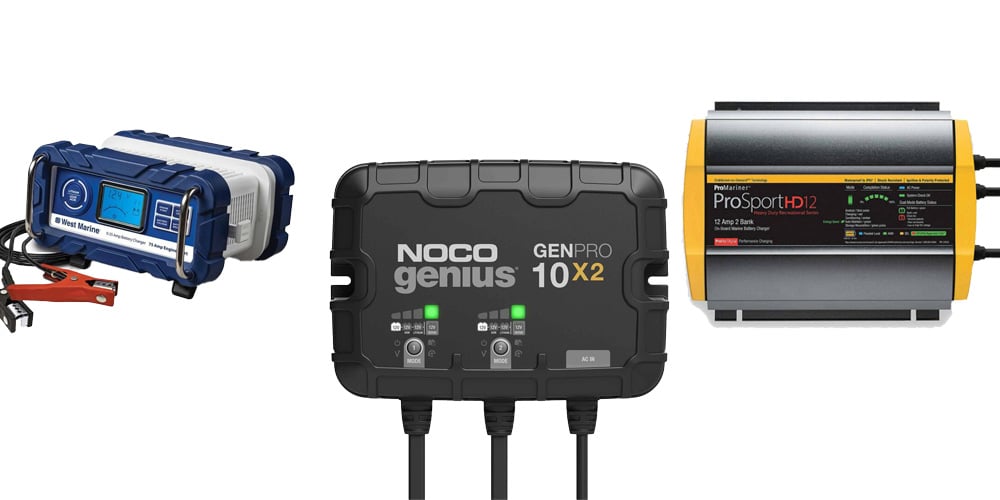
We’ve all been there. You load your gear in the boat, hop in, turn the key, and you hear the dreaded “click, click, click.” Dead battery, day ruined. Having a quality marine battery charger — either portable or permanently installed on your boat — can save you from your day on the water ending before it begins. In this article we’ll walk you through the key considerations to get the right charger for your boat.
- Your Boat Battery Type
- Portable vs. Mounted Chargers
- How Smart Chargers Work
- Single-Bank vs. Multi-Bank Chargers
- Match Your Charger to Battery Capacity
- Battery Charger Safety Features
- Waterproofing and Durability
- FAQs
Your Boat Battery Type
The single most important specification when selecting a charger is compatibility with your battery chemistry. Different battery types have fundamentally different charging requirements, and using the wrong charger can permanently damage your battery or significantly shorten its life.
- Flooded lead-acid (wet cell): The traditional boat battery. Requires a charger that supplies a controlled overcharge at the end of the charge cycle to equalize the cells — a process called equalization charging. Robust and forgiving of charging irregularities, but requires periodic water addition and adequate ventilation during charging to vent hydrogen gas.
- AGM (Absorbed Glass Mat): A sealed lead-acid battery where the electrolyte is absorbed into glass mat separators. AGM batteries are the most common upgrade choice for marine applications. They are spill-proof, require no maintenance, and accept a higher charging rate than flooded batteries. They require a charger with an AGM-compatible charging profile — specifically, a lower absorption voltage than a flooded battery charger delivers. Charging an AGM with a standard flooded lead-acid charger at too high a voltage can drive excessive heat into the battery and damage it.
- Gel: Another sealed lead-acid variant that uses a gel electrolyte. Gel batteries require the lowest absorption voltage of any lead-acid type and are the most sensitive to overcharging. Using a charger without a gel-specific profile will shorten a gel battery’s life significantly. Less common than AGM for new installations.
- Lithium (LiFePO4): Lithium iron phosphate batteries are increasingly popular on boats for their dramatically lighter weight, much higher usable capacity (typically 80–100% of rated capacity vs. 50% for lead-acid), and longer cycle life. Lithium batteries require a charger with a lithium-specific charging profile. The voltage profile is completely different from lead-acid: lithium charges at a constant current to a specific voltage, then holds briefly at that voltage with no float stage. A lead-acid charger running a float charge on a lithium battery can damage the cells over time. If you have or are planning a lithium battery installation, confirm the charger explicitly lists LiFePO4 compatibility.
Most modern multi-stage chargers from manufacturers like Minn Kota, NOCO, Victron, and ProMariner list compatible battery types in their specifications. Match the charger to your battery type before considering any other feature.
Portable vs. Mounted Chargers
The right choice depends primarily on how you store your boat and whether you have access to shore power at storage.
If you store your boat in a slip with shore power available, a permanently mounted battery charger is the better option. It connects directly to your battery bank and runs automatically whenever shore power is connected, keeping batteries at full charge between trips and eliminating the need to disconnect and reconnect anything. For boats with multiple battery banks, a permanently mounted multi-bank charger handles all banks simultaneously and independently.
If you own a small, trailerable boat stored at home without shore power, a portable battery charger is the practical choice. You can charge in the driveway, garage, or wherever the boat is stored, then unplug and stow the charger when not in use. Portable chargers are also useful as a backup aboard a boat with a mounted charger for situations where the shore power connection is unavailable.
How Smart Chargers Work: Charging Stages
Automatic smart chargers are far superior to manual chargers and are the only type we recommend for marine use. Understanding the charging stages explains why:
Bulk stage: The charger delivers maximum rated current to the battery. During this stage, the battery voltage climbs steadily. This is the fastest part of the charging process and typically fills the battery to about 80% of capacity.
Absorption stage: When the battery reaches the target absorption voltage (which varies by battery type), the charger holds that voltage constant and the current tapers off. The battery charges the remaining 20% during this stage, more slowly and more gently. Holding constant voltage rather than constant current during this stage prevents the heat buildup that overcharging causes. The absorption voltage is where battery type differences matter most — AGM, gel, and flooded batteries all have different correct absorption voltages.
Float stage: Once fully charged, the charger drops to a lower maintenance voltage (typically 13.2–13.4V for lead-acid) and holds it there indefinitely. The float stage compensates for the small self-discharge all batteries experience without overcharging. This is what allows a mounted charger to stay connected year-round without damaging the battery.
Equalization stage (lead-acid only): Some chargers include a periodic equalization charge — a controlled overcharge that drives sulfate crystals off the lead plates. This is appropriate for flooded lead-acid batteries only. Never equalize an AGM, gel, or lithium battery.
Desulfation/reconditioning mode: Many modern smart chargers include a mode that applies a pulsed high-frequency charge to break down sulfation on lead-acid batteries. Sulfation is the primary cause of capacity loss in lead-acid batteries that have been left discharged. A reconditioning cycle on a sulfated battery can recover significant lost capacity, sometimes extending a battery’s useful life by months or years.
Manual chargers lack these stage progressions and simply deliver a fixed voltage until either a timer shuts them off or you disconnect them. Overcharging a lead-acid battery boils the electrolyte, causes internal heat damage, and accelerates plate corrosion. The case for automatic chargers isn’t about convenience — it’s about not destroying expensive batteries.
Single-Bank vs. Multi-Bank Chargers
If your boat has more than one battery, this choice matters significantly. Most boats above a basic runabout have at least two battery banks: a dedicated starting battery for the engine and a house battery (or bank) for electronics, lighting, bilge pumps, and accessories.
A single-bank charger connected to one battery in a multi-battery system charges only that battery. The other batteries in the system remain uncharged unless you manually switch connections — which most boaters don’t do consistently.
A multi-bank charger has independent output circuits that simultaneously charge each battery bank at its own charge rate, independently managed. A 3-bank charger charges your starting battery, your house battery, and a trolling motor battery all at once, with each circuit delivering the right charge profile for that battery without any interaction between the banks. This is both more convenient and better for battery longevity than any workaround involving a single-bank charger.
Count your batteries before buying a charger, and match the number of charger banks to the number of independent battery banks on your boat.
Match Your Charger to Battery Capacity
Charger output is rated in amps. More amps means faster charging. The right amount depends on your battery’s amp-hour (Ah) capacity.
The standard guideline is 10–20% of the battery’s Ah rating. A 100 Ah battery charges optimally with a 10–20 amp charger. Below 10% is too slow to be practical for most situations; above 20% can stress the battery during the bulk stage and shorten its life.
Practical guidance by boat type:
- Small trailerable boats with a single starting battery (60–80 Ah): A 6–10 amp portable charger is adequate.
- Mid-size boats with starting and house batteries (total 150–250 Ah): A 15–25 amp multi-bank charger handles both banks at reasonable speed.
- Larger boats or boats with significant house loads (total 300+ Ah): A 30–60 amp charger or multiple chargers is appropriate. Charging a large bank with an undersized charger means the battery spends more time partially discharged, which accelerates sulfation on lead-acid batteries.
Charging time estimate: a fully discharged 100 Ah battery at 50% depth of discharge (50 Ah to replace) takes approximately 3–4 hours on a 15-amp charger (accounting for charger efficiency and the tapered absorption stage). It will not charge as fast as dividing Ah by amps because the current tapers during absorption.
Battery Charger Safety Features
Marine battery chargers operate in a wet, vibrating, corrosive environment while connected to the most energetic electrical source on the boat. Safety features are not optional extras — they are the reason you buy a quality charger rather than a cheap one.
- Overcharge protection: Monitors battery voltage and current throughout the charge cycle, transitioning between stages automatically to prevent overcharging. Present on every quality smart charger.
- Reverse polarity protection: Prevents the charger from operating if the clamps or leads are connected to the wrong terminals. Without this, a reversed connection can blow a fuse or damage the charger and battery simultaneously.
- Spark-proof connections: Suppresses the spark that occurs when connecting a charger to a battery. Particularly important in enclosed engine compartments where hydrogen gas from charging flooded batteries can accumulate.
- Temperature compensation: Adjusts the charging voltage based on ambient temperature. Cold batteries accept lower voltage before overcharging; hot batteries require lower voltage to prevent damage. A charger without temperature compensation will undercharge in cold weather and overcharge in hot weather.
- Short-circuit protection: Shuts down immediately if a short circuit is detected in the charging circuit.
- Automatic battery detection: Senses battery type and state, adjusts the charging profile to match. Useful when different battery types are used in different banks.
- Low battery recovery: Can start charging a deeply discharged battery that other chargers may detect as “too low to charge” and refuse to start. Applies a low-current conditioning charge to bring the battery up to a level where normal charging can begin.
Waterproofing and Durability
A mounted marine charger lives in an environment that no automotive or household charger is designed for: salt air, spray, vibration, temperature swings, and potential flooding in the bilge area. Look for an IP (Ingress Protection) rating when evaluating durability.
- IP67: Fully dustproof and protected against temporary immersion in up to 1 meter of water. Appropriate for installation in exposed locations or near the bilge.
- IP65 or IP66: Fully dustproof and protected against water jets from any direction. Adequate for most above-deck or engine compartment installations.
- IP44 or lower: Splash-resistant only. Appropriate only for protected indoor installations, not a marine environment.
Beyond the IP rating, look for marine-grade connectors and tinned wire leads (not bare copper, which corrodes rapidly in salt air), a housing material rated for UV exposure, and vibration-resistant construction. Chargers from marine-specific manufacturers (Minn Kota, ProMariner, Victron, NOCO Genius Marine) are designed for these conditions; generic automotive chargers are not.
FAQs
Can I leave my marine battery charger connected all the time?
Yes — this is actually the recommended practice for a quality automatic smart charger with a float or maintenance stage. Once the charger has completed the bulk and absorption stages, it drops to a float voltage (typically 13.2–13.4V for lead-acid) that exactly compensates for the battery’s self-discharge rate. The battery stays at full charge without overcharging, and it’s ready for immediate use whenever you step aboard. Never leave a manual charger connected unattended.
What is the difference between a charger’s bulk, absorption, and float stages?
Bulk delivers maximum current to bring the battery to about 80% capacity quickly. Absorption holds a constant target voltage while current tapers, filling the remaining 20% gently. Float holds a lower maintenance voltage indefinitely, compensating for self-discharge. A charger that skips absorption and goes directly from bulk to float will never fully charge a lead-acid battery. A charger that holds the bulk voltage too long without transitioning to float will overcharge and damage the battery.
Do I need a different charger for a lithium battery?
Yes. Lithium iron phosphate (LiFePO4) batteries have a completely different charging profile from any lead-acid chemistry. They charge at constant current to a higher target voltage (typically 14.4–14.6V), hold briefly, then stop completely — there is no float stage. A lead-acid charger applying a continuous float charge to a lithium battery will slowly overcharge it. Any charger used with lithium batteries must explicitly list LiFePO4 compatibility and have a lithium-specific charging mode.
Should I choose a single-bank or multi-bank charger?
Count your independent battery banks and match them. If you have a starting battery and a separate house battery, you need a 2-bank charger. Add a trolling motor battery and you need 3 banks. A multi-bank charger charges all banks simultaneously, independently, at the correct rate for each. A single-bank charger on a multi-battery boat means only one battery gets charged unless you manually switch connections each session.
What is the right charging amperage for my battery?
Target 10–20% of the battery’s amp-hour rating. A 100 Ah battery charges optimally at 10–20 amps. Below 10% is too slow; above 20% stresses the battery during the bulk stage. For multiple batteries on a multi-bank charger, each bank’s output should meet this 10–20% target for that specific battery’s capacity.
Is the charger weather-resistant enough for marine use?
Look for an IP65 rating minimum for most installations, or IP67 if the charger will be near the bilge or in a particularly exposed location. Beyond the IP rating, confirm the charger uses tinned wire leads and marine-grade connectors. Chargers from marine-specific manufacturers are designed for salt air, spray, and vibration; generic automotive chargers degrade quickly in a marine environment.
Ready to Charge?
With these considerations in hand, you should be well equipped to find a charger that will work for your boat and your batteries. Whether you’re topping off a trailered boat in the driveway before a day of fishing or installing a full shore power setup, we have the marine battery charger you need. Find your nearest West Marine store for hands-on guidance from our crew.


