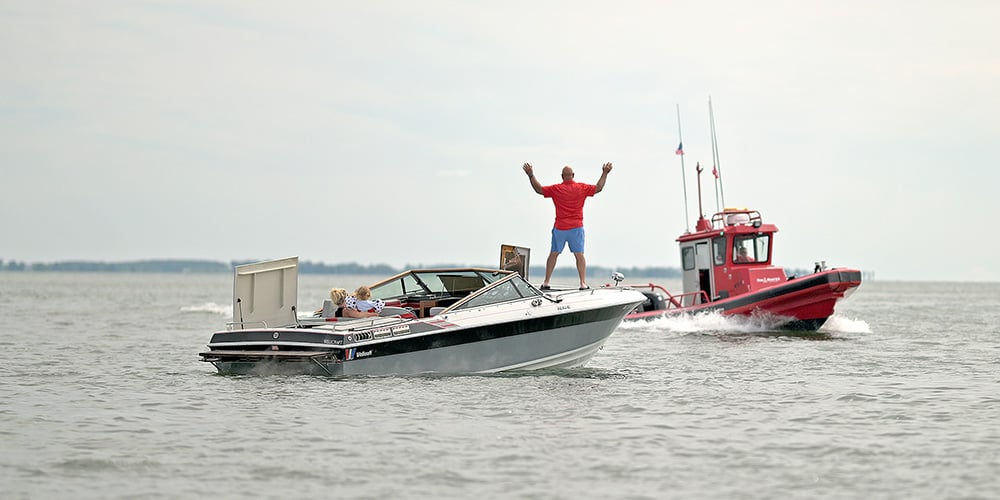
Even experienced boaters encounter situations they cannot resolve on their own — a dead battery at anchor, running aground on a sandbar, engine failure offshore. When this happens, getting back to the dock requires professional assistance, and that assistance can be expensive without advance planning. Understanding how marine towing coverage works, what it costs, and how to choose the right plan helps you make an informed decision before you need it.
- What Marine Towing Actually Costs
- Towing vs. Salvage: A Critical Distinction
- How Towing Memberships Work
- Why West Marine Recommends BoatUS
- Does Boat Insurance Cover Towing?
- Is a Towing Membership Worth It for You?
- FAQs
What Marine Towing Actually Costs
Marine towing is priced very differently from roadside assistance. Towboat operators typically charge by the hour, by the mile, or a combination of both, and costs vary significantly by region, time of day, and how far from port you are when the call is made.
Typical costs without a membership or coverage plan:
- Simple tow within a few miles of port: $300–$600 for many coastal areas
- Offshore or long-distance tow: $1,000–$3,000 or more depending on distance
- Soft grounding with straightforward extraction: $400–$800
- Hard grounding or complex situation: Can exceed $5,000 and may cross into salvage territory (see below)
These are general ranges — actual costs depend on your location, the operator, sea conditions, and time of day (after-hours and weekend calls cost more). There is no standardized pricing in the marine towing industry, and you are rarely in a position to negotiate when you are stuck on a sandbar miles from the nearest marina.
Towing vs. Salvage: A Critical Distinction
This is the most important thing most boaters don’t know about marine assistance: towing and salvage are legally and financially very different things.
Towing means moving a vessel that is still seaworthy and not in immediate danger. A tow from a soft grounding in calm conditions, or a dead-engine tow from an anchorage to a marina, is typically towing. Towing memberships cover this.
Salvage is governed by maritime law and applies to vessels in danger of sinking or total loss. Anyone who saves a vessel in genuine peril is legally entitled to claim a percentage of the saved value — salvage awards can reach 10–50% of the vessel’s worth. On a $100,000 boat, that is $10,000–$50,000. Towing memberships do not cover salvage.
The practical guidance if you need assistance:
- If your vessel is not in immediate danger, state clearly that you are requesting a tow, not salvage, and agree on terms before accepting assistance from any operator who is not your membership provider.
- Never sign a “Lloyd’s Open Form” salvor’s contract without understanding what you are agreeing to.
- If the situation is a genuine emergency, prioritize crew safety. Your boat insurance is the backstop for salvage situations.
How Towing Memberships Work
Towing memberships operate on an annual subscription model. You pay a flat annual fee and, in exchange, covered services are provided at no additional charge when you need them. Standard membership coverage typically includes:
- Unlimited towing to the nearest port of safety or qualified repair facility
- Soft grounding extraction
- Jump-start for a dead battery
- Fuel delivery (you pay for the fuel itself)
- Disentanglement from lines, nets, or debris
Premium membership tiers typically add longer covered tow distances, offshore ocean coverage beyond inland waterways, dinghy and tender coverage, and unattended vessel coverage if your boat breaks free from its mooring.
Annual membership costs typically range from $150–$250 for standard coverage, with premium tiers at $200–$400. A single towing incident without membership commonly costs more than several years of membership dues combined.
Why West Marine Recommends BoatUS
West Marine has a longstanding relationship with BoatUS and recommends their towing membership program to our customers. Other towing membership programs exist, but BoatUS is the provider we stand behind based on the breadth of their network, the depth of their coverage options, and their track record serving recreational boaters.
Largest towboat fleet in the U.S. BoatUS operates the most extensive network of professional towboat operators on the water, providing coverage across coastal waters, inland lakes, and rivers nationwide. More operators on the water means faster response times and coverage in areas where smaller networks don’t reach.
Operators with local waterway knowledge. TowBoatUS operators are not dispatched from a central pool — they are local experts who know the specific waterways, shoals, tidal patterns, and hazards of their home waters. When you call for help, the captain who responds knows how to navigate your situation safely.
24/7 dispatch with GPS-assisted technology. The BoatUS App allows you to request assistance directly from your phone with automatic GPS location sharing. This gets help to you faster and eliminates the guesswork of communicating your exact position in unfamiliar waters or low-visibility conditions. Dispatch is available around the clock, every day of the year.
Membership tiers designed for how you actually boat. BoatUS offers multiple membership levels so you pay for the coverage that matches your boating style — from freshwater lake boaters to offshore cruisers. Upgrading to higher-tier coverage as your boating expands is straightforward.
West Marine member benefit. BoatUS members receive discounts at West Marine, adding tangible value to the membership beyond the towing coverage itself.
Explore BoatUS towing packages and sign up at BoatUS.com/Towing.
Does Boat Insurance Cover Towing?
Standard boat insurance policies typically cover towing in specific circumstances, but not as broadly or predictably as a dedicated towing membership:
- Coverage is usually conditional: Many policies cover towing only when a covered loss has occurred — a collision, storm damage, or mechanical failure that constitutes a claim. Running out of fuel or a dead battery may not qualify.
- Dollar caps apply: Coverage is typically capped at $1,000–$2,500, which may not cover an offshore tow.
- Deductibles and premium impact: Using insurance for a towing claim counts toward your deductible and may affect your premium at renewal. A towing membership has no deductible and no claims impact.
- Towing endorsements: Some insurers offer a towing rider for a modest additional premium. If yours does, compare its terms carefully against a standalone membership before deciding.
For most boaters, a towing membership covers the everyday breakdowns that don’t rise to the level of an insurance claim, while boat insurance handles the larger incidents. They complement each other rather than substitute for each other.
Is a Towing Membership Worth It for You?
A towing membership is a straightforward value proposition for most active boaters. Consider these factors:
A towing membership is clearly worth it if:
- You boat regularly in coastal or offshore waters more than a few miles from port
- You anchor overnight in remote locations away from easy assistance
- Your boat is older and more likely to need mechanical attention underway
- You cruise to unfamiliar areas where you don’t know the local waterways
- You boat in areas with shallow water, tidal flats, or sandbar hazards
A towing membership may be less urgent if:
- You trailer your boat and always launch within a short distance of the ramp
- You boat exclusively on small, calm inland lakes very close to shore
- You already have a comprehensive towing endorsement on your boat insurance that covers your typical situations
Even for boaters in the lower-risk category, standard membership pricing ($150–$250 per year) is low enough that a single incident more than justifies multiple years of membership. For the cost of a nice dinner, you eliminate the possibility of a four-figure towing bill ruining a weekend on the water.
Frequently Asked Questions
What is the difference between boat towing and salvage?
Towing moves a vessel that is safe and not in immediate danger. Salvage applies to a vessel in danger of sinking or total loss, and maritime salvage law entitles the salvor to claim a percentage of the vessel’s saved value — potentially 10–50%. Towing memberships cover towing only. If your vessel is not in immediate peril, state that you are requesting a tow, not salvage, and agree on terms before accepting assistance from any operator who is not your membership provider.
How much does a boat tow cost without a membership?
A short coastal tow near a marina typically runs $300–$600. Longer distance or offshore tows commonly reach $1,000–$3,000 or more. There is no standardized pricing in the marine towing industry. Annual BoatUS membership costs a fraction of what a single towing incident typically costs without coverage.
Does my boat insurance cover towing?
Most standard policies cover towing only when a covered loss has occurred and cap the benefit at $1,000–$2,500. Everyday situations like a dead battery or running out of fuel may not be covered. A towing membership covers these situations without deductibles and without affecting your insurance premium at renewal.
What does a towing membership typically not cover?
Towing memberships generally do not cover: salvage (vessel in danger of sinking or total loss), damage to the vessel during the tow, the cost of fuel delivered, vessel repairs, hard groundings requiring heavy equipment or extended operations, or situations outside the membership’s geographic coverage area. Read your membership terms carefully, particularly regarding towing vs. salvage definitions and any distance limits.
How do I request help through BoatUS?
Contact BoatUS through the 24/7 dispatch center by phone, or use the BoatUS App to request assistance directly from your phone. The app shares your GPS location automatically with the dispatched operator, which is particularly valuable in unfamiliar waters or reduced visibility when communicating your exact position is difficult.