Maritime Distress Signals: Complete Guide to Boat Flares, EPIRB Beacons, VHF Radio Distress Calls & US Coast Guard Requirements
By Nicholas Macrino | Reviewed against U.S. Coast Guard Marine Safety guidelines
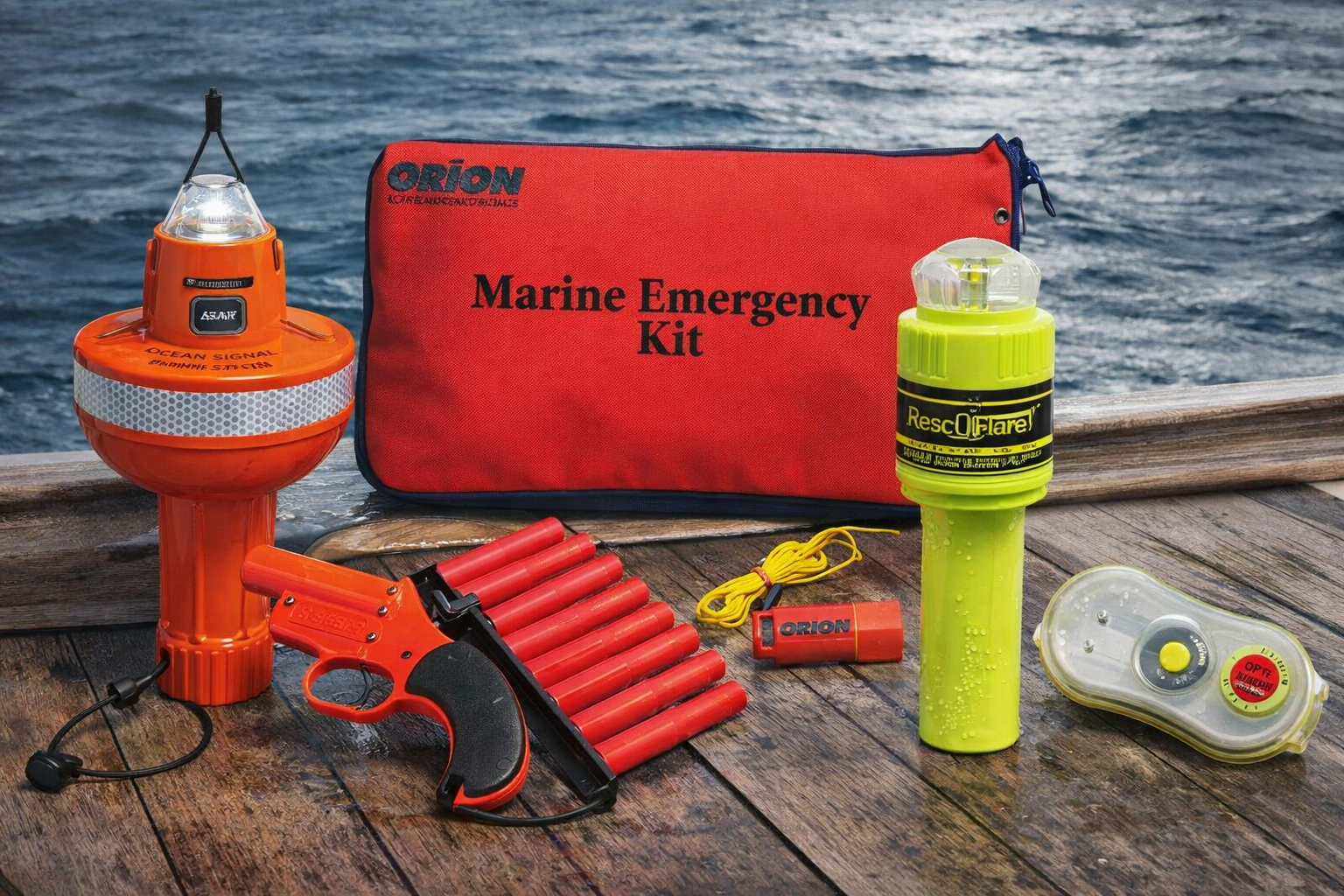
Maritime Distress Signals
Maritime distress signals are internationally recognized emergency signals used by vessels to indicate grave and imminent danger requiring immediate assistance. These signals allow nearby vessels, aircraft, and search-and-rescue authorities to quickly identify emergencies and locate people in distress on the water.
Modern maritime safety systems combine visual distress signals, satellite distress beacons, and marine radio communication to improve survival outcomes during boating emergencies.
The most widely recognized maritime distress signals include:
Orange smoke signals
Emergency Position Indicating Radio Beacons (EPIRB)
Personal Locator Beacons (PLB)
VHF marine radio distress calls on Channel 16
SOS distress signals transmitted by light or radio
International maritime distress signaling standards are defined by global maritime safety conventions and enforced in U.S. waters by the United States Coast Guard (USCG).
Maritime Distress Signaling
Visual distress signals help rescuers locate vessels during emergencies.
Red flares and orange smoke signals are internationally recognized distress signals.
VHF Channel 16 is the global marine radio distress frequency.
EPIRB and PLB emergency beacons transmit distress alerts via the COSPAS-SARSAT satellite network.
Many vessels operating on coastal waters must carry U.S. Coast Guard-approved visual distress signals.
Proper distress signaling dramatically improves the speed and effectiveness of maritime rescue operations.
What Are Visual Distress Signals (VDS)?
Visual distress signals (VDS) are emergency signaling devices designed to alert nearby vessels and rescue authorities that a vessel or individual requires assistance.
These devices produce bright light, colored smoke, or highly visible markers that can be seen from long distances across open water.
Visual distress signals allow rescuers to locate vessels by attracting attention from:
nearby recreational boats
commercial vessels
aircraft conducting search operations
Coast Guard rescue teams
Because these signals are essential during maritime emergencies, many vessels operating on federally controlled waters are required to carry U.S. Coast Guard-approved visual distress signals.
Types of Visual Distress Signals
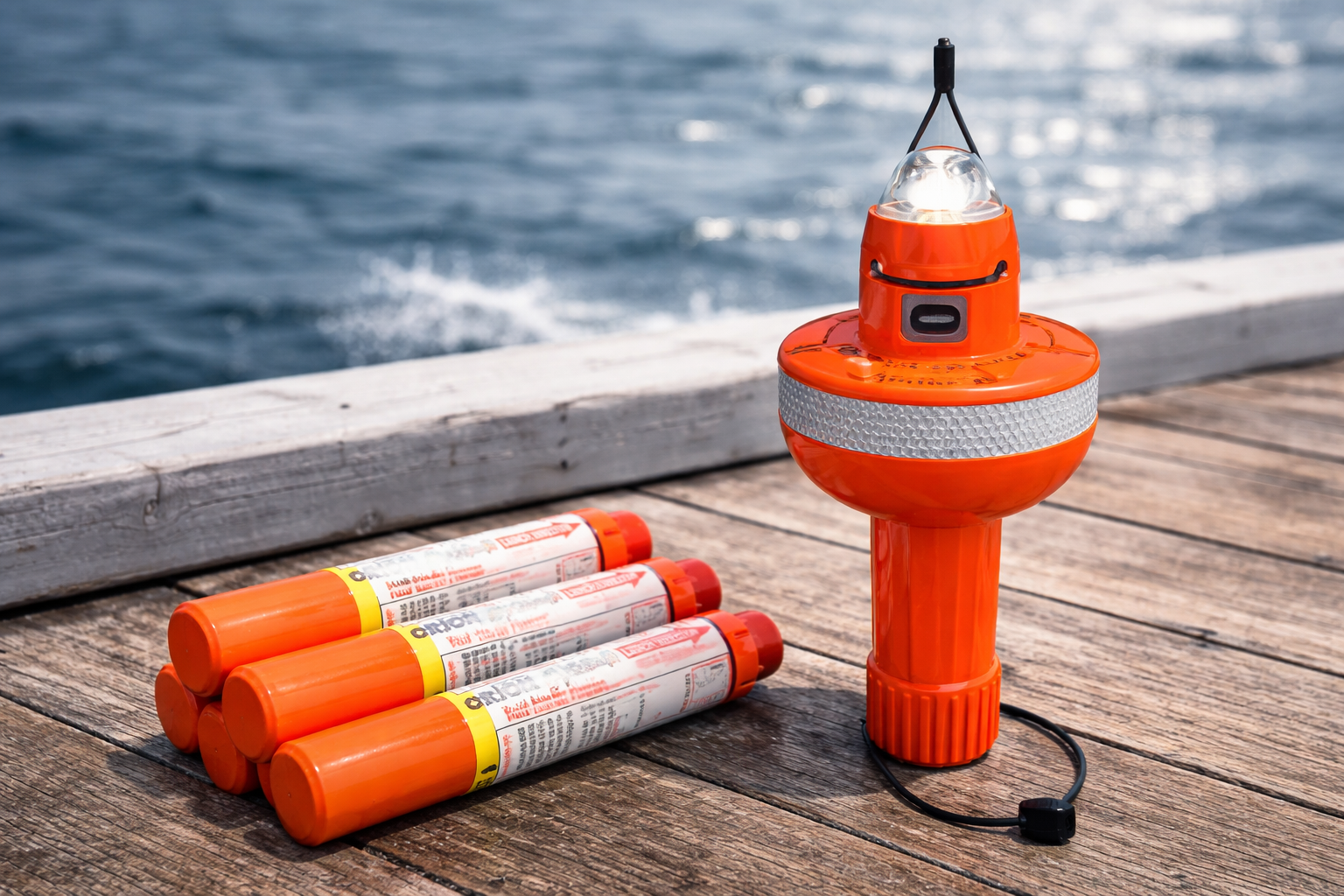
Visual distress signals fall into two primary categories: pyrotechnic signals and non-pyrotechnic signals.
Pyrotechnic Visual Distress Signals
Pyrotechnic distress signals produce intense light or smoke using chemical combustion reactions.
Common pyrotechnic distress signals include:
aerial meteor flares
parachute flares
floating orange smoke signals
These signals are extremely bright and can be seen from miles away, making them effective tools for attracting attention during maritime emergencies.
Non-Pyrotechnic Distress Signals
Non-pyrotechnic distress signals do not rely on combustion and instead use visual markers or electronic lighting.
Examples include:
Electronic visual distress signals are increasingly popular because they are reusable, safe to store onboard vessels, and do not expire like traditional flares.
Marine Flares
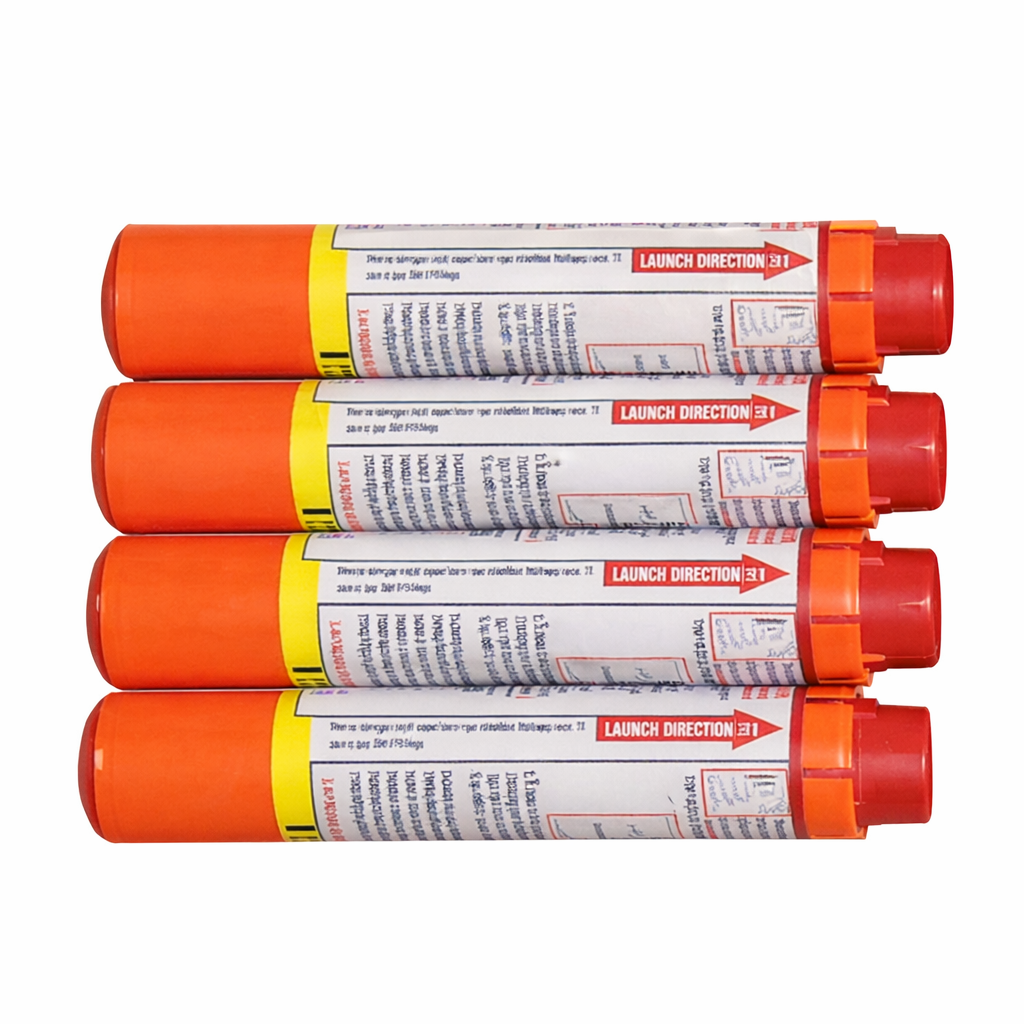
Marine flares are one of the most widely recognized maritime distress signals. These devices produce bright light or colored smoke that alerts nearby vessels or aircraft that assistance is required.
Marine flares are designed to:
attract attention from nearby boats
signal aircraft conducting search operations
guide rescuers directly to the vessel in distress
Because flares burn extremely bright, they can often be seen from several miles away in clear weather conditions.
Handheld Marine Flares
Handheld marine flares produce a bright red flame that burns for several minutes. These signals are typically used when rescuers are already nearby and the vessel needs to provide a precise location signal.
Typical characteristics include:
burn time between 1 and 3 minutes
intense red emergency signal flame
visibility from long distances
Handheld flares are generally approved for nighttime distress signaling.
Aerial Flares and Flare Guns
Aerial flares are launched into the air using a flare gun or flare launcher. Once fired, the flare travels hundreds of feet into the air and burns brightly while descending.
Common flare launcher types include:
Aerial flares are ideal for attracting attention from distant vessels or aircraft, especially when the distressed vessel is isolated offshore.
Orange Smoke Distress Signals
Orange smoke signals are primarily used during daytime emergencies. These signals produce dense orange smoke that contrasts strongly with the surrounding environment.
Orange smoke signals are commonly used during:
helicopter rescue operations
daylight search missions
Many smoke signals float on water, allowing rescuers to pinpoint the exact location of a distressed vessel.
How Marine Flares Work
Marine flares operate through a chemical reaction that produces intense light or smoke.
Typical flare components include:
oxidizing agents that sustain combustion
magnesium or metallic powders that generate bright light
chemical coloring agents such as strontium compounds that produce red light
When ignited, these compounds burn at extremely high temperatures and create a highly visible distress signal.
How Long Marine Flares Burn
The burn duration of marine flares varies depending on the type of distress signal.
Typical burn times include:
Handheld flare — 1 to 3 minutes
Aerial meteor flare — 5 to 7 seconds
Orange smoke flare — 10 to 15 minutes
Although aerial flares burn for only a few seconds, their extreme brightness allows them to be detected from long distances.
Electronic Distress Beacons
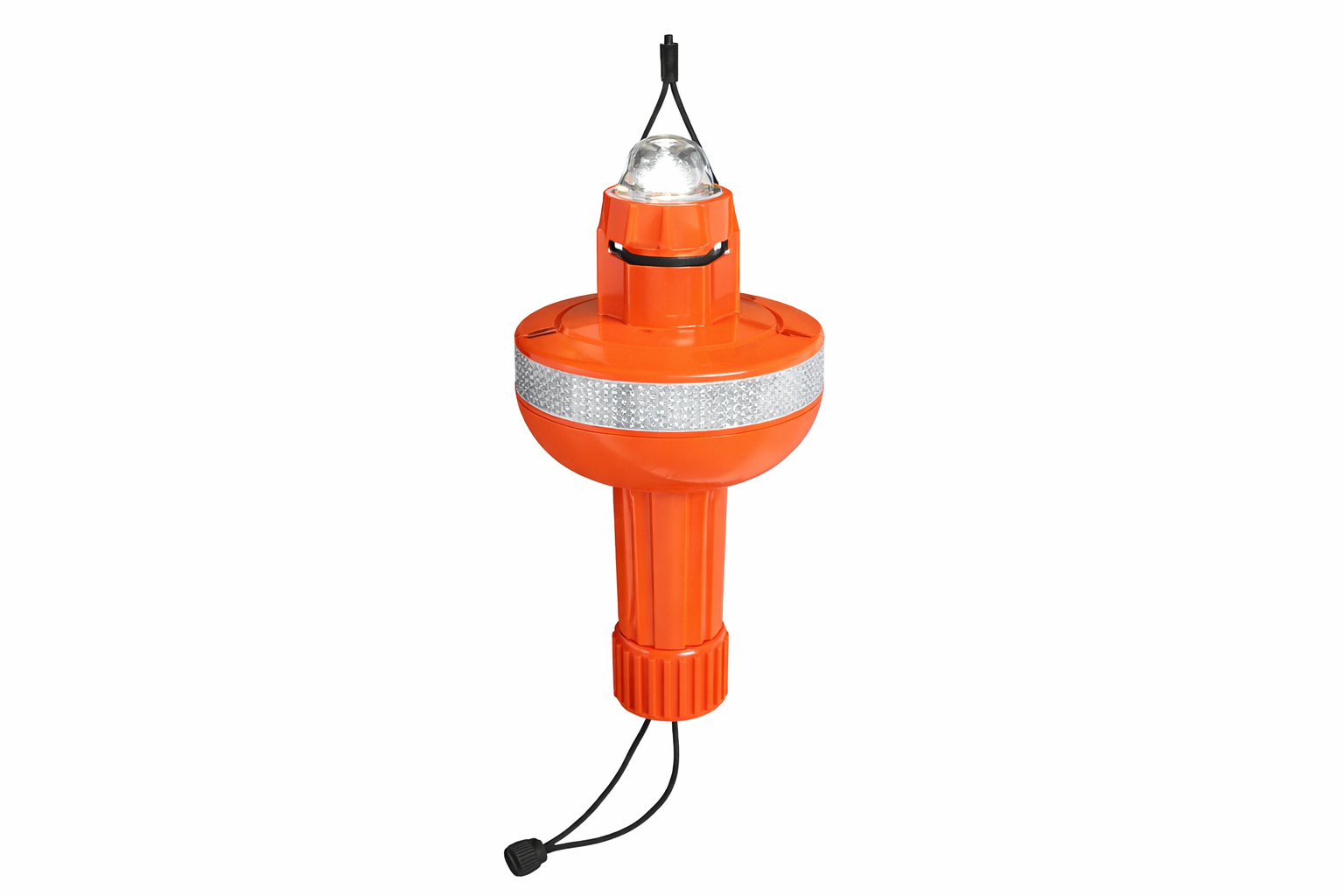
Modern maritime safety systems include satellite-based emergency beacons that allow rescuers to locate distressed vessels quickly and accurately.
The most common beacon systems are EPIRB and PLB devices.
Emergency Position Indicating Radio Beacon (EPIRB)
An Emergency Position Indicating Radio Beacon (EPIRB) is a satellite distress transmitter installed on vessels.
When activated, an EPIRB sends a distress signal on the 406 MHz emergency frequency, which is monitored by the COSPAS-SARSAT satellite search-and-rescue network. EPIRBs must be registered with the NOAA Beacon Registration Database as required by the U.S. Coast Guard.
Modern EPIRB devices transmit:
vessel identification information
GPS location coordinates
automated distress alerts
Many EPIRBs activate automatically when submerged in water.
Personal Locator Beacon (PLB)
A Personal Locator Beacon (PLB) is a portable distress transmitter designed to be carried by individuals rather than mounted on a vessel.
PLBs are commonly used by:
offshore anglers
sailors
kayakers
boat crew members
When activated, a PLB transmits a satellite distress signal containing GPS coordinates, allowing rescue authorities to locate the individual in distress.
Marine VHF Radio Distress Calls
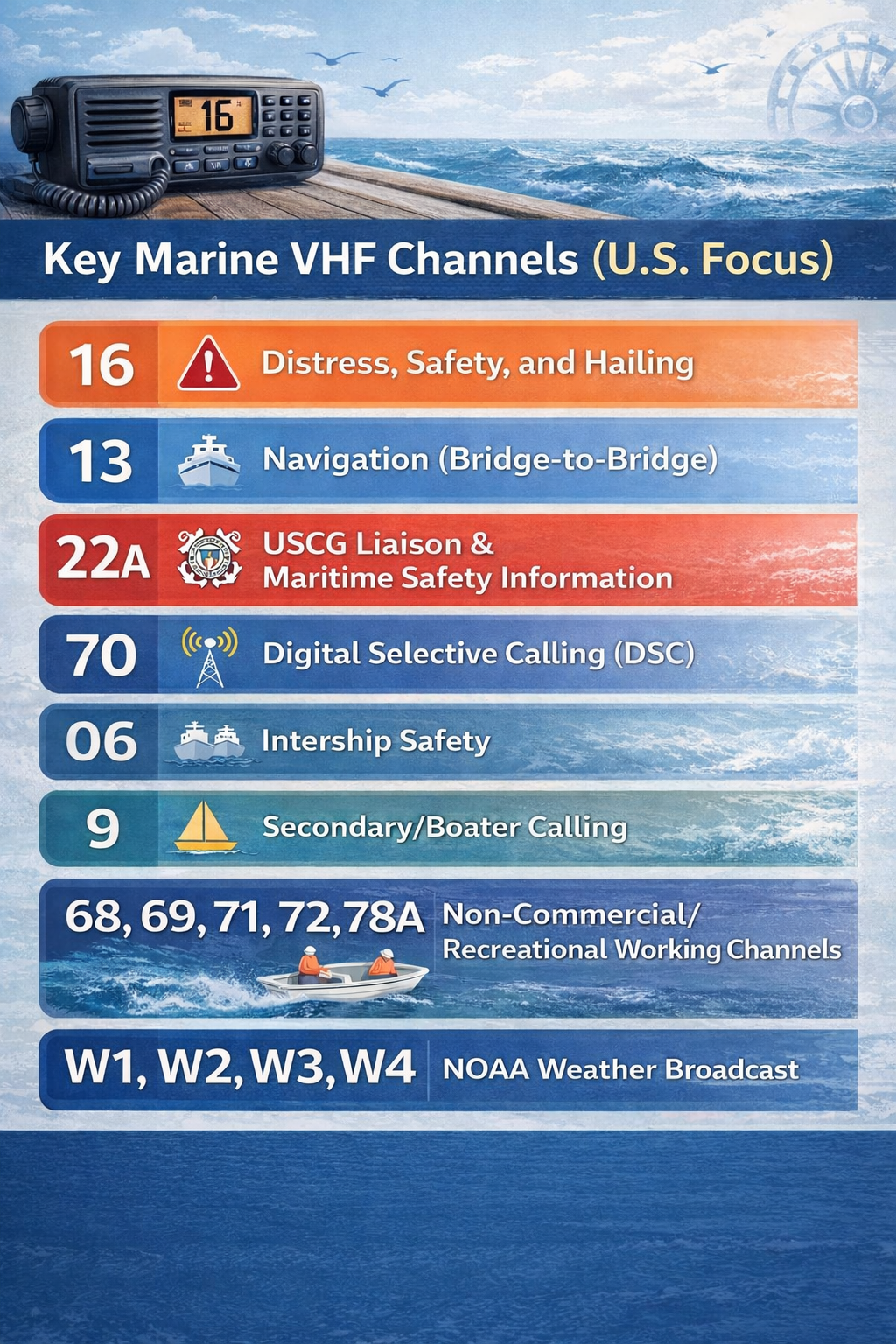
A VHF marine radio is one of the most important communication tools available during boating emergencies.
The international maritime distress frequency is:
VHF Channel 16
This channel is monitored continuously by:
commercial vessels
harbor authorities
search and rescue agencies
In emergencies, boaters should transmit a distress call using the MAYDAY procedure, providing the vessel name, location, nature of distress, and number of people onboard.
Example MAYDAY Distress Call
MAYDAY MAYDAY MAYDAY
This is vessel Ocean Star
Position 34 degrees 21 minutes north, 120 degrees 15 minutes west
We are taking on water and require immediate assistance
Four persons onboard
Providing clear and accurate information allows rescue teams to respond more effectively.
Boat Fog Signals and Navigation Sound Signals
When operating in fog or restricted visibility, vessels must use sound signals to communicate their presence and intentions.
Common fog signals include:
One prolonged blast every two minutes
Indicates a power-driven vessel underway.
One prolonged blast followed by two short blasts
Indicates a vessel restricted in its ability to maneuver.
Five short blasts
Indicates danger or uncertainty about another vessel’s intentions.
These signals are defined in the international navigation rules enforced by the U.S. Coast Guard and are used worldwide to prevent vessel collisions.
International SOS Distress Signal
SOS is the internationally recognized distress signal used across maritime and aviation communications.
In Morse code, SOS is transmitted as:
dot dot dot
dash dash dash
dot dot dot
SOS may be transmitted through:
radio transmissions
The signal indicates a life-threatening emergency requiring immediate assistance.
US Coast Guard Visual Distress Signal Requirements
The United States Coast Guard requires many vessels to carry visual distress signals when operating on federally controlled waters.
In general, vessels 16 feet or longer must carry approved visual distress signals when operating between sunset and sunrise.
Boaters must carry:
three approved day signals
three approved night signals
or
three combination day-night distress signals.
All signals must be U.S. Coast Guard approved and unexpired. Check the USCG Boating Safety page for the full list of approved devices and current requirements.
Required Boat Safety Equipment
In addition to distress signals, vessels must carry other critical safety equipment.
Required safety equipment includes:
life jackets for each passenger
fire extinguisher
sound producing device such as a horn or whistle
Additional recommended equipment includes:
VHF marine radio
EPIRB emergency beacon
PLB personal locator beacon
first aid kit
bilge pump
anchor and anchor line
Carrying proper safety equipment significantly improves survival outcomes during maritime emergencies.
What To Do During a Boating Emergency
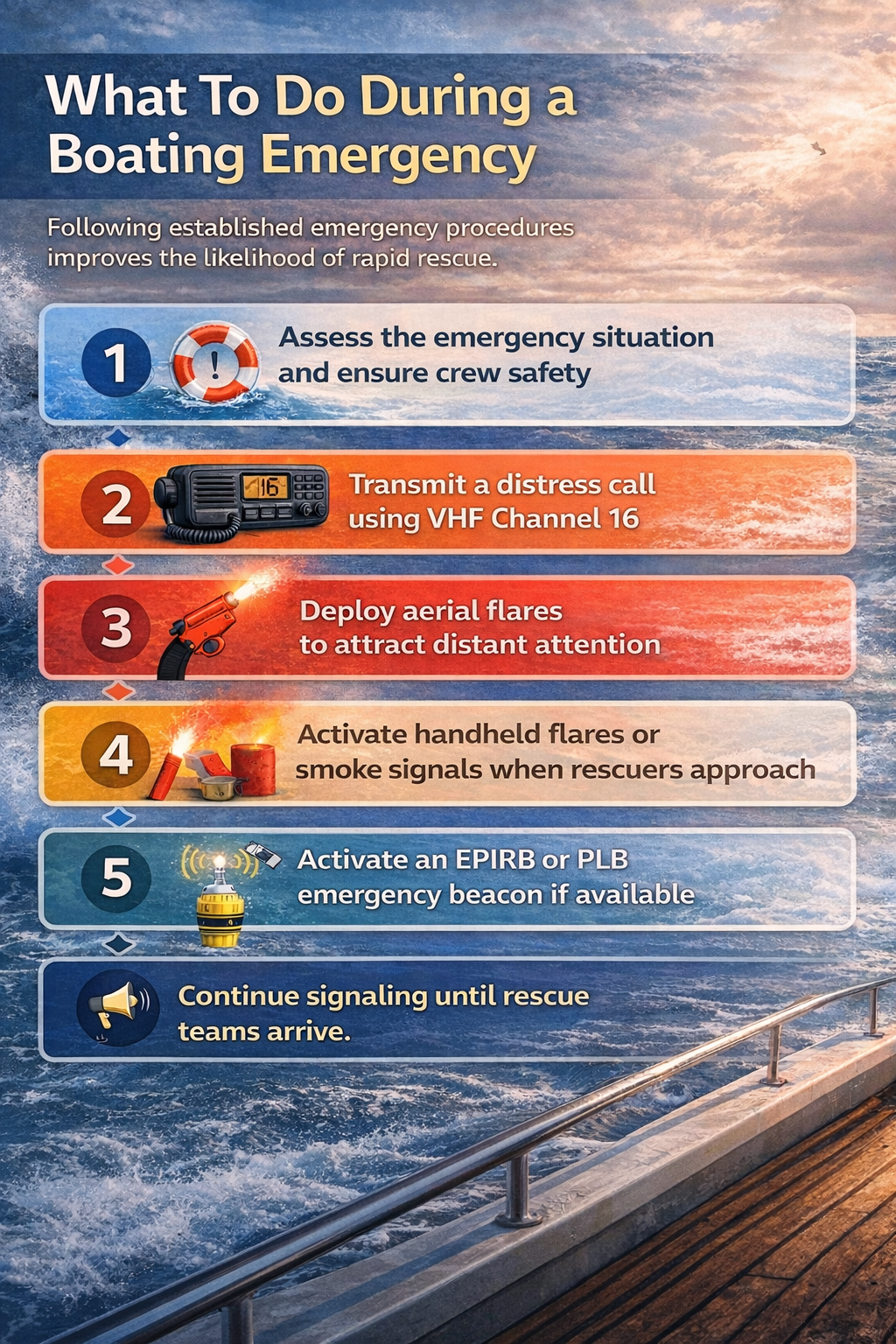
Assess the emergency situation and ensure crew safety.
Transmit a distress call using VHF Channel 16.
Deploy aerial flares to attract distant attention.
Activate handheld flares or smoke signals when rescuers approach.
Activate an EPIRB or PLB emergency beacon if available.
Continue signaling until rescue teams arrive.
Following established emergency procedures improves the likelihood of rapid rescue. For additional guidance, visit the U.S. Coast Guard Boating Safety resource center.
Frequently Asked Questions
What are visual distress signals?
Visual distress signals are emergency devices used to indicate that a vessel or person requires assistance. These signals produce bright light, colored smoke, or highly visible markers that can be seen from long distances by rescuers. They are commonly used in maritime emergencies to attract attention from nearby vessels or aircraft. Many boats operating on coastal waters must carry U.S. Coast Guard-approved visual distress signals.
Are flares required on a boat?
Many vessels operating on federally controlled waters must carry approved visual distress signals, which may include marine flares or other approved devices. This requirement generally applies to vessels that are 16 feet or longer, especially when operating between sunset and sunrise. The purpose of the requirement is to ensure that vessels can signal for help during emergencies. Boaters should review U.S. Coast Guard regulations to confirm the specific requirements for their vessel.
How many flares are required on a boat?
Most vessels must carry at least three approved visual distress signals for daytime use and three for nighttime use. Some flares are approved for both day and night signaling and can satisfy both requirements. These signals must be U.S. Coast Guard approved and must not be expired. Carrying additional signals beyond the legal minimum is recommended in case multiple signals are needed during an emergency.
What color flare indicates distress?
Red flares are the internationally recognized distress signal used to indicate that a vessel requires immediate assistance. When ignited, these flares produce an extremely bright red light visible from miles away. The color red has long been associated with emergency situations and is universally recognized by mariners and rescue authorities. Because of this recognition, red flares remain one of the most effective visual distress signals available.
When should orange smoke signals be used?
Orange smoke signals are designed for use during daylight emergencies when visibility conditions allow smoke to be easily seen. These signals produce dense orange smoke that stands out against the water and sky. They are particularly effective during man-overboard incidents or helicopter rescue operations. Because smoke signals rely on daylight visibility, they are typically not used at night.
What is VHF Channel 16 used for?
VHF Channel 16 is the international maritime distress and safety communication channel used by vessels worldwide. It is monitored continuously by the United States Coast Guard, commercial vessels, and many recreational boaters. In emergencies, distress calls using the MAYDAY format should be transmitted on this channel. Channel 16 is also used for initial contact before vessels switch to other channels for routine communication.
What is the difference between an EPIRB and a PLB?
An EPIRB is an Emergency Position Indicating Radio Beacon designed to be installed on a vessel and activated during maritime emergencies. A PLB, or Personal Locator Beacon, is a smaller portable device intended to be carried by an individual. Both transmit distress signals on the 406 MHz emergency frequency to the COSPAS-SARSAT satellite rescue network. The primary difference is that EPIRBs are vessel-mounted systems while PLBs are personal emergency transmitters.
What does five short horn blasts mean?
Five short horn blasts indicate danger or uncertainty about another vessel’s intentions. This signal is used to warn nearby vessels of a potential collision or unsafe maneuver. When another vessel hears this signal, it should immediately assess the situation and take action to avoid danger. The five-blast signal is recognized internationally under maritime navigation rules.
What does SOS mean?
SOS is the internationally recognized distress signal used in maritime and aviation emergencies. In Morse code, SOS is transmitted as three dots, three dashes, and three dots. The signal may be sent through radio transmissions, flashing lights, or visual signals. SOS indicates that a vessel or individual is experiencing a life-threatening emergency and requires immediate rescue assistance.
When should distress signals be used?
Distress signals should only be used when a vessel or person is facing grave and imminent danger. Situations may include vessel flooding, onboard fire, medical emergencies, or a person overboard. Using distress signals incorrectly may trigger unnecessary rescue operations and waste emergency resources. Boaters should ensure that a genuine emergency exists before deploying distress signaling devices.