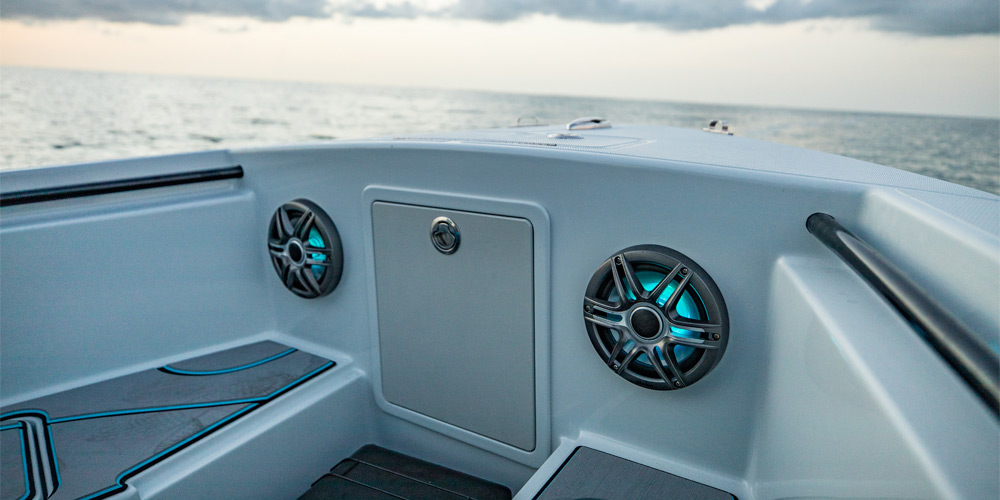
Customers sometimes ask if automotive speakers are a good choice for a boat. Our reply is that while you can install car speakers on your boat, choosing marine grade speakers is a far better choice. This is because unlike car speakers, marine grade speakers are designed to deliver dependable performance in marine environments.
Boat speakers live in a much harsher environment than speakers installed in a car. They face sun, salt, spray, vibration, sudden temperature changes, washdowns and open-air listening conditions. A speaker that sounds fine in a vehicle may corrode, fade, crack or lose output quickly on a boat. Marine grade speakers are built to resist those conditions while projecting clear sound over wind, engine noise and water noise.

Marine-grade speakers are built to live where the real fun happens.
Those who design marine speakers must take many factors into account. Exposure to water is at the top of the list. This might be in the form of rain, spray, splashing water or maybe you hosing down your boat. For boats used in saltwater, the corrosive effects of salt cannot be ignored. Marine speakers must also contend with extremes of heat and cold and extended exposure to UV radiation from the sun—all of which work together to shorten a speaker's life.
Given the nature of the marine environment, a great deal of engineering and testing goes into ensuring that the speakers that West Marine sells deliver the performance that you as a boater expect. Engineers at companies like JL Audio perform a variety of environmental and performance tests. We'll use JL Audio's testing as an example of what goes into marine speakers before they land on West Marine's shelves.
- Moisture, Thermal and UV Testing
- Sound Projection and Dispersion
- Why Marine Speakers Cost More
- Why You Need Subwoofers
- Infinite Baffle Subwoofers
- How to Choose Marine Speakers
- Marine Speaker FAQ
Moisture, Thermal and UV Testing
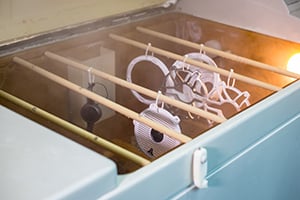
Speaker components undergo testing in JL Audio's Q-Fog machine.
Moisture testing examines a speaker’s ability to operate properly during or after exposure to water. JL Audio tests every component of their marine speakers to ensure that adhesives and materials will not fail if they come into contact with moisture of any kind.
Thermal and UV testing is done to ensure that the plastic-based material used for grilles and frames can withstand extended exposure to UV rays, as well as sudden changes in temperature. For example, it’s common for a marine speaker to sit in the hot sun all day and then suddenly be splashed with cold water. For many grades of plastic, a sudden change in temperature like this can cause the plastic to become brittle or simply crack.
Extended UV exposure is also known to make plastic brittle, soften rubber surrounds, weaken adhesive bonds and cause discoloration or fading of a speakers’ finished surfaces. Marine speakers are designed to withstand years of this type of abuse. Speaker components include stainless steel hardware that will not corrode, rust or deteriorate during or after testing in order to ensure proper sound quality, reliability and appearance.
Saltwater adds another layer of stress. Salt residue can attack terminals, grilles, fasteners and exposed metal parts. A true marine speaker uses corrosion-resistant materials, sealed or protected connection points and weather-resistant cones, surrounds and baskets. This is the main reason automotive speakers are a poor long-term choice for cockpits, center consoles, flybridges and open decks.
In addition to enduring the marine environment, marine speakers must overcome major obstacles when it comes to sound. Out on the water, boat speakers must compete with noise that would be absent in other settings. Noise challenges include but are not limited to waves, wind and the roar of an engine or engines. In this environment, non-marine speakers can suffer a severe case of mid- and high-frequency cancellation. To overcome this noise, marine speakers like JL Audio's M6 and M3-Series are designed to produce powerful sound despite the ever-present noise of the marine setting.
Sound Projection and Dispersion

Wake tower speakers have wide dispersion and powerful projection capabilities to make sure the person being towed can hear the music.
Another key element of a marine speaker’s design is its projection and dispersion abilities. A speaker’s sonic requirements lie not only within the boat, but also behind the boat when used for wakeboarding or waterskiing. Tower-mount speakers must project far behind the vessel so that the highs, mids and lows can be enjoyed while riding the wake.
Additionally, watersports activities rarely follow a straight line directly behind the boat. Your path will take you from side to side, so your marine speaker must maintain a wide dispersion path in order to provide loud and clear music that can be heard and enjoyed no matter where the rope pulls you. JL Audio's marine speakers’ wide dispersion and powerful projection capabilities are achieved through larger and strategically placed tweeters for the high frequencies and midrange drivers with larger cone areas, voice coils and power handling abilities.
For cockpit and cabin speakers, dispersion is still important. Unlike a living room or car interior, a boat rarely has a controlled listening position. Passengers move between the helm, cockpit, bow, swim platform and cabin. Good marine speakers spread sound evenly so the system does not sound harsh in one seat and weak in another.
Why Marine Speakers Cost More
Marine speakers are designed by marine enthusiasts who know and understand what boaters demand. Unlike standard automotive speakers, they are built to withstand the abuse of moisture, salt and UV rays, while providing tremendous output, sound quality and overall performance that beats lower cost car speakers hands down.
The higher cost comes from materials, sealing, testing and hardware. Marine grade speakers often use UV-resistant grilles and frames, corrosion-resistant terminals, synthetic cone materials, weather-resistant surrounds, stainless steel fasteners and adhesives designed to survive heat, moisture and vibration. Those details may not be obvious when the speakers are new, but they become important after months or years of exposure.
Subwoofers Shoulder the Load of Heavy Bass
Subwoofers reproduce the low bass tone frequencies that conventional component or coaxial speakers cannot. Adding a subwoofer to your system will also improve the sound of your existing speakers because they will no longer be taxed by the lower frequencies.
On a boat, bass is harder to reproduce than it is in a vehicle or enclosed room because much of the sound energy escapes into open air. A properly installed marine subwoofer adds depth and fullness without forcing small speakers to work beyond their comfort zone. This can make the entire system sound cleaner at cruising volume.
Just as JL Audio does with their full-range marine speakers, their M6-Series and M3-Series subwoofers go through stringent environmental testing to ensure all components meet the demands of the marine climate.
Infinite Baffle Subwoofers Can be Mounted Almost Anywhere
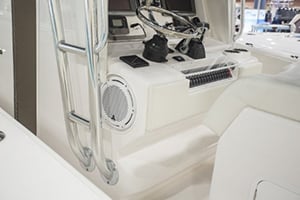
Infinite baffle marine subwoofers can be mounted almost anywhere.
Due to space limitations, it’s common to choose an infinite baffle subwoofer over a subwoofer enclosure on a vessel. Infinite baffle subwoofers mount into your vessel’s sidewall and don’t require an enclosure. This kind of flexibility allows you to install the appropriate JL Audio subwoofer for your specific application without sacrificing the sonic performance of the driver.
Placement still matters. An infinite baffle subwoofer needs a suitable mounting surface and enough air volume behind the panel to perform correctly. Before cutting, check behind the mounting location for wiring, plumbing, fuel lines, steering components and structural members. Use marine sealant where appropriate and follow the speaker manufacturer’s mounting instructions.
How to Choose Marine Speakers
Start with where the speakers will be installed. Cockpit speakers, cabin speakers, tower speakers and subwoofers all serve different roles. A pair of cockpit speakers may provide background music at anchor, while tower speakers must project sound to a rider behind the boat. Subwoofers fill in low frequencies, and amplifiers help the system play cleanly without distortion.
Next, match speaker size and power handling to your system. Larger speakers often produce stronger midbass and better output, but they require enough mounting depth and cutout space. Make sure the speaker’s impedance and power handling match your stereo or amplifier. Underpowering or overpowering speakers can both lead to poor sound if the system is driven into distortion.
Finally, think about installation details. Use marine-grade wiring, protect connections from moisture, secure wires against vibration and avoid placing speakers where they will be directly blasted by washdown water whenever possible. If the boat is used in saltwater, rinse exposed areas with fresh water and periodically inspect grilles, terminals and mounting hardware.
Marine Speaker FAQ
Can I use car speakers on a boat?
You can install car speakers on a boat, but they are not designed for the marine environment. Marine grade speakers are a better choice because they are built to resist moisture, salt, UV exposure, vibration and temperature changes.
What makes marine speakers different from regular speakers?
Marine speakers use weather-resistant materials, corrosion-resistant hardware, UV-resistant plastics, protected terminals and components designed to survive spray, sun and salt. They are also designed to project sound in open-air environments with wind and engine noise.
Do marine speakers need an amplifier?
Not always. Many marine speakers can run from a marine stereo, but an amplifier can provide cleaner power, better volume and improved sound quality, especially on larger boats or systems with tower speakers and subwoofers.
Are tower speakers different from cockpit speakers?
Yes. Tower speakers are designed to project sound farther behind the boat for wakeboarding, waterskiing and other tow sports. Cockpit speakers are designed for listening inside the boat and usually do not project as far.
Do I need a subwoofer on my boat?
A subwoofer is not required, but it improves low-frequency response and helps full-range speakers sound cleaner by reducing the bass load they must handle. It is a good upgrade for boaters who want fuller, louder and more balanced audio.
Conclusion
We hope this article has given you a good understanding of what goes into the marine speakers that we sell. While some boaters do indeed install automotive speakers on their boats, if you want superior performance in the marine environment, marine speakers are always the best choice.
Browse All Marine Electronics & Navigation Gear
- Chartplotters, GPS units, radar systems, and integrated navigation displays
- Sonar, CHIRP, downscan, and fish-finding electronics
- Marine stereos, speakers, amplifiers, and audio accessories
- VHF radios, AIS, satellite communication equipment
- Autopilot systems and steering control components
- Wind, depth, speed, and multifunction instruments
- Marine binoculars for navigation and low-light use
- Thermal and night-vision devices for situational awareness
- Onboard monitoring and security systems
- Magnetic and electronic compasses
- Paper and electronic navigation charts
- Regional cruising and harbor guides
- Traditional navigation plotting tools