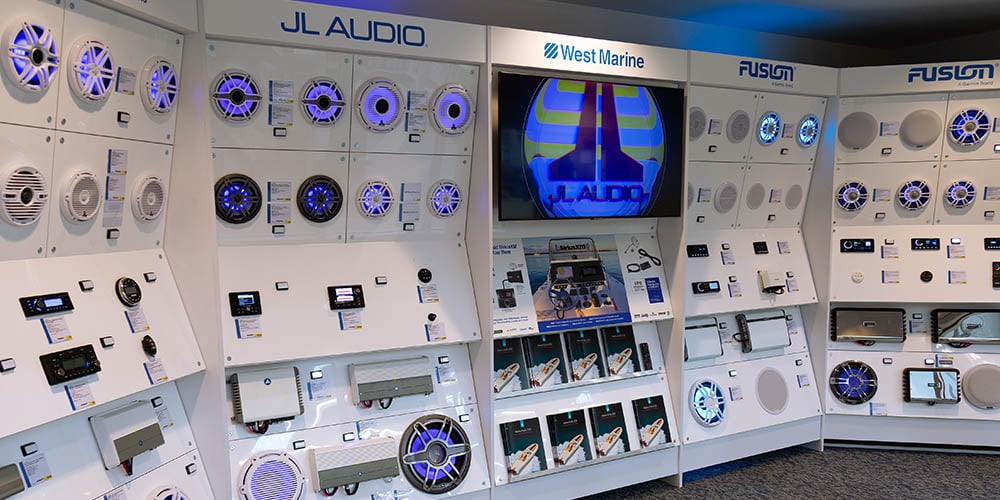
As with home theater and automotive audio systems, speakers on your boat are critical to good sound quality, so don’t skimp. A middle-quality receiver paired with the best speakers will be a better sounding marine audio system than an expensive receiver driving cheap speakers. The marine environment is one of the most demanding conditions any speaker will face — salt air, UV exposure, spray, vibration, and extreme temperature swings combine to destroy speakers that were not specifically engineered for it. We'll walk you through everything you need to choose high-quality marine speakers built to last in the marine environment.
Written by Brian Gordon, West Marine
- Box, Tower or Flush-Mount Speakers
- Number of Drivers
- Power Handling Capacity
- Waterproof Rating
- Magnetic Interference and Shielding
- Subwoofers
- Installation Tips
- Browse All Marine Electronics & Navigation Gear
Box, Tower or Flush-Mount Speakers
Box speakers
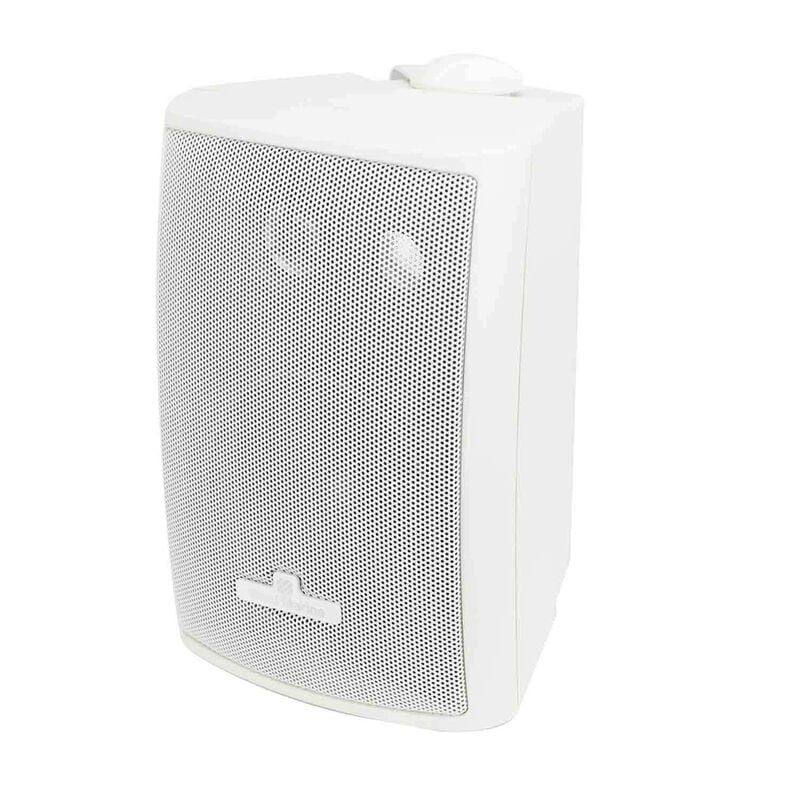
Box speakers are easiest to install and include their own acoustically-designed enclosure, so the sound you heard in our store will be what you hear on your boat. Their advantage is that you don’t need to cut holes in your boat to install them, but they take up more space, so may add clutter to a busy cockpit. Box speakers are also the easiest to relocate or remove entirely, which matters for boats that are trailered and stored where equipment removal is practical. The enclosure does all the acoustic work, so you are not dependent on finding the right depth or air volume behind a mounting surface — the box provides the correct acoustic environment regardless of where it is mounted. For boats where cockpit drilling is not an option, or for owners who want a clean installation without permanent commitment, a box speaker is often the right starting point.
Tower Speakers
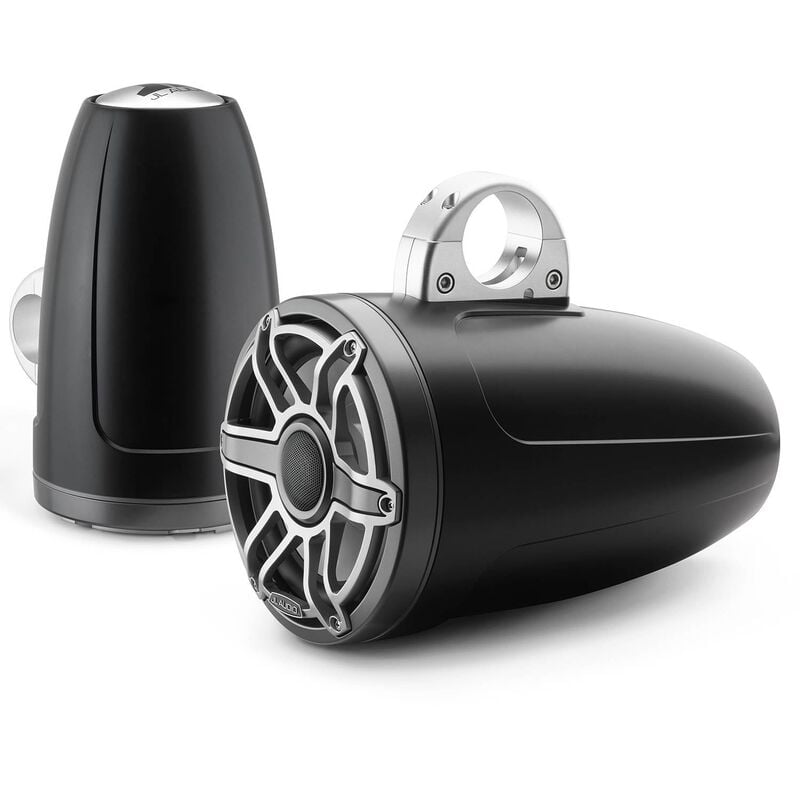
Tower speakers are fully enclosed and ready to mount to a wake tower or the rails on an offroad vehicle. These speakers are usually pointed toward the back of the boat and the bullet shaped enclosure helps project the sound toward the rider behind the boat. The elevated mounting position of a tower speaker is a genuine acoustic advantage: height separates the speaker from the water surface reflections and engine noise that degrade cockpit-level sound, and the direct line of sight to riders being towed means the sound reaches them before it disperses. For wakeboard and surf boats where music for the rider is the primary goal, tower speakers are not optional — no cockpit speaker system can match the coverage and volume that a pair of properly aimed tower speakers provides at tow distances of 60 to 80 feet. Tower speaker clamp diameter must match your specific tower tube diameter, so confirm the spec before purchasing.
Flush-Mount Speakers
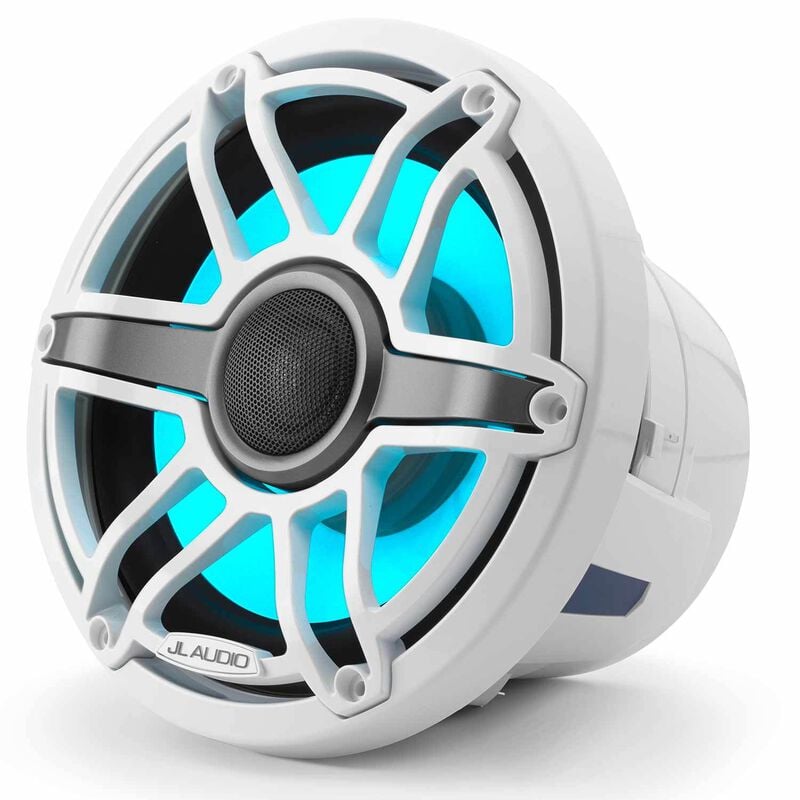
Flush-mount speakers like, JL Audio's M6 series above, are clean and attractive, fit in tight spaces and can’t snag tackle or lines but need a cutout. However, proper mounting can be tricky. Speakers work by moving a diaphragm (cone) back and forth to move air and generate sound. An air space that is too small will inhibit movement of the diaphragm and result in a serious loss of low frequency response.
Also, make certain there is no air path between the front and rear of the speaker. When the diaphragm moves forward, air will rush into the vacuum behind the speaker instead of traveling to your ear, again resulting in loss of low frequency response.
Before cutting any holes for flush-mount installation, confirm three things: the cutout diameter specified by the manufacturer, the mounting depth required behind the surface, and whether the cavity behind the mounting surface is sealed or open to adjacent spaces. A flush-mount speaker installed into a cavity that communicates with a large open bilge space will lose most of its bass response because the air behind the cone is not constrained. Ideally, each speaker should be installed into an isolated, sealed cavity of at least one cubic foot. If the mounting surface does not naturally provide this, a simple foam seal around the speaker's rear housing can help isolate it from adjacent air spaces.
Number of Drivers
Two-way, or coaxial
Coaxial speakers include a separate tweeter—located inside the woofer—to handle the high frequencies and accurately deliver your music’s sound range. This is the most common configuration in marine speakers and handles the full frequency range competently in a single unit, making installation straightforward. For most cockpit and cabin applications, a quality two-way coaxial is the right choice — it covers the full audible range without requiring additional components or complex crossover wiring.
Three-way, or triaxial
Triaxial speakers add a midrange driver to the separate woofer and tweeter for additional fullness and realism. The midrange driver handles the vocal frequency range — roughly 500Hz to 4kHz — that a two-way speaker divides between the woofer and tweeter. The result is smoother, more natural reproduction of vocals and instruments. In a noisy outdoor marine environment with wind and engine noise masking subtle frequencies, the practical difference between a two-way and three-way speaker is less pronounced than it would be in a quiet indoor listening room, but in calm conditions at anchor or at low speeds, the improvement is audible.
Dual cone
Dual cone speakers are a less costly alternative using a small “whizzer” high-frequency cone attached in the center of the woofer. Unlike a two-way speaker, dual cone models have only one voice coil (the coil of wire that converts the electrical signal from the receiver into mechanical vibration that drives the cone of the speaker). Dual cone speakers are a budget option that works adequately for low-volume, background music applications but does not match the frequency separation and clarity of a proper two-way design. For any installation where sound quality is a priority, two-way coaxial speakers are worth the modest additional cost.
Power Handling Capacity
Bigger is better, but don’t get your hopes up that a 10-watt signal will sound better on a 100-watt speaker than on a 10-watt speaker. Be sure the speakers are rated for at least as much RMS watts output as your receiver, or you’ll blow speakers when you crank up the volume.
Two power ratings appear on speaker specifications and it is important to understand the difference between them. Peak power is the maximum instantaneous power a speaker can handle for a fraction of a second without physical damage — it is a marketing number, not a performance number. RMS power (Root Mean Square) is the continuous power the speaker can handle during normal listening conditions and is the number that actually determines whether your speakers will survive being driven hard. Always match speakers to your amplifier or receiver using RMS ratings, not peak ratings. A speaker with a 50W RMS rating driven by a 50W RMS amplifier is a correct match. The same speaker driven by a 100W RMS amplifier will eventually be destroyed by the excess power, particularly at high volume settings where the signal clips and produces the damaging DC component that burns voice coils.
For open-air boating environments at speed, where wind and engine noise are competing with the audio, more power is almost always better. A receiver with 25W RMS per channel that sounds adequate in the cockpit at dock will struggle to fill the same space at 25 knots with wind noise. Adding an external amplifier — even a modest 4-channel unit rated at 50 to 75W RMS per channel — makes a more audible difference in a noisy marine environment than any speaker upgrade alone.
Waterproof Ratings
Home or automobile speakers have steel frames and grilles, exposed copper wires and, in some cases, paper cones. All of these features are a problem on a boat: steel rusts, copper corrodes, and paper dissolves.
Since salt air is the main environmental problem, waterproof or marine-rated water-resistant speakers should be used below decks as well as in the cockpit. Water-resistant speakers are made with polypropylene cones, neoprene rubber surrounds, corrosion-resistant metal parts and UV-tolerant plastic components.
Ingress Protection (IP) Many speakers from Fusion, and Sony are rated IPX5 (protected against low-pressure jets of water from all directions). Poly-planar marine speakers are rated IP65 and rated to pass an ASTM 600-hour salt spray test, and designed for permanent outdoor mounting in the saltwater environment.
Understanding the IP rating system helps you choose the right speaker for each location aboard. The first digit in an IP rating indicates protection against solid particles (dust); the second indicates protection against water. IPX5 means the speaker is protected against water jets from any direction but is not submersible. IP65 adds full dust protection. For cockpit speakers on a boat that takes spray regularly, IPX5 is the minimum you should accept. For speakers mounted in wet areas such as a swim platform, transom, or any location that may be submerged when the boat is at rest, look for IPX7 (protected against temporary submersion to 1 meter) or higher. Below-decks cabin speakers in a dry interior can use lower-rated marine speakers, but even interior marine speakers should carry a corrosion-resistant certification given the salt air present throughout any boat's interior in saltwater use.
Magnetic Interference and Shielding
Magnetic compasses have their needles pulled off magnetic North by nearby magnets from motors, unshielded cables and audio speakers. If you are installing a speaker close to your compass—either a magnetic or electronic compass—look for speakers with magnetic shielding. As a practical guideline, a standard unshielded speaker should be kept at least 18 to 24 inches from a magnetic compass. If your installation requires a speaker closer than this — a common situation on smaller boats with limited mounting options — either choose a magnetically shielded model or recheck compass deviation after installation with the audio system both on and off. Any deviation that appears with the system on indicates magnetic interference that will need to be corrected before the compass can be trusted for navigation.
Subwoofers
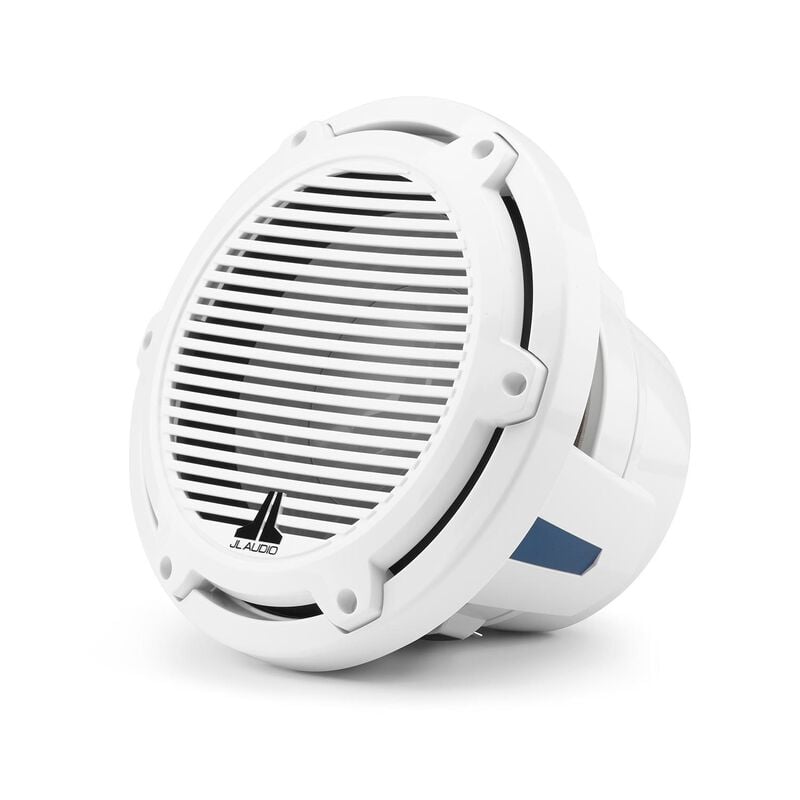
Subwoofers are big speakers (8" diameter or larger) that have only one job—attacking your eardrums with massive bass. We offer several styles in the most popular size, with a 10" woofer cone.
Free-air Rating
Most subwoofers are mounted inside specially designed boxes. A free-air or infinite baffle subwoofer doesn’t need a box and saves valuable space, but you should install it in an airtight compartment or enclosure. Free-air subs also have flat frequency response, for crisp, clean bass. The infinite baffle design is particularly well suited to marine installations where dedicated subwoofer enclosures are impractical — a sealed compartment under a seat, behind a cockpit panel, or inside a console can serve as the enclosure, provided it is airtight and has sufficient internal volume. The minimum volume for a free-air subwoofer varies by model but is typically specified in the manufacturer's documentation — confirm the available volume in your intended installation space before purchasing.
Amplifiers
If you install a subwoofer, you need a separate power amplifier to drive it (subwoofers are either “powered,” containing their own amp, or “unpowered,” and require a power amplifier). Regular speakers can run off the receiver’s built-in amp, but you’ll get more power, more volume and cleaner sound from your premium speakers with a separate power amplifier.
In a high-noise environment, like a fast powerboat, the amp provides the guts you need for great sound. Installing an amplifier requires a thick power wire run directly to your boat’s battery, and you also have to run audio cables to your head unit’s preamp outputs (or in some cases, connect your speaker wires to your amp). If you don’t plan to add an external amplifier, look for a powered enclosed subwoofer.
When sizing an amplifier for a marine subwoofer, match the amplifier's RMS output to the subwoofer's RMS rating as closely as practical. A subwoofer rated at 150W RMS works best with an amplifier capable of delivering 150 to 200W RMS into the subwoofer's impedance (typically 2 or 4 ohms). Underdriving a subwoofer with an amplifier that clips at low volume produces more distortion-related damage than overdriving with a clean signal — a counterintuitive but well-established fact of audio engineering. A marine-rated amplifier with an appropriate class D design will also draw less current from your boat's electrical system than older class AB designs at equivalent output, which matters for boats where electrical load management is a concern.
Installation Tips
Other Articles on Boating Entertainment Systems
Let’s say you’ve chosen four speakers, two flush-mount speakers and two surface mounted box speakers. For the surface mounts, installation is a snap. Just plan where you want the screws and drill a small hole for the speaker wire, seal each hole with a dab of silicone caulk, and that’s about it. Keep the wires behind the bulkhead wherever possible, bundling them together with wire ties.
Proper flush speaker mounting can be tricky. Speakers vibrate a diaphragm (the cone) back and forth to move air and generate sound. Confined air space behind the speaker will inhibit the diaphragm’s movement and reduce its low-frequency response. Make sure there is enough space (at least one cubic foot) behind a flush-mounted speaker, with no air path between the front and the rear of the speaker, to get the best bass response.
Follow manufacturer’s specifications for cutout sizes. Frequently, a template is included with the speakers. No boater likes sawing into the wall of their cabin, but we suffer for good sound. Just make sure you measure twice. Some additional tips:
- A speaker is directional, producing the best sound along its central axis. Sound radiates in a pattern approximately 45° off this axis, and if you aren’t in this radiating zone, the sound must bounce off a reflecting surface in order to be heard. Point the speakers at your ears. Below deck, with many reflective surfaces to contain the sound, direction is less critical.
- Use 18-gauge wire to connect the speakers to the stereo, in most installations. Unstranded wire exposes less area to corrosion as long as its ends are sealed between the coating and the soldered part. Liquid electrical tape is excellent for this application. For runs longer than 15 feet, step up to 16-gauge wire to prevent resistance-related power loss that reduces volume and dynamic range at the speaker end of a long run.
- Be sure your speakers are connected “in phase” with their positive terminals matched with the positive side of the stereo output. Speakers connected “out of phase” with some connecting wires reversed won’t cause harm to the stereo or the speakers, but will cause some tones to cancel each other out with an audible decrease in sound quality. If you aren’t sure which speaker terminal is positive, connect an AA or AAA battery across the terminals. When the positive terminal of the battery touches the positive terminal of the speaker, the speaker cone will move forward.
- Seal all wire penetrations through deck or hull surfaces with marine-grade silicone or butyl tape. Any hole through a deck surface is a potential water intrusion point. A pinhole around a speaker wire that lets a small amount of water into a bulkhead or cabin liner will cause rot, mold, and structural damage over time that far exceeds the cost of the audio system itself. Take five minutes to seal every penetration properly before closing up the installation.
- Use tinned marine wire throughout. Standard automotive speaker wire uses bare copper conductors that begin corroding almost immediately in a salt air environment, increasing resistance and degrading sound quality over time. Tinned marine wire — copper wire with a thin tin coating on each strand — resists corrosion dramatically better and is the correct choice for any permanent marine audio installation. The price difference is modest and the long-term reliability difference is significant.
Best Speakers for Boats
Whether you're doing a fresh install on your boat or swapping out old speakers that are giving you more cracks and buzz than music, we have you covered with a wide selection of marine stereo systems, receivers, amplifiers, speakers and more. We've pulled together ten speakers that we and our customers love and would be a great addition to any boat's marine audio system.
- For Hi-Fi sound and a light show: Fusion Apollo LED Marine Speakers
- For High-End Needs: JL Audio M6-770X-C-3Gw Marine Coaxial Speakers
- For Great Sound and a Light Show: Rockford Fosgate M2 Color Optix™ Marine 2-Way Horn Speakers
- For a Solid Bass Boost: Fusion XS Series 10" 600 Watt Sports Marine Subwoofer with RGB LED Illumination
- For Limited Install Space: JL Audio M3 10" Marine Subwoofer Driver, White Classic Grille
- For a Great Balance Between Price & Performance: Fusion SG 8.8" 330 Watt Coaxial Wake Tower Sports Speakers with White or Blue LED Illumination
- For High-End Wake Tower Speakers : JL Audio M6-770ETXv3-Gw-C-3Gw Marine Enclosed Coaxial Speaker
- For Tunes on the Go: EcoXGear EcoXplorer Waterproof Bluetooth Speaker
Flush-Mount Coaxial Speakers
Fusion Apollo LED Marine Speakers
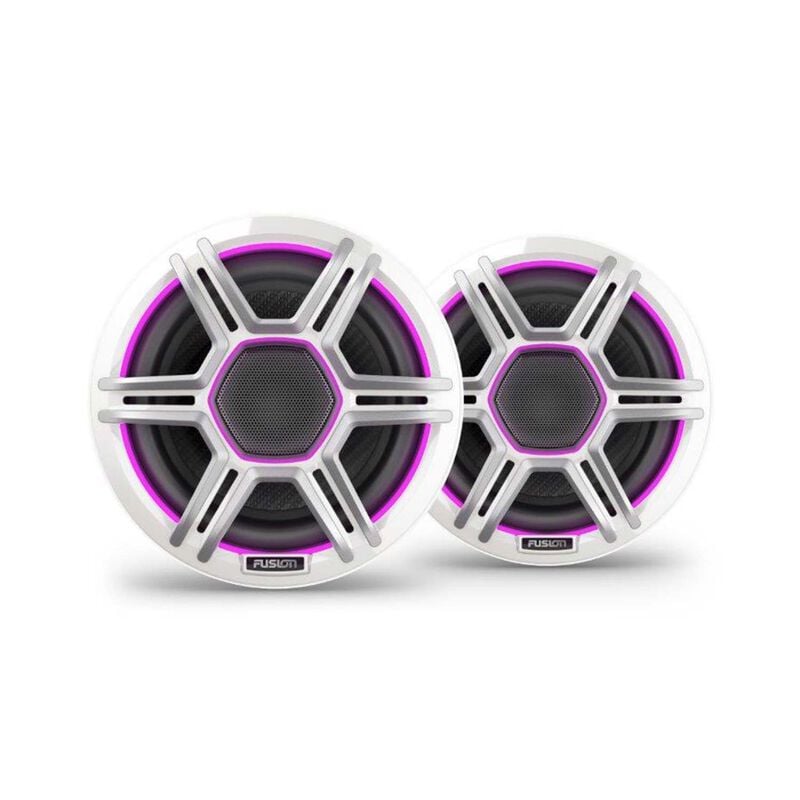
Top features: Fusion Apollo LED Marine Speakers deliver high-fidelity audio on the water even at higher volumes thanks to updated motor designs that reduce distortion. The dual-hue LED lighting rings provide a unique look and add a light show to your music and the interchangeable grilles make it easy to match the look of your boat.
What makes them stand out: Updated motor designs provide high-fidelity audio even at higher volumes.
Shop Now ≫
JL Audio M6-770X-C-3Gw Marine Coaxial Speakers

Top features: JL Audio M6-770X-C-3Gw Marine Coaxial Speakers deliver maximum audio performance in any open-air boating environment. The oversized coaxial speakers are more efficient meaning they can put out more with less power and the integrated 1-inch tweeter handles high-frequency sound with ease.
What makes them stand out: A more effecient coaxial speakers for maximum performance and produced in the U.S.
Shop Now ≫
Rockford Fosgate M2 Color Optix™ Marine 2-Way Horn Speakers

Top features: Rockford Fosgate's M2 Color Optix™ Marine 2-Way Horn Speakers are purpose built for marine use with IPX6 certification and UV resistance. They feature an integrated 1" high efficiency horn tweeter for high end response and can be complimented with Rockford Fosgate's M2 Infinite Baffle subwoofers for powerful low-end sound.
What makes them stand out: Great sound and full LED color control through the Color Optix&trad


