
What Is Doppler Marine Radar?
Doppler marine radar uses frequency shifts to help identify moving targets on the water. Boaters experience the Doppler effect in everyday life when a siren changes pitch as an emergency vehicle passes by. As the vehicle approaches, sound waves compress; as it moves away, the waves stretch out. Doppler radar applies that same principle to radar signals, helping determine whether a target is moving toward or away from your boat.
For boaters navigating crowded harbors, busy channels, fog, nighttime conditions or fast-moving traffic, Doppler radar can make radar displays easier to interpret. Instead of showing every target the same way, Doppler-capable radar can highlight moving targets so the operator can quickly identify vessels that may require attention.
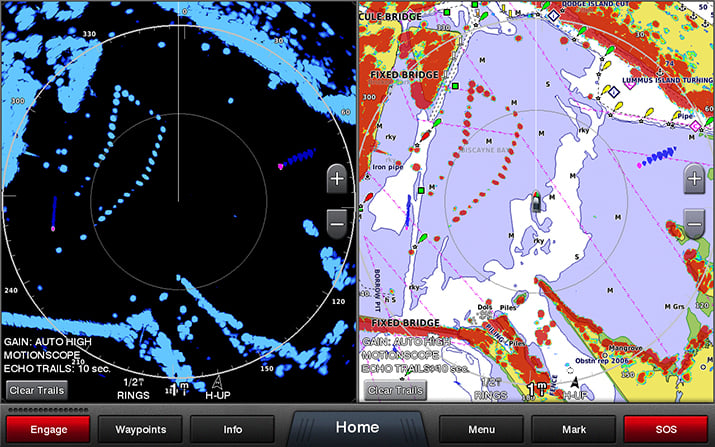
Two potentially dangerous and fast-moving powerboats are highlighted in red, with a ten-second echo trail that shows their speed and direction. This shows the advantages of MotionScope Technology.
Dual Range with Overlay: A single radar antenna is capable of providing split screen images on your chartplotter side-by-side, with independent range setting and controls for both close and long range. One or both ranges can also be viewed as a chart overlay, like the image on the right.
- How the Doppler Effect Works
- Why Solid-State Radar Made Doppler Possible
- MotionScope Doppler Technology
- Benefits for Boaters
- Helpful Radar Features
- What Doppler Radar Does Not Replace
- Browse Marine Electronics & Navigation Gear
- Doppler Radar FAQ
How the Doppler Effect Works
If you are standing still while a fire truck approaches with its siren on, the sound waves are compressed as the truck moves closer. After it passes and moves away, the sound waves spread out and the pitch appears lower. The siren transmits at one fixed frequency, but your position relative to the moving source changes how the sound reaches you.
Radar works with radio waves instead of sound waves, but the concept is similar. A radar transmits a signal, receives the reflected return and analyzes changes in frequency. A moving target creates a measurable frequency shift. That shift can help the radar determine whether the target is moving toward or away from your boat.
For a boater, that information can be valuable because a moving vessel in a crowded harbor is often more important than a stationary shoreline, buoy or dock.
Why Solid-State Radar Made Doppler Possible
Older marine radar systems used magnetron technology. Magnetrons are powerful transmitters, but they produce a broader and less controlled burst of frequencies. That made true Doppler target processing difficult for recreational marine radar.
Modern solid-state radar changed that. Solid-state radar can transmit stable, controlled pulses or chirps, which makes it possible to measure frequency shifts more accurately. This is why Doppler target highlighting became practical for modern marine radar systems.
Solid-state radar also offers other benefits for boaters, including fast startup, lower power draw, strong short-range target detail and improved performance around docks, moorings and close traffic.
Other Articles on Marine Radar Technology
Doppler radar has been used by meteorologists for years to track storms and weather movement. In marine electronics, it adds another layer of awareness for boaters, anglers and cruisers by making motion easier to see on the radar screen.
MotionScope Doppler Technology
Garmin GMR Fantom radars use Doppler processing through MotionScope technology to detect and highlight moving targets. The system can help identify targets moving toward or away from the radar, such as boats crossing a channel, weather cells, or birds feeding over fish.
MotionScope highlights moving targets in different colors on the radar display. This can make it easier to distinguish moving traffic from fixed objects and background clutter. In crowded areas, that visual separation helps the operator focus on targets that may require course or speed changes.
For anglers, Doppler radar may also help locate flocks of birds working over baitfish. Bird activity can indicate feeding fish below the surface, especially offshore or in open water.
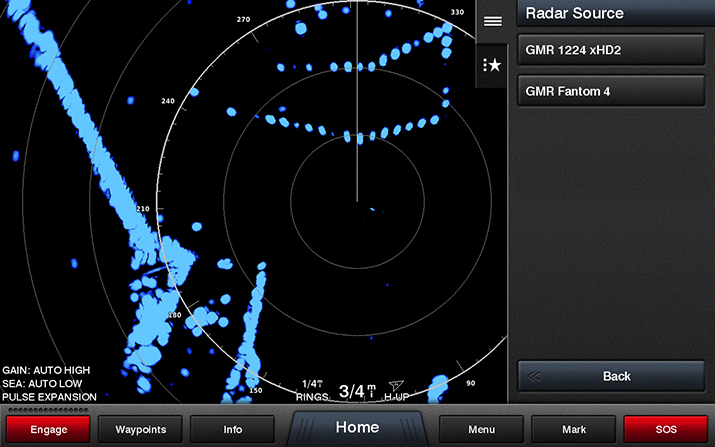
Pulse Expansion maximizes target size to help differentiate real targets from noise and provides a visually larger sized target on the chartplotter.
Benefits for Boaters
Doppler radar can be useful in several common boating situations:
- Crowded harbors: Moving vessels can be highlighted so they stand out from docks, land and fixed markers.
- Low visibility: In fog, rain or darkness, Doppler target highlighting can improve situational awareness.
- Collision avoidance: Targets moving toward your boat may be easier to identify quickly.
- Fishing: Flocks of birds can be easier to track when searching for surface-feeding activity.
- Weather awareness: Moving weather formations may be easier to interpret on radar.
- Navigation confidence: Color-coded moving targets can reduce the time it takes to understand what is happening around the boat.
Doppler radar does not make navigation automatic, but it can make radar information easier to interpret, especially for boaters who do not use radar every day.
Helpful Radar Features
Doppler is only one part of a modern radar system. Several supporting features can improve the usefulness of a radar display.
Dual Range with Overlay
Dual Range allows a single radar antenna to provide split-screen radar views with independent range settings. One display can focus on close targets near the boat while the other monitors longer-range traffic or weather. Radar overlay can also place radar returns directly over a chartplotter map for additional context.
Pulse Expansion
Pulse Expansion increases target size on the display so important returns are easier to see. This can help distinguish meaningful targets from noise and make smaller objects more visible.
VRM and EBL
Variable Range Markers (VRM) and Electronic Bearing Lines (EBL) allow quick measurement of distance and bearing to vessels, land, markers or hazards. These tools are useful for tracking traffic and confirming relative movement.
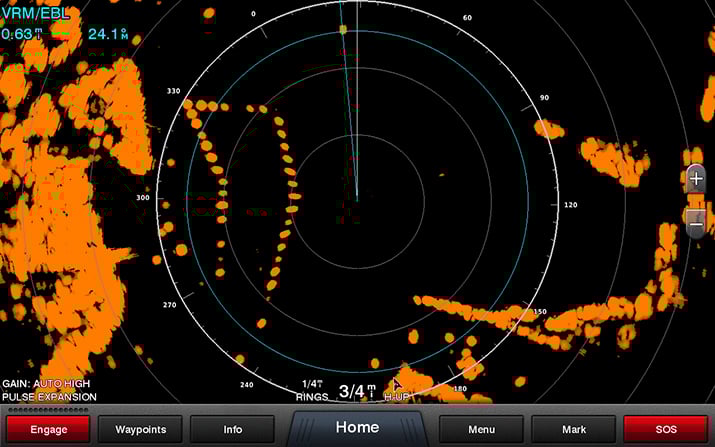
VRM and EBL: Variable Range Markers (VRM) and Electronic Bearing Lines (EBL) allow rapid measurements of distance and bearing to vessels and land.
Garmin MotionScope Videos
Here are Garmin’s videos with more about MotionScope Technology and their use of Doppler radar.
What Doppler Radar Does Not Replace
Doppler radar is a valuable navigation tool, but it does not replace safe seamanship. Operators should still maintain a proper lookout, travel at a safe speed, use navigation lights, monitor AIS when available and understand the limitations of radar displays.
Radar performance can be affected by installation height, antenna type, target size, sea clutter, rain clutter, vessel motion and user settings. A well-installed radar system and regular practice are essential for getting the most from Doppler and other radar features.
Browse All Marine Electronics & Navigation Gear
- Chartplotters, GPS units, radar systems, and integrated navigation displays
- Sonar, CHIRP, downscan, and fish-finding electronics
- Marine stereos, speakers, amplifiers, and audio accessories
- VHF radios, AIS, satellite communication equipment
- Autopilot systems and steering control components
- Wind, depth, speed, and multifunction instruments
- Marine binoculars for navigation and low-light use
- Thermal and night-vision devices for situational awareness
- Onboard monitoring and security systems
- Magnetic and electronic compasses
- Paper and electronic navigation charts
- Regional cruising and harbor guides
- Traditional navigation plotting tools
Doppler Marine Radar FAQ
What is Doppler marine radar?
Doppler marine radar uses frequency shifts in returned radar signals to help identify moving targets. It can show whether targets are moving toward or away from the radar.
How does MotionScope radar help boaters?
MotionScope highlights moving targets in color, making it easier to identify nearby vessels, weather movement or bird activity on the radar display.
Why does Doppler radar require solid-state technology?
Doppler radar relies on stable, controlled radar frequencies. Modern solid-state radar can transmit those stable pulses or chirps, while older magnetron systems produced less controlled frequency bursts.
Can Doppler radar help avoid collisions?
Yes. Doppler target highlighting can make moving vessels easier to identify, especially in crowded harbors, fog, darkness or busy traffic lanes. It should still be used with a proper lookout and safe navigation practices.
Can Doppler radar help anglers find fish?
Doppler radar can help track flocks of birds feeding over baitfish, which may indicate fish activity below the surface.