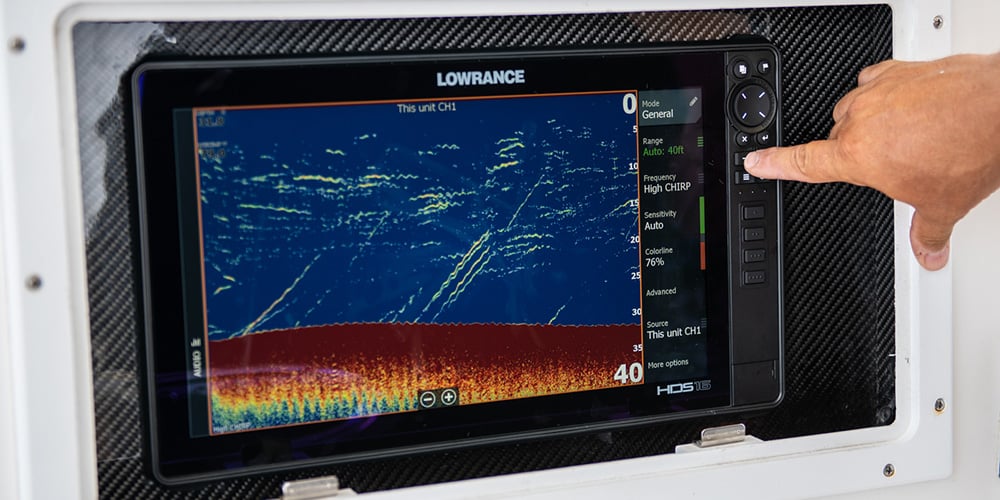
It’s hard to imagine modern fishing without sonar. Sonar technology allows anglers to focus their time on productive water by identifying fish, bait schools, bottom composition and fish-holding structure like rock piles, ledges, creek channels, brush piles, standing timber, reefs and drop-offs. Without sonar, anglers often spend far more time searching blindly for structure and active fish instead of fishing efficiently.
Sonar technology had already existed for years in commercial and military applications when Darrell Lowrance introduced the first recreational sonar fishfinder to the consumer market. In 1957, Lowrance released the original FISH-LO-K-TOR, widely known as the “Little Green Box,” forever changing recreational fishing by making sonar technology accessible to everyday anglers.
Today’s sonar systems are dramatically more advanced than the early flashers and grayscale fishfinders used decades ago. Modern marine electronics can provide high-resolution bottom imaging, side-scanning structure views, real-time live sonar and detailed fish separation capable of showing individual fish reacting to a lure presentation. These advances allow anglers to make faster decisions, identify subtle structure and target fish with much greater precision.
For freshwater anglers, sonar helps locate offshore structure, suspended fish and transition zones that would otherwise remain invisible beneath the surface. Saltwater anglers rely on sonar to locate wrecks, reefs, bait schools, thermoclines and pelagic fish activity offshore. Whether fishing shallow grass flats, deep reservoirs or offshore canyons, sonar has become one of the most important tools on modern fishing boats.
How Does Sonar Work?
Sonar is a technique used to detect water depth and the presence or depth of objects in the water by transmitting a signal, commonly called a ping, underwater and then receiving its echo. The echo forms when the original signal bounces off the bottom, structure or objects suspended in the water column between the transducer and the bottom.
The sonar system measures the time it takes for the signal to return and converts that information into a visual image on the display. Stronger returns often indicate hard structure like rock or shell bottom, while weaker returns may indicate mud, vegetation or softer bottom composition.
For fish-finding applications, traditional sonar commonly displays fish as arches, partial arches or streaks depending on boat speed, fish movement and sonar frequency. Fish arches form because the fish enters and exits the sonar cone as the boat moves overhead. Larger arches often indicate larger fish or fish that remained in the sonar cone longer.
Transducer location, mounting angle, sonar frequency, water depth and boat speed all affect sonar performance. Proper installation is critical because turbulence, aerated water and incorrect transducer positioning can reduce image clarity and target separation.
How Sonar Frequencies Affect Performance
Different sonar frequencies provide different advantages depending on fishing conditions and target depth. Higher frequencies create sharper detail and improved target separation but do not penetrate water as deeply. Lower frequencies reach greater depths but provide less image detail.
Shallow-water anglers often prioritize image clarity and fish separation, while offshore anglers fishing deeper water may need lower frequencies capable of reaching greater depths. Many modern systems automatically balance frequencies to improve both clarity and depth performance simultaneously.
Understanding Cone Angles and Coverage
Every sonar transducer sends signals through a cone-shaped beam beneath the boat. Narrow cones provide more detailed target separation directly below the boat, while wider cones cover larger areas but with less precise detail.
Understanding cone angle becomes important when interpreting fish location because fish displayed on the screen may not always be directly beneath the boat. Wider coverage areas are often useful when searching for schools of fish or structure, while narrow beams help isolate precise targets in deep water.
Types of Sonar Today
Lowrance® and Simrad® offer some of the most advanced sonar technologies available today, ranging from traditional Broadband and CHIRP sonar to high-resolution scanning sonar and live forward-facing systems.
Modern sonar systems now combine multiple sonar technologies into a single display, allowing anglers to compare traditional sonar, side-scanning views, down imaging and live sonar simultaneously. This layered approach provides a much more complete understanding of underwater conditions and fish behavior.
Broadband Sonar
An older but still effective technology, Broadband sonar sends single-frequency sonar signals at 200kHz, 83kHz or 50kHz frequencies. Higher frequencies like 200kHz produce sharper target detail and better fish separation in shallower water, while lower frequencies like 50kHz provide improved depth penetration offshore.
Traditional Broadband sonar remains popular because it provides reliable fish arches, straightforward interpretation and excellent performance across many fishing situations. Many anglers still prefer traditional sonar views for quickly identifying suspended fish and bait schools.
CHIRP Sonar
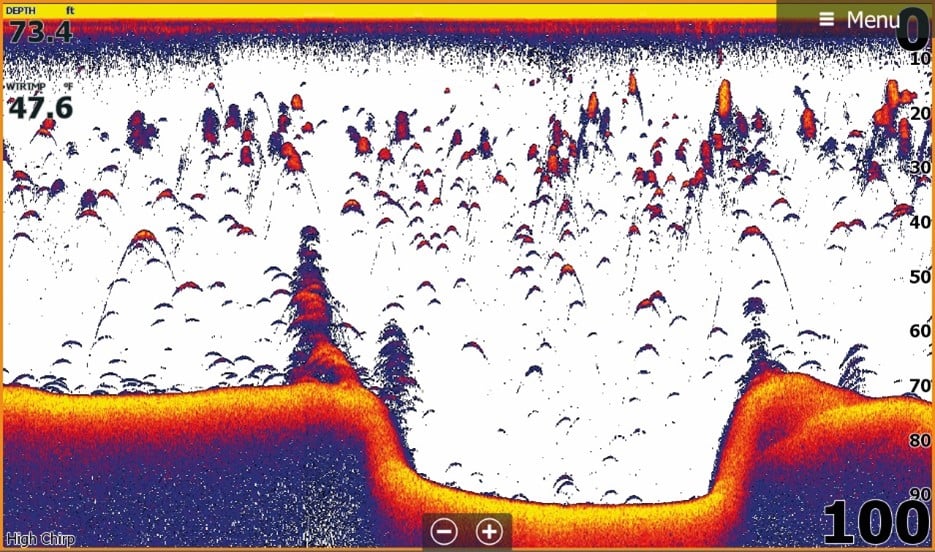
CHIRP sonar dramatically improved fishfinding performance by transmitting across a continuous range of frequencies instead of relying on a single fixed frequency. Lowrance and Simrad CHIRP sonar delivers clearer views of fish, structure and bottom composition with improved target separation and reduced screen clutter.
CHIRP continuously sweeps through ranges such as 28-51kHz (Low), 85-155kHz (Medium) and 140-250kHz (High), producing a much more detailed picture of the underwater environment. High CHIRP offers the sharpest detail and target separation, while Low CHIRP provides better depth penetration for offshore and deep-water fishing.
One of the biggest advantages of CHIRP sonar is the ability to separate fish that are positioned very close to structure or tightly grouped together. Traditional sonar may blend multiple targets into one larger signal, while CHIRP can often distinguish individual fish more clearly.
When to Use High, Medium or Low CHIRP
High CHIRP is ideal for shallow freshwater fishing where detail and fish separation matter most. Medium CHIRP provides a balance between depth and clarity, making it versatile across many conditions. Low CHIRP is commonly used offshore where greater depth penetration is necessary to locate deep structure and pelagic species.
Choosing the correct CHIRP range depends on water depth, target species, bottom composition and the level of detail needed for the fishing application.
Scanning Sonar
Scanning sonar transmits at higher frequencies such as 455kHz and 800kHz to create highly detailed images of structure beneath and beside the boat. Unlike traditional sonar, scanning sonar produces more photo-like views of underwater terrain and objects.
800kHz provides the sharpest image detail in shallower water, while 455kHz offers better depth penetration and broader range coverage. Scanning sonar is extremely useful for identifying brush piles, rock formations, submerged timber, wrecks and bottom transitions.
SideScan
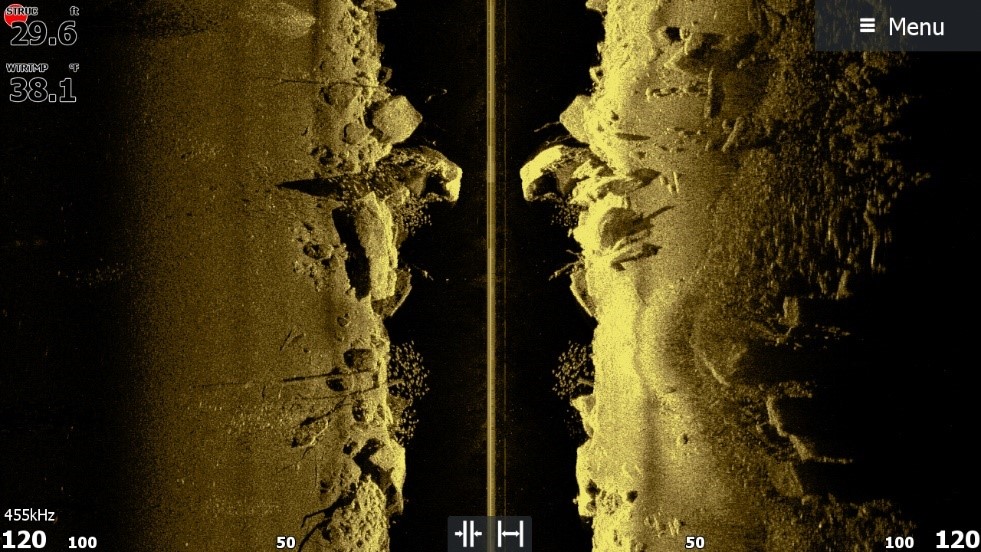
SideScan sonar allows anglers to search large areas quickly by scanning hundreds of feet to both sides of the boat. This makes it possible to locate fish-holding structure without driving directly over it.
SideScan is especially useful for finding offshore structure, isolated cover, drop-offs, creek channels, shell beds and bait concentrations. Many anglers use SideScan to identify productive water before positioning the boat for more detailed fishing presentations.
One major advantage is the ability to scan shallow water near shorelines, grass edges or docks without running the boat directly through the area and potentially spooking fish.
DownScan Imaging
DownScan Imaging provides high-resolution images directly beneath the boat, making it easier to identify fish positioning relative to structure. Rocks, brush piles, standing timber and bottom transitions appear with much greater clarity than traditional sonar.
Many anglers combine DownScan with traditional sonar because DownScan excels at structure detail while traditional sonar often displays fish arches more clearly.
FishReveal™
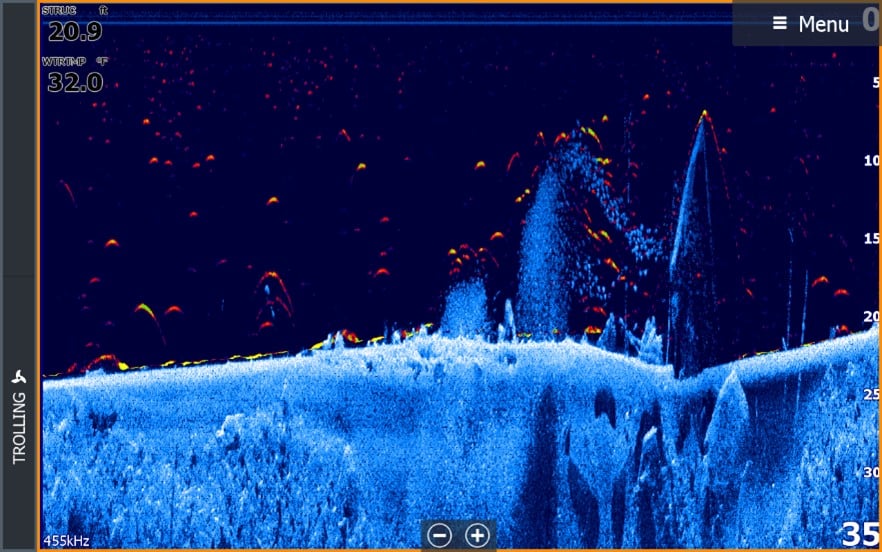
FishReveal™ combines the structure detail of DownScan Imaging with the target separation and fish arches of CHIRP sonar, making fish easier to distinguish from surrounding structure.
This technology helps anglers identify fish that may otherwise blend into brush piles, timber or bottom contours on standard DownScan views. FishReveal™ is especially valuable when fish are holding tight to structure or suspended close to bottom.
Live Sonar
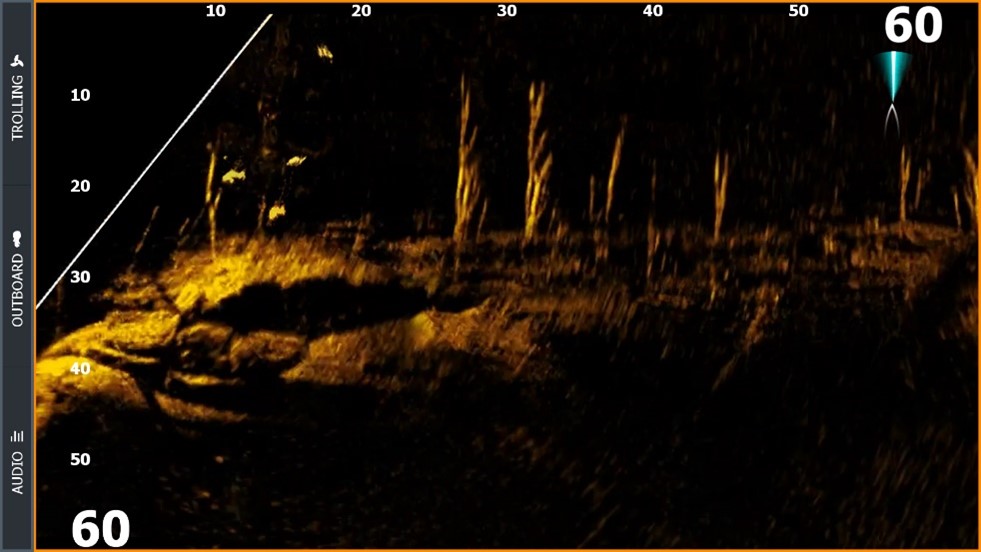
Live sonar technology has changed modern fishing more dramatically than almost any sonar advancement before it. Systems like ActiveTarget® 2 Live Sonar provide real-time views of fish movement, structure interaction and lure presentation beneath or in front of the boat.
Instead of viewing historical sonar returns after the boat passes over fish, live sonar allows anglers to watch fish react instantly to bait movement and presentation changes. This gives anglers the ability to adjust retrieve speed, lure position and casting angles in real time.
ActiveTarget® 2 includes Forward, Down and Scout views and supports optional Forward + Scout, 180 View and Scout Wide views with dual-transducer setups on compatible HDS Pro units.
Why Live Sonar Changed Fishing
Forward-facing sonar has become especially influential in bass fishing, crappie fishing and offshore pelagic fishing because it allows anglers to target individual fish instead of blindly casting to structure.
Live sonar also helps anglers learn fish behavior patterns, observe how fish react to specific lures and identify inactive fish that may not appear clearly on traditional sonar views.
Transducers
Lowrance® and Simrad® offer a wide range of transducers featuring different sonar configurations, mounting styles and frequency ranges designed for freshwater and saltwater fishing applications.
The transducer is one of the most important components in any sonar system because it converts electrical signals into sonar pulses and receives returning echoes. Choosing the correct transducer affects sonar clarity, depth capability, coverage angle and overall performance.
Transom Mount vs. Through-Hull Transducers
Transom-mount transducers are common on freshwater boats and smaller fishing vessels because they are relatively easy to install and adjust. Through-hull transducers are often preferred offshore because they maintain cleaner water flow at higher speeds and generally provide stronger deep-water performance.
In-hull and trolling motor-mounted transducers are also popular depending on boat layout and fishing style.
ActiveTarget® 2
ActiveTarget® 2 provides high-resolution live sonar views of fish and structure. By seeing fish movement in real time, anglers can react quickly and make adjustments that improve presentation and increase strike opportunities.
Active Imaging™ HD
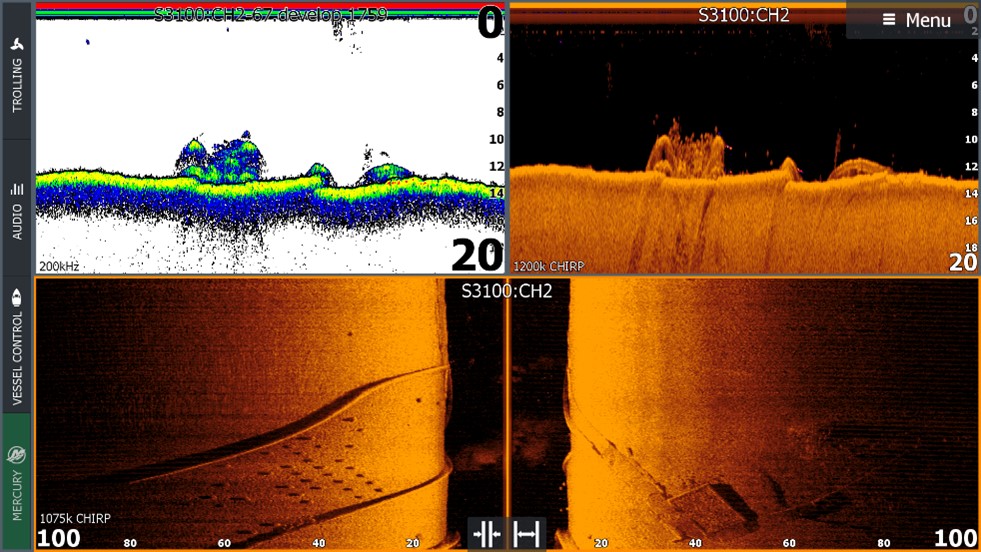
Active Imaging™ HD combines CHIRP sonar, SideScan and DownScan Imaging™ with FishReveal™ technology to deliver extremely high-resolution underwater detail. Operating at frequencies up to 1.2 MHz, Active Imaging HD produces exceptionally sharp images of fish and structure.
CHIRP Transducers
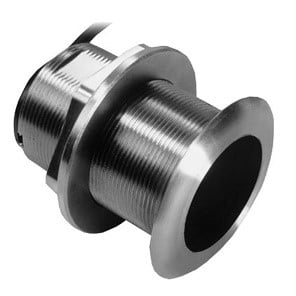
Lowrance® and Simrad® CHIRP transducers provide excellent target separation and bottom detail for both freshwater and saltwater anglers. Different CHIRP transducers are optimized for different depth ranges and fishing conditions.
High/Low CHIRP transducers are commonly used offshore for deep-water fishing, while Medium/High combinations are popular for inland and nearshore fishing applications.
S5100 CHIRP Module
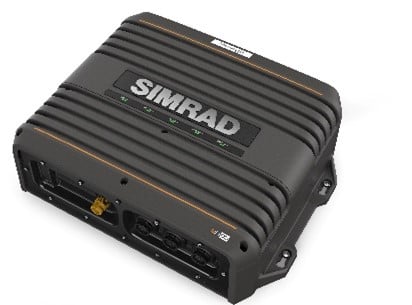
The S5100 features three fully independent sonar channels capable of delivering high-resolution CHIRP coverage across multiple depth ranges simultaneously. Multiple transducers can be combined to create customized sonar coverage for specialized fishing applications.
This setup helps anglers identify thermoclines, detect tightly grouped fish and target specific depth zones more efficiently.
HDI
Hybrid Dual Imaging transducers combine traditional CHIRP sonar with DownScan Imaging™ and FishReveal™ technology to provide both fish arches and high-resolution structure detail in one transducer package.
The HDI High/Low CHIRP transducer is especially well suited for saltwater applications where anglers need strong depth penetration combined with detailed bottom imaging.
How to Choose the Right Sonar System
The best sonar setup depends on where you fish, target species, boat size and fishing style. Freshwater bass anglers may prioritize SideScan and live sonar for locating structure and suspended fish, while offshore anglers often focus on deep-water CHIRP performance and transducer power.
Kayak anglers may prefer compact fishfinder systems with simple DownScan capability, while larger offshore boats may run multiple networked displays, radar integration and advanced sonar modules simultaneously.
Understanding the strengths of each sonar technology helps anglers choose systems that match their fishing goals instead of paying for features they may never use.
Browse All Marine Electronics & Navigation Gear
- Chartplotters, GPS units, radar systems, and integrated navigation displays
- Sonar, CHIRP, downscan, and fish-finding electronics
- Marine stereos, speakers, amplifiers, and audio accessories
- VHF radios, AIS, satellite communication equipment
- Autopilot systems and steering control components
- Wind, depth, speed, and multifunction instruments
- Marine binoculars for navigation and low-light use
- Thermal and night-vision devices for situational awareness
- Onboard monitoring and security systems
- Magnetic and electronic compasses
- Paper and electronic navigation charts
- Regional cruising and harbor guides
- Traditional navigation plotting tools