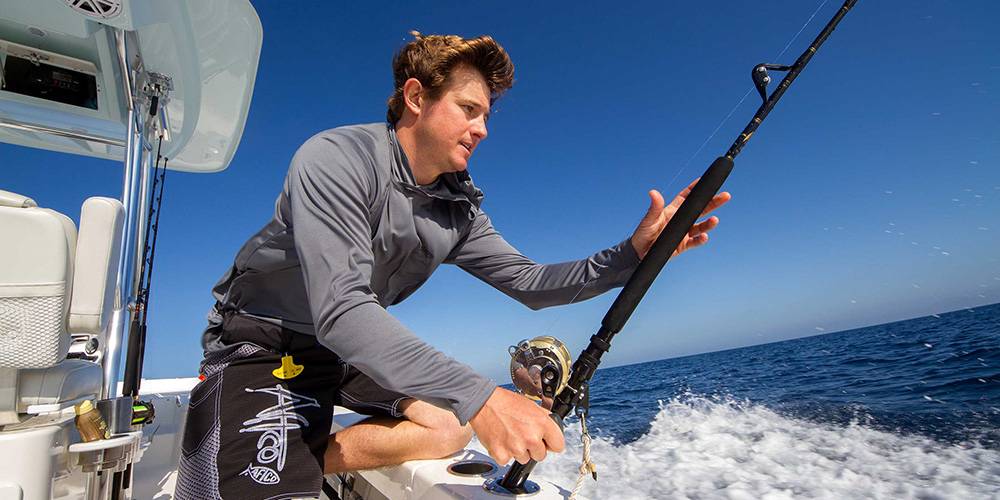
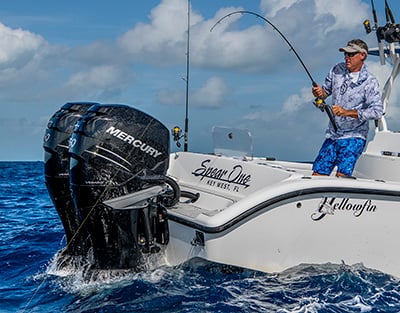
The rush of adrenaline as a big marlin breaks the surface, the sight of a powerful sailfish dancing across the waves, the explosive burst of speed as a big tuna strips line off your reel — these are moments that etch themselves into anglers’ souls. If you have never experienced deep sea fishing, this introduction covers the techniques and gear needed for an angling excursion into the blue.
- Deep Sea Fishing Defined
- Trolling
- Deep Drop Fishing
- Bottom Fishing
- Kite Fishing
- Nets and Gaffs
- Rods and Reels
- Do You Need a Fighting Chair?
- Catch and Release and Circle Hooks
- Safety
- Other Gear
- FAQs
Deep Sea Fishing Defined
Deep sea fishing refers to angling in the open ocean, typically in deeper waters, with the aim of catching large pelagic fish or species found at depth. Techniques include trolling, bottom fishing, deep drop fishing, and kite fishing — each suited to different target species and conditions.
Trolling
Trolling entails dragging baits or lures behind a moving boat to entice fish to strike. Depending on the target species, outriggers or downriggers are employed.
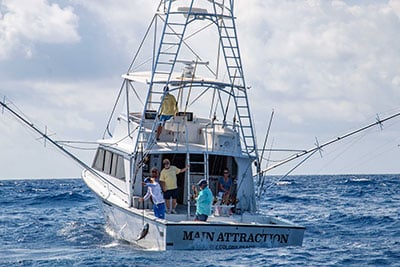
Trolling for pelagics with outriggers.
Outriggers: Outriggers offer multiple advantages for fishing near the surface for pelagic species like marlin, sailfish, and tuna. They create a “spread” of up to four or more baits, greatly increasing the chance of enticing a strike. They also place lures and baits away from the boat and its shadow, which can spook fish. Multiple lines can be deployed at different distances from the boat, increasing the chances of simultaneous hookups. West Marine offers outrigger mounts and bases, outrigger poles, and outrigger rigging kits from Taco Marine, Tigress, and others.
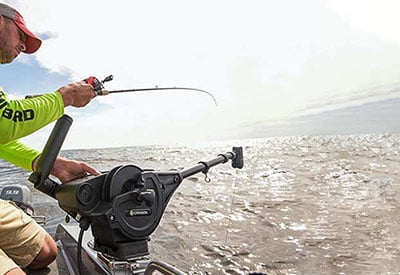
Downriggers are used to precisely control trolling depth.
Downriggers: Downriggers are commonly used for trolling at predetermined depths for fish like salmon, cod, haddock, pollock, and tuna. They consist of a spool of cable or wire attached to a heavy weight. Different weights are used depending on boat speed to control trolling depth. The fishing line connects to the cable via a line release mechanism that maintains tension. Downriggers enable precise depth control and presentation of baits or lures while trolling or drifting. West Marine offers manual and electric downriggers by Cannon and Scotty.
Deep Drop Fishing
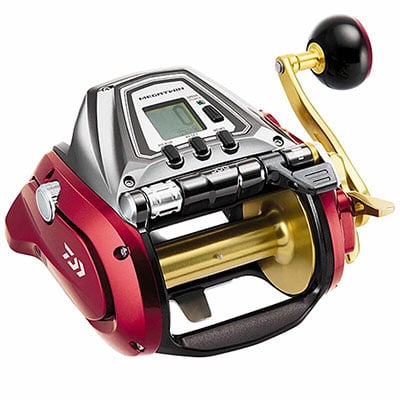
Electric reels are preferred for deep drop fishing.
Deep drop fishing targets species that reside in very deep water — often hundreds or more than a thousand feet down — near the ocean floor. Target species include tilefish, snapper, grouper, and swordfish. Specialized equipment is required to reach these depths and present baits effectively.
Hand cranking a conventional reel from extreme depths is exhausting. Most deep drop anglers use electric fishing reels, which include a line counter for precise depth control. Rods used for deep drop fishing are heavy action, with roller guides and a roller tip to minimize line friction at depth.
Bottom Fishing
Bottom fishing targets species in shallower offshore areas where the ocean floor includes structure — reefs, wrecks, and rocky formations. Anglers deploy specialized terminal tackle rigs, often with multiple baited hooks, to entice fish holding at or near the bottom. Target species include snapper, grouper, cod, halibut, and other structure-oriented fish. Heavy-action rods with roller guides and conventional reels are preferred for handling powerful strikes from these species, though heavy spinning tackle is also used.
Kite Fishing
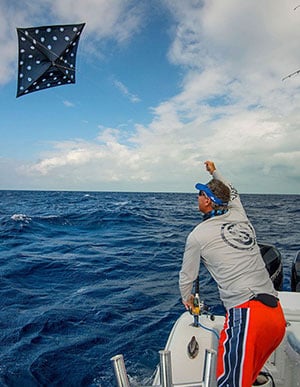
Launching a fishing kite.
Introduced in South Florida by fishing icon Bob Lewis, kite fishing has become a popular technique for catching billfish and other surface-feeding game fish. The kite keeps live bait swimming invitingly just below the surface with the leader hanging vertically out of the water — less likely to spook wary predators. The heavy monofilament leader that would otherwise be visible to the fish stays above the surface, and only the bait is in the strike zone.
Experienced anglers multiply their chances by flying up to three kites, each with up to three baits beneath it — as many as nine baits in the water simultaneously. West Marine offers kite fishing gear from R&R Tackle, Rupp Marine, Taco Marine, and Tigress. A typical kite fishing setup includes a kite, a kite rod and reel, a kite rod holder, line release clips, and other components. For more detail see our West Advisor article Kite Fishing.
Nets and Gaffs
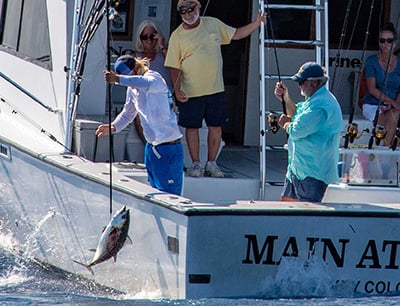
A fishing gaff in use at boatside.
West Marine offers a complete selection of landing nets. For offshore use, large nets are preferable, but for billfish, large tuna, and other big fish, landing nets are generally too small. Gaff hooks — a pole with a sharp hook at the end used to grab and pull a fish from the water into the boat — are the standard tool.
For very large fish, a flying gaff is used. Flying gaffs have a sharp, detachable hook (typically stainless steel) affixed to the end of a pole with a line attached to the hook. When a large marlin or billfish is brought alongside, the hook is set into the fish, the gaff person jerks the hook free of the pole, and the line is made fast to a cleat. West Marine carries conventional and flying gaffs by Blacktip, AFTCO, Cuda, Bubba Blade, and others.
Rods and Reels
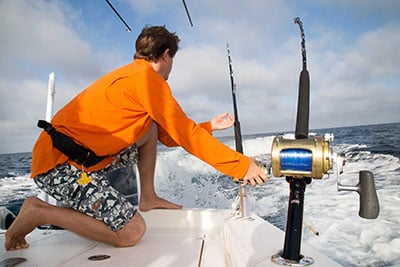
Example of a heavy conventional reel and heavy-action fighting rod.
Deep sea fishing traditionally relies on heavy-action rods and powerful conventional reels capable of handling large, powerful fish. West Marine offers heavy-action conventional rod and reel combos for this purpose. There is also a strong trend toward heavy spinning gear, and West Marine offers an excellent selection of heavy-action spinning rod and reel combos well-suited for big, hard-fighting offshore species.
If you are unsure what tackle to select, consult with a West Marine crew member at a store near you for local knowledge on what rods, reels, and terminal tackle other anglers in your area are using successfully.
Do You Need a Fighting Chair?
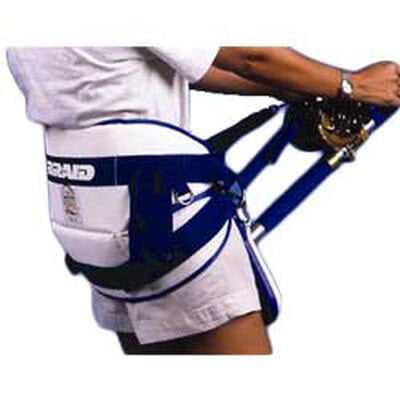
Fighting belt with rod harness and back support for stand-up fishing.
Traditional billfish angling used a fighting chair, with the angler secured in the chair and the rod butt in a gimbal. Springfield’s tournament fighting seats are available alone or as a package with a base. Fighting chairs remain the right choice for very large fish where an extended battle is expected.
Many anglers today opt for the stand-up method, fighting large fish with only a fighting belt and back harness. This technique is athletic, exciting, and keeps the angler mobile. Some stand-up anglers also forego conventional tackle in favor of lighter spinning gear for added challenge. For targeting a true leviathan, however, conventional tackle and a fighting chair ready for use is the most reliable setup.
Catch and Release and Circle Hooks
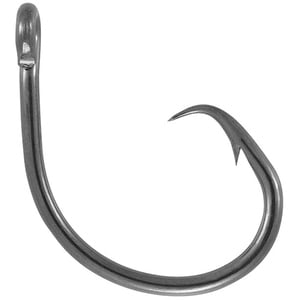
Circle hooks reduce gut hooking and improve survival rates for released fish.
West Marine strongly supports catch and release. Circle hooks reduce the chance of gut-hooking a fish and improve survival rates for released fish. The combination of catch-and-release practices and circle hook use is having a measurable positive impact on game fish populations.
Scott Walker, co-star of the fishing show “Into the Blue,” noted: “With the advent of circle hook fishing, fishing for sailfish in the Florida Keys in the 35 years I have been here is as good today if not better.” On proper release technique, he advises: “Don’t take ’em out of the water. The science is there. I understand both sides of the case. Light tackle records are great, but the longer you fight the fish, the more exhausted it’s going to be. Catch ’em quick and use the appropriate tackle for the size fish you are after.”
Safety
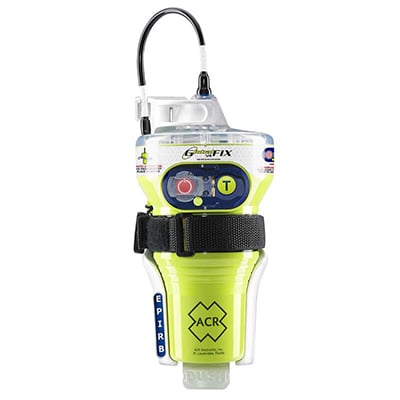
Every boat that ventures offshore should carry an EPIRB.
This article assumes you have an offshore-capable boat meeting all USCG equipment requirements, including a full complement of USCG-approved life jackets for every person aboard. Standard offshore safety equipment should include a VHF radio for emergencies and Mayday calls, a medical kit, and an EPIRB or at minimum a PLB. Do not venture offshore without these items regardless of the weather forecast.
Other Gear
Essential offshore fishing gear extends beyond rods and reels. A well-outfitted offshore boat will also carry a fishfinder, fishfinder/chartplotter combo, or multi-function display; one or more large coolers or kill bags to keep the catch fresh; a bait tank; a fillet or bait table; rod holders; and a well-organized tackle bag stocked with the terminal tackle you need for your target species.
Frequently Asked Questions
What is the difference between trolling and deep drop fishing?
Trolling involves dragging baits or lures behind a moving boat at or near the surface, targeting pelagic species like marlin, tuna, and sailfish. Outriggers spread multiple baits across the surface; downriggers control trolling depth for species like salmon and tuna. Deep drop fishing is stationary or slow-drift fishing with heavy tackle and electric reels, targeting bottom-dwelling species at extreme depths — often hundreds to more than a thousand feet — such as tilefish, snapper, grouper, and swordfish.
What tackle do I need for offshore trolling?
Heavy-action conventional rods with roller guides, powerful conventional reels with large line capacity and a smooth, strong drag, and heavy monofilament or braided line in the 50–130-pound class range are standard for offshore trolling. Outriggers for spreading baits, a fighting chair or fighting belt for the angler, a gaff for landing fish, and appropriate terminal tackle (lures, rigged baits, trolling skirts) round out a basic setup. Consult with a West Marine crew member or local charter captain for specific tackle recommendations for your target species and region.
What are circle hooks and why should I use them?
Circle hooks have a distinctive inward-pointing tip that makes them far less likely to gut-hook a fish compared to J-hooks. When a fish takes the bait and runs, the circle hook naturally rolls to the corner of the mouth and sets itself — an ideal hook-up position for releasing the fish unharmed. Billfish, sailfish, and other catch-and-release target species have shown population recovery in areas where circle hook use is widespread. Circle hooks are now required for certain fisheries and strongly recommended for any catch-and-release offshore fishing.
What safety gear do I need for offshore fishing?
At minimum: USCG-approved life jackets for every person aboard, a VHF radio (DSC-capable), an EPIRB or PLB, a medical kit, visual distress signals, and a sound device. For extended offshore passages, add a life raft, a second form of communication (satellite communicator or SSB radio), a ditch bag with emergency supplies, and a handheld GPS. File a float plan with someone ashore before every offshore trip. Cell phones should not be relied upon as primary communication — VHF range significantly exceeds cell coverage offshore.