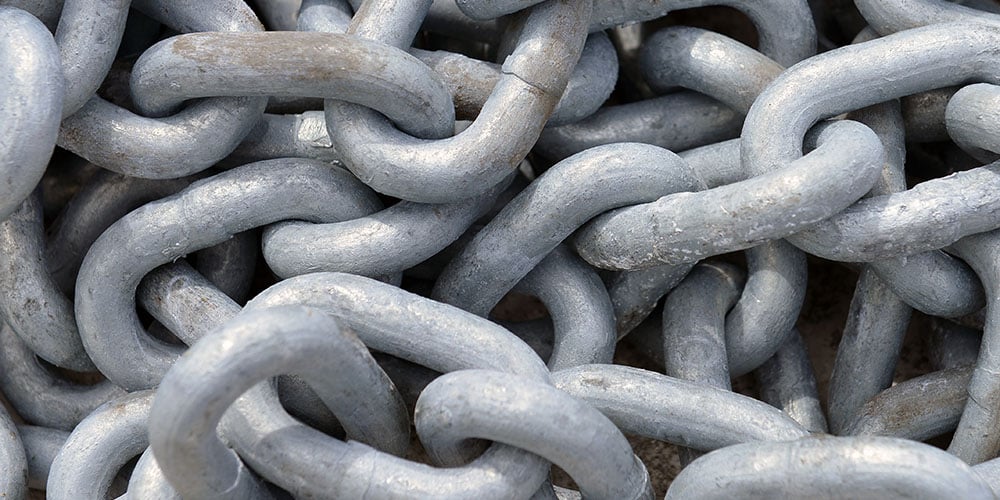
When choosing an anchor rode, first ask yourself what depths and conditions you generally anchor in. If you mostly anchor in protected coves in shallow lakes, your anchor rode needs will be different than those of ocean boaters anchoring in deeper water who need their anchor to hold overnight and stand up to squalls, swells, and other conditions that might break an anchor loose.
We’ll walk you through different anchor rode types and help you find the right one for your boat.
- Types of Anchor Rodes
- Anchor Chain Types
- Matching Line and Chain Size to Your Boat Length
- How Long Should Your Anchor Rode Be?
- Matching Your Rode to a Windlass
- Anchor Rode Recommendations for Different Boat Types
- Conclusion and Main Anchor Rode Selection Points
Types of Anchor Rodes
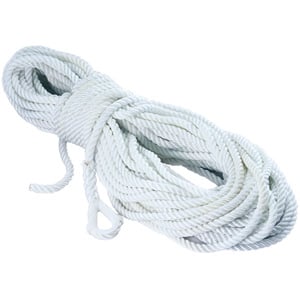
All-nylon rodes like this Economy Pre-spliced Anchor Line are great for small boats.
Anchor rodes consist of a length of chain, rope, or a combination of rope and chain that connects an anchor to a boat. The rope portion of anchor rodes typically consists of nylon three-strand, 12-strand, or double-braid line. Nylon is the material of choice because it is elastic and able to absorb the shock loads encountered when anchoring. This elasticity is what makes nylon uniquely suited to anchor rode — when a wave or wind gust loads the rode, the nylon stretches and absorbs the energy rather than transmitting a hard jerk directly to the anchor, which can break it free. Polyester and other non-stretching materials should not be used for anchor rodes for this reason.
All-Rope Rodes
Many small boats use anchor rodes made entirely of three-strand nylon anchoring line. All-rope rodes are lightweight, inexpensive, and easier to stow than rope-chain or all-chain rodes. Although all-rope rodes can be quite strong, they lack the chafe resistance of chain and are not appropriate for anchoring near coral, among rocks, or in anchorages with significant surge and wave action. However, for smaller boats, as the rode for a “lunch hook” or other temporary anchoring in calm conditions, an all-rope rode is a reasonable choice.
Rope-Chain Rodes
Adding chain to your rode serves two functions:
- To protect the nylon line from chafing on the bottom
- To weigh down the anchor rode so it lies flat on the bottom and keeps the pull on the anchor horizontal
The rule of thumb for the chain portion of a rope-chain rode is typically half a boat length to a full boat length of chain. For a 30-foot boat, that means 15 to 30 feet of chain. The exception is anchoring on a particularly rocky bottom. Many experienced boaters recommend running as little as 4 feet of chain on rocky bottoms to avoid the chain fouling on rocks or debris, which could cause you to lose your anchor. If you frequently anchor in different bottom conditions, consider maintaining multiple anchor and rode setups if storage permits.
One drawback of rope-chain rodes is that they are not abrasion-resistant over their entire length, and the rope section may not have enough weight to keep the rode lying flat on the bottom in strong winds. A second drawback is the connection between rope and chain — a stainless steel or galvanized shackle and thimble. This connection is bulky, has the potential to work loose if not seized with wire, and is incompatible with windlass gypsies. A rope-chain spliced rode eliminates this issue.
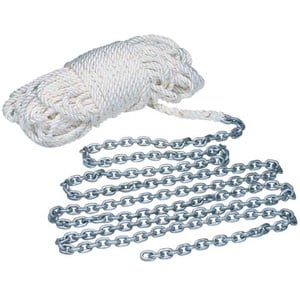
Rope-Chain Anchor Rode Packages have a rope-to-chain splice that will run over the gypsy of your windlass.
Rope-Chain Spliced Rodes
Splicing the nylon line directly to the last link of chain — rather than connecting with a shackle and thimble — produces a clean, low-profile joint that stows easily, passes through a chain pipe without snagging, and retains approximately 90% of the line’s breaking strength. The splice is also windlass-compatible, passing smoothly over the gypsy where a shackle-and-thimble connection would jam. Learning to splice rope to chain is not particularly difficult, but if you prefer professional work, any marine shop can handle it. You can find a qualified shop using our Find a Pro tool.
All-Chain Rodes
Larger boats with windlasses frequently use all-chain rodes. Chain’s weight keeps the rode lying flat on the bottom until severe conditions are encountered, which reduces the scope required compared to a rope rode — the catenary effect of the heavy chain absorbs surge loads that would require additional rope scope to handle. Since chain has very little elasticity, care must be taken to prevent the chain from becoming bar-tight in high winds. The solution is a snubber — a length of nylon line that attaches to the chain and takes the load, allowing the chain to hang slack while the stretchy nylon absorbs shock.
What Is an Anchor Rode Snubber?
An anchor snubber is a shock absorber for all-chain anchor rodes. It consists of a section of nylon line — typically 15 to 30 feet — with a hook at one end that attaches to the chain, and either a single line or a bridle with two legs leading to the bow cleats. Once the snubber hook is attached to the chain and the lines are led to the cleats, you pay out additional chain until the snubber is carrying the load and the chain hangs slack. The flexible nylon absorbs the surge and wave loads that would otherwise transmit as hard jerks through the rigid chain to the boat’s hull and deck hardware. A snubber is not optional for all-chain rodes — it is an essential component that protects your boat’s cleats, windlass, and anchor from shock loading. Nylon rode, with its inherent stretch, provides the same function naturally.
Drawbacks of All-Chain Rodes
The drawbacks to all-chain rode are weight, expense, and the need for a windlass. A windlass and all-chain rode may add 300 to 600 pounds in the bow, which can adversely affect the performance and pitching behavior of lighter boats. Many owners of modern lightweight cruising and racing sailboats are not willing to accept the performance penalty from this concentration of weight forward. It is also essential to have a length of nylon at the bitter end of any all-chain rode so that the anchor rode can be cut in an emergency — a chain secured directly to the boat with no nylon tail cannot be quickly released if necessary.

Rope-to-chain splice
Anchor Chain Types
There are three main factors to look for when selecting chain for your rode:
- Strength
- Corrosion resistance
- Chain pitch uniformity (required for windlass compatibility)
High-Test (Grade 43 / G4 / HT): Made from high-carbon steel. G4 is the preferred chain for anchoring and windlass applications. It has twice the working load of BBB chain at the same diameter, which means you can use a one-size-smaller chain with the same strength — reducing weight by approximately 30% compared to equivalent-strength BBB. G4 has a uniform pitch and works correctly on windlass gypsies designed for it.
BBB (Grade 30): Made from low-carbon steel with a uniform short-link pitch that works well on windlass gypsies. BBB was the most popular chain for windlass applications for many years but has been largely replaced by G4, which offers equivalent strength at lower weight. Still a solid choice for boats where lower cost is a priority.
Proof Coil: Does not have a uniform pitch and is not compatible with anchor windlasses. Acceptable for applications without a windlass but should not be used where chain must run over a gypsy.
Grade 70 (G7 / Transport Chain): The highest-strength chain in common use, with a substantially higher working load than G4 High Test and exceptional hardness that resists wear. G7 is compatible with very few windlass gypsies — confirm windlass compatibility before purchasing. Recommended by some noted cruising authorities for offshore passage-making where maximum strength-to-weight ratio is the priority. Primarily used on larger boats for all-chain rodes.
Matching Line and Chain Size to Your Boat Length
When recommending anchor rodes we generally use the following guidelines:
- Heavy or high windage boats should use 1/8” of diameter for every 8’ of boat length
- Normal boats can use 1/8” of diameter for every 9’ of boat length
- Lightweight or low windage boats can use 1/8” of diameter for every 10’ of boat length
- BBB chain should be half the line diameter (1/2” nylon line matched to 1/4” galvanized chain)
- Use shackles one size larger than the chain (1/4” chain uses 5/16” shackles)
The load on an anchor rode varies with the square of the boat’s waterline length. A high-windage, heavy-displacement boat such as a trawler or fishing vessel requires heavier anchor rode than an ultralight racing sailboat of the same length. As a general guide, for winds up to 30 knots, use the following line and chain diameters with three-strand, high-quality nylon line. This table assumes an 8:1 working load ratio.
| Light Boat | Medium Boat | Heavy Boat | 3-Strand Nylon Dia. | Chain Dia. |
|---|---|---|---|---|
| 26’–30’ | 23’–27’ | 21’–24’ | 3/8” | 3/16” PC |
| 31’–35’ | 28’–32’ | 25’–28’ | 7/16” | 1/4” PC |
| 36’–40’ | 32’–36’ | 29’–32’ | 1/2” | 1/4” PC |
| 41’–45’ | 37’–40’ | 33’–36’ | 9/16” | 5/16” PC/BBB or 1/4” HT |
| 46’–50’ | 41’–45’ | 37’–40’ | 5/8” | 5/16” PC/BBB/HT |
| 51’–60’ | 46’–54’ | 41’–48’ | 3/4” | 3/8” PC/BBB or 5/16” HT |
| 61’–70’ | 55’–63’ | 49’–56’ | 7/8” | 1/2” PC or 3/8” HT |
| 71’–80’ | 64’–72’ | 57’–64’ | 1” | 5/8” PC or 1/2” HT |
How Long Should Your Anchor Rode Be?
Anchor rode length is determined by scope — the ratio of rode length to the vertical distance from your bow chock to the bottom. This vertical distance is the water depth plus your freeboard (the height of your bow chock above the water surface). A boat with 4 feet of freeboard anchoring in 10 feet of water has a vertical dimension of 14 feet, not 10 feet. Using water depth alone underestimates the scope calculation, which is particularly significant for boats with high freeboard such as trawlers and sport fishers.
A scope ratio of 7:1 is the standard recommendation for normal conditions — for every foot of vertical distance from bow chock to bottom, you pay out 7 feet of rode. In the example above, 7:1 scope in 10 feet of water with 4 feet of freeboard means 98 feet of rode, not 70. In crowded anchorages where swinging room is limited, many boaters accept 5:1 scope as a compromise, but this reduces holding power significantly and should not be used when conditions are deteriorating or an overnight stay is planned.
In rough conditions or when leaving the boat unattended overnight in an exposed anchorage, 10:1 scope provides substantially better holding. The extra scope keeps the pull on the anchor closer to horizontal, which is what anchors are designed to resist. A steep angle of pull is the most common mechanical cause of anchor dragging regardless of anchor type or size.
Determining Total Rode Length
To determine the minimum rode length needed, identify the maximum depth you expect to anchor in, add your freeboard, and multiply by the scope ratio you want to achieve. For a boat with 4 feet of freeboard planning to anchor in up to 30 feet of water:
- 30 feet of water + 4 feet of freeboard = 34 feet vertical distance
- 34 feet × 7 (scope) = 238 feet of rode needed for 7:1 scope
- 34 feet × 10 (storm scope) = 340 feet for 10:1 scope
Most boaters carry 200 to 300 feet of rode minimum. A longer rode than you think you need is never a problem; a shorter one often is.
Proper Scope With All-Chain Rodes
All-chain rodes can use less scope than rope rodes in normal conditions because the weight of the chain creates a catenary curve that keeps the pull on the anchor horizontal even at lower scope ratios. A 4:1 scope is generally workable in calm to moderate conditions with an all-chain rode. As water depth increases, less scope is needed because the chain has more weight in the water. Many cruising boats carry 200 to 250 feet of chain for normal use, with some adding 300 feet of nylon rode that can be connected at the bitter end for extremely deep anchorages. Regardless of rode type, always secure some nylon at the bitter end of the chain so the rode can be cut and released in an emergency.
Matching Your Rode to a Windlass
Every anchor windlass includes a gypsy — the wheel or drum that hauls rope and chain. Each gypsy fits specific combinations of line diameter and construction (three-strand, eight-strand, or twelve-strand) and specific types and diameters of chain. The gypsy and rode must be an exact match — an incorrect chain size or type will not feed correctly and can damage the gypsy or jam the windlass.
The correct sequence is: size the rode for your boat first using the diameter table above, then select a windlass with a compatible gypsy. Most windlasses are available with a choice of gypsies to fit different line and chain combinations. Confirm the windlass gypsy is rated for the specific chain grade you plan to use — G4 and G7 gypsies are not interchangeable. If you already have a windlass and are selecting chain, obtain the gypsy specifications from the windlass manufacturer and match chain type, grade, and diameter precisely.
Anchor Rode Recommendations for Different Boat Types
Small Boat Anchor Rodes and Anchor/Rode Packages
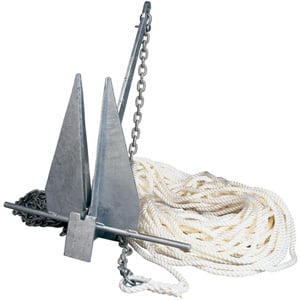
Our West Marine Traditional Anchor and Rode Package has everything the small boat operator needs in one package. Choose between a 4lb., 8lb. or 13lb. Traditional Anchor.
The simplest anchor rode for a small boat connects the anchor directly to a spliced nylon anchor line. An example: a West Marine 8lb. Traditional Anchor, a 1/4” shackle, and a 3/8” × 150’ anchor line. This is an appropriate day-use setup for small boats in calm, protected waters. It is lightweight, inexpensive, and will hold well as long as the scope is sufficient.
To make this setup more effective, add a short length of chain between the anchor and the line. The classic recommendation is a chain length equal to the length of the boat, which protects the nylon from bottom chafe and keeps the angle of pull on the anchor parallel to the bottom. Even a short length — as little as 4 feet of coated chain — makes a significant improvement in anchor performance and the longevity of the line. Connect the anchor to the chain with a correctly sized shackle and connect the chain to the nylon eye splice with another shackle one size larger than the chain. This combination of long nylon line, a length of chain, and a properly sized anchor will satisfy the needs of most boaters on boats up to about 30 feet.
Larger Boat Anchor Rodes
If you own a boat over 40 feet and cruise to varied anchorages with different seabed types, an all-chain anchor rode is worth serious consideration. The strength and abrasion resistance of chain for open-water and heavy-weather anchoring provides a level of security that rope-chain rodes cannot fully match.
The weight penalty of chain is real. Since boats typically need 200 feet or more of chain for an all-chain rode, and chain is significantly heavier than rope, the bow weight adds up quickly. This is why many boaters — particularly owners of lighter sailing vessels — choose Grade 43 (G4) or Grade 70 (G7) chain. By using a higher-strength chain, you can step down one chain size while maintaining the same working load, reducing chain weight by approximately 30% without sacrificing holding strength. Confirm that your windlass gypsy is compatible with the chain grade before purchasing.
For boats over 60 to 70 feet, windage is the primary variable in rode sizing and it is difficult to calculate without specialized knowledge. A naval architect or marine surveyor familiar with the vessel can provide authoritative guidance on sizing ground tackle at this scale.
Conclusion and Main Anchor Rode Selection Points
- Ensure your rode is long enough to achieve 7:1 scope in the deepest water you expect to anchor in, using the correct vertical measurement: water depth plus your bow freeboard. Carry enough rode for 10:1 scope in storm conditions.
- Add a length of chain equal to your boat’s length to any rope rode to improve holding and protect against bottom chafe. On rocky bottoms, 4 feet of chain minimizes the risk of the chain fouling on rocks and losing your anchor.
- Use the line and chain diameter table above to size your rode based on boat length and displacement category.
- If you have a windlass, confirm the gypsy is compatible with your specific chain grade, type, and diameter before purchasing chain.
- If using an all-chain rode, always install a nylon snubber to absorb shock loads, and secure a length of nylon at the bitter end of the chain for emergency release.
Frequently Asked Questions: Anchor Rodes
What is the best anchor rode for a small boat?
For most small boats used in protected waters, a rope-chain combination rode is the best balance of performance, weight, and cost. A length of chain equal to the boat’s length protects the nylon from bottom chafe and keeps the anchor pull horizontal. The chain connects to the nylon via a rope-to-chain splice (preferred) or a shackle and thimble, with the nylon making up the majority of the rode length. All-rope rodes work for day-use anchoring in calm conditions but are not suitable for overnight anchoring, rocky bottoms, or exposed anchorages.
How do I calculate scope for anchoring?
Scope is the ratio of rode length to the vertical distance from your bow chock to the bottom. This vertical distance is your water depth plus your freeboard (the height of the bow chock above the water). Multiply the vertical distance by 7 for normal conditions, by 10 for overnight or storm conditions. A boat with 4 feet of freeboard anchoring in 20 feet of water needs (20 + 4) × 7 = 168 feet of rode for 7:1 scope. Most boaters carry at least 200 to 250 feet of rode to ensure they have adequate scope in varied anchoring situations.
What is the difference between BBB chain and G4 (High Test) chain?
BBB (Grade 30) chain is made from low-carbon steel and has a uniform short-link pitch that works well on BBB-specific windlass gypsies. G4 High Test (Grade 43) is made from high-carbon steel and has twice the working load of BBB at the same diameter. This means you can use one size smaller G4 chain to achieve the same strength as a larger BBB chain, reducing weight by approximately 30%. G4 has replaced BBB as the standard for most new windlass installations. If you are purchasing chain for an existing windlass, confirm whether the gypsy is BBB or G4 specification — they are not interchangeable.
Why do I need a snubber with an all-chain rode?
Chain has almost no elasticity. Without a snubber, every wave and surge transmits directly through the chain to the boat’s deck hardware, windlass, and anchor. The repeated hard shock loads can fatigue cleats, stress windlass mounts, and break anchors free even in conditions where they would otherwise hold well. A nylon snubber — attached to the chain with a hook and led to the bow cleats, with slack let out in the chain to put the snubber under load — provides the shock absorption that nylon rope provides naturally in a rope-chain rode.
Should I use G4 or G7 chain for my all-chain rode?
G4 (High Test, Grade 43) is the standard choice for most recreational boats and is compatible with a broad range of windlass gypsies. G7 (Grade 70, Transport Chain) is stronger than G4 at the same diameter — allowing an even further reduction in chain size and weight — but is compatible with very few windlass gypsies. Before purchasing G7 chain, confirm your specific windlass gypsy is rated for it. G7 is primarily used on larger offshore cruising boats where maximum strength-to-weight ratio is the priority and the windlass has been specified for G7 compatibility.
Need More Help?
West Marine has you covered for your next trip. With knowledgeable associates in store, we can help you find the right anchor rode for your boat so you can anchor securely in any conditions your adventures take you to. Find your store here.


