Onboard fires are one of the most common reasons boaters are forced to abandon ship. In spite of the protection that fire extinguishers provide, most boaters tend to ignore them. Along with providing information on the number of extinguishers required, classes of fires, and types of extinguishing agents, this article also covers the portable fire extinguisher regulations enacted in April 2022 that changed the required labeling and age limits for extinguishers on all recreational vessels.
- Minimum USCG Fire Extinguisher Requirements
- Types of Fires
- Fire Extinguisher Ratings
- Do You Need a New Fire Extinguisher?
- Fire Extinguisher Agents
- PASS: Fighting a Fire with a Portable Extinguisher
- Automatic Fixed-Mount Systems
- Automatic Engine Shutdown
- Conclusion
Minimum USCG Fire Extinguisher Requirements
The Coast Guard requires from one to three extinguishers on pleasure boats, depending on whether they have enclosed engine compartments and whether there is a permanently-mounted fixed extinguisher system in the engine room. The minimum number of extinguishers required depends on boat length. Some readers will notice that the minimum requirements below do not include the old USCG extinguisher type designations such as “B-1” or “B-II”. This is because the regulations enacted in April 2022 are based on the fire extinguisher designations employed by UL (Underwriters Laboratories). Later in this article we list allowable combinations of extinguishers that meet the minimum requirement and in some cases will provide enhanced protection for your boat.
- Less than 26’: One 5-B size extinguisher. Fire extinguishers are not required on outboard-powered pleasure boats less than 26’ in length, not carrying passengers for hire, without permanently-installed fuel tanks, that do not have spaces where explosive or flammable gases or vapors can collect.
- From 26’ to less than 40’: Two 5-B extinguishers
- From 40’ to 65’: Three 5-B extinguishers
- Greater than 65’: One or more 20-B. Number required depends on gross tonnage.
While simply meeting the minimum requirements will enable you to pass a Coast Guard inspection, we suggest you go beyond what the government mandates and purchase extinguishers according to your boat’s layout. We recommend at least one in the cockpit, one in each stateroom, and one in the galley area — which should be reachable even if the stove is on fire. Statistically speaking, onboard fires double in size every seven seconds, so having a fire extinguisher readily available may make the difference between inconvenience and catastrophe.
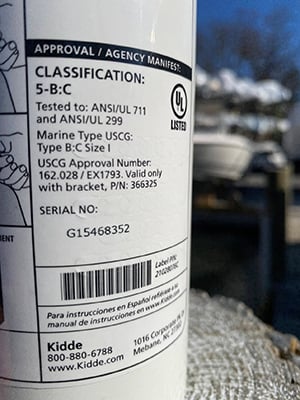
Example of new labeling on UL-listed, 5-B:C extinguisher. While the USCG type designation does appear on the label, for boats 2018 and newer, it is the UL designation that counts. Photo courtesy BoatUS.
Types of Fires: Class A, B, and C
- Class A Fires: Include all combustible solid materials, such as paper, wood, cloth, rubber, and many plastics including the fiberglass reinforced plastic used for decks and hulls. (Memory device: Class A fires leave an Ash.)
- Class B Fires: Include all flammable liquids including stove alcohol, grease, gasoline, diesel, kerosene, oil, oil-based paint, teak oil, paint thinners, acetone, varnishes, and flammable gases or fumes. (Memory device: Class B fires Boil.)
- Class C Fires: Include all energized electrical equipment. Class C fires are identified for their potential to electrocute or shock a person if you apply electrically conducting water-based extinguishing agents. Turning off the electricity is the top priority when fighting a Class C fire — usually by shutting off the main battery switch. Cutting the power will convert a Class C fire to a Class A and/or B fire. (Memory device: Class C fires have a Charge.)
Fire Extinguisher Ratings
Labeling for extinguishers includes ratings that reflect an extinguisher’s ability to combat specific classes of fires. UL uses letters to denote the types of fires an extinguisher can fight and numbers that refer to firefighting capacity relative to other extinguishers. For example, a 1-A, 10-B:C extinguisher is effective on Class A, B, and C fires, and a 40-B:C extinguisher has four times the extinguishing capacity of a 10-B:C extinguisher.
Until the 2022 regulatory change, fire extinguisher labels also included U.S. Coast Guard ratings that differed from UL ratings. Coast Guard terms such as “B-1” and “B-II” referred only to the weight of the extinguishing agent, whereas UL labeling denotes actual firefighting ability. For boats model year 2018 and newer, only the UL designation counts.
Do You Need New Fire Extinguishers?
On April 20, 2022, new fire extinguisher regulations took effect. How the regulations affect you depends on the model year of your boat. For boats up to 65’, the minimum USCG requirement is from one to three 5-B extinguishers depending on boat length. Allowable substitutions appear in parentheses. The table and italicized text appear courtesy of BoatUS.
| Vessel Length | No Fixed System | With Approved Fixed System |
|---|---|---|
| Less than 26’ | One 5-B (or One 10-B) | None |
| 26’ to less than 40’ | Two 5-B (or Two 10-B or One 20-B) | One 5-B or One 10-B |
| 40’ to 65’ | Three 5-B (or Three 10-B or One 20-B and One 5-B or One 20-B and one 10-B) | Two 5-B or Two 10-B or One 20-B |
Note: Many retailers offer 10-B and 20-B class fire extinguishers, which may be a good choice as they exceed USCG minimum carriage requirements for boats under 26 feet while giving boaters more extinguishing coverage. For boats 26 feet or larger, however, having one 10-B aboard does not equal two 5-Bs.
If you own a boat that is model year 2018 or newer, you may need to replace your fire extinguishers.
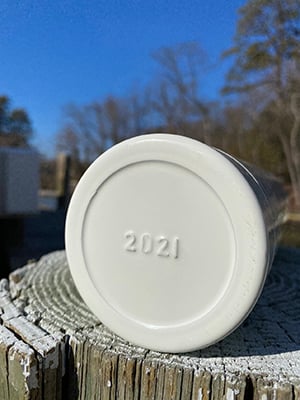
Extinguishers must not be over 12 years old according to the date stamped on the bottle. Photo courtesy BoatUS.
In addition to meeting the carriage requirements for the correct number of extinguishers for your boat’s size, they must be labeled as 5-B, 10-B, or 20-B. Extinguishers labeled with B-I or B-II only are no longer acceptable for boats model year 2018 and newer.
Extinguishers must not be more than 12 years old according to the date of manufacture stamped on the bottle.
You only have to get new extinguishers if they are no longer serviceable. Good serviceable conditions are as follows:
- If the extinguisher has a pressure gauge or indicator, it must be in the operable range or position
- The lock pin is firmly in place
- The discharge nozzle is clean and free of obstruction
- The extinguisher does not show visible signs of significant corrosion or damage
2017 Model Year Boats and Older (1953–2017)
- You may keep extinguishers labeled B-I and B-II as long as they are still serviceable.
- If there is a date stamped on the bottle, extinguishers must not be more than 12 years old according to that date.
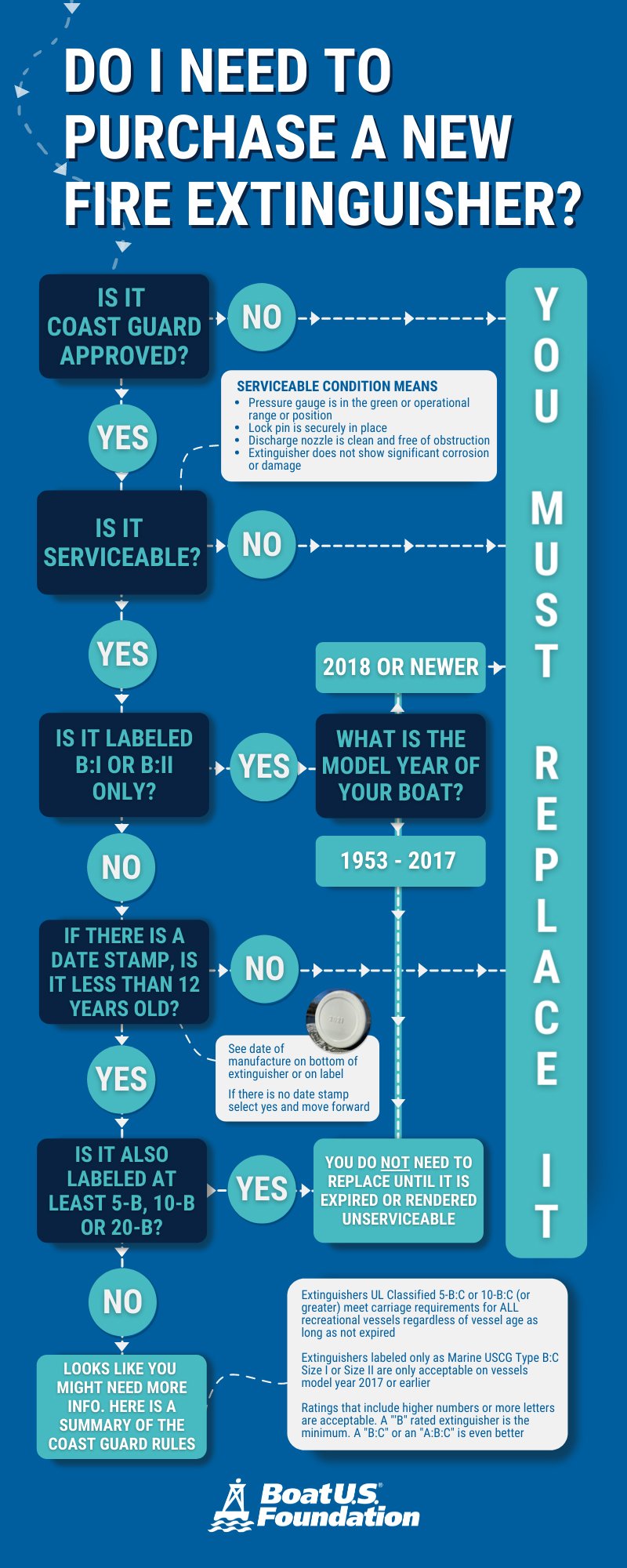
See the decision-making flow chart at the bottom of this article for a quick reference on whether your extinguishers meet current requirements.
Fire Extinguishing Agents
Water: Good for Class A fires. Extinguishers are heavy, difficult to store, and are NOT for use on flammable liquid or electrical fires.
Carbon Dioxide (CO2): Good for Class B and Class C fires. No residue. Easy to use. Useful only in confined interior spaces. Does not cool the fire — deep-seated fires may re-ignite.
HFC-227 (FM-200): A clean agent effective on Class B and C fires that has been widely used in fixed engine room extinguisher systems. HFC-227 is being phased down under the EPA’s AIM Act due to its high global warming potential. Existing systems can continue to be used and recharged while the agent remains available, but new installations are increasingly using alternative clean agents. HFC-227 can cause respiratory illness and can be lethal to crew caught in the vicinity of a discharge — automatic engine shutdown is essential on vessels equipped with HFC-227 systems.
FK-5-1-12 (formerly sold as Novec™ 1230): A clean agent that was marketed by 3M as Novec 1230 and positioned as an environmentally preferable successor to HFC-227. 3M discontinued production of Novec 1230 by the end of 2025 as part of a broader phase-out of PFAS compounds. The generic compound FK-5-1-12 is still manufactured by other companies and remains available as a clean agent option. It has no ozone depletion potential and leaves no residue after use. Check with the fixed system manufacturer for current agent availability and approved alternatives.
Halotron 1: EPA-approved. Safe for computers, electronics, and clean rooms. Leaves no residue after use. A good choice for helm stations and nav areas where dry chemical powder would cause damage.
Dry Chemical: Low toxicity. Inexpensive. Effective on Class B and Class C fires. Not effective on Class A fires. Difficult to clean up — the powder is corrosive and damages electronics and electrical equipment. Not a good choice for helm or nav station installations.
Tri-Class Dry Chemical: Low toxicity. Inexpensive. Effective on Class B and C fires. Moderately effective on Class A fires. Difficult to clean up and corrosive to electronics. Not a good choice for helm or nav station installations.
Aqueous Foam: Effective on Class A, B, and C fires and relatively easy to use effectively. Avoid excessive skin or eye contact.
PASS: Fighting a Fire with a Portable Extinguisher
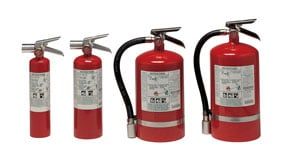
Typical fire extinguishers have a discharge time of only about 10 to 12 seconds, so you must use them before the fire gets too large. Deep-seated fires that appear to be out may re-ignite. The short discharge time, combined with the possibility of reflash, are important reasons to carry extra extinguishers onboard.
To quickly remember how to fight a fire with a handheld extinguisher, use the acronym PASS:
- Pull the pin
- Aim the fire extinguisher at the base of the flames
- Squeeze the two handles together
- Sweep across the base of the flames
Automatic Fixed-Mount Fire Extinguisher Systems
According to the Coast Guard, 90 percent of boat fires start in the engine room. Based on actual claims of BoatUS insurance, electrical wiring fires account for 55 percent of all boat fires, followed by engine and transmission fires at 24 percent, DC wiring fires at 12 percent, and fuel leaks at 8 percent.
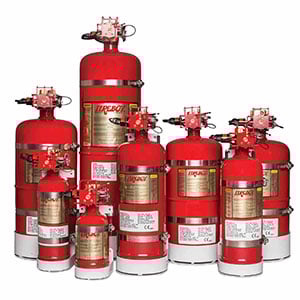
Fixed-mount fire extinguishers should be sized according to the volume in cubic feet of the engine space. Install the extinguishers either horizontally or vertically.
Boaters can reduce fire risk with periodic maintenance of their mechanical and electrical systems. This includes keeping water intake lines free of debris and weeds, replacing raw water pump impellers on schedule, and keeping exhaust manifolds and risers free from blockages caused by rust deposits.
Unfortunately, fires do happen even on well-maintained vessels. Often, when an engine starts to sputter or someone sees or smells smoke, the first impulse is to open the door or hatch to the engine compartment. This well-intentioned action may result in an inrush of oxygen that stokes a smoldering fire into a mass of flames.
Fireboy-Xintex Manual and Automatic Clean Agent Fire Extinguishers address this scenario by fighting fires from the start, triggering automatically when a temperature sensor reaches 175°F. In addition to automatic operation, they can be discharged manually by pulling an optional manual release cable when the fire is discovered. Cable lengths range from 6 to 40 feet.
Fireboy-Xintex systems release a clean agent for approximately 10 seconds, smothering the fire and leaving no residue behind. A dash-mounted LED display (fits a 2 1/8” cutout) shows the engine compartment extinguisher’s charged/discharged status. A remote 85 dB horn also sounds when the extinguisher is low on pressure or has discharged. Regarding crew safety: HFC-227 can cause respiratory illness and can be lethal to crew caught in the vicinity of a discharge, which underscores the importance of automatic engine shutdown systems on vessels equipped with HFC-227 engine room extinguishers. Clean agent alternatives without this risk should be considered for new installations.
Automatic Engine Shutdown
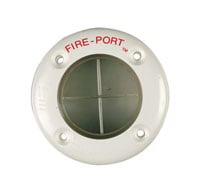
The Fire Port allows you to safely fight an engine room blaze without opening the hatch.
If there is an engine room fire while underway and the automatic system discharges, the engine, generator, and bilge blower systems must be immediately shut down — either by crew or (preferably) by an electronic automatic shutdown device. Otherwise, the diesel engine keeps running, feeding oxygen to the blaze and drawing the fire-retardant agent out of the compartment through the engine’s air intakes or the ventilation exhaust fans, rendering the fire-fighting system ineffective. Automatic engine shutdown units take care of this immediately upon discharge detection.
For small boats, an inexpensive alternative to automatic systems is the Fire Port — a clear 2 11/16” diameter plastic port that installs in a hatch, engine cover, or bulkhead. You can see inside the engine compartment without opening the hatch, and if you see evidence of fire, knock out the small plastic window with the nozzle of your fire extinguisher and blast away without introducing oxygen by opening the compartment. Halotron I portable fire extinguishers are excellent for this application, since they leave no residue and fight the fire by removing oxygen.
Conclusion
Government regulations on fire extinguishers are often confusing, especially given the 2022 changes to labeling requirements and the evolving landscape of clean extinguishing agents. We hope this article has helped you understand the regulations as they apply to your boat. The following flow chart, provided courtesy of BoatUS, summarizes the decision process for determining whether your current extinguishers remain compliant.
Frequently Asked Questions: Boat Fire Extinguishers
How many fire extinguishers does my boat need?
The USCG minimum depends on your boat’s length: one 5-B for boats under 26 feet, two 5-B for 26 to 40 feet, and three 5-B for 40 to 65 feet. If you have an approved fixed extinguisher system in the engine room, you can reduce the portable requirement by one extinguisher in each size category. Beyond the legal minimum, West Marine recommends at least one extinguisher in the cockpit, one in each sleeping area, and one in the galley — readily accessible even if the stove is on fire. Fires double in size every seven seconds, so physical location matters as much as quantity.
Do I need to replace my old B-I or B-II labeled fire extinguishers?
It depends on your boat’s model year. For boats model year 2018 and newer, B-I and B-II labeled extinguishers are no longer acceptable and must be replaced with extinguishers bearing 5-B, 10-B, or 20-B UL ratings. For boats model year 2017 and older, B-I and B-II extinguishers are still acceptable if they remain serviceable. Regardless of model year, any extinguisher more than 12 years old as indicated by the manufacture date stamped on the bottle must be replaced. See the flow chart above for a step-by-step compliance check.
What is the difference between dry chemical and clean agent fire extinguishers?
Dry chemical extinguishers (including tri-class ABC types) are inexpensive and effective at suppressing fires, but they discharge a corrosive powder that is extremely difficult to clean up and will damage electronics, wiring, and engine components. They are appropriate for general use aboard but not ideal for helm stations or nav areas. Clean agents — including Halotron 1 and FK-5-1-12 — leave no residue after discharge and are safe for use around electronics and in occupied spaces. Clean agents are the correct choice for fixed engine room systems and for extinguishers kept at the helm.
What happened to Novec 1230 as a fire suppression agent?
3M’s Novec 1230, which was marketed as an environmentally preferable clean agent replacement for HFC-227, was discontinued by 3M by the end of 2025 as part of a broader company-wide phase-out of per- and polyfluoroalkyl substances (PFAS). The underlying generic compound — FK-5-1-12 — is still manufactured by other companies and available as a clean agent option. If you have a fixed marine fire suppression system currently using Novec 1230 or HFC-227, consult your system manufacturer about currently available and approved alternative agents.
What is PASS and how do I use a fire extinguisher?
PASS stands for Pull, Aim, Squeeze, Sweep. Pull the pin from the handle. Aim the nozzle at the base of the flames, not at the flames themselves. Squeeze the handles together to discharge. Sweep the nozzle from side to side across the base of the fire. A typical portable extinguisher discharges in 10 to 12 seconds, so act quickly and aim accurately. If the fire does not go out or immediately re-ignites after discharge, do not attempt a second attack — evacuate and prepare to abandon ship. Have your crew call the Coast Guard.
Do I need a fixed automatic fire suppression system in my engine room?
It is not required on most recreational vessels, but it is strongly recommended for any inboard or stern drive powered boat with an enclosed engine compartment. According to the Coast Guard, 90 percent of boat fires start in the engine room. A fixed automatic system that triggers when the temperature sensor reaches 175°F can suppress an engine room fire before it reaches a size that a portable extinguisher could not handle — and without requiring anyone to open the engine compartment hatch, which can introduce oxygen and turn a smoldering fire into a flashover. A fixed system in the engine room also reduces your portable extinguisher requirement by one unit under current USCG rules.