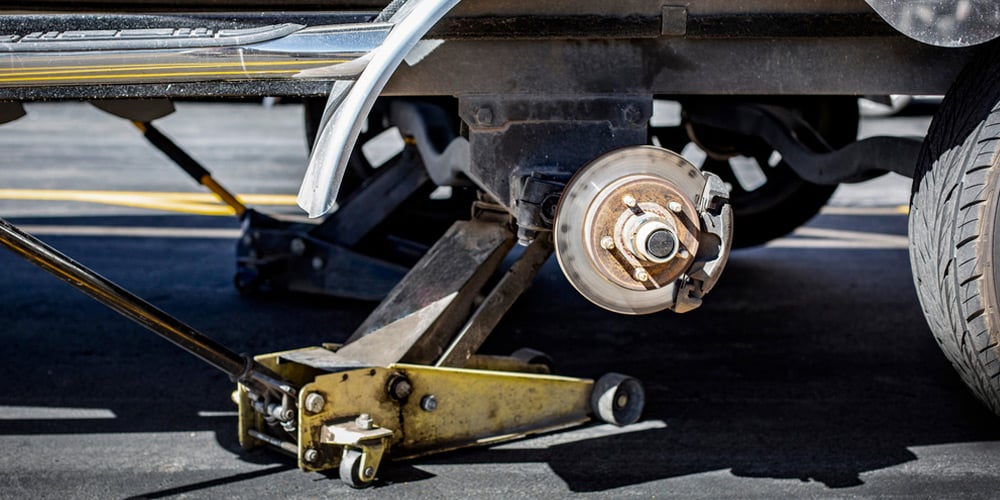
This trailer uses a set of surge brakes for controlled stops.
- When They Are Necessary
- Adding Brakes to Your Trailer
- How Trailer Brakes Work
- What to Look For
- Brake Options for Backing Up
- Additional Buying Considerations
- Maintenance Tips
- Selecting Trailer Brakes FAQs
- We're Here to Help!
- Related Articles
When They Are Necessary
Many trailerable boats, especially powerboats and small keeled sailboats, are heavy and are a challenge for the brakes of your tow vehicle. Going down a hill with a heavy trailer pushing your car, SUV or truck, your vehicle’s brake system can easily be overpowered. Your stopping distance can become excessive, your brakes may overheat and you can start to swerve from side to side, putting you, your passengers, your boat and other motorists in danger.
Trailer brakes are required above certain weight limits by laws that vary from state to state. Check with your state’s Department of Motor Vehicles, to determine the requirements in your state.
Adding Brakes to Your Trailer
Brakes can be added to an axle that does not have brakes if the axle has brake flanges welded to the axle. These flanges are metal plates with four holes for 10" brakes and five holes for 12" brakes. We don't recommend welding these on, as the brake flanges must be straight and 90° to the spindle. If they are not “square” to the spindle, the brakes will not center properly in the brake hub or rotor and this will create wear problems.
How Trailer Brakes Work
If your trailer is equipped with hydraulic surge brakes, the brakes are activated by the surge actuator/coupler located at the front end of the trailer tongue. When your tow vehicle stops, the trailer pushes into the tow vehicle, compressing the master cylinder that is located inside the actuator, forcing the fluid to the drum or disc brakes. Inside each brake is a wheel cylinder that expands with the surge of brake fluid, pushing the brake shoe against the inside of the drum or squeezing the caliper tight over the disc.
Surge brakes are entirely self-contained within the trailer and need no electrical or hydraulic connections to the car. Surge brakes are a passive system, acting only after the car has begun to slow down. This results in a split second of delay during which the trailer load pushes the car, requiring a longer distance to stop your rig.
Electric brake systems are controlled by the car’s brake pedal pressure and require an electric brake controller in your car. When you step on the brake pedal the brake lights come on and voltage is simultaneously sent to the trailer’s electromagnetic actuators, engaging the brakes. The trailer always brakes first, and this positive brake action is safer for downhill driving and quick stops.
However, few boat trailers are equipped with electric brakes, but they’re used on many RV and utility trailers. RV-grade systems, with painted automotive-grade components, are not intended for submersion, especially in salt water. Submerging a pair of electromagnet actuators and their wiring is generally regarded with the suspicion that occurs whenever you mix water with electricity. We don't recommend electric brakes for marine applications.
Emergency breakaway system: Federal law requires all trailers with brakes to have a system that automatically applies the brakes if the trailer detaches from the tow vehicle. Surge brake systems use a mechanical cable or chain connected to the tow vehicle that activates the master cylinder. Electric brake systems use a battery-operated activator that energizes the electromagnets in the wheels. These kits often include a battery and charger, emergency switch and battery case in one package.
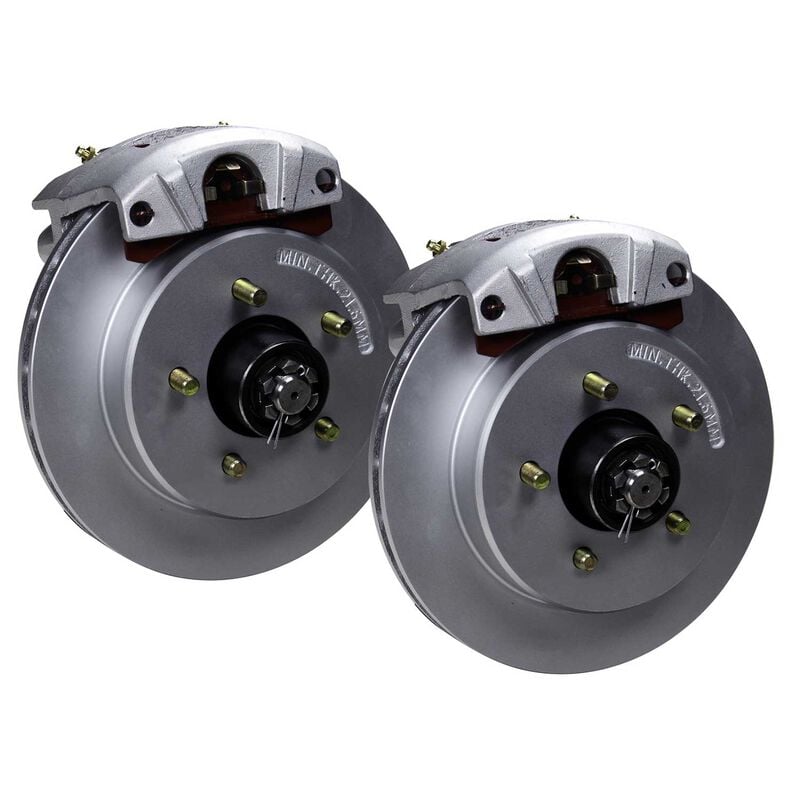 CE Smith Trailer Disc Brakes have a vented design that prevents overheating.
What to Look For
Disc vs. drum brakes: Trailer brakes are either disc or drum brakes. Disc brakes can replace most drum systems with minimum modifications and offer the following advantages over drum brakes:
- Better resistance to fade when descending a mountain pass or in stop-and-go traffic
- Self-adjusting
- Greater stopping power
- Self-cleaning and lower maintenance
- Fewer moving parts
- Easy to visually inspect without removing components
Disc brakes require a higher static brake line pressure to operate than drum brakes, which begin to grab at lower pressure. Drum brakes are more effective for lighter boats.
Brake Options for Backing Up
Drum brakes come in two styles, Uni-Servo and Free Backing.
Uni-Servo brakes, with a single-pushrod wheel cylinder, retain about 20 percent of their braking ability in reverse. They should be connected to a reverse lock-out solenoid for backing up an incline or over soft ground.
Free Backing brakes have a unique design that moves the front brake shoe away from the drum when backing. This lets the trailer roll free when backing up, but they have no braking power, so your tow vehicle’s brakes carry the entire load.
Reverse lock-out solenoid switch: Disc brakes maintain 100 percent of their braking force in both directions and require a reverse lock-out solenoid switch to disengage them when going in reverse. Solenoid switches, like Free Backing drum brakes, render your trailer brakeless when you are backing down a slope or a ramp.
Additional Buying Considerations
Vented rotors: Brakes work using friction. Friction creates heat. Vented disc brake rotors have a hollow cage design that allows air inside to keep the system running cooler.
Corrosion resistance: Corroded brake systems are prone to failure. If you have to immerse your trailer in saltwater to launch your boat, make sure your brakes are corrosion-resistant galvanized or stainless steel systems. Inexpensive flushing system kits extend the life of your drum brakes.
Maintenance Tips
Thoroughly rinse the brake system with fresh water after wet launching your boat. Freshwater flushing systems that attach to your garden hose are the easiest way to keep your system clean. At West Marine, we also offer Salt-Away, salt removing treatment in spray bottles for flushing outboard engines, which also works well to prevent corrosion on trailer brakes. If you are confident, mechanically inclined, and have some familiarity with hydraulic systems (bleeding lines, for example) upgrading or replacing brake components may be a backyard project for you.
- Drum brakes must be adjusted periodically, annually or every 3,000–5,000 miles. One of the advantages of disc brakes is that you do not need to adjust them.
- Lubricate the caliper pins on a regular basis.
- Check fluid levels before every trip. Check for leaks in the master cylinder, wheel cylinders or connections in the tubing if fluid levels drop.
- Check the wear of pads and shoes every 3,000–5,000 miles.
- Lubricate moving parts of brake coupler annually.
- On electric brakes, check the contacts between tow vehicle and trailer.
Selecting Trailer Brakes FAQs
Why are trailer brakes necessary for heavy boats?
Heavy boats can overwhelm a tow vehicle’s brakes, especially on hills, causing longer stopping distances, brake overheating, and dangerous swerving, putting passengers, the boat, and other drivers at risk.
What is the function of brake flanges on a trailer axle?
Brake flanges are metal plates welded to the axle with four or five holes to mount 10" or 12" brakes. They must be perfectly aligned with the axle’s spindle (the part holding the wheel) to ensure brakes fit correctly and wear evenly.
How do hydraulic surge brakes operate on a trailer?
When the tow vehicle slows, the trailer pushes forward, pressing a device (actuator/coupler) on the trailer tongue. This squeezes a master cylinder, sending brake fluid to drum or disc brakes, which either push shoes against a drum or clamp calipers on a disc to stop the trailer.
How do electric brake systems differ from surge brakes?
Electric brakes activate instantly when you press the tow vehicle’s brake pedal, using a controller to engage trailer brakes first for safer stops. Surge brakes, self-contained and common in marine trailers, activate slightly later after the vehicle slows, but don’t require electrical connections.
What does an emergency breakaway system do?
Required by federal law, it applies brakes if the trailer detaches. Surge systems use a cable or chain to trigger the master cylinder; electric systems use a battery-powered activator to engage wheel electromagnets.
What advantages do disc brakes have over drum brakes?
Disc brakes stay effective longer during heavy use, adjust automatically, stop more powerfully, clean themselves, require less upkeep, have fewer parts, and allow easy inspection without taking them apart.
How do Free Backing drum brakes function when reversing?
Free Backing drum brakes move the front brake shoe (a curved pad inside the brake drum) away from the drum (a rotating metal cylinder) when reversing, letting the trailer roll freely without braking, so only the tow vehicle’s brakes are used.
How should trailer brakes be maintained to prevent corrosion?
After saltwater exposure, rinse brakes with fresh water or use a flushing kit or Salt-Away (a salt-removing spray). Check brake fluid levels and for leaks before trips, inspect brake pads or shoes every 3,000–5,000 miles, and yearly lubricate caliper pins (disc brake components) and the coupler’s moving parts.
We're Here to Help!
At West Marine, we’re passionate about elevating your boating experience. Beyond trailer brakes and accessories, explore boating’s best selection of gear online or in over 220 stores, where our expert crew provides trusted guidance for unforgettable days on the water. Use our store locator to find the West Marine store near you.


