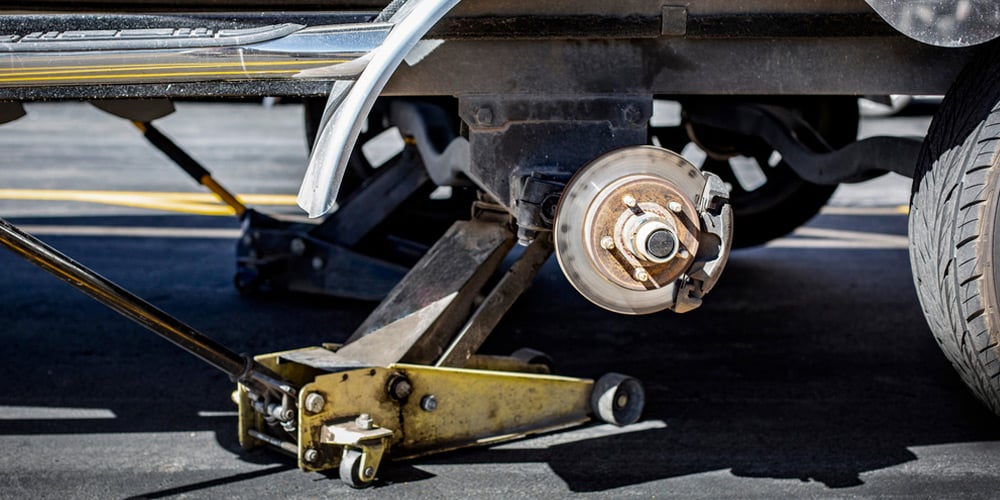
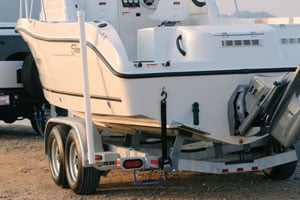
This trailer uses a set of surge brakes for controlled stops.
Boat trailers carry heavy loads, and the heavier the boat, trailer, fuel and gear, the harder it is for your tow vehicle to stop safely. Trailer brakes help reduce stopping distance, control trailer movement and protect your boat, tow vehicle and passengers during downhill grades, sudden stops and highway towing.
Choosing the right trailer brakes depends on trailer weight, axle setup, saltwater exposure, braking style and maintenance preferences. This guide explains when trailer brakes are needed, how surge brakes work, when to choose disc or drum brakes and what to inspect before every trip.
- When Trailer Brakes Are Necessary
- Adding Brakes to Your Trailer
- How Trailer Brakes Work
- Disc vs. Drum Trailer Brakes
- Brake Options for Backing Up
- Additional Buying Considerations
- Trailer Brake Maintenance Tips
- Trailer Brake FAQs
- We're Here to Help
- Related Articles
When Trailer Brakes Are Necessary
Many trailerable boats, especially powerboats and small keeled sailboats, are heavy enough to challenge the brakes on a car, SUV or truck. When descending a hill with a heavy trailer pushing your tow vehicle, your vehicle’s braking system can become overpowered. Stopping distance can increase, brakes may overheat and the trailer can begin to sway, creating a serious safety risk.
Trailer brake requirements vary by state and are usually based on trailer weight or gross trailer weight rating. Before towing, check your state’s Department of Motor Vehicles requirements and confirm that your trailer complies with local laws.
Even when brakes are not legally required, they may still be a smart upgrade if you tow long distances, launch on steep ramps, drive through hills or carry a heavy boat with fuel, batteries, coolers and gear onboard.
Adding Brakes to Your Trailer
Brakes can often be added to an axle that does not currently have them, but the axle must have brake flanges welded in place. These flanges are metal plates with four holes for 10" brakes or five holes for 12" brakes.
Brake flange alignment is critical. The flange must be straight and positioned at 90° to the spindle. If it is not square to the spindle, the brake assembly may not center correctly in the hub or rotor, causing uneven wear, poor braking and premature component failure.
For this reason, we do not recommend welding brake flanges onto an axle unless the work is performed by a qualified trailer professional. In many cases, replacing the axle with one already equipped with brake flanges may be the better solution.
How Trailer Brakes Work
Most boat trailers use hydraulic surge brakes. Surge brakes are self-contained within the trailer and do not require a brake controller inside the tow vehicle.
When the tow vehicle slows, the trailer pushes forward against the surge actuator/coupler at the front of the trailer tongue. This compresses the master cylinder inside the actuator and forces brake fluid through the lines to the drum or disc brakes. In a drum system, the wheel cylinder pushes brake shoes against the drum. In a disc system, hydraulic pressure squeezes the caliper over the rotor.
Surge brakes are common on marine trailers because they are simple, self-contained and practical for boat launching. They activate after the tow vehicle begins slowing, which can create a brief delay as the trailer compresses the actuator.
Electric brake systems are controlled by a brake controller in the tow vehicle. When you press the brake pedal, voltage is sent to electromagnetic actuators in the trailer brakes. Electric brakes are common on RV and utility trailers, but they are not ideal for most marine applications because the components and wiring are frequently submerged during launching. We do not recommend standard electric brakes for boat trailers, especially in saltwater use.
Emergency breakaway systems are required on trailers equipped with brakes. If the trailer separates from the tow vehicle, the breakaway system automatically applies the trailer brakes. Surge brake systems typically use a mechanical cable or chain connected to the tow vehicle to activate the master cylinder.
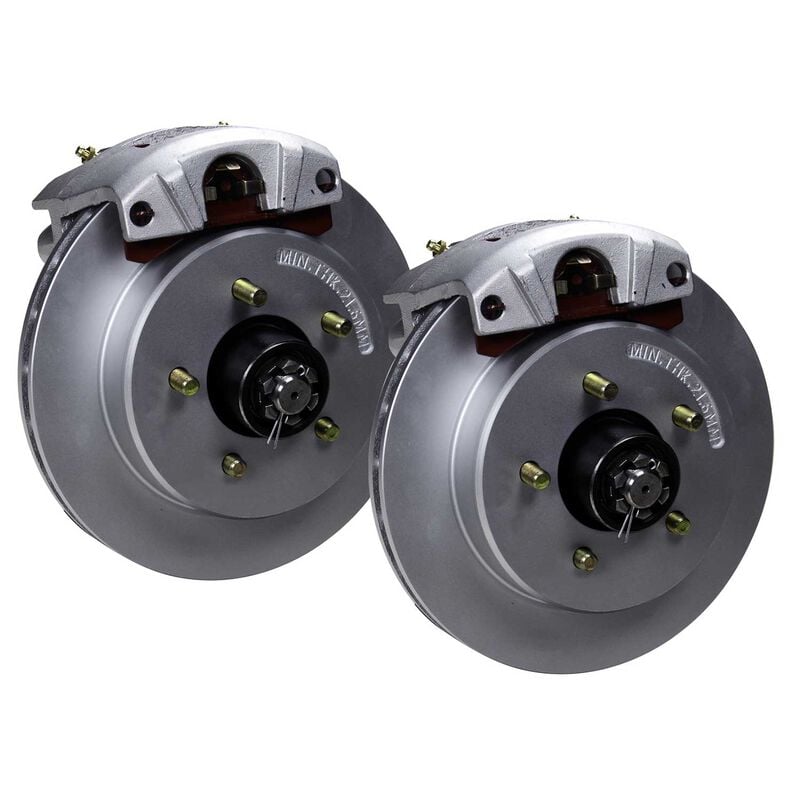
CE Smith Trailer Disc Brakes have a vented design that helps prevent overheating.
Disc vs. Drum Trailer Brakes
Boat trailer brakes are usually either disc brakes or drum brakes. Both systems can work well when properly sized and maintained, but each has advantages.
Disc Trailer Brakes
Disc brakes are often preferred for marine trailers because they are easier to inspect, rinse and maintain. They also handle heat better, which helps reduce brake fade during repeated stops or downhill towing.
- Better resistance to brake fade
- Greater stopping power
- Self-adjusting operation
- Fewer moving parts
- Lower maintenance than drum brakes
- Easier visual inspection
- Better self-cleaning after immersion
Disc brakes require higher static brake line pressure than drum brakes, so the actuator must be compatible with disc brake systems.
Drum Trailer Brakes
Drum brakes can be effective for lighter boats and trailers. They generally begin braking at lower hydraulic pressure and may cost less upfront. However, drum brakes contain more moving parts and require periodic adjustment.
Drum brakes are more enclosed than disc brakes, which can trap water, salt and debris. This makes rinsing and maintenance especially important after wet launching.
Brake Options for Backing Up
Backing a trailer up a ramp or driveway can activate surge brakes unless the system includes a way to prevent braking in reverse. The right reverse solution depends on whether the trailer uses disc or drum brakes.
Uni-Servo Drum Brakes
Uni-Servo drum brakes use a single-pushrod wheel cylinder and retain about 20 percent of their braking ability in reverse. They should be connected to a reverse lock-out solenoid when backing up an incline or over soft ground.
Free Backing Drum Brakes
Free Backing drum brakes use a design that moves the front brake shoe away from the drum when backing. This allows the trailer to roll freely in reverse. However, the trailer has no braking power while backing, so the tow vehicle’s brakes carry the load.
Reverse Lock-Out Solenoids
Disc brakes maintain full braking force in both forward and reverse. Because of that, disc brake trailers require a reverse lock-out solenoid switch to disengage the brakes while backing. This is especially important when backing up ramps, driveways or soft ground.
Additional Buying Considerations
Vented rotors: Brakes stop the trailer through friction, and friction creates heat. Vented disc brake rotors use an open internal design that allows air to move through the rotor, helping the brake system run cooler.
Corrosion resistance: Corrosion is one of the biggest causes of boat trailer brake failure. If your trailer is immersed in saltwater, choose galvanized, stainless steel or other corrosion-resistant brake components whenever possible.
Actuator compatibility: Disc and drum systems require different hydraulic pressures. Make sure the surge actuator is designed for the type of brakes installed on the trailer.
Axle rating and brake size: Brake size must match the trailer axle, wheel size and load rating. Common brake sizes include 10" and 12", but the correct choice depends on the trailer’s specifications.
Saltwater flushing: Drum brake flushing kits and thorough freshwater rinsing help extend brake life after launching.
Trailer Brake Maintenance Tips
Trailer brakes live in a harsh environment. They are exposed to road grit, heat, water, salt and long periods of storage. Routine maintenance is critical for safe towing.
- Rinse brakes thoroughly with fresh water after wet launching.
- Use a freshwater flushing system when available.
- Check brake fluid before every trip.
- Inspect the master cylinder, wheel cylinders, calipers, hoses and fittings for leaks.
- Check brake pads and shoes every 3,000–5,000 miles.
- Adjust drum brakes periodically, typically annually or every 3,000–5,000 miles.
- Lubricate caliper pins regularly on disc brake systems.
- Lubricate moving parts of the brake coupler annually.
- Inspect brake lines for corrosion, cracks, kinks or abrasion.
- Test the breakaway system before towing.
If you are mechanically inclined and familiar with hydraulic systems, replacing brake components may be a manageable project. If you are unsure about bleeding brake lines, actuator compatibility or brake adjustment, have the work completed by a qualified trailer service professional.
Trailer Brake FAQs
Why are trailer brakes necessary for heavy boats?
Heavy boats can overwhelm a tow vehicle’s brakes, especially on hills or during sudden stops. Trailer brakes help reduce stopping distance, control trailer movement and prevent brake overheating.
Can brakes be added to any boat trailer?
Brakes can be added if the axle has properly aligned brake flanges. If the axle does not have flanges, it may need to be replaced or professionally modified.
Are disc brakes better than drum brakes for boat trailers?
Disc brakes are often preferred for boat trailers because they resist fade, self-adjust, have fewer moving parts and are easier to inspect and rinse after saltwater use.
Why are electric brakes not recommended for most boat trailers?
Standard electric brakes are not ideal for marine trailers because the actuators and wiring are often submerged during launching, especially in saltwater. Hydraulic surge brakes are more common for boat trailers.
What does a reverse lock-out solenoid do?
A reverse lock-out solenoid prevents surge brakes from engaging when backing up. It is especially important for disc brake trailers because disc brakes maintain full braking force in reverse.
How often should trailer brakes be maintained?
Inspect trailer brakes before each trip, rinse them after every launch and check pads, shoes and adjustment every 3,000–5,000 miles or at least annually.
How can I prevent boat trailer brake corrosion?
Rinse brakes thoroughly with fresh water after launching, use corrosion-resistant components, inspect brake lines and hardware regularly and repair leaks or rust before they cause failure.
We're Here to Help
At West Marine, we offer trailer brakes, trailer parts and accessories to help keep your boat trailer ready for the road. Our crew can help you choose the right brake components, maintenance supplies and trailering gear for your setup. Use our store locator to find the West Marine store near you.


