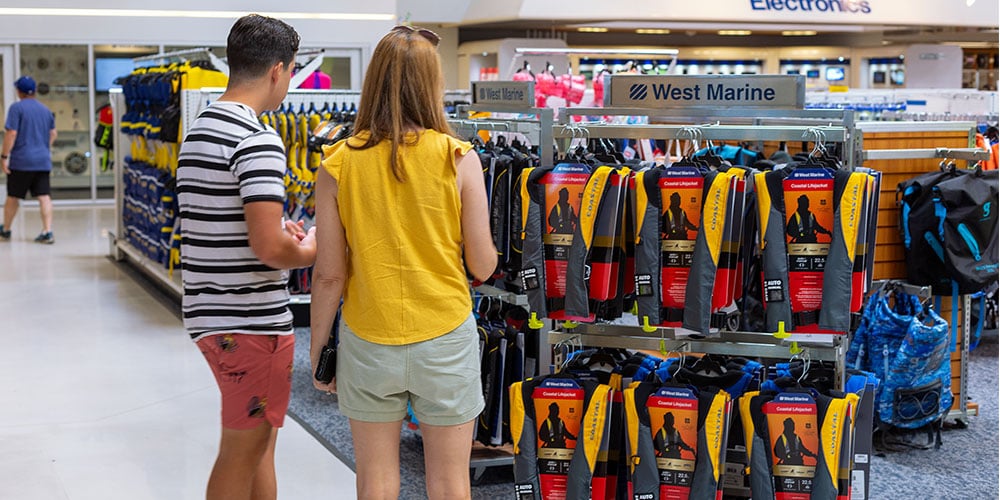
We carry life jackets in a variety of designs to meet the requirements of a wide variety of boating activities. In the video below, Chuck Hawley, West Marine alumnus (and recognized expert on boating safety) presents examples and discusses the features and benefits of different life jacket designs. Chuck also discusses USCG Type approvals and gives examples for each. Editor's Note: In October of 2014, the United States Coast Guard removed references to “Type codes” from regulations on the carriage and labeling of Coast Guard-approved personal flotation devices. As of June 2020, this change affects labeling for USCG Type III flotation devices only. See "Legacy Type III Personal Flotation and Equivalent Level 70 Labeling" below.
- Who Needs a Life Jacket?
- USCG Standards and Life Jacket Types
- How to Read USCG Life Jacket Icons
- How to Tell if a Life Jacket is U.S. Coast Guard Approved
- Classifying Inflatable PFDS by Coast Guard Types
- More About Type V PFDs
- How to Choose the Right Life Jacket for You
- Other Features to Consider
Who Needs a Life Jacket on a Boat?
The USCG requires all passengers on a boat or other qualifying vessel to have a USCG-approved personal flotation device whenever onboard. This means your boat must have at least as many USCG approved life jackets as there are people onboard. In most states, children under the age of 13 are required to wear a life vest at all times when on a boat.
There are some watercraft that fall in a bit of a gray area. For example, according to the USCG, a stand-up paddleboard (SUP) is legally considered a "vessel," and must abide by the laws regarding vessels "when used beyond the narrow limits of a swimming, surfing or bathing area". On the East, West and Gulf Coasts of the United States, this means that SUPs used outside of the surf zone are required to carry a personal flotation device, a whistle (or other sound-producing device) and—if out after dark—a white light to give warning to other vessels in the area. What about inland waters outside of Federal jurisdiction? State boating laws vary, so "know before you go", and check your local regulations.
USCG Standards
Personal Flotation Devices (PFDs) are available in inherently buoyant (foam) and inflatable designs. Life jackets were traditionally sorted into "types" based on their performance, but the U.S. Coat Guard is transitioning away from the old type designation for some life jackets in favor of icons and newton ratings that are meant to be easier to understand.
Old type designated life jackets still meet the USCG carry requirements, but if you go to buy a new life jacket, you'll likely see many life jacket performance factors listed as icons, rather than being rolled up under a type designation. We'll walk you through how to understand both so you know how your life jacket is meant to perform.
Type I

- Required on commercial vessels
- Large, bulky and fairly uncomfortable for recreational use
- Have 22 pounds of buoyancy and keep the wearer high in the water
- Intended to turn most wearers face up
Type II

- Standard, boxy, single-strap, orange life jackets
- Have 15 1/2 of pounds of buoyancy and are designed to turn most wearers face up
- Not comfortable for personal, extended use, but are great to have on board to still meet USCG carry requirements when you have more passengers than usual
Type III
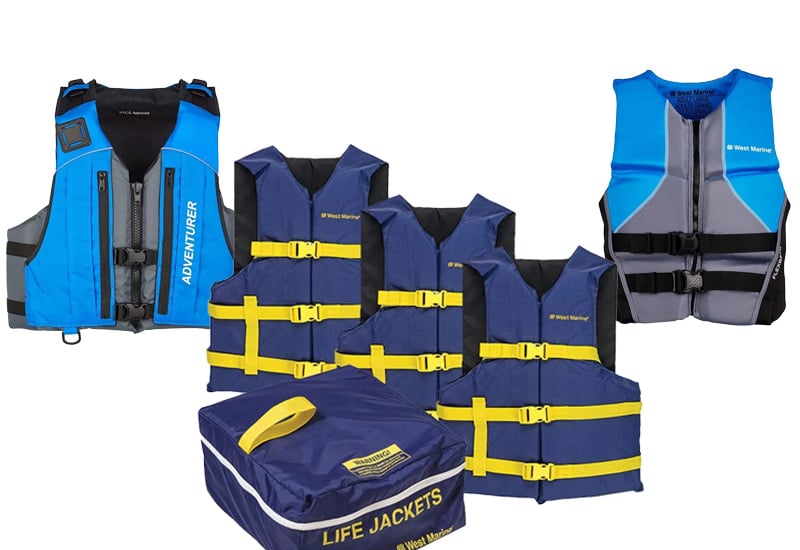
- Have up to 15 1/2 pounds of buoyancy (less for children and youth models)
- Available in a large number of styles for different types of on-the-water activities including wakeboarding, kayaking, sailing & more
- Labeling for Type III PFDs is gradually being replaced with icon-based labels to make it easier to understand how a life jacket is performed and what activities it's suitable for.
Type IV

- Throwable flotation devices that can be thrown to a person that has fallen overboard
- Can double as a crew overboard retrieval device when attached to rope
- All boats 16' and longer (except sailboards, racing shells, rowing sculls, racing canoes and racing kayaks) must carry one
Type V

- Designates a special use device or a device that requires special care or knowledge of its specific features
- A catchall for PFDs that don't fit in the other categories but are still approved by the USCG
- Often listed as Type V with Type I, II or III Performance to designate how the PFD is meant to perform when inflated
How to Read the New U.S. Coast Guard Life Jacket Icons
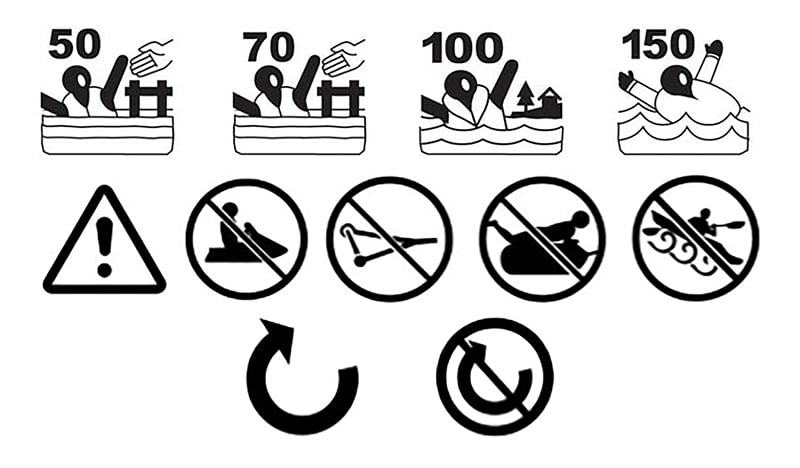
The life jacket icons are meant to make it easy to tell at a glance how a life jacket performs. There are three categories of icons to pay attention to when choosing the right life jacket for you.
1. Buoyancy Level, Distance to Shore and Water Conditions
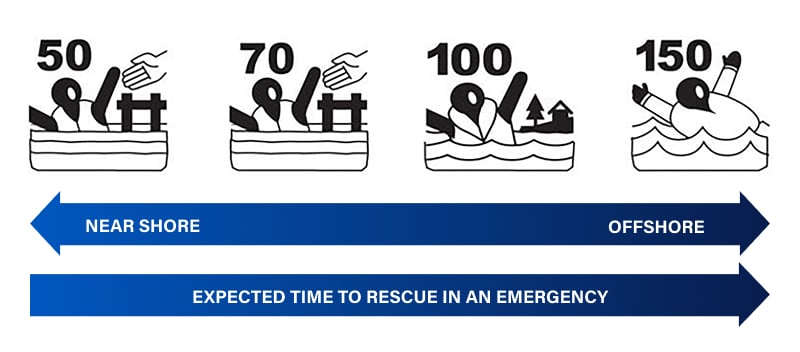
These icon have three important factors to pay attention to:
- The number: This indicates the buoyancy (measured in Newtons) of the life jacket. The higer the number, the more bouyant the life jacket is.
- The hand, shore or open water: This indicates how close you will be to rescue when using the life jacket.
- The hand and dock in the left side icons indicate that rescue will be almost immediately available such as at the beach or in a swimming pool
- The shoreline in the right-middle icon indicates that the life jacket is acceptable for inshore boating where you can still see the shoreline, but rescue might take longer to get to you
- The open water in the right side icon indicates that the life jacket is acceptable for offshore boating where rescue could be hours away
- The water conditions: Straight lines indicate that the life jacket is intended to be used in calm, flat waters. Jagged wave lines indicate that the life jacket can be used in rough waters.
2. Water Activites Ratings
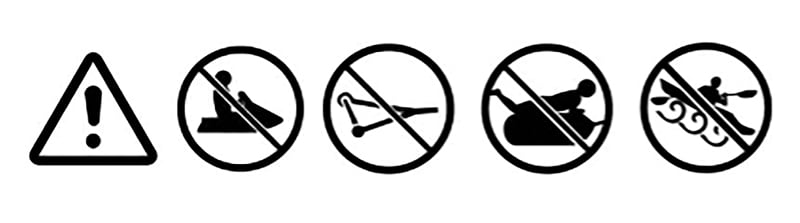
These icons indicate what the life jacket is not suitable for. From left to right the icons mean:
- This is a general icon used to draw attention to the other intended use icons
- Not suitable for riding a personal watercraft like a SeaDoo, Waverunner or Jet Ski
- Not suitable for towed water activities like water skiing or wakeboarding
- Not suitable for riding towable tubes
- Not suitable for white water conditions
3. Turning the Wearer in the Water

These icons indicate whether the life jacket is meant to turn most wearers face up in the water. The left icon indicates that the jacket is intended to turn the wearer, the right icon indicates that the vest is not. Turning the wearer is especially important for infant or child life jackets and in commercial applications where there's a chance the wearer might be knocked unconcious when they fall in the water.
How to Tell if a Life Jacket is U.S. Coast Guard Approved
All U.S. Coast Guard lifejackets will be labeled somewhere on the jacket, either on the inside of the back or front panels. It is incredibly important to make sure that your life jacket is USCG approved, especially for infant, children and youth life jackets. There are a lot of swim vest and buoyancy aids on the market, but a lot of these products are meant for swimming lessons where an instructor is always in reach of the child. For boating and swimming outside of an instructional setting, you should be using a USCG approved life jacket and preferably one designed to turn the wearer face up in the water.
Classifying Inflatable PFDs by Coast Guard Types
Prior to Coast Guard-approved inflatables, you could determine a PFD’s USCG type by sight. Type IIIs looked like vests or float coats, Type IVs were horseshoes, rings, or cushions, and so forth. The introduction of inflatable PFDs changed everything. Inflatables are given a Coast Guard type, just like non-inflatables, but they are also given a performance type and a designation as to whether they have to be worn to be counted in the vessel’s life jacket inventory. What this means is that you cannot simply say that an inflatable is a Type III and equate its characteristics to the Type III with which you are familiar. All inflatables are for swimmers 16 years or older and all Type II and III inflatables provide some degree of turning ability and greater buoyancy than comparable Type II or Type III foam vests. Here are some pointers on how inflatables are classified:
- Inflatables with harnesses are, by default, Type V life jackets. They come with instructions that you should be familiar with when wearing a harness. Their performance type is generally Type III or Type II.
- Belt pack inflatables are Type V life jackets with Type III performance. They are for competent swimmers only, because they require secondary donning of the life jacket in the water after inflating it and some require additional topping off of the bladder using the oral inflation tube.
- High buoyancy inflatables (150 N or 33 pounds of buoyancy) have a Type III performance rating if they are manually-activated with a ripcord, and a Type II performance rating if they are water-activated. Since the bladder and the rest of the life jacket are identical except for the inflator, once they’re inflated they perform exactly the same.
- The Coast Guard requires that automatic, water-activated inflatables that lack a single-point, arming status indicators that are readily visible have to be worn to be counted in the vessel’s inventory of life jackets. Inflatable life jacket models that do include a ready-status indicator (so-called "stowables") don’t have to be worn to be counted as inventory. However, this misses the point of inflatable PFDs, which are so comfortable that you’ll wear them while on the water.
- Inshore Coastal Series inflatables use a 24g cylinder, and provide 26 pounds of flotation. They are only legal when worn.
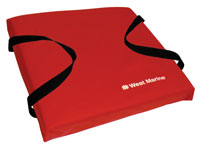
Type IV Throwable Device. Not to be worn.
More About Type V PFDs
This category is comprised of inflatable PFDs that have special features or require user interaction for use. PFD Belt Packs are one example. These PFDs are worn deflated on one's waist. Once inflated they must be manually slipped over one's head, which makes PFD belt packs appropriate for competent swimmers only. Inflatable PFDs with a built-in harness (to which you attach a tether) are another example of a Type V PFD.
- Inflatable PFDs with harnesses are always Type V. Along with the the benefit of a built-in harness, when inflated these devices provide the buoyancy of an offshore SOLAS-grade PFD or Type I foam life vest.
- As mentioned, belt packs are Type V. Base your selection on the desired level of performance and and keep in mind that belt packs are not sufficient if you are at risk of going overboard unconscious. This is because you will have to manually activate the inflator and then slip the inflated chamber over your head.
- High-buoyancy inflatables with 33 pounds of buoyancy have a Type III performance rating if they are manually activated with a ripcord, and Type II if they are water activated. This seems counterintuitive, as they perform the same once inflated, but it has more to do with the method of inflation and whether or not the wearer has to be conscious to use it.
- Some inflatables are only legal when worn. This is important to know when purchasing PFDs for your boat. While standard PFDs will always float in the case of an emergency, some inflatables will not unless activated. If you want to stow inflatables, review the approval label.
Many boaters keep spare PFDs stowed for guests to keep with USCG regulations, but if you are stowing extra PFDs, we recommend inherently buoyant (foam) models. If you have enough inflatable PFDs onboard, have each boater actually wear theirs. They are generally so comfortable you will forget you are wearing them, unlike standard PFDs.
How to Choose the Right Life Jacket for You
This depends largely on what kind of boating you enjoy. Below are a list of common water-based activities and the PFDs we recommend for each.
Recreational
Powerboats and sailboats in relatively calm, warm water should be stocked with PFDs that provide comfort and freedom of movement. We recommend a belted or day sailing vest, or an inshore inflatable that falls under Type III. This category includes many options in terms of style, fit and deployment. A Type II PFD could work for recreational boaters, but keep in mind that these are bulkier and restrict movement. If you plan on spending many long days on the water, go for the more comfortable option that won't chafe.
Water Sports
Activities like wakeboarding, water skiing, being towed on an inflatable tube and riding a personal watercraft present a risk of repeated water entry at high speed. PFDs for watersports must remain intact and securely attached to your body. Belted vests with three or four strong belts encircling your torso work best because they won’t get torn off easily, even when you wipe out at high speed. Look for vests that have "watersports" marked on the label, and ensure that they can be adjusted to a snug fit. (Editor's note: The USCG does not allow lifejackets to be advertised as providing protection from impact and they cannot reference impact on the labels or in marketing.)
Day Sailing
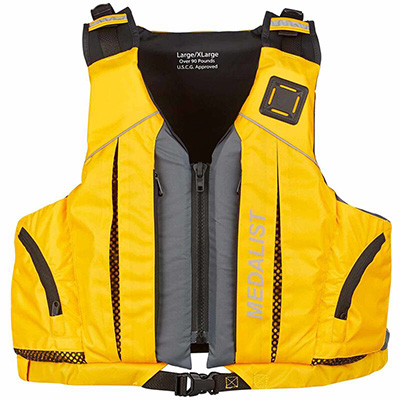
Our type III Medalist Day Sailing Life Jacket for adults offers a minimum of 15 1/2 pounds of buoyancy. Life jacket buoyancy can be used to right this El Toro in the event of a capsize.
Sailing small boats requires PFDs that fit snug to the body and that maximize freedom of movement. The preferred style has a zippered closure and is made from soft, pliable foam. Day sailing vests often feature an articulating design, with strips of foam inserted into channels that enables the vest to flex and wrap comfortably around your torso. Large armholes offer additional freedom of movement, but may allow the vest to ride up when in the water, so a snug fit is important. If you sail a dinghy or beach catamaran, your PFD may have to be worn with a trapeze harness, so take the harness with you when you shop for a new life jacket. Day Sailing vests are a good choice for a variety of boating styles except for high-speed water sports.
Fishing
Fishing vests include built-in pockets to accommodate anglers who often carry a collection of lures, leaders and other gear. Anglers with high-speed bass boats require vests designed to survive high-speed impacts. Therefore, we offer two distinct types of fishing vests: those with pockets that can hold lure boxes, snacks or fishing tools, and those with wide encircling belts. The second style is similar to watersports PFDs and can be adjusted to a snug and secure fit, so the vest will stay in position during high-speed water entry.
Offshore Sail
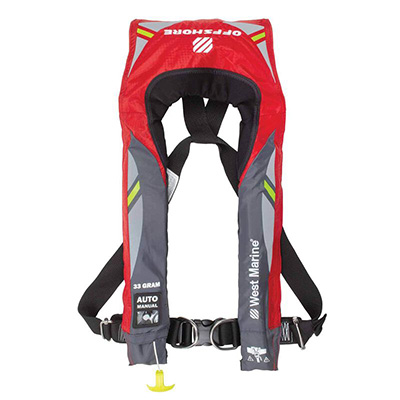
Our All Clear® Offshore Inflatable PFD features automatic or manual inflation and includes a harness for clipping into jacklines.
Offshore vests provide lots of buoyancy, freedom of movement and typically a safety harness that the wearer tethers onto jacklines to stay connected to the boat. In the past, offshore sailors chose between a life jacket and a safety harness, since the two items were seen as interfering with one another. Today’s inflatable life jackets with integrated harnesses provide a high level of safety in one single product. Offshore PFDs equipped with Hammar hydrostatic or Halkey Roberts V95000 inflators require complete submersion before inflation will occur. Neither will inflate due to spray, rain or humidity. West Marine Offshore Series vests only inflate when submerged. Manual and automatic inflation options are available. Virtually all models in the Offshore Sailing category will have similar 35 pounds of buoyancy and a harness that complies with International Sailing Federation (ISAF) standards.
We recommend that offshore powerboaters also have one or two of these vests aboard. You never know when you might need to venture out onto a pitching, slippery deck in rough conditions—perhaps to get the anchor ready or to secure a dinghy that has come loose.
Offshore Power
Passagemaking requires high-buoyancy life jackets designed for rough waters. While the chances of ending up overboard are far lower on a trawler with an enclosed pilothouse, the crew should always wear high-buoyancy inflatable PFDs every time they go on deck. If a crewmember goes overboard the time to rescue may be long, the water may be cold and the sea rough.
Paddlesports
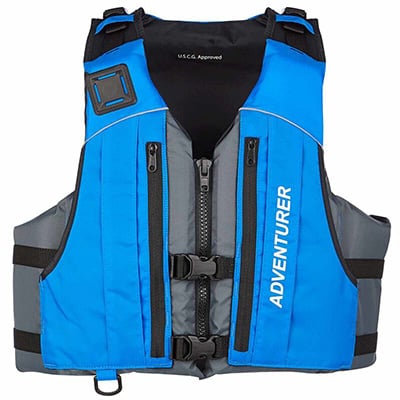
Paddlesports PFDs like our Paddle Adventurer jacket have large arm holes for increased range of motion and often have additonal pockets and D-rings for carrying extra gear.
Canoeists, kayakers and whitewater rafters need PFDs that combine freedom of movement and protection. Many specialized paddlesports PFDs have been developed for niche markets and different styles of paddling, so make sure you try different models that are labeled for paddle sports. Most feature large arm holes for freedom of movement and to reduce chafe when paddling. Kayakers may need vests with high-cut waists that don’t interfere with a spray skirt. Waist-worn inflatable vest belt packs are popular among stand-up paddle boarders. This option, while allowing 100% freedom of movement, is for competent swimmers only, because it requires the user to don the vest manually while in the water.
Commercial Vessels
Commercial vessels must have specific types of life jackets onboard to be legal. We offer a range of Type I life jackets and SOLAS-approved models, often referred to as industrial life jackets, but we don’t recommend their use on recreational boats. Type I devices, due to their bulk, are not practical for recreational boating activities and require extra space to stow. However, if you operate a commercial fishing boat that is required to have Type I vests onboard, West Marine has you covered.
Other Features to Consider
Below are some other attributes or applications for life jackets that affect their performance requirements.
Hypothermia Protection
If you boat in cold climates you should understand the importance of hypothermia protection. Immersion in cold water rapidly reduces your core body temperature, leading to greatly impaired physical and mental capabilities. Even a five-minute immersion in 50°F water can impair your ability to climb a ladder, catch a line, or tread water. In addition to protective clothing such as exposure coveralls, immersion suits, wetsuits, and float coats, a properly fitted Type III vest also can delay the onset and lessen the effects of hypothermia. High buoyancy vests like offshore inflatables allow the wearer to assume the Heat Escape Lessening Posture (HELP), which can double survival times by reducing heat loss to the water.
Maximum Freeboard
Crew who have gone overboard may become unconscious, either through injury or due to hypothermia. In this case, high-buoyancy inflatable or Type I vests are the best choice. These vests are designed to right an unconcious victim face-up in the water and with their extra buoyancy increase the victim's freeboard, which is the distance from the water's surface to their mouth.
Children
Infants and small children are hard to keep floating in a face-up position, and sometimes protest when wearing a PFD. Frankly, we think that boating with infants is not a very good idea if there is any likelihood of the baby ending up in the water. As kids get older and more water-savvy they become right at home onboard. There are many choices for well-fitting PFDs that provide stability and buoyancy.
Those of us who have had to pull our children out of the water appreciate behind-the-head flotation collars designed for smaller kids. These come standard with a grab strap and crotch straps. We highly recommend testing the life jacket you select for your child ahead of time in a safe environment, like a pool, to familiarize yourself and your child with the device's characteristics. Be sure to review the "Important information about children’s PFDs" card that is supplied with these devices.
Be Safe on the Water
- Always have the federally required safety equipment on board, meaning Coast Guard-approved life jackets. If you select non-approved devices, make sure you back them up with what the law requires.
- If you have an older, non-approved SOSpenders, Crewfit, or West Marine inflatable, wear it confidently until its useful life is over (around 10 years). If you have life jackets in your inventory that must be worn to be counted, back them up with Coast Guard approved life jackets so you are never caught short and suffer an expensive fine.
- Establish rules on board your boat defining when life jackets are to be worn and lead by example. Most states require that children always wear a life jacket. Where no state law exists, federal law requires children 13 years and younger to always wear one. Perhaps the same law should apply to parents—since there would be far fewer boating deaths if they always wear one.
We're Here to Help!
Online and in our stores, West Marine customers find the products and the advice they need. For additional help with selecting a PFD, check our West Advisor article about the Top 9 PFDs Our Customers Love; which is one of the hundreds of online West Advisor articles available to you. Of course, friendly (and knowledgeable) West Marine crew members are always ready to help in over 230 stores. Click on our store locator for the location of a West Marine store near you.
Related


