Choosing the Right Marine Satellite TV Antenna
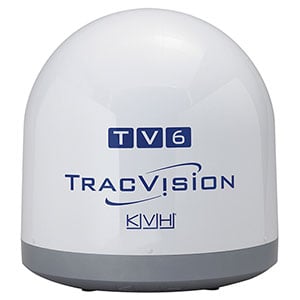
The KVH TracVision satellite TV antenna brings your favorite television programming aboard no matter where your cruising takes you.
Marine satellite TV, once found only on superyachts with large domes and expensive systems, has become compact and affordable for smaller boats. KVH leads the marine satellite TV market with their TracVision series, offering antenna sizes from 12.5” to over 33” in diameter. To choose the right system, you need to answer two questions: where will you be boating, and which antenna size is right for your boat?
- Where Are You Headed?
- Traveling to Other Continents
- How to Receive HDTV
- Watching on More Than One TV
- FAQs
- Browse All Marine Electronics & Navigation Gear
Where Are You Headed?
Your cruising area determines which antenna you need. Satellite TV broadcast spot beams are aimed at landmasses where the bulk of subscribers are located. Signal strength decreases as you travel offshore, so the further you go from land, the larger the antenna you need to maintain a reliable signal.
As a general guide using the KVH TracVision lineup:
- TracVision TV1 (12.5” antenna): Best for coastal cruising and inland waterways. Compact and easy to install on smaller boats.
- TracVision TV3 (14.5” antenna): Suitable for moderate offshore use, extending coverage further from shore than the TV1.
- TracVision TV5 (18” antenna): A strong choice for sportfishing boats and vessels heading offshore or to the islands. Supports DIRECTV, DISH Network, Bell TV, and worldwide Ku-band services.
- TracVision UHD7 (larger format): KVH’s current top-performing system, winner of NMEA’s 2024 Satellite TV Product of Excellence. Suited for serious bluewater cruising, northern latitudes, and boats that need the best possible performance in marginal signal conditions.
Use coverage footprint maps as a general guide for antenna sizing, then visit the service provider’s website to confirm what programming is available in your cruising area.
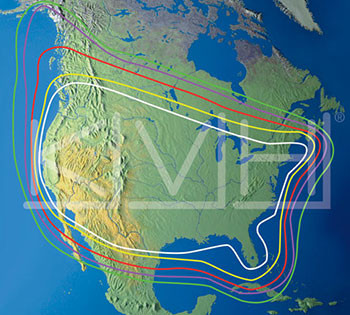
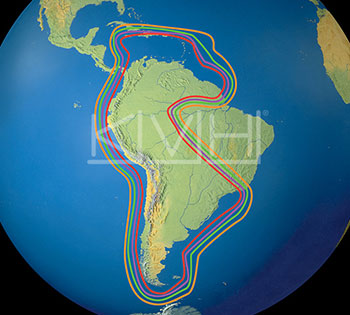
These coverage maps apply to KVH antennas but other manufacturers’ products are similar. Traveling further offshore requires a larger antenna. To receive signals in both North and South America, you need a system that works in both regions.
DIRECTV Recommended Dish Diameters:
- White: 12.5”
- Yellow: 14.5”
- Red: 18”
- Purple: 24”
- Green: 32”
- Orange: 41.5”
Traveling to Other Continents
Can a satellite TV antenna be used in different regions? US and European satellite TV models may appear physically identical but contain distinct internal differences. The Low Noise Block (LNB) — which converts the satellite signal into an IF signal — is specific to a geographic region. This applies to any brand of satellite TV antenna. It is not possible to receive European satellite signals using a USA-configured system and vice versa.
If your vessel has a US-configured system and you cruise into European coverage, the system will become inoperative until the LNB is replaced by an authorized service dealer. If you plan to travel across different geographic regions (North America, South America, Europe, Africa), choose a satellite TV antenna with an All-Americas™ LNB, or a Worldview antenna with a global LNB installed.
How to Receive HDTV
To receive HD programming, you need a high-definition television and an activated HD receiver. Marine satellite domes fitted with an HD Antenna Control Unit (ACU) enable the full range of HD broadcasting. In the US, HD programming is available through DISH Network and DIRECTV service providers.
HD channels from DISH Network and Bell TV may require a multi-satellite interface module (MIM) for automatic switching between satellites. For DIRECTV HD viewing, KVH’s TracVision UHD7 provides high-definition programming with simultaneous reception from multiple satellites. Check current service provider requirements before purchasing, as receiver compatibility requirements can change with service updates.
Watching on More Than One TV
One satellite antenna can serve multiple televisions. If each screen has its own satellite set-top box (from DISH Network or DIRECTV), each TV can display a different channel independently. If there is only one satellite set-top box, all TVs will display the same channel simultaneously.
KVH’s IP AutoSwitch option simplifies multi-receiver installations, allowing automatic channel switching across receivers using the master receiver’s remote control when used with compatible DISH Network or Bell TV receivers.
Frequently Asked Questions
What size satellite TV antenna do I need for my boat?
Antenna size depends primarily on how far offshore you cruise. For coastal and inland use, a compact 12.5”–14.5” antenna like the KVH TracVision TV1 or TV3 is typically sufficient. For offshore passages and island hopping, an 18” antenna like the TracVision TV5 provides better coverage margins. For bluewater cruising, northern latitudes, or demanding offshore conditions, a larger antenna like the TracVision UHD7 gives the most reliable performance. Consult the manufacturer’s coverage footprint maps for your specific cruising area.
Can I use my US satellite TV system in Europe or other regions?
No — the LNB (Low Noise Block) inside the antenna dome is region-specific and cannot receive signals from satellites in a different region. A US-configured system will not receive European satellite signals. If you plan to cruise internationally across different satellite coverage regions, specify a Worldview or All-Americas LNB when purchasing the system. Regional LNBs can be swapped by an authorized service dealer if your cruising plans change.
Do I need a special antenna for HD satellite TV on my boat?
Most current KVH TracVision systems support HD reception when paired with an HD-capable receiver and an HD television. The antenna must have an HD-compatible ACU (Antenna Control Unit). Check the specific system’s compatibility with your preferred service provider (DISH Network or DIRECTV) and confirm current receiver requirements directly with the provider before purchasing, as service requirements change over time.
Will marine satellite TV work while the boat is moving?
Yes — marine satellite TV antennas are fully stabilized and designed to maintain a lock on the satellite while the boat is underway, pitching, and rolling. The stabilization system continuously tracks the satellite regardless of boat motion. Performance can degrade in very heavy seas or when the satellite signal is partially blocked by the mast, superstructure, or nearby vessels, but the system is designed for continuous operation while moving.
Can I use Starlink instead of a satellite TV system?
Starlink provides internet connectivity, not satellite television broadcasts directly. You can stream TV content through Starlink via services like YouTube TV, Hulu Live, or DIRECTV Stream, but this requires a continuous internet connection. A dedicated marine satellite TV antenna receives broadcast signals directly from TV satellites and does not require an internet connection to display programming — a meaningful advantage when offshore or in areas with limited Starlink coverage. Many boaters use both: Starlink for internet and a TracVision system for live TV.
Browse All Marine Electronics & Navigation Gear
- Chartplotters, GPS units, radar systems, and integrated navigation displays
- Sonar, CHIRP, downscan, and fish-finding electronics
- Marine stereos, speakers, amplifiers, and audio accessories
- VHF radios, AIS, satellite communication equipment
- Autopilot systems and steering control components
- Wind, depth, speed, and multifunction instruments
- Marine binoculars for navigation and low-light use
- Thermal and night-vision devices for situational awareness
- Onboard monitoring and security systems
- Magnetic and electronic compasses
- Paper and electronic navigation charts
- Regional cruising and harbor guides
- Traditional navigation plotting tools