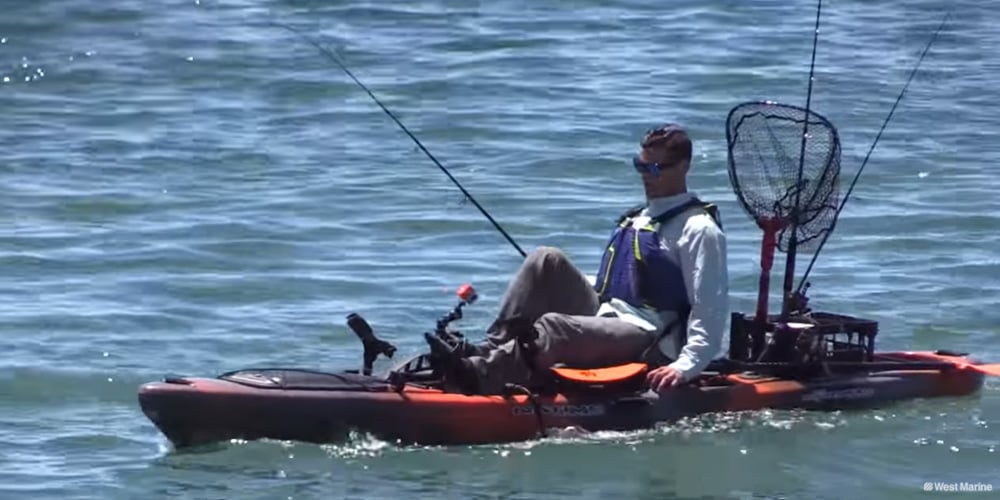
Kayaks provide an easy way to get on the water and enjoy our natural environment. For anglers, the small size and nimble nature of kayaks makes them a great platform for fishing in fresh- or saltwater. Regardless of the type of kayak you own, a few well-placed accessories can make the difference between catching fish — or returning home skunked at the end of the day. Here’s our advice on how to turn your kayak into a fishing machine.
Written by Brian Gordon, West Marine
- How to Choose the Right Fishing Kayak
- How to Outfit a Fishing Kayak
- Get Organized and Clear Your Kayak
- Drogues and Anchors
- Live Bait
- Keep Your Catch Fresh
- Camera Mounts
- Landing Net
- Fishfinders
- Accessory Mounts and Tracks
- Safety
- FAQs
How to Choose the Right Fishing Kayak
If you don’t already have a kayak, getting one designed for fishing is your first step. Fishing kayaks generally include built-in rod holders and rail mount systems to make it easy to add rod holders, fishfinders, action camera mounts, and more. On-board storage for tackle bags, coolers, and buckets is equally important. For more information on selecting a kayak, check our Selecting a Kayak and Top Kayaks for Every Age Group articles.
The single most important feature to evaluate in a fishing kayak is stability. A kayak stable enough to stand and cast from changes the fishing experience fundamentally — standing gives you a higher line of sight to spot fish, a better casting angle, and the ability to fight a fish without being confined to a seat. Most sit-on-top fishing kayaks offer primary stability — resistance to initial tipping on flat water — but only wider-hulled models with beams of 33 inches or more offer the secondary stability needed to stand safely. If standing to fish is a priority, look specifically for kayaks marketed as stand-and-fish capable and confirm the beam and hull design support it before purchasing.
Pedal-drive kayaks have changed the fishing kayak category significantly. A pedal drive frees both hands for fishing at all times while the kayak moves under foot power — a genuine advantage when trolling, maneuvering into position for a cast, or fighting a fish while keeping the bow pointed toward it. Pedal drives add weight and cost, and require deeper water to avoid damaging the drive unit on the bottom, but for serious fishing applications they represent a real functional upgrade over paddle-only models.
How to Outfit a Fishing Kayak
Get Organized and Clear Your Kayak for Action
Organized anglers catch more fish. Fishing rods, tools, flies, jigs, weights, and other gear must be kept out of the way but within easy reach. Fishing kayaks frequently place built-in rod holders behind the seat, which is great for paddling but awkward when you need to grab a rod quickly. If that describes your kayak, or if it has no rod holders at all, install a couple forward of the seat to make rods immediately accessible.
When fishing, your paddle needs to be secured and out of the way. Install a pair of paddle clips, available with many other kayak gear mounting accessories. If you fish in areas where snagging on underwater objects or shoreline brush is common, a paddle with a hook retrieval notch can save you an expensive lure.
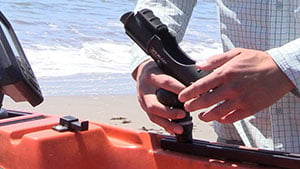
Rail-mounted accessories like this rod holder are easy to install and remove at the beginning and end of your fishing day.
Fish with at least two rods. That way, you can keep one line wet while you switch out terminal tackle on the other.
Tackle organization is where many kayak anglers lose significant fishing time. A tackle tray or small tackle bag that mounts to a rail or sits in a forward hatch within arm’s reach means you can change rigs, switch lures, and rig new leaders without rooting through a bag behind you. The best fishing kayak setups treat the cockpit like a workstation: everything needed for the next thirty minutes of fishing is within arm’s reach, and restocking from rear hatch storage happens during a natural break rather than interrupting active fishing. A few minutes organizing before you launch keeps you fishing instead of rummaging throughout the day.
Drogues and Anchors
Depending on conditions, you may want to drift and cast. If you are drifting too fast, reduce your drift rate with a drogue — an underwater parachute on a length of line attached to the bow that creates drag and slows your drift to a fishable pace.
Most every fishing kayak needs an anchor. Anchors serve two purposes: they prevent your kayak from drifting into dangerous areas if you lose your paddle or become incapacitated, and they hold your position over a productive spot so your hands are free to fish.
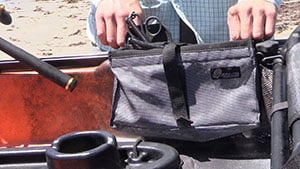
This rail-mounted gear bag puts tackle and tools within easy reach, but out of the way.
Most kayakers use a 1.5- or 3-pound folding grapnel anchor. For calm lakes or rivers with little wind or current, the smaller anchor works fine. For areas with surge, wind, and current, the 3-pound anchor holds better. Grapnel anchors and anchor line can be purchased separately or as a kayak anchor kit.
Along with an anchor, use an anchor trolley system — one of the most useful and underutilized pieces of fishing kayak equipment available. A trolley system runs a loop of line from bow to stern along the side of the kayak, with a ring the anchor line clips to. Sliding the ring forward or aft changes the point where the anchor line exits the boat, which changes the angle the kayak sits relative to wind and current. Anchored at the bow, the kayak points into the wind. Anchored amidships, it sits broadside. Moving the trolley ring positions the kayak for the best casting angle to a structure or current seam without moving the anchor — a significant tactical advantage whenever precise positioning determines whether you can reach the water you want to fish.
Give ’em What They Want: Live Bait
Many kayak anglers prefer artificial lures, but sometimes fish will only hit live bait. A live bait bucket with a built-in battery-operated aerator keeps bait alive for hours and fits easily into the storage wells on most kayaks.
Keeping live bait healthy requires attention to water temperature as well as oxygenation. On hot days, bait in a bucket exposed to direct sun will die quickly even with an aerator running, because warm water holds less dissolved oxygen than cool water. A small amount of ice in the bait bucket on hot days, or keeping the bucket in the shade of the kayak’s bow, extends bait life significantly. Lethargic, barely-alive bait draws far fewer strikes than healthy, swimming bait — it is worth the extra step to keep baitfish in prime condition throughout the day.
Keep Your Catch Fresh
A small cooler keeps both refreshments and your catch fresh. Soft-sided coolers by Yeti, AO, and Igloo are a good choice because they conform to the curved surfaces of storage wells in a kayak, fitting where a rigid cooler cannot.
For anglers who plan to keep their catch, a fish bag or insulated fish cooler bag filled with ice is more effective than a standard cooler. Fish that are immediately bled and placed on ice retain significantly better flesh quality than fish left in a livewell or on a stringer. A fillet knife, pliers, and a small cutting board in an accessible location make immediate fish handling practical from the kayak. Even in a small cockpit, having these tools within reach means you can handle your catch properly in the field rather than compromising quality by waiting until you return to shore.
Fish Stories Are Great, but Video Proof Is Best
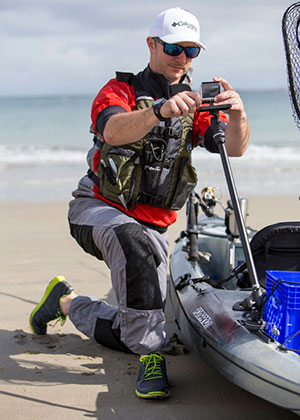
Preparing to record an epic day on the water.
To record and share your days on the water, install an action camera on an adjustable mount. Camera placement makes a significant difference in the quality of footage you capture: a mount on the bow pointing back toward the seat captures the angler’s face and rod during a fight; a mount at water level on the side captures the fish coming to the net; a mount on a short arm over the cockpit captures a top-down view of the lure presentation and strike. Many serious kayak fishing video creators run two or three angles simultaneously and edit the best footage together after the trip. Action cameras from GoPro and similar manufacturers are the standard choice — compact, waterproof, and compatible with the full range of RAM and RailBlaza mounting hardware.
Yes, You’re Going to Need a Net
Invest in a quality landing net and keep it ready in a rod holder on your kayak.
Net selection for kayak fishing involves considerations specific to the platform. A folding or telescoping handle is much easier to manage in the confined cockpit than a fixed handle. Rubber-coated mesh is significantly better than traditional knotted mesh for fish you intend to release — it removes far less of the fish’s protective slime coat and causes less fin damage, dramatically improving survival rates for released fish. For larger species like redfish, stripers, or salmon, a handle that extends to 36 or 48 inches gives you the reach to control the fish before it gets close enough to the kayak to thrash and throw the hook.
Fishfinders Help to Locate Prey
A small fishfinder takes the guesswork out of locating fish. With available mounting systems, they are easy to install and remove at the start and end of each fishing day. Depending on the transducer style, you will mount it through a scupper hole, glue it to the inside of the hull, or suspend it in the water from a gunnel mount. Power the fishfinder with a small 12-volt battery located under the deck, protected in a watertight box secured against movement inside the kayak. Use small sealing glands to cleanly route transducer and power cables through any bulkhead penetrations.
Modern fishfinders offer features that have transformed kayak fishing effectiveness. Side-imaging sonar sweeps a wide beam to both sides of the kayak and displays a nearly photographic image of bottom structure and suspended fish out to 100 feet or more on each side — dramatically increasing the water area you can survey from a single position. This is especially valuable in shallow flats fishing where covering water efficiently to locate fish is the primary challenge. Down-imaging provides a highly detailed picture of what is directly beneath the kayak, making it easy to distinguish rocky structure from soft bottom, identify weed beds, and spot fish holding tight to the bottom. For kayak anglers targeting structure-oriented species, upgrading from basic sonar to side- or down-imaging is one of the most productive investments available.
Accessory Mounts and Tracks
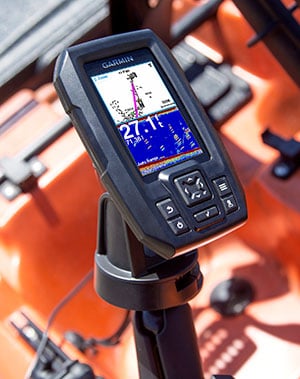
Fishfinders give kayak anglers an edge.
Accessories can be mounted in fixed locations or slid onto grooved tracks for infinite position adjustment. For fishfinder mounting, select from adjustable kayak electronics mounts by RAM, RailBlaza, and Scotty.
The mount system you choose at the outset determines what accessories you can add later, so it is worth understanding each ecosystem before committing. RAM Mounts uses a ball-and-socket system providing nearly infinite angle and position adjustability — excellent for fishfinders and cameras that need to be precisely aimed. RailBlaza uses a StarPort mount and track system that allows accessories to slide to any position along a track and lock securely — excellent for rod holders and gear bags that need to stay exactly where you put them under load. Scotty mounts use a proprietary post-and-ring system widely adopted by fishing kayak manufacturers as an OEM fitting, meaning many kayaks come from the factory with Scotty mount points already installed. Mixing systems is possible with adapters, but building your accessory setup around a single ecosystem simplifies compatibility from the start.
Safety
Anytime you venture out on the water, make safety a priority. Wear a paddling life jacket — fishing-specific PFDs include pockets for small tackle boxes and D-rings for line clippers and tools. If you are beyond shouting range of shore, carry a waterproof handheld VHF radio. Since kayaks can be hard to see from powerboats, announce your presence with a kayak visibility flag mounted at the stern. Also carry sound signals (horn or whistle), visual distress signals such as flares, and a small first aid kit. Stow these items in a dry bag to keep them protected and ready. New to kayaking? Check out our Beginner’s Guide to Kayaking.
Kayak fishing introduces specific safety considerations that general paddling does not. When fighting a large fish, the instinct is to focus entirely on the fish — which can mean losing awareness of boat traffic, drifting into hazardous water, or leaning far enough to capsize. Always maintain situational awareness when fighting a fish, particularly in areas with powerboat traffic. A leash attaching your paddle to the kayak ensures a dropped paddle does not drift out of reach at a critical moment. In tidal areas, know the current tide stage and direction of tidal flow so that losing your paddle or being blown off a spot does not take you somewhere dangerous. File a float plan with someone onshore any time you fish alone or in a remote location, and carry a charged phone in a waterproof case or a personal locator beacon for any offshore or remote freshwater fishing.
Get Your Fishing Machine in Gear
There’s virtually no limit to what you can catch from a kayak — from freshwater trout, bass, pike, and panfish to coastal redfish and sea trout, and even offshore species like wahoo and marlin. Get set up with the gear you need, then paddle out and have some fun.
Kayak Fishing FAQ
Most kayakers use a 1.5- or 3-pound folding grapnel anchor. The 1.5-pound anchor works fine for calm lakes and rivers with minimal wind or current. The 3-pound anchor is better for coastal waters, tidal areas, and anywhere with surge, wind, or significant current. Both are easy to store in a kayak hatch or bow storage well. An anchor trolley system is a worthwhile addition to either — it lets you adjust the angle your kayak faces relative to wind and current without moving the anchor, which is one of the most tactically useful things you can do when fishing structure.
An anchor trolley is a loop of line running bow to stern along the side of the kayak with a ring the anchor line clips to. Sliding the ring forward or aft changes the point where the anchor exits the kayak, which changes the angle the kayak sits relative to wind and current. This lets you position the kayak for the best casting angle to a structure or current seam without re-anchoring. For any kayak fishing where precise positioning matters — working a dock edge, a grass point, or a rock pile — an anchor trolley is one of the most useful accessories available.
For most kayak anglers, a compact unit with CHIRP sonar and GPS chartplotting is the right starting point. Units from Garmin, Lowrance, and Humminbird in the 4–7-inch screen range are the most popular choices for kayaks. If you fish shallow flats or structure-heavy water, upgrading to a unit with side-imaging or down-imaging sonar significantly improves fish-finding effectiveness. For transducer mounting, scupper-mount transducers are the simplest installation for most sit-on-top kayaks — they drop through an existing scupper hole and require no drilling or hull penetration.
All three are quality systems. RAM Mounts excels for fishfinders and cameras that need precise angle adjustment via its ball-and-socket system. RailBlaza excels for rod holders and gear bags that need to stay exactly positioned under load via its track-and-StarPort system. Scotty has the widest OEM adoption — many fishing kayaks come from the factory with Scotty mount points installed. Check what mount points your kayak already has and build around that system to minimize adapters. If starting from scratch, choose the system best represented by the accessories you want to add.
At minimum: a Coast Guard-approved PFD (wear it, don’t just carry it), a sound-producing device (whistle or horn), and visual distress signals if fishing in coastal waters after sunset. Beyond legal minimums: a handheld VHF radio, a kayak visibility flag, a paddle leash, and a dry bag with your phone and first aid kit are standard equipment for any serious kayak fishing trip. For fishing alone in remote areas, a personal locator beacon (PLB) or satellite communicator is strongly recommended — kayaks are hard to spot from a search aircraft without a signal.


