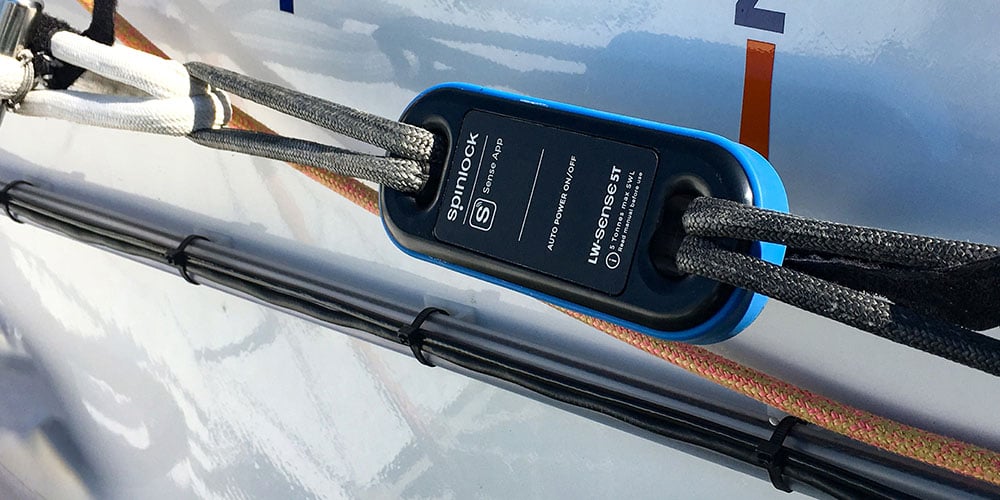
Maximum Working Load (MWL) is the load at which a block, line, or other piece of gear will function reliably without excessive friction or permanent deformation. It is typically one half of the fitting’s breaking strength — the load at or around which you can expect a major structural failure.
- Understanding MWL and Safety Factors
- Static vs. Dynamic Loads
- How Purchase Systems Multiply Load
- The Effect of Load Angle
- Selecting Blocks
- FAQs
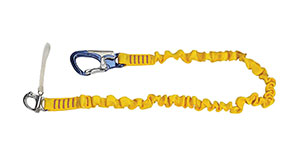
This Single Safety Tether has stitching that shows when the tether’s Maximum Working Load has been exceeded — for example from a hard fall on deck.
Understanding MWL and Safety Factors
MWL is typically set at 50% of a fitting’s breaking strength, giving a 2:1 safety factor. Above MWL, balls may flatten or pit, sheaves may seize, and shackles may begin to distort. Continued use of a fitting that has been loaded beyond its MWL can cause invisible internal damage that leads to failure at a lower load than expected — often when the fitting is next subjected to a shock load.
The 2:1 safety factor exists because calculated loads and actual loads often differ significantly. Friction in blocks, uneven load distribution across multiple lines, and errors in estimating sail forces all introduce uncertainty. More importantly, dynamic loads — shock loads from a sudden gust, a wave impact, or a line running suddenly taut — can far exceed steady-state loads. The MWL margin accounts for these real-world conditions.
Never exceed the fitting’s MWL with either static or dynamic forces. When calculating the load on any fitting, account for the purchase system multiplying forces, the angle of the load, and the rope load.
Static vs. Dynamic Loads
Static loads are sustained, steady forces — the tension in a halyard holding a fully hoisted sail in steady conditions. Dynamic loads are transient, impact-type forces — the sudden jerk when a flogging sail fills abruptly, or the shock when a block comes taut after momentary slack. Dynamic loads can multiply the effective load on a fitting by 2× or more compared to the equivalent static load.
This is why the safety tether shown above uses load-indicator stitching. A hard fall on deck generates a dynamic shock load that can exceed the tether’s MWL even if a calculation based on body weight alone would suggest the fitting is within limits. The stitching gives you visible evidence of whether the tether has been overloaded and needs inspection or replacement.
For all running rigging and safety equipment: design the system for steady-state loads, then verify that the MWL of every fitting provides adequate margin for the dynamic loads your boat will actually experience.
How Purchase Systems Multiply Load
A purchase system (a block and tackle arrangement) multiplies the force a crew member can apply to a line — but it also multiplies the load on every fitting in the system. A 4:1 purchase pulling on a sheet with 50 lbs. of hand force produces 200 lbs. of output force. The block at the load end of the system must handle the full 200 lbs. plus friction losses.
The critical fitting in most purchase systems is the turning block at the load end, which carries the combined load of both the incoming and outgoing parts of the line. In a simple 2:1 purchase, this block carries twice the load of the single line leaving it. Always size the turning block and anchor point for the full system output load, not just the line load at the crew end.
The Effect of Load Angle
The angle at which a line enters and exits a block significantly affects the load on the block’s attachment point. When a line makes a 180° turn through a block (a straight pull with the line doubling back on itself), the load on the block attachment is twice the line tension. As the included angle between the incoming and outgoing lines decreases, the load on the attachment point decreases as well.
Practical implication: a block used as a turning block at the base of a purchase system — where the line nearly doubles back — carries close to twice the line load. A block at the top of a purchase where the two parts of the line are nearly parallel carries a lower proportion of that load. Size fittings for the worst-case angle the system will actually achieve in use.
Similarly, a shackle loaded at an angle across its gate rather than axially along the pin can fail at a fraction of its rated load. Always load shackles along their primary axis.
Selecting Blocks
When selecting blocks, consider total load, acceptable friction, and the bulk of the system. As an example: Ronstan’s Series 20 blocks and Harken’s 40mm Carbo Airblock have essentially the same MWL, but the Harken block is roughly twice the size and costs significantly more. Larger sheave diameter almost always means less friction under load — an important consideration for high-cycle applications like mainsheet trimming where friction accumulates with every tack. For low-cycle applications like a backstay adjuster that is set and left, a smaller, lighter block may be the better choice. The right block depends on the application, not just the MWL.
Frequently Asked Questions
What is the difference between Maximum Working Load and Breaking Strength?
Breaking Strength (also called Break Load) is the load at which you can expect a fitting or line to fail catastrophically. Maximum Working Load is typically set at 50% of breaking strength — the load at which the fitting is safe for continuous use without permanent deformation or hidden internal damage. Using a fitting above its MWL but below its breaking strength may not cause immediate failure, but it can cause invisible damage that reduces the fitting’s actual breaking strength for the next load cycle.
Why is the safety factor for rigging fittings only 2:1?
The 2:1 safety factor (MWL = 50% of breaking strength) may seem low compared to construction or lifting equipment, which often uses 5:1 or higher. Sailing rigging operates at these lower safety factors because weight and windage matter, and because loads are reasonably predictable under normal conditions. The 2:1 factor accounts for uncertainty in load calculations and typical dynamic loading. For safety-critical applications like jacklines, tethers, and lifeline stanchions, higher safety factors are appropriate — consult ABYC standards and manufacturer guidance.
How do I calculate the load on a block in a purchase system?
Multiply the load you are moving by the mechanical advantage, then add friction losses (typically 10–15% per sheave for ball-bearing blocks, higher for plain bearing blocks). The turning block at the load end carries the full system output load. Example: a 4:1 vang pulling on a 100-lb. boom load generates 400 lbs. at the attachment point. Each block in the system should have an MWL of at least 400 lbs.; the turning block at the boom end may see higher loads due to angle effects.
What should I do if I suspect a fitting has been overloaded?
Inspect it carefully for visible deformation — distorted shackle bows, flattened or pitted balls, sheaves that don’t spin freely, or cracked or distorted block shells. If you find any of these signs, replace the fitting before the next use. If the fitting appears undamaged but you have reason to believe it was loaded near or above its MWL (such as a load-indicator tether showing overload stitching), treat it as suspect and replace it. The cost of a replacement fitting is negligible compared to the consequence of a failure aloft or on a safety-critical piece of gear.
Related Articles
- How to Correctly Coil Rope
- Removing a Halyard from Your Mast
- Selecting Line for Running Rigging
- Stainless Steel Rigging
- When and How to Replace Your Lifelines
