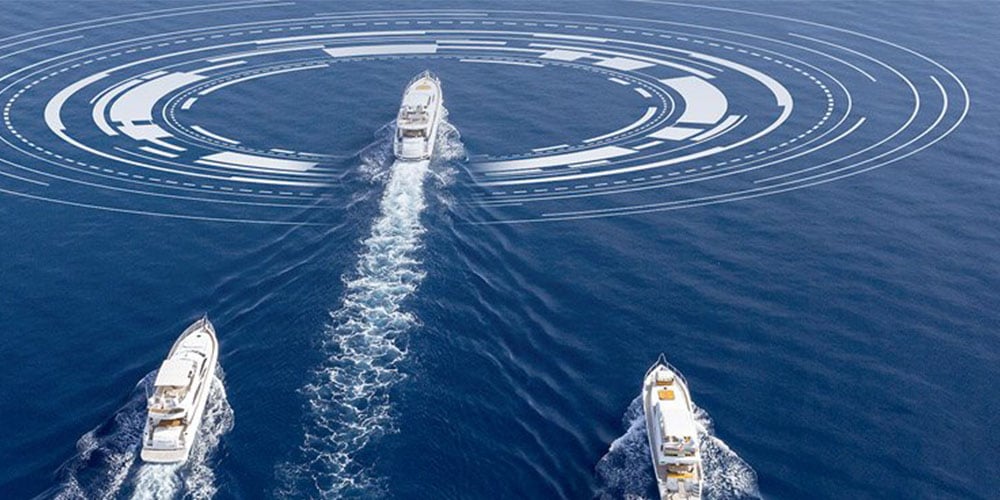
One of our customers wrote the following review that concisely sums up the value of radar:
“I use radar all day off the Oregon coast. Navigating a tricky bar in the fog is impossible without radar, and overlaying synced data on top of my chartplotter makes it much easier. Offshore, I can locate other fishing boats, large bird flocks, and obstructions while navigating and fishing. With multiple displays, you can overlay radar data and view it separately at the same time. I won’t go offshore without it.”
This sentiment is echoed by many experienced boaters, and radar is considered an essential navigation tool — particularly in low visibility conditions. In this article, we’ll walk you through the key considerations to help you find the right radar for your boat.
- Are Your Electronics Compatible with Radar?
- Do You Have a Powerboat or Sailboat?
- How Far Do You Need to See?
- Power Output
- Two Radar Technology Alternatives
- Pulse Compression Radar
- Radar Mounting and Installation
Are Your Electronics Compatible with Radar?
Compatibility is the first question to settle if you’re considering adding radar. In general, multifunction displays (MFDs) can operate a radar unit, while smaller or more basic combos — especially those intended for inland fishing applications — cannot. If you’re considering a whole new electronics suite or adding radar to your existing equipment, check compatibility first.
The most important compatibility rule in marine radar: radar sensors are brand-specific. Garmin radars work with Garmin GPSMAP displays. Raymarine radars work with Raymarine Axiom displays. Simrad, B&G, and Lowrance radars share the same Navico platform and are intercompatible, but do not work with Garmin or Raymarine displays. This means your MFD brand effectively determines your radar brand. If you’re building a new electronics suite, decide on the radar capability you want first and select an MFD ecosystem accordingly.
We carry radar from all the major manufacturers — Garmin, Raymarine, Simrad, Lowrance, and B&G — making it easy to find a unit compatible with your existing display.
Do You Have a Powerboat or a Sailboat? How Large Is Your Boat?
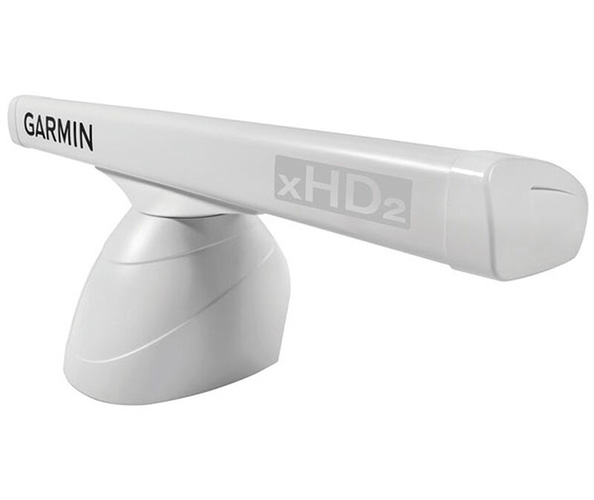
Garmin’s GMR xHD2 Open Array Radar is a high-powered pulse radar that easily networks with compatible Garmin displays.
Your boat type settles the fundamental choice between the two radar antenna formats: open array or radome.
Open arrays (where the rotating arm is visible, like on commercial vessels) have the widest antennas, the narrowest beamwidth (between 1.1° and 3.5°), the sharpest focus for picking out small targets, and the longest ranges. Open arrays are best for larger powerboats with radar arches or pilothouses. They are also used by serious anglers on smaller fishing boats who need precise long-range target discrimination to locate birds and fish schools.
Radomes enclose all moving parts inside an 18” or 24” dome. Horizontal beamwidths between 3.5° and 7° provide adequate resolution for most situations, though small adjacent targets at close range may be clumped together. Radomes are the better choice for walk-around fishing boats, RIBs, small cruisers, and sailboats. For sailors, the enclosed design is safe around halyards and sails because there are no external moving parts to snag rigging. Radomes also use less power than open arrays, an important consideration for cruisers generating their own power offshore.
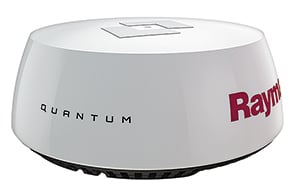
The Raymarine Quantum CHIRP Pulse Compression Radome connects to compatible Raymarine displays via Wi-Fi or a standard network cable.
How Far Do You Need to See?
How much range you need from a radar involves two factors and some genuine trade-offs. The first factor is height. Radar cannot see over the earth’s curved horizon, so the height of your antenna above the water surface and the height of the target you’re looking for jointly determine maximum detection range.
For those who want the math: the radar horizon formula is (1.22 nautical miles × square root of radar height in feet) + (1.22 nautical miles × square root of target height in feet). In practical terms, a radar antenna on a T-top nine feet above the water searching for a similarly sized boat also nine feet at the waterline gives a maximum geometric range of 7.3 nautical miles (1.22 × 3 + 1.22 × 3 = 7.32 nm). In practice, fiberglass reflects radar poorly, so you may need to be significantly closer before a fiberglass target appears on screen. Metallic targets — and especially those fitted with radar reflectors — will appear at much greater ranges.
The trade-off with height: mounting your radar higher extends maximum range, but it also increases the minimum detection range around your boat — the area immediately around the vessel where targets cannot be detected. If you are primarily looking for distant targets (fishing fleets, shipping traffic), higher is better. If your primary need is close-in navigation in a foggy harbor (seeing pilings, moored boats, channel markers at short range), a lower mount with better close-range performance may actually serve you better.
Power Output
More transmit power is generally better, but power is far less important than antenna height, target height, and the target’s radar reflectivity. Where power matters most is in poor weather: fog, drizzle, and rain absorb microwave energy and reduce range. Higher transmit power partially compensates for this absorption.
Outputs for traditional pulse-style recreational radars range from 4 kW to 25 kW. A 4 kW radar typically has a rated maximum range of 48 nautical miles. Solid-state radars transmit at far lower wattage — the Garmin Fantom series transmits at 40 watts compared to 4,000 watts for a small traditional pulse radar — but achieve comparable or better performance through signal processing rather than brute transmit power.
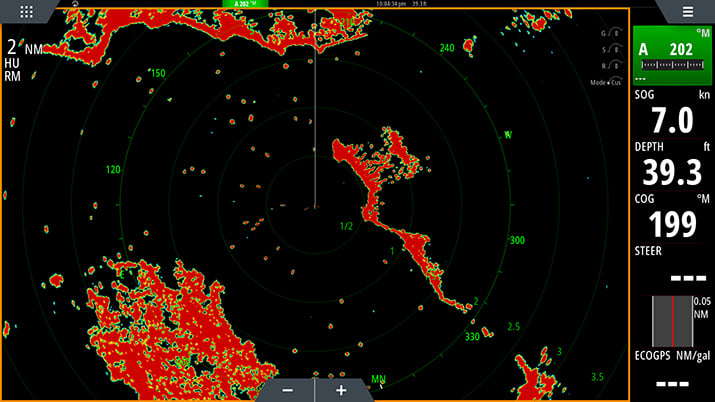
Simrad NSS evo3 radar on 2 nautical mile range setting.
Two Technology Alternatives
The fundamental technology choice in marine radar is between traditional pulse radar and solid-state radar (also called broadband, FMCW, or pulse compression radar depending on the implementation).
Traditional pulse radars use high-powered magnetrons to generate microwave signals in very short bursts. The time between pulse transmission and echo return determines target distance. Solid-state X-band radar uses FMCW (Frequency Modulated Continuous Wave) or pulse compression techniques — technology long used in military radar and now standard in recreational marine equipment.
Solid-state broadband radar transmits a continuous wave with linearly increasing frequency. The wave retains its frequency as it travels outward and reflects back. Meanwhile, the transmitter continues outputting an increasing frequency. The difference between the currently transmitted and received frequencies — coupled with the known rate of frequency increase — allows precise calculation of target distance. Because FMCW continuously builds up radar return energy rather than relying on a single pulse, it delivers superior close-range target detection while transmitting at far lower power levels.
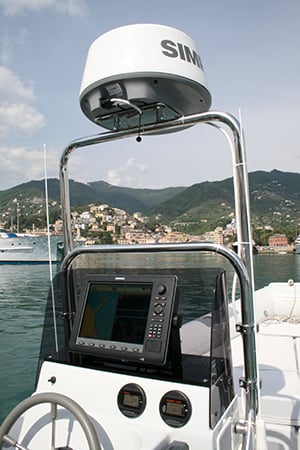
Simrad Broadband 4G™ Radar
Solid-state radar offers the following advantages over traditional pulse radar:
- Low RF transmission for safe, flexible installation: Solid-state radar transmits at very low power. The Garmin Fantom series transmits at 40 watts, compared with 4,000 watts for a small traditional pulse radar. This allows mounting in locations that were not possible with high-powered units. The Navico Broadband 4G, used by Simrad, Lowrance, and B&G, emits less radiation than an average cell phone. Low DC power draw makes solid-state radar well suited for sailboats and other power-limited vessels.
- Improved short-range target discrimination: Solid-state radar provides better target resolution at close range, including at 1/32 nm. Docks, channel markers, and moored vessels are displayed with clarity and separation. Solid-state broadband radar also eliminates the “main bang” dead zone of pulse radar — the obscured area immediately around the vessel that prevents detection of close targets.
- Instant-on operation: No warm-up time. Traditional magnetron radars require 2 to 3 minutes to warm up before they can transmit. Solid-state units are ready immediately. This makes them ideal for sailboats wishing to conserve power, or any boat wanting radar on demand when fog rolls in.
- Maximum range now comparable to conventional pulse radar: Early solid-state radars were limited to shorter ranges, but the gap has closed substantially. Navico’s Halo series offers maximum ranges from 20 nautical miles for the Halo 20+ radome to 72 nautical miles for the 6-foot Halo-6 open array. Garmin’s Fantom series open arrays are also rated to 72 nautical miles.
Pulse Compression Radar
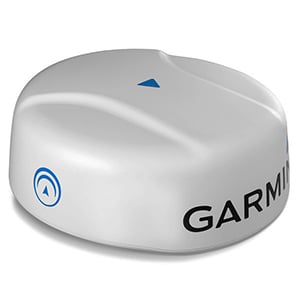
Garmin’s Fantom™ Pulse Compression Radar uses the Doppler effect to highlight fast-moving targets.
Pulse compression radar represents a hybrid between traditional pulse radar and solid-state FMCW technology. Rather than transmitting a single high-power pulse (traditional) or a continuous wave (pure FMCW), pulse compression radars transmit a longer, coded pulse that is mathematically compressed on reception to deliver excellent range resolution at relatively low power.
The Simrad Halo radar series uses solid-state electronics to produce low-power pulsed frequency-swept transmissions — the radar equivalent of CHIRP sonar technology. Halo claims maximum ranges of 48 nautical miles for a 3-foot array, 64 nautical miles for a 4-foot array, and 72 nautical miles for a 6-foot array. For more technical detail on how Halo radar works, see our companion West Advisor on new radar technology.
Garmin’s Fantom Pulse Compression Radar, available in 18-inch radome and 4-foot (Fantom 54) and 6-foot (Fantom 56) open array sizes, is likewise rated to 72 nautical miles at the open array sizes. Fantom uses the Doppler effect — called MotionScope™ Technology by Garmin — to detect and highlight moving targets, distinguishing fast-moving vessels, approaching weather cells, and bird flocks from stationary returns.
Doppler capability is now available across all major brands: Garmin MotionScope (Fantom series), Simrad VelocityTrack (Halo series), and Raymarine Doppler (Quantum 2). The technology color-codes approaching and receding targets on the display, giving you at-a-glance situational awareness about which contacts represent potential collision threats.
Mounting and Installation
Other Articles on Marine Radar Technology
Once you’ve chosen your radar, placement is critical for maximum range, safe operation, and minimum blind spots. The antenna must be mounted above head height since direct exposure to the electromagnetic energy emitted by a traditional pulse radar antenna can be harmful. (This warning applies less strongly to low-emission solid-state units.) The ideal location — usually the highest practical point on a powerboat — gives the radar an unobstructed 360° view. Avoid mounting near large masts, horizontal spreaders, stacks, or other solid objects, as they create shadows, reflections, and blind sectors.
Streamlined mounting struts from Seaview provide a clean way to raise the radar above spotlights, horns, or other hardware. Radars have a vertical beamwidth of approximately 25°, so a level-mounted antenna projects the beam downward about 12.5°. Planing-hulled boats that run with the bow raised may need to shim the back of the mount so that close-in targets ahead of the boat are not lost below the beam.
Sailboat radars are typically mounted on the front face of a mast, on a dedicated radar mast, or on a backstay bracket. Seaview self-leveling mounts keep the dome level regardless of angle of heel, maintaining full sideways coverage even when the boat heels beyond 12.5°.
Wiring is straightforward. A dedicated circuit from the distribution panel, sized between AWG 7 and 16 depending on the radar’s draw, typically protected by a 10–30A breaker, provides power. Small radome units receive power through the display via a multi-conductor cable. Open array radars often have a separate DC power cable for the antenna. Other connections include an electronic compass and GPS or other network cables. Raymarine’s Quantum radome offers the simplest installation for compatible displays, connecting via Wi-Fi or a standard network cable with no additional cabling required.
Installing radar provides peace of mind when boating in difficult conditions. Tuning on modern radars is largely automatic, and the learning curve is reasonable. Choosing the right antenna location is the critical decision; the installation itself is within the skill range of most handy boat owners.
Marine Radar FAQs
What is marine radar and what does it actually detect?
Marine radar transmits microwave radio waves and detects the energy that reflects back from objects: other vessels, coastlines, channel markers, weather cells, and flocks of birds. It displays these returns on a screen as contacts at measured distances and bearings from your position. Unlike a camera or binoculars, radar works in complete darkness, heavy fog, rain, and any other condition that blocks visible light — which is precisely when it is most valuable.
What is the difference between a radome and an open array radar?
A radome encloses the antenna inside a sealed plastic dome, making it compact, easy to mount, and safe around rigging. An open array has the rotating antenna exposed, which provides a wider aperture, narrower beamwidth, sharper target discrimination, and typically longer range. Radomes are the right choice for most recreational boats under 40 feet and all sailboats. Open arrays are the right choice for larger powerboats, pilothouse vessels, and serious offshore fishermen who need maximum range and resolution.
What is the difference between pulse radar and solid-state radar?
Traditional pulse radar uses a magnetron to transmit high-power microwave pulses (4,000–25,000 watts). Solid-state radar uses digital signal processing to achieve comparable or better performance at far lower power (20–50 watts). Solid-state radar starts instantly (no warm-up), has better close-range target detection, uses less battery power, and allows safer mounting locations. The main historical disadvantage of solid-state — shorter maximum range — has largely been eliminated in modern designs, with current solid-state units now matching traditional pulse radar at ranges up to 72 nautical miles.
What is Doppler radar technology in a boat radar?
Doppler processing measures the frequency shift of returning radar signals to determine whether a target is moving toward or away from you, and how fast. This is displayed as color-coding on the radar screen: approaching targets in one color, receding in another. It gives you immediate visual identification of which contacts represent potential collision threats vs. stationary objects like anchored boats or buoys. Garmin calls this MotionScope, Simrad calls it VelocityTrack, and Raymarine incorporates it in the Quantum 2. Doppler processing is now available across all major brands’ current radar lines.
Does radar work in fog and rain?
Yes — radar is effective in fog, rain, and other conditions that block visible light. This is its primary advantage over visual navigation. However, heavy rain and very dense fog do absorb some radar energy and reduce effective range. Higher transmit power helps partially compensate. In rain, modern radars include rain clutter rejection processing that filters out the diffuse rain return to reveal the sharper contacts of vessels and coastlines within it.
Can I see birds on boat radar?
Yes. Many experienced anglers use radar specifically to locate concentrations of feeding birds, which indicate bait fish concentrations below the surface and therefore potential game fish. Open array radars with narrow beamwidths and high resolution are more effective for bird detection at range than radomes. Doppler processing is also useful here, as moving bird flocks show up distinctly from stationary targets.
Does radar require a license to operate?
In the US, operating marine radar on a recreational vessel does not require a specific radar operator license. However, if you operate a radar on a vessel that also has a ship station license (required for vessels operating internationally or in certain commercial categories), the radio operator who uses the station should hold an FCC Restricted Radiotelephone Operator Permit at minimum. For purely recreational domestic use, no special license is required. Check requirements for the specific waters you operate in if sailing internationally.
How do I know which radar is compatible with my chartplotter?
Marine radar sensors are brand-specific: Garmin radars require Garmin GPSMAP displays, Raymarine radars require Raymarine Axiom displays, and Simrad/B&G/Lowrance radars are intercompatible within the Navico platform but do not work with Garmin or Raymarine. If you are adding radar to an existing electronics suite, you must match the radar brand to your MFD brand. If you are building a new system, select the brand ecosystem first and choose compatible components throughout.
Browse All Marine Radar & Electronics
- Chartplotters, GPS units, radar systems, and integrated navigation displays
- Sonar, CHIRP, downscan, and fish-finding electronics
- Marine stereos, speakers, amplifiers, and audio accessories
- VHF radios, AIS, satellite communication equipment
- Autopilot systems and steering control components
- Wind, depth, speed, and multifunction instruments
- Marine binoculars for navigation and low-light use
- Thermal and night-vision devices for situational awareness
- Onboard monitoring and security systems
- Magnetic and electronic compasses
- Paper and electronic navigation charts
- Regional cruising and harbor guides
- Traditional navigation plotting tools
Need More Help?
West Marine is the perfect place to get set up with the right radar for your boat. With knowledgeable associates in store and online, we can help you match a radar to your existing electronics and your specific use case. Find your store here.