Imagine hauling your boat out of the water, only to find mysterious bubbles scattered across its hull. These unsightly bubbles aren’t just cosmetic; they’re signs of a deeper problem that can damage your boat over time. Boat blisters, caused by water seeping through the gelcoat into the fiberglass laminate, can lead to weakening and delamination. But don’t worry — with the right knowledge and a little effort, you can repair and protect your boat from this sneaky foe. Here's what you need to know about what causes blisters and how to fix them.
- What are fiberglass blisters and how do they occur?
- More About Blisters
- What Barrier Coats Do
- How Barrier Coats Work
- Regularly Inspect Your Boat’s Hull for Blisters
- Should You Just Repair the Blisters?
- How to Prep Your Hull for a Barrier Coat
- Applying the Barrier Coat
- Which Barrier Coat System is Best?
- Epoxy Barrier Coat FAQ
- Glossary of Terms
- Conclusion
- We're Here to Help!
- Related Articles
What are fiberglass blisters and how do they occur?
Osmotic blistering generally occurs in fiberglass boats that are five or more years old, especially those that are kept in warm waters. Blistering is caused by a complex chemical reaction involving water, gelcoat, uncured resin and time.
In short, blisters are bubbles of seawater drawn through the gelcoat to small pockets of uncured resin in the laminate by osmotic pressure. Uncured resin and seawater undergo a chemical reaction inside the laminate, as osmotic pressure tries to equalize the concentrations of chemicals inside and outside the hull. More and more water is drawn in through the gelcoat, eventually causing the gelcoat or lay-up to delaminate.
Whan a boat that spends most of its time in the water is hauled for a new coat of bottom paint, it is common to find hundreds of blisters on an otherwise smooth hull. The solution to this dilemma is to dry the hull, fix the blisters, coat the hull with a waterproof barrier coat, and reapply the bottom paint. Barrier coats must be applied to the bare hull, underneath all other bottom coatings.
More About Blisters
On a fiberglass boat, the exterior surface of the hull is gelcoat, a pigmented polyester (usually) resin that gives fiberglass its shiny appearance. Underneath the gelcoat are layers of fiberglass fabric and resin which form a strong, slightly flexible, nearly moisture impervious laminate, which is affordable and easy to build.
We say nearly moisture impervious because gelcoat is not a perfect barrier. In the warm waters of Florida, the Gulf States, Southern California, and elsewhere, water can invade the fiberglass laminate at a controlled and predictable rate. Although not always a warm water phenomenon, the vast majority of serious blister problems occur in elevated sea temperatures (50% versus 10% in cold water).
Water intrusion seems to be much more commonplace in dirty laminations where there is foreign matter in the layers, or where there are pockets of incompletely catalyzed resin. However, even a perfect laminate can absorb 3% water, while poorly constructed laminates might absorb 9–10%.
The water that passes through the surface will begin to dissolve the chemicals in small voids in the laminate, which causes a high concentration of chemicals in the water that is trapped in these voids. More and more water will try to enter these voids, to attempt to lower the chemical concentration and make it equal with the seawater outside the hull. Water passage through the laminate barrier is called osmosis, and this process causes blisters to form inside the hull laminate.
Pressures build and the blisters grow in width and height. They eventually delaminate the hull, and the water begins to wick along fiberglass strands and spread to other pockets of resin. This process does not get better by itself — it gets worse with time until either the boat’s hull is destroyed, or the blisters are fixed.
What Barrier Coats Do
Barrier coating systems help seal gelcoat and fiberglass laminates by increasing the moisture exclusivity of the hull surface, creating a water “barrier” and helping prevent the formation of blisters.
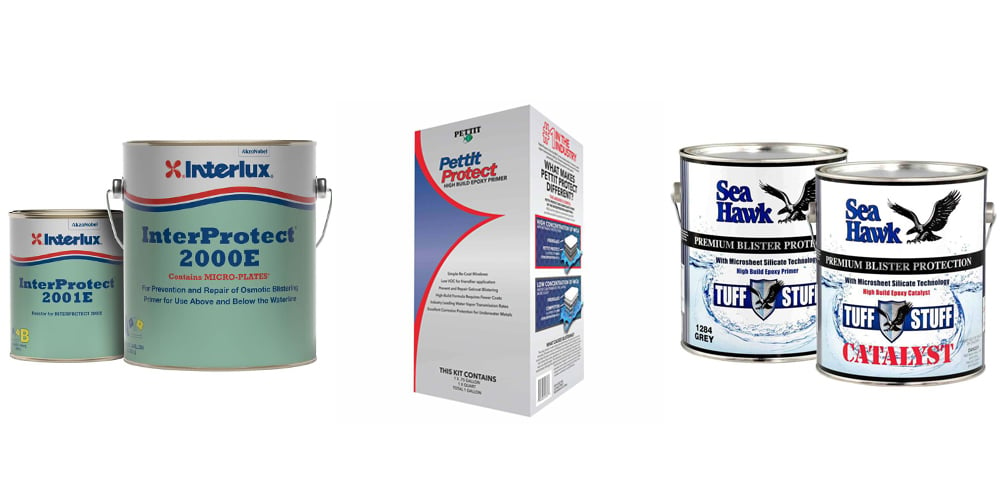
Bottom paint manufacturers such as Interlux, Pettit and Sea Hawk and manufacturers of epoxy coatings such as WEST System, offer a variety of barrier coating systems that work well.
How Barrier Coats Work
Barrier coat compounds rely on a dense molecular structure to prevent the migration of water molecules into the gelcoat. Some products add an additional physical barrier in the form of mica or glass flakes to the chemical barrier formed by the epoxy matrix. The additives and dense epoxy matrix help eliminate a direct path for water migration.
Regularly Inspect Your Boat’s Hull for Blisters
Regular physical inspection of your boat’s hull is the best way to detect the formation of blisters before the problem becomes serious. Blisters require prompt treatment, and a good time to address the issue is at the time of your boat’s seasonal haulout or bottom paint job.
Besides the appearance of the blisters, the following bad things can also happen:
- The hull increases in weight due to the absorbed water.
- The hull gets weaker from the delamination.
- The hull becomes slow due to its rough surface.
Interestingly, the moisture in the inside of the hull can contribute too. This is why keeping your boat’s bilge dry and the moisture in the interior low, can also help prevent blisters.
To be effective, a barrier coat must have a high moisture exclusion effectiveness, be easy and safe to apply, and must have good adhesion with the base material.
Should You Just Repair the Blisters?
When your boat is hauled out, you might notice a few isolated blisters on the hull or rudder, but overall, the gelcoat looks smooth with no significant damage. In these cases, you might wonder if it’s necessary to go through the time and expense of applying a barrier coat or if you can simply fix the blisters and hold off on the barrier coat for now.
Here’s what to consider:
- Short-Term Use or Seasonal Boats: If your boat is only in the water seasonally or spends extended time in dry storage, many owners choose to repair the blisters and apply fresh bottom paint without a barrier coat. For these boats, the risk of new blisters forming is generally lower, making this a reasonable option.
- Frequent or Long-Term Immersion: On the other hand, boats that stay in the water for long periods — like liveaboards or those moored year-round—are much more susceptible to osmotic blistering. For these vessels, applying a barrier coat is a wise investment, helping to prevent future blisters and costly repairs.
Ultimately, the decision comes down to how you use your boat and how much risk you’re willing to take. If your boat spends most of its time in the water and has a history of blistering, applying a barrier coat is the best way to protect your investment and avoid headaches downline.
How to Prep Your Hull for a Barrier Coat
To prepare a new fiberglass boat that lacks a blister barrier coat, follow this procedure:
- If there is no paint, wipe down the hull with solvent wash to remove all traces of mold release agent. Interlux 202 Fiberglass Solvent Wash and Sea Hawk S-80 Wax 'n' Grease Killer both work well for this purpose.
- Any/all bottom paint must be removed by sandblasting or sanding, leaving a rough (50-grit paper) surface.
To prepare an already blistered hull, follow this procedure:
- As soon as the boat is hauled (absolutely the same day), scuff-sand the hull to locate the blisters. This will remove any existing bottom paint from the tops of the blisters and make them easy to see.
- Open each blister by sanding or grinding. Grind away all delaminated material. Continue until all blisters have been opened and drained. This can be done with small, high-speed sanding discs.
- After all blisters have been removed down to the solid laminate, remove bottom paint on the rest of the hull. Rough-sand the surface to facilitate resin adhesion.
- Wash with fresh water and let dry. Dry hulls should be left for two weeks. Saturated hulls must be left longer. If a blistered hull is hauled for the winter, wait until spring. The hull must be completely dry before proceeding. Removing the entire gelcoat, whether damaged or not will speed drying at the expense of “unfairing” of the hull.
Filling/Repairing the Blisters
- Wet out the blister pockets with unthickened resin/hardener mixture, suing a roller cover or a glue brush. Brush out bubbles and roller marks using a roller cover brush.
- While the resin is still wet, prepare a low-density filler mixture or epoxy fairing compound to trowel into the blister pockets. Squeegee the filler in place and remove excess compound. Sand when cured. The more care you take in filling the voids, the less fairing and other work you’ll have when it cures.
- Using a resin spreader, fill low areas with filler mixture to insure fairness. This is especially true if you have removed the entire gelcoat.
- Sand between filling coats with #80 grit paper and remove all dust before coating.
Applying the Barrier Coat
- Remove all sanding residue by solvent washing the entire hull. We suggest Interlux 202 Fiberglass Solvent Wash or Sea Hawk S-80 Wax 'n' Grease Killer for this purpose.
- Apply three to six coats of the epoxy barrier coat mixture, according to the manufacturer’s instructions. To achieve the desired moisture exclusion, most manufacturers recommend at least 10 mils (0.010 inches) of protective epoxy coating when dry. As epoxy dries it contracts, so the wet film thickness must be approximately double the desired dry film thickness. Some brands have a higher volume of solids, which tends to result in application of fewer coats.
- Most barrier coats can be applied “wet-on-wet,” meaning the next coat can be applied while the previous coat is still in its initial cure stage. Wet-on-wet application creates a chemical link between the two coats, which is the strongest type of bond. If the resin cures between coats, sand lightly with #80 grit paper before recoating to form a good mechanical bond between layers.
- Before applying bottom paint, wait 24 hours after the last coat of resin has been applied. Scrub the surface with water and a medium-coarse scrub pad, or wet sand with #80–180 grit sandpaper for proper bottom paint adhesion. Scrubbing or sanding is necessary to remove amine blush, a by-product of the curing process, which forms a waxy film on the cured surface and inhibits adhesion. The surface should appear dull before applying other coatings — take care not to sand off too much epoxy.
Which Barrier Coat System is Best?
West Marine offers barrier coating systems by Interlux, Pettit and Sea Hawk. Since repairing or preventing a blistered bottom and applying a barrier coat system involves considerable time and expense, the question everyone asks is, “which barrier coat product is best?” The answer, unfortunately, is that nobody knows. At least, we’ve never seen definitive results of any test that show one product to be clearly superior. The problem is that testing barrier coats is extremely difficult.
Since all barrier coat systems are designed to prevent moisture penetration over a prolonged period, it takes an inordinate amount of time to achieve measurable results. As far as we can tell, each of the products we offer can provide satisfactory results provided the manufacturers’ recommendations and guidelines for proper preparation and application are followed.
Epoxy Barrier Coat FAQ
Q: What is an epoxy barrier coat, and why is it necessary?
A: An epoxy barrier coat is a protective coating applied to a boat's hull to prevent water absorption and the formation of osmotic blisters. It's typically used on to seal the hull of fiberglass boats that are stored “wet” in the water.
Q: How does an epoxy barrier coat protect against osmotic blisters?
A: Osmotic blisters form when water penetrates the gelcoat and reacts with the hull’s materials. The epoxy barrier coat creates a watertight seal, preventing water from reaching the fiberglass, thus stopping the blistering process.
Q: How many coats of epoxy are recommended for an effective barrier?
A: Most manufacturers recommend applying between 4 to 6 coats of epoxy barrier paint to achieve the necessary thickness for optimal water protection, typically around 10-15 mils of dry film thickness.
Q: Can I apply an epoxy barrier coat to an old boat hull?
A: Yes, you can apply an epoxy barrier coat to an older boat, but proper surface preparation is crucial. This involves removing all of the old antifouling paint, cleaning, sanding, and ensuring the hull is dry and free from contaminants.
Q: What is the difference between an epoxy barrier coat and a gelcoat?
A: Gelcoat is a smooth, pigmented polyester coating that forms the outer surface of most fiberglass boats. It is more porous than epoxy, and is susceptible to water absorption over time. An epoxy barrier coat is applied over the gelcoat surface to create a waterproof barrier against water absorption and the formation of osmotic blisters.
Q: Can I apply bottom paint over an epoxy barrier coat?
A: Yes, bottom paint can be applied over an epoxy barrier coat. In fact, this is the standard practice to provide both water protection (from the barrier coat) and antifouling protection (from the bottom paint).
Q: What is the drying time between coats of epoxy barrier paint?
A: Drying times vary depending on the product and environmental conditions like temperature and humidity. Generally, epoxy coats need about 3 to 6 hours between applications, but it's essential to follow the manufacturer’s recommendations.
Q: Can I use an epoxy barrier coat on a wooden or metal hull?
A: Epoxy barrier coats are primarily designed for fiberglass hulls, but they can also be used on wood and metal surfaces with proper surface preparation. On wooden boats, the epoxy helps seal the wood, while on metal boats, it provides corrosion resistance.
Q: How do I know if my boat hull needs an epoxy barrier coat?
A: If your boat is showing signs of osmotic blisters, water absorption, or the gelcoat is deteriorating, applying an epoxy barrier coat may be necessary. If you're unsure, consult a marine surveyor or contact a boatyard professional for advice.
Q: Can I apply an epoxy barrier coat myself, or should I hire a professional?
A: Applying an epoxy barrier coat can be a DIY project if you're comfortable with detailed surface preparation and painting. However, if the hull requires significant prep work or if you're concerned about the outcome, it may be best to hire a professional to ensure proper application.
Glossary of Terms
Antifouling Paint: A protective coating applied over the barrier coat to prevent the growth of marine organisms like barnacles and algae. The barrier coat must be fully cured before antifouling paint is applied.
Barrier Coat: A protective layer of epoxy applied to a boat’s hull to prevent water absorption and the formation of osmotic blisters. It acts as a waterproof shield, typically applied before antifouling paint.
Blister Repair: The process of grinding out and repairing osmotic blisters before applying a barrier coat. This includes drying out the affected areas and filling them with epoxy filler to restore hull integrity.
Cure Time: The amount of time required for the epoxy barrier coat to fully harden. Proper curing is essential for achieving maximum waterproofing and protective properties.
Dew Point: The temperature at which moisture in the air condenses on surfaces, including the boat’s hull. It’s important to ensure that the surface temperature of the hull is above the dew point before applying the barrier coat to avoid moisture contamination.
Epoxy Compatibility: The ability of epoxy barrier coats to bond with various substrates, including fiberglass, wood, and metal. Ensuring compatibility is key to creating an effective barrier against water.
Epoxy Primer: A specially formulated primer that bonds the epoxy barrier coat to the hull surface. It enhances adhesion between the hull and the barrier coat and helps seal imperfections in the gel coat.
Epoxy Resin: A synthetic polymer used in the formulation of barrier coats. It has strong adhesive properties, is waterproof, and creates a durable, protective layer to prevent moisture intrusion.
Fairing Compound: A thick, spreadable epoxy resin mixture used to smooth out surface imperfections or voids in the hull before applying the barrier coat. It ensures an even, level surface for better protection and paint application.
Fiberglass Laminate: The reinforced material made from layers of glass fibers bonded with resin, forming the structural hull of most boats. This laminate is vulnerable to water absorption without protective coatings.
Gel Coat: A thin, smooth outer layer of resin applied to the hull's surface. While it adds aesthetic value and some water resistance, gel coat alone does not provide full protection against water absorption.
Hull Preparation: The critical process of cleaning, sanding, and fairing the hull before the barrier coat is applied. Proper preparation ensures the barrier coat adheres correctly and provides effective water resistance.
Hydrophilic Materials: Substances within the hull laminate that attract and absorb water, contributing to osmosis and blistering. Epoxy barrier coats are designed to seal these materials, preventing water ingress.
Mil Thickness: The measurement of the thickness of the applied barrier coat. A sufficient mil thickness is required for optimal protection, usually achieved through multiple layers of epoxy.
Osmosis: The process by which water molecules penetrate through the hull's gel coat, leading to water absorption into the laminate. Over time, this can cause blistering and structural damage to the hull.
Osmotic Blisters: Bubbles or blisters that form on a boat's hull due to the absorption of water into the fiberglass laminate. They result from osmotic pressure and can cause damage to the hull if not properly treated.
Solvent: A liquid used to clean the hull surface before barrier coat application. Proper solvent cleaning ensures the removal of oils, waxes, and contaminants, allowing for better adhesion of the barrier coat.
Substrate: The surface of the boat’s hull (fiberglass, wood, or metal) to which the barrier coat is applied. Proper preparation of the substrate ensures good adhesion and effective protection from water.
Water Absorption: The process by which water seeps into the porous structure of the boat's hull, particularly through cracks or imperfections in the gel coat. Water absorption is the primary cause of osmotic blistering.
Wet Sanding: A method used to smooth the surface of the barrier coat using water and fine-grit sandpaper. Wet sanding helps create a uniform, smooth surface for the next layer of epoxy or antifouling paint.
Conclusion
If you’re feeling a bit overwhelmed, here’s a quick recap of this article's main points. Boat blisters form when seawater seeps through the gelcoat into the fiberglass, causing reactions between water and uncured resin. This leads to blistering and can even result in hull delamination. Boats in warm waters are especially vulnerable, and the problem gets worse over time.
A barrier coat creates a waterproof seal to prevent water intrusion and new blisters. Regular inspections help catch blisters early, and surface prep — drying, sanding, and cleaning the hull — is crucial before applying multiple layers of epoxy. Blister repair involves opening the blisters, removing damaged material, and applying fairing compounds before sealing with a barrier coat.
We're Here to Help!
West Marine is your one-stop shop for everything to keep your boat in top shape and ready for adventure. From essential maintenance supplies to the latest gear, we have it all. With a vast online selection and over 230 stores, West Marine offers the gear and expertise you need for smooth sailing and great times on the water. Use our handy store locator to find a West Marine store near you.