Fishing Nets, Crabbing Pots, and Lobster Traps: Gear for Landing and Harvesting
Catching a fish on the line is only half the battle—landing it, holding it, and handling it correctly is where the right gear makes the difference between a successful outing and a frustrating one. Fishing nets, crabbing pots, and lobster traps are the tools that complete the harvest: they help you land fish cleanly without damage, secure crabs and lobsters efficiently, and handle your catch in a way that keeps everything fresh and usable from the water to the table. West Marine carries a complete selection of landing nets, cast nets, bait nets, crabbing gear, and lobster traps built for durability and real-world performance—from freshwater lakes to offshore marine environments.
Fishing Nets: Land Every Fish You Hook
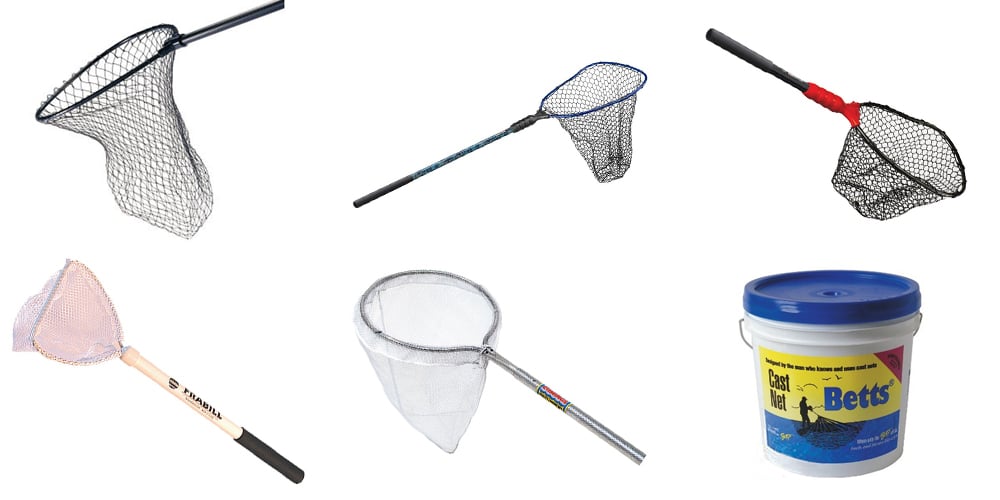
A quality fishing net is one of the most overlooked yet most impactful pieces of gear on any boat or pier. More fish are lost in the final moments of the fight than at any other point—the fish sees the boat, surges, and throws the hook before the angler can control the situation. A net eliminates that window entirely. It also protects fish designated for release by allowing them to be unhooked in the water with minimal handling, and it gives you a stable, controlled way to lift and hold a large fish without putting excessive stress on the line or the rod.
West Marine carries several net types, each designed for a specific application. Matching the right net to your fishing style and target species is just as important as choosing the right rod and reel.
Types of Fishing Nets
Landing Nets
Landing nets are the standard fish-landing tool for boat anglers, pier fishermen, and bank fishermen alike. A good landing net has three elements working in concert: the hoop size (should be large enough to accommodate the fish you’re targeting without forcing it to fold), the handle length (longer handles reach further over gunwales, seawalls, and high pier railings), and the mesh material (rubber-coated or knotless mesh significantly reduces hook tangles and protects a fish’s slime coat for catch-and-release).
- Telescoping handles collapse for easy storage on kayaks and small boats, extending when needed for reach over the side
- Rubber-coated mesh prevents hook points from tangling in the net during the netting process—critical when using treble-hook lures on bass or inshore species
- Floatable frames ensure the net remains recoverable if it goes overboard—a practical feature for kayak and small-boat anglers
- Hoop size selection: 18–22 inch hoops for trout and inshore species; 24–30+ inch hoops for larger inshore fish, bass, and nearshore species that require a larger opening to net efficiently
For larger offshore fish where a net is impractical, pair your landing setup with a quality fishing gaff—the standard tool for boating large pelagics, grouper, and other offshore species that are too large or too heavy to net.
Cast Nets
Cast nets are circular throw nets with weighted edges that spread open in flight and sink quickly to trap baitfish underneath. Mastering the cast net is a fundamental skill for inshore and nearshore saltwater anglers who rely on live bait—pilchards, mullet, menhaden, and sardines—as their primary fishing presentation. A live well full of fresh-caught baitfish consistently outperforms frozen or store-bought bait for virtually every inshore saltwater species, and a cast net is how you fill it.
- Diameter: Measured as the radius when fully open—a 6-foot cast net opens to a 12-foot circle. Larger diameters cover more water per throw but require more strength and technique to throw correctly. Most inshore anglers use 6–8 foot nets.
- Mesh size: Smaller mesh (3/8 inch or less) captures small baitfish like pilchards and scaled sardines without letting them escape. Larger mesh (3/4 inch to 1 inch) is used for larger bait like mullet and menhaden.
- Weight per foot: Heavier lead lines sink the net faster, keeping bait from escaping under the edges before the net closes. For deep water or strong current, choose a heavier weight-per-foot rating.
- Learning to throw: A proper cast net throw requires practice. The most common method involves folding the net over the forearm, holding the horn in the throwing hand, and using a full body rotation to open the net in a flat circle. Consistent practice on dry land before attempting on the water dramatically accelerates skill development.
Keep your live bait alive and active after catching it with a quality bait tank and aerator pump—healthy, frisky live bait significantly outproduces stressed or sluggish bait in almost every situation.
Bait Nets
Bait nets are small, fine-mesh nets used to transfer live baitfish from the bait tank to the hook without stressing or injuring them. Speed and gentleness are the priorities: a slow, clumsy scoop that chases baitfish around the well stresses the entire live well and degrades bait quality quickly. A purpose-built bait net with a lightweight frame and fine mesh completes the transfer in seconds with minimal impact on the baitfish.
- Lightweight frames allow one-handed scooping with minimal disruption to the live well
- Fine mesh prevents scale loss and gill damage that reduces bait lifespan and presentation quality
- Compact size stores flat in deck compartments and live well lids without taking up space
Cages, Baskets, and Bait Buckets
Fishing cages, wire baskets, and bait buckets are used to temporarily hold live fish, crabs, or bait in the water alongside your fishing location. Submerged wire baskets keep fish alive and fresh for extended periods—far longer than a cooler without ice—making them ideal for multi-hour fishing sessions from piers, docks, and anchored boats where you want to keep your catch alive until heading in. Pair with a kill bag for transport and storage after leaving the water.
- Corrosion-resistant wire and coated construction withstand constant saltwater immersion without degrading
- Collapsible designs fold flat for storage on small boats, kayaks, and in dock boxes
- Top-access openings allow easy fish retrieval without fully opening the basket and risking escapes
Crabbing Pots and Traps: Strategy Meets Patience
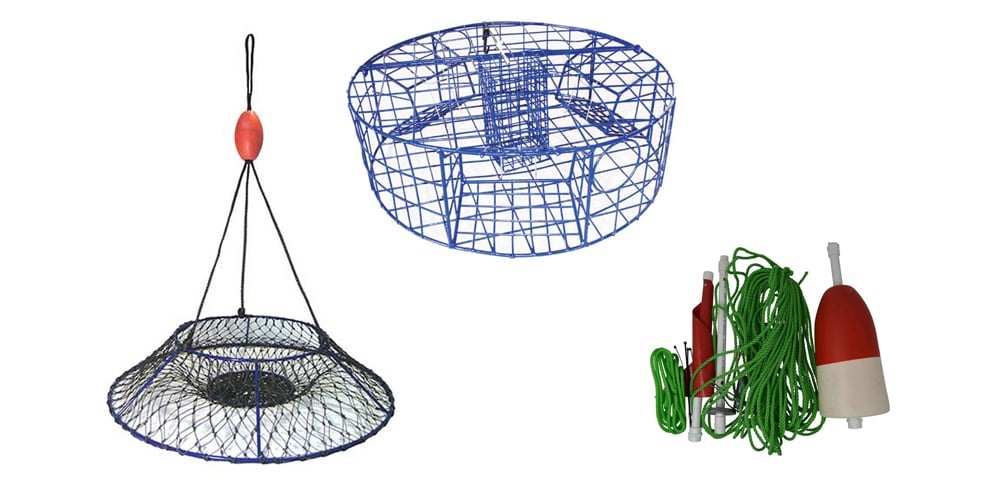
Crabbing is one of the most accessible and rewarding forms of coastal harvesting—requiring minimal equipment, little technical skill to get started, and delivering one of the finest seafood results available. Blue crabs, Dungeness crabs, and stone crabs are all catchable with the right traps and technique, and the experience of pulling a heavy pot and seeing it full of crabs is genuinely satisfying. Success comes down to three variables: location, bait, and timing. Set your pots in moving water near structure—dock pilings, bridge supports, channel edges—use fresh, oily bait that produces a strong scent trail, and check your pots on a regular schedule appropriate to your gear type.
Types of Crabbing Gear
Ring Nets and Hoop Traps
Ring nets are the most beginner-friendly crabbing option and the standard choice for dock, pier, and bridge crabbing. A ring net consists of two wire rings connected by mesh—the bait is placed in the center, the net is lowered flat to the bottom, and crabs walk onto the flat net to reach the bait. When pulled, the outer ring collapses upward, trapping crabs inside. Ring nets are extremely portable, require no special setup, and work well for quick-check crabbing outings where you pull the net every 10–15 minutes.
- Collapsible design stores flat and deploys in seconds from a dock or pier railing
- Works best in shallow to moderate depths (6–20 feet) with a clear pull-up path
- Multiple nets can be deployed simultaneously to increase catch rate during active crab feeding windows around tide changes
Crab Pots and Box Traps
Crab pots are enclosed wire traps that crabs enter through funnel-shaped openings but cannot exit once inside. They are designed for longer soak times—typically several hours to overnight—and are the preferred tool for anglers targeting blue crabs, Dungeness, and other commercial-priority species. The enclosed design prevents crabs from escaping between checks, making them significantly more efficient per unit of effort than ring nets over extended periods.
- Vinyl-coated wire construction resists corrosion and protects the crab’s shell during capture and handling
- Top-access doors make retrieving crabs and rebaiting straightforward without dismantling the trap
- Escape rings on quality traps allow undersized crabs to exit, supporting responsible harvesting and compliance with local size regulations
- Marker buoys: Always mark deployed pots with a visible buoy on a separate line long enough to account for tide rise. This marks your pot’s location, prevents other vessels from fouling on your line, and is required by law in most crabbing jurisdictions.
Bait Holders and Crabbing Accessories
Bait containment inside your crab pot directly affects how effectively the pot attracts crabs. Loose bait drifts out of the pot or gets consumed quickly without drawing crabs fully inside. Bait holders—perforated plastic or wire containers that secure bait in the center of the trap—disperse scent consistently over a longer period, drawing crabs from further away and keeping them working the pot longer. Fresh chicken necks, oily fish frames, and bunker (menhaden) are among the most productive crab baits. Change bait after each check for maximum effectiveness.
Lobster Traps: Patience Meets Payoff
Lobstering is a pursuit that rewards methodical anglers willing to invest in proper equipment and learn the habitat and behavior of their target. From the cold rocky bottoms of Maine and Massachusetts to the warm shallow channels of the Florida Keys, spiny lobster and American lobster require different approaches but share the same core requirements: durable traps positioned in the right location with proper bait, checked on an appropriate schedule, and handled with the tools needed to measure, manage, and safely transport the catch.
Recommended Lobstering Gear
- Lobster Traps and Cages: Constructed from heavy-gauge galvanized or vinyl-coated wire with funnel entrances that allow lobsters to enter but not exit. Quality traps have reinforced frames that withstand repeated bottom contact, current load, and the mechanical stress of hauling. Top-access doors allow efficient rebaiting and retrieval on every pull.
- Measuring Gauges: Accurate carapace measuring gauges are essential for legal compliance. American lobster minimum carapace length is 3¼ inches in federal waters; Florida spiny lobster minimum carapace length is 3 inches. Know the regulations for your specific fishery and measure every lobster before keeping it. Releasing undersized lobsters in good condition supports long-term fishery health.
- Gloves and Grabbers: Protective gloves and handling grabbers protect hands from the sharp spines of spiny lobster and the powerful claws of American lobster. Non-slip wet-grip gloves are especially important when hauling traps from a moving boat in any sea state.
- Trap Lines and Buoys: Use line rated well above the weight of your trap with sufficient length to reach the trap from the surface at maximum tidal height. Brightly colored buoys with your name and license number (required in most jurisdictions) mark your gear and prevent fouling by other vessels.
Florida spiny lobster season opens in late July with a 2-day sport season before the regular season begins August 6th—one of the most anticipated events on the Florida fishing calendar. New England American lobster season runs year-round in most areas with daily possession limits and minimum/maximum size requirements. Always verify current regulations with your state fish and wildlife agency before fishing.
Completing Your Harvest Setup
Landing and harvesting gear works best as part of a complete on-the-water system. Once you’ve netted, crabbed, or pulled your lobster traps, proper handling and storage equipment takes over to protect your catch quality from water to table. West Marine carries the full range of accessories to complete that system:
- Fishing Gaffs for boating large fish that are too big or too heavy to net
- Kill Bags for insulated, waterproof fish storage that maintains catch quality throughout the trip
- Fillet and Bait Tables for processing your catch on the water with a stable, hygienic work surface
- Bait Tanks and Pumps for keeping live bait and live catch healthy until you’re ready to use or process them
- Rod Holders to free your hands when managing nets and traps while keeping your fishing rods secured and accessible
- Fishing Tools including pliers, dehookers, lip grips, and measuring devices for efficient, safe fish handling
- Storage Cases and Creels for organized tackle and catch storage throughout the day
Browse the complete selection of fishing nets, cages, and baskets at West Marine—alongside our full range of lures and baits, fishing line and leaders, and all the gear you need for a productive day on the water. Explore the full West Marine fishing department to gear up from the first cast to the last fish.