Have your boat’s topsides gone from brilliant to boring? Will no amount of cleaning, polishing or waxing restore that radiant finish of days past? If so, the time to refinish your boat’s topsides has arrived. Now, if you are not sure which type of boat paint to select, read on for how to choose the best paint for you.
- Topside Paints Offered by West Marine
- Determine What’s Compatible with Your Existing Paint
- How Will You Apply the Paint?
- Alkyd Enamels
- One-Part Polyurethanes
- Two-Part Polyurethanes
- Summary
Topside Paints Offered by West Marine
Broadly speaking, West Marine offers three types of topside paint: traditional alkyd enamels, one-part polyurethanes, and two-part polyurethanes. So, which type of paint is appropriate for you? The answer to that question hinges on two important considerations:
- Which of these three types of paint are compatible with your boat’s existing paint?
- How will you be applying the paint?
Determine What’s Compatible with Your Existing Paint
Considering the fact that most topside paint is applied over previously painted surfaces, the most important step in any refinishing job is to ensure that the existing surface is capable of accepting the new paint. This entails proper surface preparation, and an understanding of any differences between the old and the new coatings.
Most alkyd enamels and one-part polyurethane enamels can be applied directly on top of a previously painted surface, after a thorough sanding to ensure proper adhesion and to remove surface imperfections. Undercoaters may be required to smooth deep surface blemishes. Primers are required only when applying enamels to unpainted surfaces.
One-part alkyd enamels, one-part polyurethanes and two-part polyurethanes can be applied over properly prepared, previously unpainted, fiberglass gelcoat.
Do not attempt to paint over old alkyd enamel or one-part polyurethane coatings with two-part polyurethanes. Two-part coatings contain aggressive solvents, which are liable to soften and/or lift old coatings. So, what if you want to use a two-part polyurethane, but are not sure what kind of existing paint you have? Here’s the test: Saturate a lint-free cloth with acetone and place it on the surface for 10 minutes. If the old paint wrinkles, it is a one-part paint that can only be repainted with another one-part paint. If the old finish remains intact, you’ve got a two-component paint and you can cover that with either a one- or a two-part paint.
How Will You Apply the Paint?
Most topside paints can be applied by brush, roller or spray. While each method can produce a professional looking finish, there seems to be an inverse relationship between ease of application and the esthetics of the finish. While brushes and rollers are easy to use, achieving uniform coverage can be tricky as they can leave behind brush marks or air bubbles, resulting in a less-than-perfect finish. While it's hard to beat the mirror-like finish of a sprayed-on paint job, spraying requires expensive equipment, experience and skill, which makes it a poor choice for most do-it-yourselfers.
While boatyards and professionals most always spray on topside paint, with the right technique, preparation and patience, novices can achieve surprisingly good results with a roller and a brush. Alkyd enamels, one-part polyurethanes and even two-part polyurethanes (See Interlux Perfection below) can yield an excellent, high-gloss finish with brushes and rollers. Now let’s take a closer look at each type of paint and our top picks for each.
Alkyd Enamels
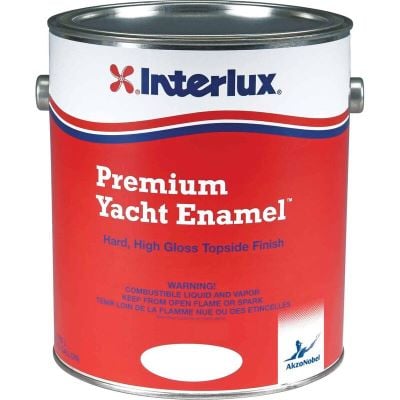
With a history that goes back nearly 100 years, alkyd enamels are a popular choice for painting wood boats. They generally cost less than one- or two-part polyurethanes, which makes them an attractive option for boat owners looking for an economical solution. They are also easy to apply, making them a good choice for DIY projects and novice applicators. In addition to their use for painting wood boats, alkyd enamels can be applied over properly prepared fiberglass, steel and aluminum surfaces. Interlux Premium Yacht Enamel is our top pick for this category of paint.
Interlux Premium Yacht Enamel
This high quality, easy-to-apply, alkyd-based enamel has been a proven performer for over 40 years. Outstanding characteristics include excellent hiding ability, dependable adhesion, excellent flow and leveling properties and good gloss and color retention. In addition to application on topsides and decks, Interlux Premium Yacht Enamel can be applied to interior surfaces. This premium enamel is for above-the-waterline application only.
One-Part Polyurethanes
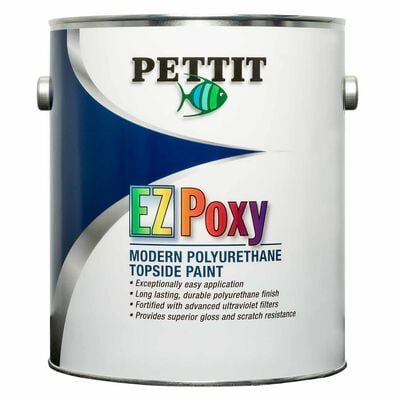
One-part polyurethanes represent newer technology in coatings. Along with being easy to apply, they tend to be harder, glossier, and longer lasting than alkyd enamels. They are also more expensive. Like all of the topside paints we offer, one-part polyurethanes are for above-the-waterline application only. They can be sprayed, brushed or rolled on to properly prepared wood, fiberglass, steel, and aluminum substrates. Pettit EZPoxy is a popular choice in this category.
Pettit EZPoxy
This one-part blend of urethane, silicone and alkyd components flows out to a smooth, sleek finish with excellent hiding characteristics. Even brushed or rolled, it can produce the high gloss appearance of a sprayed-on finish. For best results, prime the surface with EZ Prime Undercoater. EZPoxy can be sprayed, brushed or rolled on to properly prepared fiberglass, wood or metal surfaces. For above-the-waterline application only.
Two-Part Polyurethanes
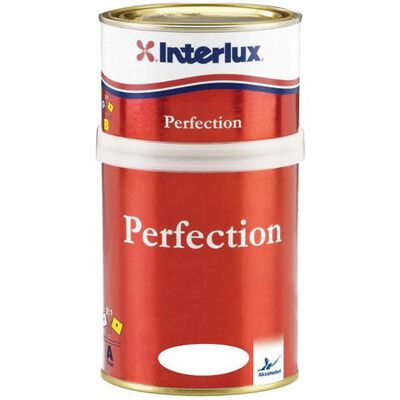
Two-part polyurethanes, the ultimate topside paint, are generally sprayed by professionals. Since they are catalyzed, they have less solvent (or no solvent content), which results in a very hard, very tough film that remains glossy and bright for many years. In addition to being expensive, two-part enamels like Awlgrip Two-Part Linear Polyurethane and Awlcraft 2000 Acrylic Topcoat require spray application and are for professional application only. However, with Interlux's introduction of their Perfection Two-Part Polyurethane Paint (our top pick for this category), average do-it-yourselfers can achieve professional results with a roller and a brush.
Interlux Perfection®
Simpler to use than other two-part polyurethanes, Interlux Perfection has been formulated to enable do-it-yourselfers to achieve professional-quality results on topsides, superstructure and decks. While spray application predominates, Perfection can deliver outstanding results when applied with a roller and a brush using the “roll and tip” method. Offering long-term impact and abrasion protection — even on the highest wear areas, Perfection is also resistant to a wide range of chemicals, including fuels, mild acids and detergents. May be brushed, rolled or sprayed over primed fiberglass, wood, aluminum or steel. Not for application over one-part enamels.
Summary
The choice between traditional alkyd enamels, one-part polyurethanes, and two-part polyurethanes depends on factors such as your existing paint’s compatibility, your budget, skill level, and the level of performance you expect. Alkyd enamels offer affordability and ease of application but sacrifice some durability. One-part polyurethanes strike a balance between cost and performance, while two-part polyurethanes provide unmatched durability at a higher cost and complexity of application. We hope our know-how helps guide you to the best possible outcome for your next topside painting project! As always, West Marine crew members are ready to help at a store near you.